92 points · by cwan · 15y ago · 89 comments
This article mentions that Pittsburgh has also seen significant decreases in population over this decade. Pittsburgh is often used as the model city for rust belt rebirth. They were the big player in steel, lost the steel industry, and were able to rebrand themselves. They are considered by most to be the most tech-friendly city in the rust belt. I'm sure a lot of that has to do with the fact that Pittsburgh did a better job in attracting businesses outside of steel when they still had the luxury of steel.
Having Carnegie Mellon doesn't hurt either. Most cities in the Rust Belt cannot worry about attracting talent because they are hemorrhaging talent. Instead these cities have to focus their attention and resources on retention. With CMU, Pittsburgh gets the benefit of bringing in some quality students who may stay within the community after graduation.
In real life, to most southeast Michiganders, "Detroit" is a much larger area encompassing dozens of neighboring suburbs. That Detroit continued growing into the late '90s. The effects of the economic downturn were visible there long before the big 2008 crash (mostly in housing prices and boarded-up storefronts on suburban main streets), but its overall population decline has been much less dramatic than 25% in 10 years.
The "dying" talk is overblown. Cities ebb and flow. Manhattan in the 1970's, anyone? This is a very low ebb for the Detroit area, but it'll come back. All the way? Probably not -- being the central hub of a world industry was a bit of a historical fluke. But there's a foundation of engineers, designers, and other educated white-collar types -- along with the vestiges of a blue-collar middle class -- to build upon.
When I moved to Los Angeles ten years ago, the Hollywood area was a wasteland. So was downtown. Old Town Pasadena was gang territory. Echo Park is where you went to get shot. Now all of those areas -- and many dozens more -- are bustling and in various stages of gentrification.
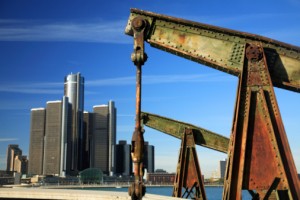
Being spread out, there are many great places to live that happen to be outside of the city limits. It's not as if all of those people are leaving the area entirely (although that is happening to some extent, too).
Not saying that the area's not in trouble. It is. But the difference between "in trouble" and "dying" is significant.
Note that this includes only the white/black/asian numbers, and the total is adjusted accordingly.
Note: this chart includes "Others or Mixed", but not "Foreign Born" which to subset of the other categories (i.e. some from each category are foreign born).
Also made a chart like yours with "Others or Mixed" included to match the percentage chart above: https://spreadsheets.google.com/oimg?key=0AqDMNINEecZvdEZWOT...
http://www.freep.com/article/20110323/NEWS01/103230444/Detro...
Notice the blue areas of 20% growth. These are areas where young people are moving in. Around downtown and the midtown area near Wayne State.
The data the chart is representing is interesting though; I don't mean to imply that you were wrong about that.
You can probably dig up other useful figures if you poke around enough: http://factfinder2.census.gov/ (it’s listed under "Detroit city, Michigan")
Striking how quickly the population has dwindled over the past twenty years.
ie. just because Detroit is going through economic changes and the proportion of black people in Detroit has increased across the same period, that does not necessarily mean those black people are responsible for said economic changes.
"Blackness" seems like a poor metric for economic vibrancy.
But of course sensational headlines like this get the most attention.
The first thing I thought was "what a great opportunity to create parks and greenways!" Even if they don't have the money to develop them right now, the land will be super cheap. Doing some of this and announcing plans for more would surely draw some business and development. "Look, you can have offices here, and workers can ride their bikes through a forest from their homes!"
The collapse of detroit is a catastrophic failure in what is supposed to be a well-run country. There's no real consensus on what went wrong and how to fix it, and worse, most people don't really seem to care.
In some neighborhoods, house values have dropped to $300. "Enough empty space that some other large cities could fit inside it". With that kind of exodus and drop in value, you'd think there was a Chernobyl there, but there wasn't. Just a completely unexplained failure of management.
So yeah, parks and greenways are great, but don't overlook the massive failure that allowed that. Chernobyl is now an amazing wildlife preserve.
I know a $300 house is going to be a shithole in the middle of nowhere but you could buy 1,500 of those shitholes for the land value alone of one place in a mid-range suburb here!
Does anyone else dream of buying up a suburb, fencing it off and creating a CoD Nuketown-style paintball arena?
And I don't think it's such a mystery either; as the big 3 go, so goes Detroit (or so it use to be). The hard economic times sped this collapse along probably sooner than people were ready to deal with.
Still I think this is an opportunity not just for Detroit but for our entire nation. Solving this problem is key to moving America back on track - this is not just an isolated problem of 'Detroit'.
If fact, for some time now I've wondered what happens when we automate all jobs out of existence. The writing is on the walls, really, it's not like you can't automate almost everything with enough technology and brainpower.I think in the long run we will become a nation of creative artists - and by that I don't mean purely 'art', but rather anything that needs to be made that others take pleasure in.
Think about it this way - we all have a nearly insatiable desire for new interesting things. And out of all the things we humans do, I think creativity is probably the only area that can't easily (or possibly ever) be automated.
What this means from an economic standpoint I have no clue, but it seems inevitable that we all end up out of 'work' at some point in the future.
To your point about management: what do you mean? (I'm honestly asking.) Who should be in charge of making sure a town doesn't get lopsided with one industry, for example? And was that even a bad thing, considering how long things went well? Maybe in 20 years we'll look back and say "50 years of prosperity, 10 years of the dumps and now Detroit is doing great again. Not terrible."
What kind of management alternatives would you suggest? I suppose a different policy regarding balance of trade might have been impactful but it's too late now.
Nature in Michigan is astonishingly boring anyhow. I am not kidding. We have very few native plants, very few native animals, very few native birds and frogs and so on. My wife majored in zoology at MSU and one of the assignments was to memorize all the names and sounds of frogs in Michigan, and the professor commented on how easy that was relative to most states. You can't even blame EVIL MAN, most of the state is basically untouched. A few of the larger mammals were driven extinct or chased away but most of the lack of biodiversity was here when we got here.
Michigan isn't the valley or the east coast. Dropping a nature preserve in the middle of Detroit isn't giving Michigan wildlife its last bastion against the advance of EVIL MAN, it's increasing the land left to Nature in Michigan by fractions of a percent.
The city might look like rock-bottom to outsiders, but something is brewing. In 5 years, the headline will be 'is Detroit making a comeback?'.
There are also some great incentives to live in the Midtown area, which is home to Wayne State University.
That's striking. It's almost hard to imagine that the city could have been so strong in the past.
It was in the top 5 a few years back, I am sure it's gone down a few spots since then.
Check out this video, pretty cool referencing the rise and fall (and rise again): http://vimeo.com/11021663
Maybe it's just paranoia...
My dad tells me stories of when he was a little boy in the twenties when the city was the best place on the planet to start a company and it was just bristling with entrepreneurs.
Sadly the city lost its way but it's starting to get it back. The destruction of Detroit is the easy story for the media however and the city's rise isn't being widely reported.
Silicon Valley also has nicer weather than Detroit.
http://en.wikipedia.org/wiki/Music_of_Detroit
(i.e. Motown to techno was based in Detroit)
Just kidding. The heart of rock and roll (and r&b and techno and hip hop, etc) is in ... yadda yadda ... DETROIT!
Detroit is within 90 miles of about 6 major Universities, the lack of talent argument is lame.
SE Michigan does have one of the highest rates of engineers in the country. It's great for manufacturing but Michigan needs more business sectors. As it stands, Ann Arbor is the only tech hub in the state and even then, plenty of talent is leaving for Silicon Valley.
In Detroit, I am helping with FutureMidwest (http://FutureMidwest.com) and FundedByNight (http://fundedbynight.com).
There are a lot of Michigan ex-pats so to speak, it's a matter of showing them we can create a tech community (that unites AA + Detroit) and get then pool our resources.
http://www.palladiumboots.com/explorations
It made me want to move there. It also plugged omnicorp, which is a pretty cool hackerspace located there.
It's not unusual, in the U.S., for urban centers to have a high minority concentration, but I believe this is much higher than most major cities.
Southern states are offering tax breaks, state funding to train workers, low cost labor pool, low rates of unionization, etc.