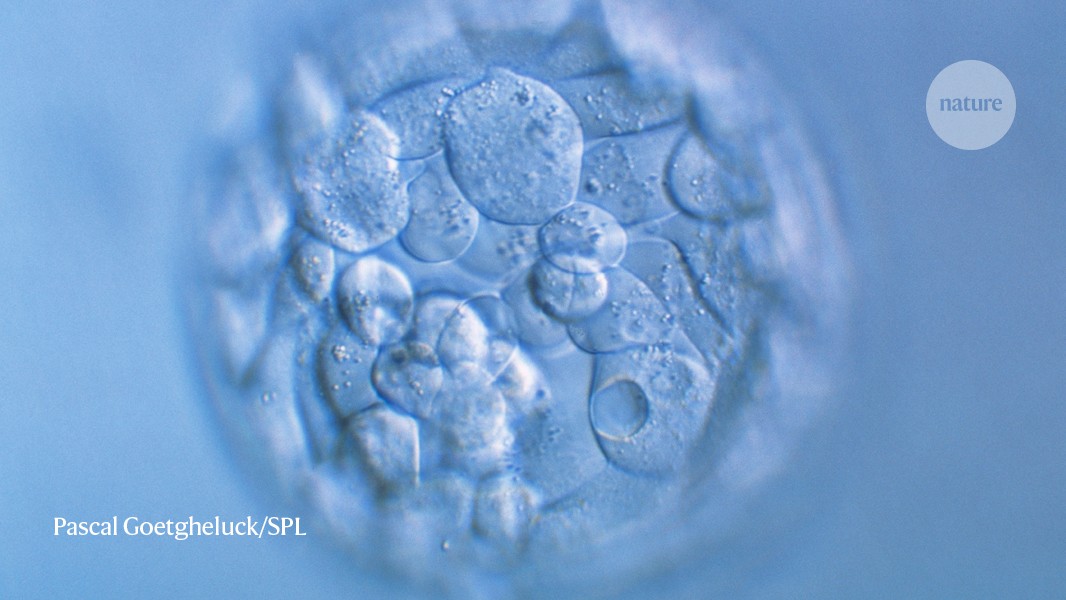
CRISPR gene editing in human embryos wreaks chromosomal mayhem
Three studies showing large DNA deletions and reshuffling heighten safety concerns about heritable genome editing.
nature.com
72 points · by YeGoblynQueenne · 6y ago · 38 comments
Note: looks like these findings are from preprint, and so still need to undergo peer review. This is a phenomenon that was anticipated however based on the science, even though as the article states there some controversy around the specific mechanisms at play.
The analogy might hold if we treated CPUs like a magical artifact that we don't have the technology to understand.
"Brain computation by assemblies of neurons"
> As a biologist and programmer, nothing makes me roll my eyes harder than SV types talking about biology like a computer.
Same.
But in truth, I'm glad this experiment took place, we need to adhere to the rigors that uphold the notion of incremental progress for a desirable end, and this begins by quantifying just how immense this problem really is. I'm glad that Dr. Jiankui He did it anyway.
It cost him his career and he will likely remain as a cautionary tale for all other future biologists in academia, but in Biohacking scene he is really no different then the pioneers in cell biology that often resorted to self experimentation, History in Biology is such a fickle thing: we'll laud them when the outcomes favour conventional wisdom and it accepts there methods, but infamy awaits anyone who defies to go out of its per-ordained confines. Even though we all accept that the walled garden of peer-reviewed publication is flawed and riddled with so many unnecessary things that encumber its ability to live up to its potential when it can use unorthodox or unconventional means and methods.
The Health Sciences, specifically that of genetics and cellular and molecular biology, has a history of being the punk-rock branch. Where even a monk playing with peas in his free time can help establish the notion of inheritable mutation (Mendelian genetics) based on adaption created by a British Medical school drop out who took to sea-fairing and island hopping to create the concept of what we'd eventually call Darwinian Evolution.
This is our History and as a Cell/Molecular Biologist myself, I take great pride in it and I have tried my best to live up to this reputation and apply this to my work in Agricultural and Food Sciences after abandoning my career as a lab scientist.
Dr. He got consent from the parents to undergo this procedure and move Biology in a territory it otherwise would never go for another couple of decades at the earliest. This is more than what some physicians did not too long ago, and the data we obtained from those experiments proved incredibly useful to this day.
What's "SV"?
One of the more and more prominent insights in biology is that almost every gene apparently appears to influence everything else.[1] Which is why I think methods like CRISPR are fundamentally misguided for anything but the most simple problems.
Trying to impose deliberate change on biological systems by editing a single gene is like trying to turn a story from drama into comedy by switching out individual letters.
[1]https://www.quantamagazine.org/omnigenic-model-suggests-that...
Title should say "researcher succeeds in disrupting embryo development"
"Previous work using CRISPR in mouse embryos and other kinds of human cell had already demonstrated that editing chromosomes can cause large, unwanted effects. But it was important to demonstrate the work in human embryos as well, says Urnov, because different cell types might respond to genome editing differently."
It says of one study "Of 18 genome-edited embryos, about 22% contained unwanted changes". Such a failure rate probably isn't such a big deal in some applications. In embryos, especially human embryos, it's definitely a big deal.
The worst case scenario would be a viable but badly diseased embryo.
I wonder if they can tell which of these outcomes they got from the experiment.
Some quick reasons:
- A 25 base-pair RNA can probably kinda-sort-sometimes bind/recognize sequences as short as around 5 basepairs. It may not be the majority of incidences, but it can happen.
- There are different Cas9 proteins. They do many things, with some are more effective at certain activities and some eliciting a stronger host response. There's a balancing act.
- The human genome is somewhere around 1000 times larger than a bacteria like E. coli.
- We have seen them! Tons of them! Scientists will customize and tweak proteins and RNAs to match a given organism. It's obviously harder in humans...