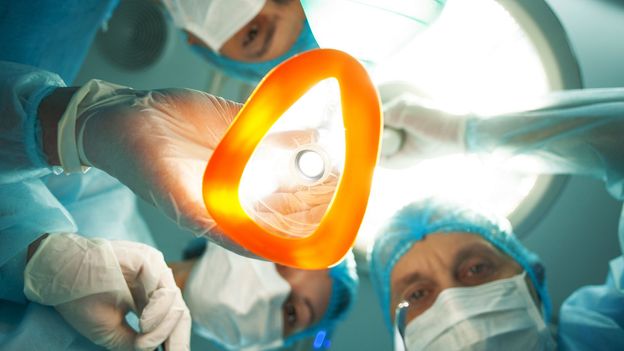
How agonising surgery paved the way for anaesthetics
In Victorian times, surgery was painful, brutal – and often a death sentence. But the discovery of drugs which put the patient into blissful sleep was a step towards safer operations.
bbc.com
54 points · by Tomte · 6y ago · 61 comments
And more recently, reading a thoughtful review of the BBC comedy series 'Quacks' from 2017 - where they described breathtaking advances in medicine around 1840.
Things went from "Let's cut this off quickly enough that you don't die from shock" with a 20+% chance of dying from the truly agonising operation meant to save you -- to a few decades later when they'd mostly worked out how to safely knock you out, carefully operate, and were aware of germ theory & sterilisation procedures.
I remember being tied to a sort of lazy-chair with heavy belts and getting a giant lollipop afterwards. Everything in-between seems like a blur.
While it sounds brutal, it was actually a better option, and I am thankful to the surgeon for not putting me under. The thinking was, as I understand now from speaking to my parents, that soviet anaesthesia options were rather primitive and dangerous, especially to a child, and the surgeon elected to omit it, making the operation that much more challenging. Thankfully, he was at the top of his game.
I had to go have my adenoids removed, and it was done with just a local anesthetic - actually, if I remember correctly I was given an injection beforehand which made me sort of woozy, but not very. I didn't get belted down to a lazy-chair, but I did sit on the lap of a beefy nurse who kinda held me down and made sure I didn't squirm too much. My dad was a doctor and was present throughout.
I live in the UK now and when I say that this sort of operation was done with just a local or nothing at all, people don't believe me.
> I have only one unpleasant memory of the summer holidays in Norway. We were in the grandparents’ house in Oslo and my mother said to me, “We are going to the doctor this afternoon. He wants to look at your nose and mouth.”
> I think I was eight at the time. “What’s wrong with my nose and mouth?” I asked. “Nothing much,” my mother said. “But I think you’ve got adenoids.” “Don’t worry about it,” she said. “It’s nothing.” I held my mother’s hand as we walked to the doctor’s house. It took us about half an hour. There was a kind of dentist’s chair in the surgery and I was lifted into it. The doctor had a round mirror strapped to his forehead and he peered up my nose and into my mouth. He then took my mother aside and they held a whispered conversation. I saw my mother looking rather grim, but she nodded.
> The doctor now put some water to boil in an aluminum mug over a gas flame, and into the boiling water he placed a long thin shiny steel instrument. I sat there watching the steam coming off the boiling water. I was not in the least apprehensive. I was too young to realize that something out of the ordinary was going to happen. Then a nurse dressed in white came in. She was carrying a red rubber apron and a curved white enamel bowl. She put the apron over the front of my body and tied it around my neck. It was far too big. Then she held the enamel bowl under my chin. The curve of the bowl fitted perfectly against the curve of my chest. The doctor was bending over me. In his hand he held that long shiny steel instrument. He held it right in front of my face, and to this day I can still describe it perfectly. It was about the thickness and length of a pencil, and like most pencils it had a lot of sides to it. Towards the end, the metal became much thinner, and at the very end of the thin bit of metal there was a tiny blade set at an angle. The blade wasn’t more than a centimeter long, very small, very sharp and very shiny.
> “Open your mouth,” the doctor said, speaking Norwegian. I refused. I thought he was going to do something to my teeth, and everything anyone had ever done to my teeth had been painful. “It won’t take two seconds,” the doctor said. He spoke gently, and I was seduced by his voice. Like an ass, I opened my mouth. The tiny blade flashed in the bright light and disappeared into my mouth. It went high up into the roof of my mouth. It went high up into the roof of my mouth, and the hand that held the blade gave four or five very quick little twists and the next moment, out of my mouth into the basin came tumbling a whole mass of flesh and blood. I was too shocked and outraged to do anything but yelp. I was horrified by the huge red lumps that had fallen out of my mouth into the white basin and my first thought was that the doctor had cut out the whole of the middle of my head.
>“Those were your adenoids,” I heard the doctor saying.
> ...
> That was in 1924, and taking out a child’s adenoids, and often the tonsils as well, without any anesthetic was common practice in those days.
I am not from UA, but this video seems to be about right: https://youtu.be/ihBGocSbC-I?t=124
I'm sure there are other plants with soporific or dissociative effects that would make surgery less painful. (Coca leaves, maybe?) But Papaver somniferum is the one that mostly comes to mind.
General anaesthetics are dangerous for Brugada patients, so most of the surgery is done under local anaethetics. I have to tell the surgeons when I can feel pain, so they can put a bit of local where it's hurting. Given how "special" the sensations are when they get to a bit where there's not enough numbing, I can only imagine what it must have been like before modern anaethesia.
My last procedure was in March this year, and involved a lead revision, a defib upgrade and moving the unit deeper into my chest. Surgery lasted 3 and a half hours, so numbing wore off during the surgery. Not a lot of fun.
They might refuse due to fear of toxic dose, but worth trying.
It kinda sucks, but hey, despite many cardiac episodes (my first VF was at 14, and I'm 58 now) I'm still alive. And I'm a cyborg.
Another thing you might try is hypnosis or autohypnosis. It works pretty well for that kind of thing. Besides, that would also allow the anesthesiologist to give you efficient painkillers and sedation that does not interact with sodium channels.
However, I think you would find the cumulative dose of 3.5 h of intermittent lignocaine injections surprisingly high. And let me assure you that they have absolutely no idea of your true lignocaine plasma level. The comparative peak with long-lasting drugs will likely be much lower.
All in all, I guess my main point is that if by chance you're doing that without an attending anesthesiologist you should try to ask for one and you might find it far more comfortable.
You probably already know this, but:
https://www.google.com/url?sa=t&source=web&rct=j&url=http://...
He then goes on to recount a story of a surgeon performing an operation in front of a group and the following happened:
- He accidentally cut the person assisting him
- A woman in the crowd suffered a heart attack from the shock of watching the above
- The assistant ended up dying of infection from the cut
- The patient also ended up dying.
As he tells it, it was the only operation where the mortality rate was 300%
1970 for co2 monitoring.
Salaries for other doctors and surgeons are similar - a neurosurgeon will make perhaps 4x-5x less money here than in the States. Meanwhile cost of living in Dublin is about the same as major American cities like Seattle with one of the highest rents in Europe.
Realize that the cost of basic medical insurance in the United States, for you and your family (spouse and children), is now approaching $7,000/year USD. It can easily exceed $550/month. This is tied to your employer. And this is just insurance. You still have to pay some percentage of the cost if you actually have to perform the procedure.
Anyway, anesthesia is much safer than 30 years ago
https://theanesthesiaconsultant.com/do-anesthesiologists-hav...
Surgery is a team effort
Note that Russian dentists were late in adopting anesthesia, and the result was patiencs flinching during procedures, causing broken teeth and other complications.