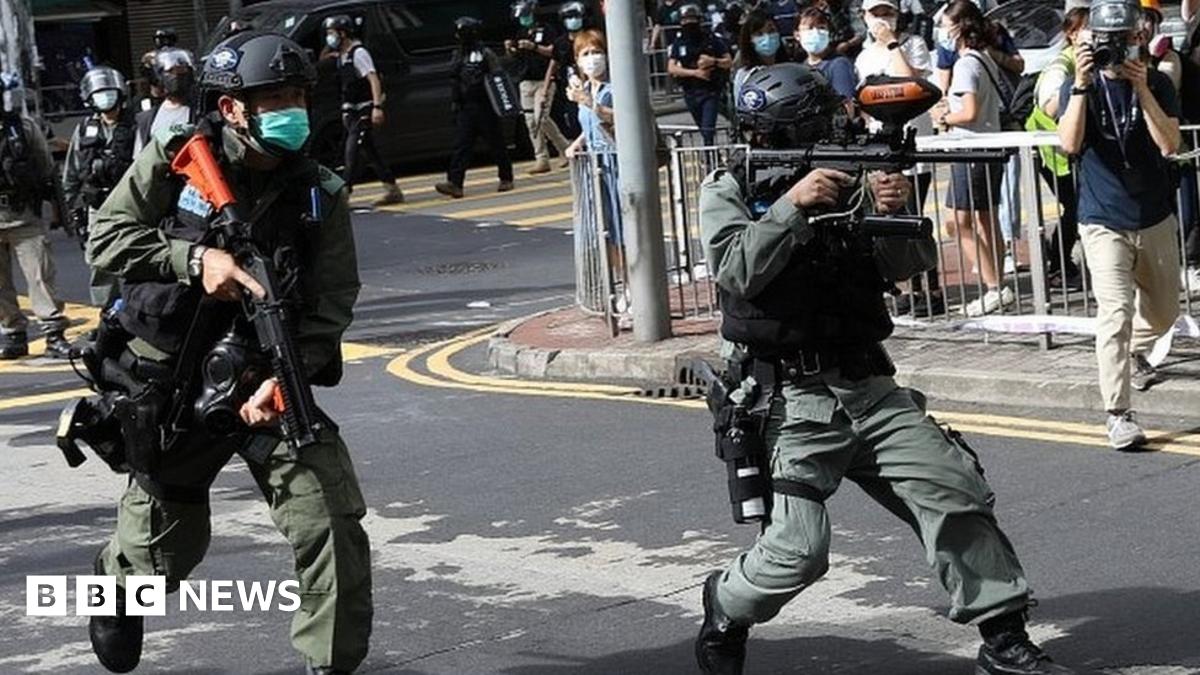
Hong Kong: UK makes citizenship offer to residents
Up to three million people living in the former colony are being given the chance to settle in the UK.
BBC News
353 points · by sjcsjc · 6y ago · 377 comments
The pattern for many Hong Kong immigrants is to have the mother and children live in Canada while the father works in HK.The family doesn't declare the foreign income in Canada.
So they enjoy the benefits of a low tax HK income. And they get all the nice things that go with living in high tax Canada while not contributing to it -free healthcare, subsided University, safe communities, clean environment, low income benefits.
It's so common it has a name, satalite family/astronaut dad.
This isn't a good deal for Canada and Canadians.
https://vancouversun.com/news/staff-blogs/the-unsettled-live...
"The global elite, as well as criminals and foreigners avoiding economic sanctions, can set up shell companies to 'make suspect transactions seem legitimate' under the cover of Canada's reputation for fiscal integrity."
Same is true for Chinese families in New Zealand and Australia as well. ...and it's not restricted to Chinese people either - obviously.
It's the curse of high tax jurisdictions.
I'd criticize an individual for evading taxes, but a "group" of people is just doing what people do.
EDIT: If you want to talk about the "functional" value of immigrants, then you need to get to the root purpose and bring in whoever is having the most kids.
Weren’t they talking about taxing vacant properties in Vancouver recently? Was there social media backlash?
Either that or it's brought in in literal cash. That's why the stories of Chinese home buyer showing up with literal briefcases in cash are all over the place.
Why would the father pay taxes in Canada when he lives and works in HK (or anywhere else) and (likely) is not a Canadian tax resident? It doesn't make any sense.
After all they pay local taxes in Canada while spending (GST, PST, property tax etc.)
Earning money and sitting on it doesn't hurt anyone. But in buying a nice life in Canada, you are in part buying what the government provides.
At first, I was also going to post about how Canada uses a residential income tax system: even if you’re a citizen, you don’t pay income tax if you live and work overseas. But it turns out where your spouse lives is relevant for determining residency. [1]
Regardless of whether the “astronaut” dads are evading taxes, the bigger question is about designing a tax system that’s both fair and easy to enforce.
[1]: https://www.canada.ca/en/revenue-agency/services/tax/interna...
Sales taxes are small and regressive.
It's a monster difference.
Variable rate sales tax on the other hand is more progressive than any income tax.
Like the more I spent the less I pay in sales tax? I don't think so.
When these children grow up - they will pay taxes in Canada.
It looks like a good deal for Canada. Even if father's income is taxed in Hong Kong only.
And many of the children of Hk immigrants will go back to HK to earn more money.
They will do whatever is in their best interest.
Just like every other living being
Besides, you are assuming that the children of this tax evader aren't going to figure out some other method of avoiding Canadian taxes - like doing literally exactly the same thing.
300,000 Canadians living in HK right now.
At least, they are less likely to do so than they are people who aren’t foreigners, although even them I wouldn’t want to bet my life on it.
China ending the two-systems arrangement in Hong Kong despite the Joint Declaration is basically saying “As far as HK (and, implicitly, anything we consider Chinese territory) is concerned, we aren't concerned about what other countries think, or international law or agreements, only power.”
This level of brain drain, as in the other mass migration events away from HK, could trigger the government to loosen their grip.
I've heard that HK is no longer as important to China as it was 20 years ago. HK's contribution to China's GDP has declined in relative terms as the rest of China has developed. With regards to the brain drain I get the impression that there are plenty of people from the mainland that could fill the gap.
It doesn't help that China is in bad terms with the U.S. and India. India is on track to become the third-world economy. China is gradually isolating itself from the rest of the world.
Which for Hong Kong as the universe of analysis would be a travesty, but for China is probably not a significant consideration against removing that population as a source of unrest which can spread beyond HK.
Nonetheless it is the right thing to do for the UK (where are the EU nations on this?), and exile doesn't have to mean abandoning the future of your birthplace. Hong Kongers might be able to achieve more for HK from the UK than under a Beijing cyber-dictatorship.
Actually that raises an interesting comparison with the Tibetan diaspora that mostly left during around 1950. How many of their descendants growing up in India/US/UK still know how to speak Tibetan?
IMO assimilation isn't a bad thing, rather an indicator of a culture they bring with them which is accustomed to concepts of citizenry (or even more evolved) and the state (confucianism?).
They're silent. It's not their ex-colony and, very sorry to say it like this, but HK isn't worth angering China over.
Hong Kongers are likely to achieve more for the world - from UK rather than from authoritarian China. The fate of Hong Kong, specifically, is not that important.
The CCP is super clever and imbued a sort of nationalistic pride from birth. Instead of the US's more complicated dualistic individualism/patriotism combo, the Chinese people actually get some sort of pride for being a cog in the CCP machine.
It's a completely different paradigm and obviously super dangerous because it allows the people at the top who aren't elected to pull the strings on a machine of 1.4 billion people. If they run the system correctly, it can be much more "effective".
Democracy has lots of pressure outlets, and it is definitely much more healthy longterm. That's why I think it's the better system, even vs a well-run (and let's even assume benevolent) CCP.
Yes, a lot of those connections can potentially move to the same city & country as you but will your neighbor still be your neighbor? Will the bar at the end of the street you go to after a hard day still be there and know exactly what you want when you walk through the door?
The revolt started almost 15 months ago against this kind of crap from China. Emigration may protect you from getting arrested but you're giving up everything you know and love in exchange. That's not much of a deal.
There is no guarantee that the system that is more just will win out. That's the reason why we have to do everything we can to make sure that liberal democracy works and to impede authoritarianism in all its forms and guises. The CCP should never have had the amount of international investment and export markets it has had, given the overall strategy of the party to hoard power and crush dissent.
If it is so bad in the US, what is keeping you there? Many developed countries have relatively few immigration hurdles for US Americans to pass. UK in particular, European countries are lax in general in these regards (I live in Germany).
https://yougov.co.uk/topics/politics/articles-reports/2020/0...
It goes on to list the coronavirus and Tiananmen as possible reasons; isn't the most obvious contributory factor that a lot of voters have been born since then, and it hasn't been on the national curriculum or often reported on?
Edit: FYI Dominic Cummings actually blogged about the important of Turkey to their success:
https://dominiccummings.com/2017/01/09/on-the-referendum-21-...
Although unemployment was officially low, many in low end jobs felt that the huge influx of Eastern Europeans pushed wages down.
There is also the societal aspect of it because of the demographic change caused by a large influx of immigrants into an area.
Then, the prospect of Turkey joining the EU was raised, which would mean free movement for Turkish nationals and that scared people as well.
Brexit will simply make their position worse.
It's a combination of differential racism and elitism.
So basically the existing word "racism" didn't fit (because racist Brits would hate Asian HKers just as much as brown Syrians and black Africans) so you invented a new completely concept but conveniently attached the word "racism" to it for maximal emotional impact?
Despicable.
Is it possibly more representative of your own prejudices that you see only negative motivation here?
Moving people & jobs physically to UK, when people have physical investment in a house, school, bank accounts, investments is not easy. I can see people moving if CCP is literally killing non-protesting citizens like holocaust. On top of it, what is to prevent CCP from blocking people from leaving?
People will take a lot before they physically leave the country. And CCP knows that very well.
Yes, HKers have ties to HK that are a hassle to break, but plenty of people have broken them and up and left.
Indeed, who would leave HK? Arguably the anti-CCP, the "troublemakers". So that'd mean less 'trouble' in HK and there is a large supply of mainlanders happy to move to HK.
Obviously the Chinese government will officially be outraged but privately they may think good riddance.
Adopting HK citizens is a far easier sell than Syrians. They already speak English, are highly educated, wealthy, westernized, and have special status in UK law.
Letting a ton of refugees in is a large burden on the host country. They don't share British culture and values, tend to have no education or marketable skills, are in poor health, don't speak the language, need a lot of government support, and depress wages for already poor citizens of the host country. It should still be done for humanitarian reasons but there's a lot of pushback from citizens for reasonable concerns.
No they don't. According to the Hong Kong government's 2011 census only 41% of residents spoke English moderately well (not even fluently, just moderately well). 20% reported not being able to speak any English whatsoever; not even a few sentences.
Only 57% of residents of Hong Kong considered themselves "bilingual".
Only 30% of students attended an EMI school (English as a Medium of Instruction).
And I doubt the numbers have become more favorable to English in the decade since that census.
You have to consider which ones are being adopted. It is overwhelmingly the educated and wealthy ones who will go, and a far higher percentage of them speak English.
==About 350,000 UK passport holders, and 2.6 million others eligible, will be able to come to the UK for five years.==
==Under the government's plans, all British Overseas Nationals and their dependants will be given right to remain in the UK, including the right to work and study, for five years. At this point, they will be able to apply for settled status, and after a further year, seek citizenship.==
Do you know (or care to speculate) on how those eligible for this offer would compare to residents captured by the census?
e.g. Did lots of people arrive from the mainland post-97, who might drive down the average? Or perhaps those with overseas-british papers are older, and the younger generation speaks much more English? I don't know enough to guess.
Trying to apply this same logic to a country that's stagnant economically or that already has a fast growing population would be silly.
That's not nothing.
Please enlighten me. As a German, I have yet to see even a statement of any German politician to do as the Brits do. Is there any non-english speaking country being "proactive"?
https://news.rthk.hk/rthk/en/component/k2/1535138-20200701.h...
And the schools they were sent to are largely the same as the schools that the people who run the UK went to (at least when there's a Conservative government).
So when the cabinet visualise "someone from Hong Kong", they think "one of us".
https://twitter.com/SimonCh15198572/status/12783360604063375...
[1]https://www.wsj.com/articles/hong-kong-police-make-first-sec...
I'm sure they'll get around to it though - it will reinflate their property markets which have sagged a bit this year.
I think the Australian government is worried about further deterioration in the Australia-China relationship. I think they’ll do something if UK/US/Canada/NZ make the first move.
If those are true: the upside will be easier settlement into the UK, maybe increased entrepreneurship. The downsides are: driving up local housing prices, increased competition for jobs.
If those are false, the UK may experience an influx of lower-wage labor and increased competition for blue-collar jobs. Possibly even increased crime (maybe Triads would move to the UK?)
I have a feeling anti-Asian/Chinese racism would spike in the UK. It has popular bipartisan support right now (another comment mentioned that) because anti-China/CCP sentiment is probably at an all-time high, but you can't take in thousands/millions of people in a short amount of time from a different culture without expecting an impact on your own.
tl;dr: How do I invest in British real estate?
This might be more like the ethnic cleansing that happened in Kenya and Uganda - where people where forced out leaving behind a lot of assets.
Add in lots more working from home - property values will probably, IMO, level out across the country rather than being concentrated heavily in the south east, London and major cities as less people need to commute. Why live close to London if you don’t need to travel in everyday? Businesses will then undoubtedly scale down or reduce the burden of commercial property with more homeworkers, etc. leading to an increase in available real estate, etc. Just my opinion.
No, no.
Increasing housing prices are a long-standing policy in the UK (and many other Western countries, as evidenced by low credit rates and extra bonuses for mortgages) and a gift to many voters (whose personal wealth is tied to their homes), and would be a welcome boost in times of COVID.
If the UK was afraid of brain drain of London's financial elite (UK's big "export" is finance) because of Brexit just a year ago, vacuuming up HK's financial elite would be a welcome counterweight.
> Increasing housing prices are a long-standing policy in the UK (and many other Western countries, as evidenced by low credit rates and extra bonuses for mortgages) and a gift to many voters (whose personal wealth is tied to their homes), and would be a welcome boost in times of COVID.
Would you apply that same argument to say, Vancouver? Would you say their increased housing prices is a welcome boost? The locals certainly don't think so.
> If the UK was afraid of brain drain of London's financial elite (UK's big "export" is finance) because of Brexit just a year ago, vacuuming up HK's financial elite would be a welcome counterweight.
My understanding is that the "brain drain" is because the finance jobs would move to somewhere in the EU (and the expertise would simply move with them). It's not like they're leaving because the UK doesn't pay well in that sector (e.g., Canada vs. the US in the tech, medical sectors).
Builders (e.g. Persimmon) and LSE-listed investment trusts buying land for development, assuming you mean residential.
If you mean commercial, there's a wider choice of funds, developers, and management companies.
https://www.heraldscotland.com/news/11920027.scotland-could-...
Edit: I'm sure we could find a bit that was fairly similar to the scenery of Hong Kong, though not sure we can do much about the weather....
Hong kong has a population of over 7 mil so this is less than half. What's the criteria for this chance at a uk citizenship?
I found a good video about the special passports given to hong kong from the uk. It is a bit complicated but this video seems to summarise the important bits quite well.[1]
https://www.freemovement.org.uk/bno-visa-hong-kong-dominic-r....
tldr;
It applies to Hong Kongers who applied for British National (Overseas) Citizenship (BNO) before registration closed in 1997, and it can not be inherited. Many of the young HK protestors will therefore be ineligible for it.
BNO is an obscure post-Colonial status applicable to Hong Kongers which did not up till now grant long term residence to the UK.
BNOs who now want to take up the government's offer for long term residence in the UK will have to fork a significant up front fee. This makes it available only to wealthy BNOs. If the government wanted to they could have changed the law to allow them to skip much of this, but they haven't.
Arbitrary? This is the opposite of arbitrary, it's everyone who is eligible for BNO status (i.e. was alive during the handover) and their dependents.
But the consolidation of existing companies and operations in Hong Kong would still be pretty unique, its uniqueness still not that relevant. For regional price discovery it would be useful, like for some publicly traded companies or local futures markets.
But the market based economies of China's Special Economic Zones should make Hong Kong as attractive as any other major financial center, instead of as a micro-state.
There are many international HQs in major financial centers under high tax regimes, whether it is Shanghai, New York City, London, Frankfurt.
I would say 30% move, so less than 50%. Incumbents in Hong Kong are already beneficiaries of the Communist Party in Beijing, otherwise corporate consensus in the LegCo would have matched the individual consensus already.
It would have been better if they made it into an independent city state like Singapore.
Alternatively, UK could have made switching recognition from ROC to PRC conditional on a New Territories lease renewal.
We are well pass the time when a technologically advance oceanic power can establish and hold enclaves on the heartland. That was only possible in the past because of the huge development lead the European power's developed through industrialization and colonialism.
Hong Kong used to have a desalination plant. The British closed it because importing water from PRC was cheaper. Instead, they could have expanded desalination for water self-reliance, and built nuclear power stations to produce electricity to power it. But the UK wasn’t willing to make that investment.
If the US had said "we wish Hong Kong to declare independence and will provide military backing as required", I expect the UK would have gone along with it (I offer no opinion on whether that would have worked). But in the absence of that that I don't think there was much of a decision to make.
Quite possibly the UK were out-diplomatted and a somewhat better deal would have been available in principle. But ultimately (as we have seen in recent years) there's nothing that stops a superpower saying "we're now going to walk away from this treaty we previously signed".
Is the CCP willing to jeopardise its position and future in the World for the sake of a few humid islands with no natural resources or strategic advantages?
And even more mind-focusing is the fact that the UK had the nuclear option on the table against Argentina in 1982.
Its not like the UK had a choice. We're you expecting them to go all Hawaii on the situation and just annex it?
You really want to set the precedent that regime change voids all international agreements, rather than obligations and rights under them passing to successor regimes?
While China is obviously much more powerful than Guatemala, they still wouldn't have been able to invade given that it would have caused a nuclear war. Also, at that point China was much weaker economically so an economic war would have severely hurt their economic growth, undermining the key source of their power over the past 20 years.
The real issue is that HK wasn't viable without support from the mainland -- support they would have lost had this tactic been tried.
"Although not quite a piece of "barren rock" as derided by Lord Palmerston, Britain’s foreign secretary during the First Opium War, from 1839 to 1842, the fact remains that Hong Kong isn’t endowed with the necessary natural resources to support its population of 7 million. The Hong Kong special administrative region of China gets over 70 percent of its water from Dongjiang, a river in neighboring Guangdong province. Meanwhile, over 90 percent of fresh meat and vegetables consumed in Hong Kong is sourced from the mainland. And mainland energy sources generate more than half of the electricity consumed locally."[3]
They would have had to bear a massive cost, investing in desalination plants, nuclear power plants, and imported their food from elsewhere.
That cost -- while extreme -- might be looked at in hindsight as cheaper than the current outcome with the likely significant brain drain from HK.
[1] https://en.wikipedia.org/wiki/Belizean%E2%80%93Guatemalan_te...
[2] https://en.wikipedia.org/wiki/British_Army_Training_and_Supp...
[3] https://foreignpolicy.com/2014/08/21/hong-kongs-inconvenient...
China isn't just more powerful than Guatemala, it's more powerful than the UK.
> they still wouldn't have been able to invade given that it would have caused a nuclear war.
If Deng Xiaoping really thought the UK would accept nuclear ese as the cost of keeping China out of HK, sure, that might have kept China out. But literally no one would believe that.
I'll take, “A routine practice of European (including states that are former European colonies) colonialism in dealing with non-Europeans”. So, like, no one would have been surprised with Hong Kong.
> We're you expecting them to go all Hawaii on the situation and just annex it?
The UK was pulling that kind of thing before the US existed, so, sure, why not? I lean, ignoring the poder balance in the región, which is the real issue.
Anyways, Singapore's independence wasn't a given either, they had to fight for theirs from "the mother land" as well: https://en.wikipedia.org/wiki/Singapore_in_Malaysia
Edit: I stand corrected - Not "to fight". However, the point being (as with Belize, Israel, India or other colonies which became independent) by no means was it clear what entities were to became out of its former colonies.
* Beijing will establish a new security office in Hong Kong, with its own law enforcement personnel - neither of which would come under the local authority's jurisdiction
* This office can send some cases to be tried in mainland China - but Beijing has said it will only have that power over a "tiny number" of cases
* Beijing will have power over how the law should be interpreted, not any Hong Kong judicial or policy body. If the law conflicts with any Hong Kong law, the Beijing law takes priority
"Crimes of secession, subversion, terrorism and collusion with foreign forces are punishable by a maximum sentence of life in prison"
I'm not sure if criticizing Chairman Xi or the CCP would qualify as subversion.
https://www.cnn.com/2020/06/17/us/brooklyn-molotov-lawyers-p...
Both allow for everything that has happened, which suggests restraint by both Hong Kong and Chinese authories.
Hong Kong Basic Law (its constitution) allows for National Security to be controlled by Beijing.
I can see the symbolism of 50 year autonomy being undermined, but can someone explain why this topic never has a legal discussion attached, whereas other topics do?
Britain's motivation is they contend that this is a violation of the treaty between Britain and China from the handover of Hong Kong [1], and letting one other country violate your treaties with impunity makes other countries think they can get away with the same thing.
But at the same time there's also no appetite in Britain to go head-to-head with China - in fact, if the HK stuff wasn't going on they'd be looking for a trade deal right now.
So if you see something that's a response, but not a really tough muscular response, that's exactly what the UK government is aiming for.
[1] https://uk.reuters.com/article/uk-hongkong-protests-britain/...
Still, it is the decent thing to do. It also underlines once again this country has no real power or influence left in the superpower age. Before, we could at least try to get the EU to go to bat for our interests, and have a real impact. We have none of that now, which is probably part of the reason the Chinese accelerated the process.
the same EU that rewrote its coronavirus report several times in fear of CCP repercussions?
https://www.nytimes.com/2020/04/24/world/europe/disinformati...
come on
Then there is also the reduced power of the EU post-Brexit. Just because Brexit costs the UK influence doesn’t mean it doesn’t cost the EU too — without the UK, the EU is only about 85% of the GDP of the other two big trade giants (the USA and China are each about equal to what the EU was with the UK).
My cynical self thinks that this is not a genuine offer but one for the headlines in a time where good news are sorely needed (Leicester lockdown, general covid-19 omnishambles)
I hope my cynical self is wrong
They know how many current BN(O) holders there are. But they don't know how many are eligible exactly -- they have the entire list of people who have received one, but that's over 20 years ago, and a lot could have happened to them since.