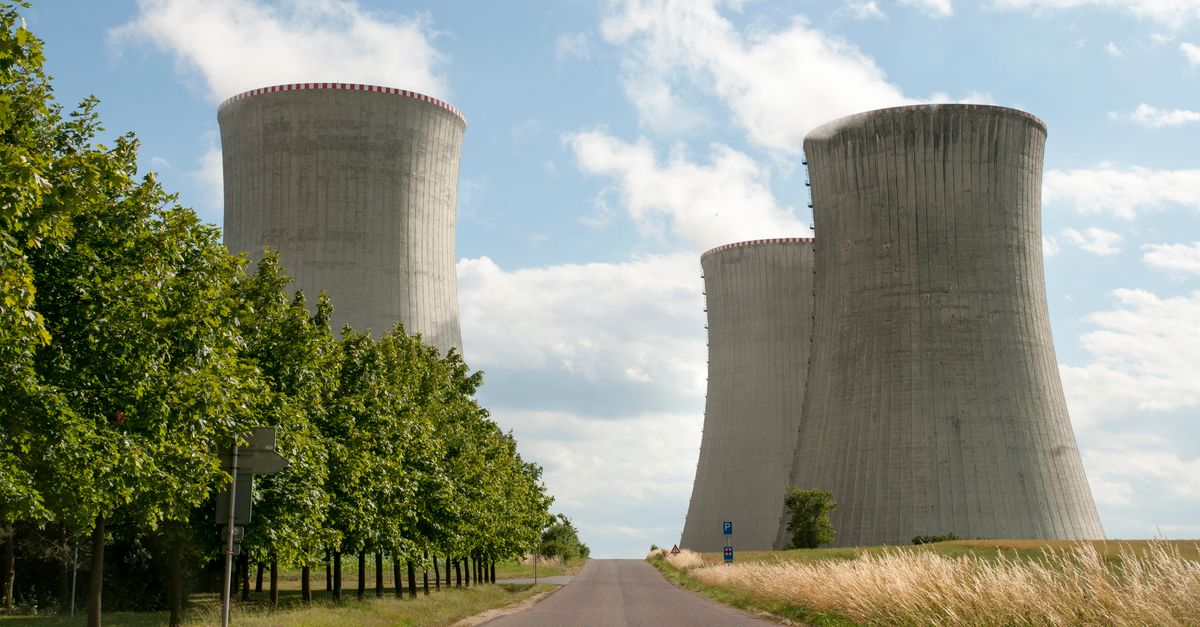
A safe and profitable nuclear plant is closing in France. Why?
A nuclear plant closes while a coal plant opens. That is hardly a welcome trade-off.
Sustainability Times
164 points · by ericdanielski · 6y ago · 246 comments
Particularly in the context that most discussions surrounding nuclear fission power generation lead with "modern designs and reactors being so much better", now we are apparently at the point where even running the same reactors close to a century supposedly represents no problem?
Afaik originally the life-span for most reactors of that kind was 40 years, how far past that are we willing to go? And what consequences will there be if, once gain, the "one in a million that would never happen" incident leads to yet another catastrophe?
[0] http://watt-logic.com/2016/11/25/french-nuclear-problem/
The plant that is being closed was certified by the ASN. The 40y lifespan was the MINIMUM certified lifespan of the power plant. It could very well run for another 40y. These kinds of equipment are modernised every 10 years during the shudowns. The power plant itself is NOT the one that was built 40y ago.
"In 2007, the same year a Swiss study found that seismic risks in the Alsace region had been underestimated during construction, the ASN denounced a “lack of rigour” in EDF’s operation of the plant."
In no way can the ASN be really independent, as it is staffed with the people that went through this system.
But that's not what happened. The anti-nuclear team won and we collectively made the responsible decision to fill our atmosphere with CO2 instead. Yay?
Also, universities are quite far from the political elite in France, none of which actually know about anything related to nuclear power plants. Engineer at the ASN are just that: engineers. They don't take decisions.
I will just criticize the "pro-nuclear propaganda" bit and ignore the other anti-elite stuff about the engineering schools, after all "What can be asserted without evidence can also be dismissed without evidence."
What is called in France ENR (new renewable energies, basically solar and wind power) are backed by gaz companies, and now even French oil companies (Total) have a hand in the game. Areva (Now Oreno i think), the biggest company ever in the nuclear industry recently had a 6 billion turnover (around 2016 i think since this was the time i took interest on this particular subject). For scale, Gazprom, heavily invested in wind turbin in Denmark and Germany, had a 130 Billion turnover around the same time. I did not check Total cause frankly, i'm tired of spending energy against this "argument". Who do you think is putting more money on the table?
Also (because this anti-engineer stuff is frankly broking me), if you don't believe the ASN and the people working there, then you should vote or manifest to replace the ASN and its sisters organisations that are taking care of the electrical network, bridge and tunnels in France. Surely they weren't considered amongst the best in the world for a long time, barely more than 50 years!
And if you think the UNSCEAR rapports (like the one on the effect of Fukushima) are lying, well then don't be picky and choose to reject all scientific products of this corrupt organisation that use the same compilation method, like the IPCC. And if you or your familly have cancer and have to go under radiation, refuse every doctor that wrote on the subject whose paper where used by the UNSCEAR scientist.
Do you have any source for that? I'd be interested, although I find it difficult to believe since those "big universities", assuming you are talking about ENA and maybe Polytechnique, are public and very largely funded by taxes rather than private organizations.
We have electricity, not so much accidents and the know how so China, Russia and the US arent the only people who can make large scale nuclear infrastructure.
What an horror they put us through, are engineering elite.
That's a lie, or at least an unprecise statement, mostly shared by the anti-nuclear who are looking for a reason to close reactors.
In France, reactors were designed to work for 40 without any major checkup ; and after 40 years, without any decommission deadline planned in advance, as long the "visite décennale" (in-depth inspection every 10 years) does not discover any major issue. So a reactor can totally work for 60, 70, 80, or even more.
It is not. That number was made so that EDF would get a proper return of investment. Some plants based on the same design have been granted lifespan to 60 years in the US.
> how far past that are we willing to go?
As long as its safe. Why throw away something that works, is safe and reliable on the counts that some folks put out a number?
Nor, for that matter, should the most lenient regulation always dictate other countries'. That could just result in endless ping-pong of extensions, and it make lobbying so much easier if you only needed to convince one country and then shame all others into following.
https://en.wikipedia.org/wiki/San_Onofre_Nuclear_Generating_...
One is captured, packaged, and stashed away; the other is poured into the air in high volumes, continuously fueling a runaway scenario.
They assigned the incident level 1, the lowest one, in order to cover it up.
France has huge power demands in cold weather due to badly isolated houses heated with electricity. The power grid is already unstable, France cannot afford to loose much generator power, as they have nothing to replace it with - very few renewables.
https://www.lemonde.fr/planete/article/2016/03/04/un-inciden...
It is in French, but it is saying that nothing was out of control and out of ordinary small issues. The temperature was a little bit out of the normal during the operations but that is quite common. And they used Boron because it was the adequate procedure in this case but again not out of ordinary. They decided to not use the control rodes that were not operating 'automaticaly' because of the disruption of the flooded system. But manual control was still available if they wanted to. And at the same time, like in a space shuttle, every electric control circuits are mirrored for safety. So the control room A was affected by the flooding but the control room B and the B circuits were ok, unaffected and operational as designed!
https://en.wikipedia.org/wiki/Fessenheim_Nuclear_Power_Plant...
Official report says it wasn't tried and remained a last line of defense. http://www.french-nuclear-safety.fr/Media/Files/Technical-no...
Also it was 2014, not 2016.
1) It's not one of the first French reactors by a long shot. It's actually a licensed American design.
2) More modern designs being better does not mean that previous ones are unusable, particularly when they've been built and are just sitting there. Stupid car analogy: a better car being sold with better crash test ratings does not mean you're going to die if you drive last year's model.
3) Life-span is a licensing issue. Lifetime extensions are common for reactors and designs without issues, which Fessenheim did not have. The fact that it's not automatic means that there is an in-depth study of the state of the reactor before the extension being approved. Reactors with the exact same design in the US have been extended to 80 years.
4) Your source is rubbish (and for reasons that stray far away from the topic so I'll leave it at that).
https://www.bloomberg.com/news/articles/2018-12-10/french-po...
Here's a retrospective, ie an attempt at looking at how things have actually played out compared to projections we're often fed, https://www.energy.gov/eere/solar/downloads/retrospective-be... (Chapter 5 of pdf is what looks into your question)
https://en.wikipedia.org/wiki/Cost_of_electricity_by_source also aggregates information to try answer your question
Seven countries are expected to end the use of coal by 2025: Portugal (2021), France (2022), Slovakia (2023), the UK (2024), Ireland (2025) and Italy (2025) (per Europe Beyond Coal)
Politics and entrenched interests will have no choice but to accept market forces. The sun dumps enough power on the Earth in an hour to power all of humanity for a year, and it's mostly free for the taking.
[1] http://ddnews.gov.in/business/pm-modi-dedicate-nation-750-mw...
[2] https://www.solarpowerworldonline.com/2020/07/new-report-fin...
[3] https://english.elpais.com/economy_and_business/2020-06-29/s...
[4] https://electrek.co/2020/07/14/worlds-longest-subsea-power-c...
[5] https://www.pv-magazine-australia.com/2019/10/26/australias-...
You can NOT replace nuclear with wind and solar. Because you can't choose when the sun shines and when the wind blows.
Hydro in France is already built-up everywhere it was feasible. There are no more spots to build meaningful hydro power capacity. Too bad since hydro is the only renewable that can really replace the nuclear power plants.
https://www.energymatters.com.au/renewable-news/baseload-ene...
That's what grid energy storage is for. Traditionally this is often implemented with hydro (sometimes even by pumping water up to a high-altitude reservoir during periods of excess power generation). There are many more exotic methods as well - e.g. the crane that stacks concrete blocks, or the train with concrete that goes up and down the hill.
More recently, grid-scale batteries are being installed at increasing scale (e.g. Tesla's Megapack), and the cost efficiency of that solution seems to be improving rapidly.
This is a terrible argument. There is always some place on the grid where the wind is blowing and (during the day) the sun is shining.
It's odd to pretend that renewables are all talk when at the moment I'm writing this France's power grid is 28% renewable[1]. And France still has lots of opportunities to expand, both solar and wind. You'd think with >4000km of coast line there'd be lots of space for offshore wind.
[1] https://www.electricitymap.org/zone/FR and 60% nuclear, but the point still stands
https://www.youtube.com/watch?v=l3-SXFtPYe0
This was a [prototype 750 kW (KiloWatt) plant operating at Orkney Islands and near Portugal](https://en.wikipedia.org/wiki/Pelamis_Wave_Energy_Converter) - as a reference, it took wind power plants more than 20 years of enthusiastic development until the installed power reached 500 kW.
It is a shame that this development was shut down (while the design has been reported to be picked up by, guess whom, the Chinese), while being owned by E.ON. But I am sure more developments will follow, as the design is an excellent idea.
It's disingenuous to point at 28% renewables as if it's a sudden victory of good wind and solar against bad old nuclear.
Particularly when we know that gas power plants will be built to partially replace Fessenheim.
Fusion is still way off but solar/wind have proven to be quite the generators, with grid-scale storage or some other way to utilize the energy surplus it could probably disrupt the electricity sector quite a bit.
Those are actually emerging research fields, while nuclear fission is pretty much dated and new designs depend on materials we haven't even discovered yet.
In that context this insistence on fission reactors reminds me quite a bit about the definition of insanity; Trying the same thing over and over expecting different results, like the world is just some kind of management sim.
Meanwhile Germany is actually trying to innovate outside the box; It's been big on hydrogen research and application for a while, by now there is even a whole roadmap to utilize hydrogen as a future energy resource [0].
Which could utilize large parts of the already existing natural gas pipeline network [1], there's also pilot projects for repurposing old coal plants into thermal storage to retain more of the solar/wind electricity [2].
Yet news like that never make any waves, it's always "Why did Merkel shut down all reactors?", when she never decided the phase-out (That was ratified under Red/Green back in 2002) nor did she actually shut down any reactors, but rather keeps trying to extend their running times.
[0] https://www.fraunhofer.de/content/dam/zv/de/ueber-fraunhofer...
[1] https://www.cleanenergywire.org/news/gas-grid-operators-say-...
[2] https://www.greentechmedia.com/articles/read/germany-thermal...
> It’s worth noting that, as Fessenheim closes, Germany is commissioning a new coal-fired power plant, in Datteln
Exactly. Why are so many people ignoring what happens in step 2?
When nuclear is shut down, it gets replaced with something worse. Often coal!
"German electricity was nearly 10 times dirtier than France's in 2016... Germany's overall emissions increased in 2016 as a result of the country closing one of its nuclear plants and replacing it with coal and natural gas" [1]
"It is one unintended consequence of the Fukushima nuclear disaster almost a decade ago, which forced Japan to all but close its nuclear power program. Japan now plans to build as many as 22 new coal-burning power plants — one of the dirtiest sources of electricity"[2]
Nuclear energy is also far safer than most other sources, about the same as renewables.
"Nuclear and renewable sources are similarly safe: in the range of 0.005 to 0.07 deaths per TWh. Both nuclear and renewable energy sources have death rates hundreds of times lower than coal and oil, and are tens to hundreds of times safer than gas."[3]
1. https://environmentalprogress.org/big-news/2017/2/11/german-...
2. https://www.nytimes.com/2020/02/03/climate/japan-coal-fukush...
Everyone has their vested interests and pre-conceived biases I suppose.
The implication that this is what happened in Germany is misinformation. None of the energy production of retired nuclear plants in Germany was replaced by coal. Renewable energy replaced the vast majority of it over the last 10 years, and coal use is down by 50% in that period.
https://www.energy-charts.de/energy.htm?source=all-sources&p...
It's true that in the first 3 years after the decision to speed-up the closure of nuclear in Germany in 2011, coal use increased. But more recently it went down drastically and was replaced mostly by wind and solar on a yearly basis.
Here is similar data but not just Germany (using the data from the 2020 BP statistical review):
https://nbviewer.jupyter.org/github/ogrisel/energy_charts/bl...
The debate is not renewables vs nuclear. It's nuclear vs fossil .
France still has a lot of nuclear plants left (and of course hardly any coal at all). The one discussed in the article was the smallest one in any case according to this overview: https://en.wikipedia.org/wiki/List_of_power_stations_in_Fran....
Interestingly, this overview excludes solar and wind. Especially solar would be popular in the sense that there are loads of small domestic deployments and comparatively small plants that collectively add up to a lot of production with more coming online all the time. Most of the country gets a decent amount of sun throughout the year and like pretty much anywhere else, the French have been deploying loads of solar panels on their roofs. Also they've been growing their wind deployment in the order of about 1GW/year in recent years: https://en.wikipedia.org/wiki/Wind_power_in_France
Basically, what the article conveniently also overlooks is that France actually exports more energy than it imports: it produces more than it consumes. The numbers in this article are a bit out of date but paint a clear picture of imports decreasing year over year until 2015 and actually being smaller than exports in any case: https://en.wikipedia.org/wiki/Energy_in_France. I did not find any more recent number but I have no reason to assume that this trend turned around in the last 6 years (the opposite actually).
Mostly imports and exports are driven by capacity and energy cost. Nuclear is not exactly known to be cheap, so exporting over capacity with tiny margins (or at a loss) in a market increasingly dominated by new, clean, cheap energy sources is less attractive than shutting down what was probably a plant with a comparatively high operational overhead. I'm guessing more plants will follow in the next years for exactly the same reason.
It would be really enjoyable to see how they would solve that while still keeping an functional energy grid (buying fossil generated power from neighbors during bad weather would be cheating), and the scientific progress from such attempt would benefit the world greatly.
Your first article is provided by a pro nuclear propaganda association. It's almost certainly also false. And ignores conveniently how much more unrecycable nuclear waste France was producing in 2016, waste we can not store safely.
I have not seen them refuted on HN. I would be interested to see a refutation - and if a refutation is posted every time, it should be easy for you to find.
But if you are honestly interested, read the greenpeace criticism of these studies to understand how the statistic might be false and how it can be disputed, https://wayback.archive-it.org/9650/20200415093014/http://p3.... Sure, it's easy to ignore that by looking at where it's coming from, but that goes both ways.
Yeah so nuclear waste is recycled in large part. See Mox. But I agree, I wish we'd use FNRs too. Too bad the Green party shut down the first reactor (SuperPhenix) in the 90s.
"waste we can not store safely."
Did you do your homework? See CIGEO.
All unsafe waste is by definition recyclable because its viability as fuel is what makes it unsafe.
If it is unviable as recycled fuel then it is quite safely storable and is no more dangerous than the tons of toxic chemicals we store regularly from manufacturing and mining byproducts.
- Actinides (neptunium, plutonium, americium, curium, leftover uranium). Most of these materials are fissile or can be bred into fissile materials. Fuel recycling processes reclaim and reuse these elements.
- Fission products. These are the lighter elements formed when fuel atoms split apart. Some of the components that are most important from a waste management perspective are strontium 90 and cesium 137.
Fission products cannot be used as nuclear fuel. The fission products of greatest concern are also much more toxic than ordinary chemical wastes.
The LD50 for arsenic in rats is 15 milligrams per kilogram: https://whs.rocklinusd.org/documents/Science/Lethal_Dose_Tab...
The LD50 for strontium 90 in hamsters (90 day survival) is 2 millicuries per kilogram: http://www.rrjournal.org/doi/abs/10.2307/3573895
Given strontium 90's specific activity of 142 curies/gram (https://ntrs.nasa.gov/archive/nasa/casi.ntrs.nasa.gov/196800...), in mass terms that's 14 micrograms per kilogram for the LD50. Gram for gram, strontium 90 is about 1000 times as acutely deadly as arsenic, or three times as acutely deadly as the nerve gas sarin. There are few industrial chemicals that have toxicity comparable to or greater than nerve gas, and they (like spent nuclear fuel) have special regulations and require special handling.
1. The only body qualified to asses the safety of a nuclear power plant is the french nuclear safety agency, Autorité de Sûreté Nucléaire (ASN)
2. ASN deemed its security "very satisfying" [1]
3. The usual fallacious arguments have been debunked time and time again (seismic fault, various upgrades, more incidents than other plants etc...)
4. Read the actual report on Fessenheim from ASN [1]
The actual answer from the article:
The answer to why Fessenheim is closing is sadly one of politics. It goes back to 2012 when then President of France, Francois Hollande, made a deal to guarantee the support of the Greens (les Verts). Hollande promised France would reduce its reliance on nuclear to 50% instead of 75% of all electricity.
Part of the deal was to close Fessenheim.
1. https://www.asn.fr/L-ASN/L-ASN-en-region/Grand-Est/Installat...
https://en.wikipedia.org/wiki/Nuclear_power_phase-out
An immediate effect of this decision was to increase Germany’s reliance on fossil fuels, including “brown coal” which is strip-mined in an extraordinarily environmentally-destructive process. Another effect was to increase the German grid’s reliance on nuclear power generated in France.
Average are misleading.
Solar (photovoltaic) has its maximum around noon, when there is high demand.
The irony is that in summer, it has happened in several warm years now that nuclear power plants in France had to shut down - they are cooled by rivers and when the water level becomes too low, they need to shut off to maintain safety and avoid ecological damage. These are the times when Germany exports most electricity to France.
Some German articles on the topic:
2012: https://www.heise.de/tp/features/Warten-auf-den-Blackout-in-...
2017: https://www.heise.de/tp/news/Atom-Frankreich-versucht-Blacko...
2019: https://www.heise.de/tp/features/Alle-Jahre-wieder-Frankreic...
I learned a term recently called "base load supply". Essentially, something like a nuclear plant is hard to ramp/up down with changing grid demands, but it great at steady-state operation and can run like that for years. This takes care of the minimum load placed on the grid which is fairly predictable.
Nuclear strengths' play an important role in an "all of the above" approach.
See https://twitter.com/TristanKamin/status/1247460245460443138?...
Nuclear wants to be constant-- both because ramping isn't super fast and because you want to recover large capital costs. Renewables ... produce varying amounts pseudo-periodically and unpredictably, which is even worse. Neither matches conventionally to demand.
The only way around this is technologies that store (hydroelectric, batteries, power-to-gas-to-power, solar thermal) or burning fossil fuels to supplement. Overprovisioning is also necessary: it takes a lot less storage / peaker plants / etc to meet 99th percentile demand with 150% of required generation capacity than 101%.
Renewables and nuclear do complement each other a little bit in reducing volatility.
This is not necessarily the case for all nuclear power plant, it has to be designed for that.
This is untrue, we regularly modulate nuclear plants from 10 to 100% in a space of hours
Also, the grid needs much faster reaction than modulating demand over hours. If a large generator fails (which sometimes happens to nuclear plants) you need 1GW in a few seconds.
It's also the oldest nuclear power plant France was still running.
Oh and also the Rhine valley is seismically active, even if only at a low level.
If you actually bothered to read the ASN reports, you'd see that it's because it was one of the most transparent plant, hence the higher numbers.
> Rhine valley is seismically active
It is, which is why it was scaled for several times the biggest ever earthquake recorded (1365 IIRC, they derived the scale from models based on the damages it did).
ASN deemed its security "very satisfying", the rest is BS.
And I totally agree this is as dumb as it gets.
You are absolutely right. Which is why others way more qualified than I (climatologists, nuclear engineers) are trying to debunk those fallacious arguments and slowly people seem to realise. I'm doing my part.
The very existence of this article and its present on HN front page is a sign that this is working.
But, in reality, it was probably a mix of all 3 and some more.
I don't, and I'm not sure it's possible to figure out exactly — since it's politically sensitive and possibly involved "back channel pressure" and other shenanigans.
That said, it has been a longstanding topic in German anti-nuclear circles, cf. list of articles (German) on:
https://www.dw.com/en/reports-fessenheim-nuclear-accident-pl...
I'm not sure there's an easily accessible list of all incidents and/or way to compare that against other plants :/
Ed.: also, yeah, it'd be cool if this wasn't causing an uptake in coal :(
The original political deal was putting online the EPR then closing Fessenheim, partly to avoid going over the legal limit for nuclear power capacity set by "PPE" law in France.
According to wikipedia [1] Flamanville EPR construction started in 2007 with budget of 3.3 billions EUR and completion date of 2012.
Current estimates are 19.1 billions EUR and end of 2022 for completion.
[1] https://en.wikipedia.org/wiki/Flamanville_Nuclear_Power_Plan...
Yes there are some promising reactors that produce less waste, and breeder reactors that can burn waste. But those are mired in political problems unrelated to the tech itself. I think that the crux of the issue is that human fallibility approaches 100% on decades-long timescales, so some reactor somewhere will be melting down roughly every decade from this point forward. Personally that level of risk just isn't acceptable to me. That's why I'm against the construction of new reactors.
All that said, I would not have voted to retire this reactor at this time. I also find it sad that little or none of the cost of operating it will make its way to renewable energy. So even in progressive France, noble goals like sustainable non-polluting energy generation continue to face artificial hurdles created by attempts at shortsighted political gain.
Pessimistically, I suppose.
But I don't understand how someone can take this position and simultaneously feel like climate change has any hope whatsoever of being addressed.
Then it has not been reversed by the current ruling party.
https://beyond-coal.eu/coal-exit-tracker/
France has one of the lowest number of coal plants compared to other European countries. The links on the left of the page let you filter the map into different data sets.
Uranium is so abundant, it does not give anyone any power in negotiations. But fossil fuel has to be imported. Natural gas, for example, flows only through pipes.
There's enough uranium in France - it's just not cheap uranium and open pit mines in Africa are more economical.
Additionally, France never had to even prospect for uranium ore, as incidentally many of their former colonies had plenty of potential for cheap open pit mining using cheap local workers....
For reference, just a few hundred kilometres east of their border, East Germany was the third largest uranium producer in the world and there's no geological reason why France should be devoid of it.
> Additionally, France never had to even prospect for uranium ore
But this is false. (There is no english link sorry for that). https://fr.wikipedia.org/wiki/UraMin
Peak-oil is a bitch and we're going to run these nuclear plants until the metal in the cores and foundations start to show cracks visible to the naked eye.
Because Uranium has 1.000.000x the power content per weight more than gasoline and 1.000.000.000x more than batteries!
That said fission costs a lot of dead trees to build, so we're going to have to stick to the plants we already have.
Building new nuclear plants will not be possible no matter how much money you print.
I predict the french will do the same once the KWh price jumps around a little too much to be ignored.
Electric cars are a joke, they take hours to charge and once everyone has them; charging will be impossible!
Instead we should focus on Raspberry Pi 4 and electric bikes!
Edit: If you look here you'll see that most WH plants put into service ~75 have been closed: https://en.wikipedia.org/wiki/List_of_nuclear_reactors
The only other interesting tidbit here is that Saudi-Arabia is planning 4 reactors!
https://www.google.com/amp/s/www.latimes.com/world/europe/la...
Unfortunately, that really happened[1]. Commission as in started running, not as in started constructing, which they did in 2007. The usual argument is that a modern coal power plant replaces older ones and more efficient/less polluting. Obviously, it's all very controversial.
[1] https://www.dw.com/en/climate-activists-protest-germanys-new...
Which is, of course, bullocks even if it's true, because the alternative exists to shut down the older coal fired power plants and replace them with something that isn't coal at all. Like nuclear, or solar. Even natural gas would be better than coal.
The answer being that it was originally commissioned decades ago, construction started 2007 and was supposed to be finished in 2011, its purpose is to replace three older blocks from the 60s which were put offline in 2014 [0].
Putting 3 old blocks offline to replace them with one modern block looks like a rather good progress.
Tho, those small steps just doen't sit well with the current popular narrative of "Let's end all fossil fuel use instantly and replace it with fission reactors everywhere!". As if changes and projects like that wouldn't take decades to retool whole industries and infrastructure.
See https://www.reuters.com/article/us-france-nuclear-protest/pr...
Corruption? Stupidity? At any rate, the article is right.
https://translate.google.com/translate?sl=auto&tl=en&u=https...
My guess is bury it somewhere else.
> The Nuclear Safety Authority has confirmed that the rock has not moved for several million years.
https://en.wikipedia.org/wiki/Meuse/Haute_Marne_Underground_...
Also, I'm not in the field, i just like to inform myself before having an opinon. Too many times there is lies spread about nuclear facilities.
Most of it is stored underground (FAR underground) in special regions where we know that the geological makeup is highly stable
New power plants which statisfies western standards like UK Hinkley are a cost nightmare. Further it essentially funds new nuclear weapons: https://www.theguardian.com/uk-news/2017/oct/12/electricity-...
Sure there is some slim chance that old western or new Chernobyl style reactors would offer dead cheap ecological energy eventually (moving all complementary processes like getting the ore or building holes to dump the radioactive waste to electric). Also this offers the chance to create a huge wild life refugee in even more central Europe eventually (sure why should we care about people losing their homeland): https://www.theguardian.com/uk-news/2017/oct/12/electricity-...
I live nearby the plant (within its 30km radius) and we had reports on Fessenheim incidents every other week or so.
>The answer to why Fessenheim is closing is sadly one of politics.
This is some outright BS from the author here. Fessenheim is built next to the Rhein-river but below its own water-level. If the dam would breach because of an earthquake or flood, the whole nuclear plant would be under water. Does Fukushima ring a bell, what happened there? Exactly that!
Several examinations also found the inbounds of Fessenheim to be poorly protected from flood. They even have their own security measures and fallback circuits not properly secured against flooding. Only a water leakage would cause some serious issues not to mention a dam breach.
So with the combo of old tech, often interrupted uptime and shitty protection against floo, there are simply too many good reasons to close down the whole thing.
The owner/operator of the facility, EDF, envisaged a 40 year life for all 2nd generation reactors. That would have meant the reactor would have been shut down 2 years ago.
It's in a flood zone and a 2011 commission found that it didn't have necessary redundant cooling in place should the canals around it fail.
It's in a seismically active area.
It's on a river over an aquifer so any leakage will have severe consequences.
It has to be shut down during heat waves because the excess heat it dumps into the neighboring river will kill wildlife.
In the last decade it has had a number of small incidents.
It has served it's purpose for longer than it's expected lifespan and it's being shutdown safely before a catastrophe happens.
The SOP of Capitalism to do it until something bad happens doesn't mesh with Nuclear power.
For reference best UK offshore wind farm had 55.3% capacity factor in 2019 and UK offshore wind average capacity factor was 40.6% in 2019 (2)
(1) https://media.rte-france.com/bilan-electrique-2019-2/ 379.5 Twh produced, 63.1 GW installed, 68.7% capacity factor
(2) https://energynumbers.info/uk-offshore-wind-capacity-factors
Almost every article seems to come around to saying "and nuclear power would be great", even when it starts with some solar power invention.
But you can also see that this is not just that, there is also scientifics who work on responsible sourcing of rare earth, sustainable agricultural tech. This is probably once agian a science-based newspaper that will never work. I've learn that if you want people to care about climate change, just don't talk about nuclear energy
https://news.ycombinator.com/item?id=23662241
Could Fessenheim 2 be leaking nuclear particles?
That doesn't justify burning coal, however, there are many renewable energy sources that do not produce pollution or toxic waste that is hazardous for ten thousand years.
That isn't true, most renewable energy sources, eg, solar panels [0], produce waste that will be toxic waste that will be hazardous for tens of thousands of years. Lead and cadmium don't even decay in practical terms, even after 10s of thousands of years.
Maybe for hydro what you say is true.
[0] https://www.cfact.org/2019/09/15/the-solar-panel-toxic-waste...