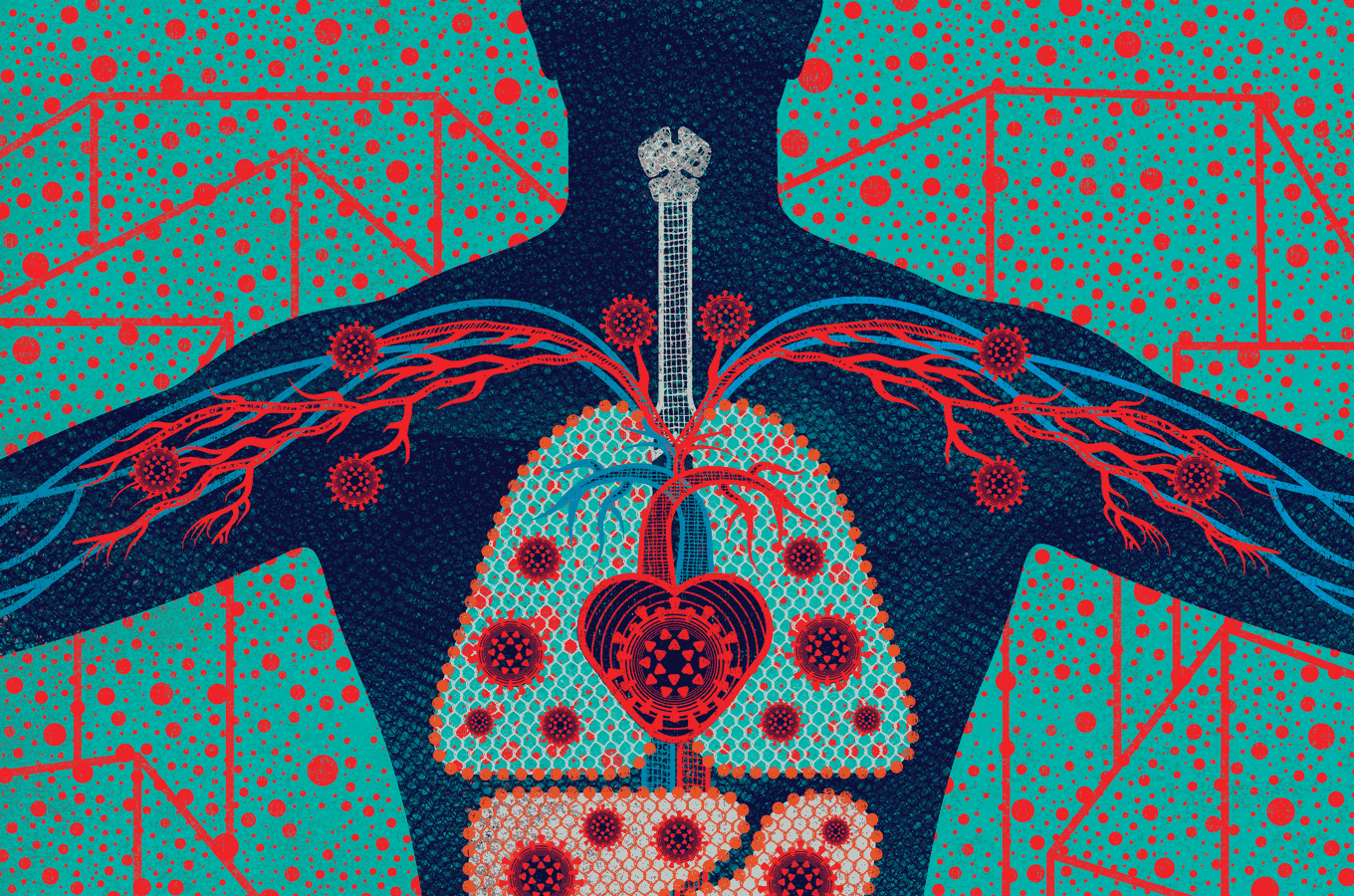
We Thought It Was Just a Respiratory Virus
UCSF researchers are taking a closer look at COVID-19’s dizzying array of symptoms to get at the disease’s root causes.
We Thought It Was Just a Respiratory Virus | UCSF Magazine
265 points · by thereare5lights · 6y ago · 150 comments
A lot of the early part of the article rehashes basics, like how viruses replicate. If you have basic knowledge of that sort, you can kind of skim until the mid point, where we find the above factoid.
I have been reading less about the virus of late, but this fits with everything I know. It causes blood clots. Ventilators aren't really fixing it. The lack of oxygen is probably more about what it does to the blood (than what it does to the lungs).
Later in the article, it talks about impacts on the feet suspected to be a side effect. Feet issues are commonly associated with blood/circulation issues. This is why diabetes can lead to feet being amputated.
The blood issues are well established and this has been known for some time. I'm somewhat aghast to see this article talking like we don't already know that detail.
Not everyone has done as much research as you, and the public perception and debate is still awash with "just a bad flu" disinformation, so its really important a clearer and more accurate picture is put out as widely as possible.
The stuff about blood clots began coming out about the time I concluded I probably had it and had been mostly asymptomatic and about that same time I ran into a researcher on HN who said something about the blood that I didn't follow and I asked questions and that went weird places and then they said something else about zinc.
And that led to an epiphany for me and I turned to my son and kind or recounted the exchange with the researcher and then I said "We've been eating a lot of zinc-rich foods. I am going to go get a cheese pizza because cheese has zinc." So I got a pizza and then he felt vastly better.
So the whole blood angle is cemented in my mind like "Clearly, this is a hard fact and everyone knows it." But it's probably just me in my little bubble and that's it.
I'm still aghast. But what you say makes sense.
For example, yes there is some research suggesting zinc (and related, vitamin D) may be very relevant with covid-19, but there isn't yet definitive understanding among experts yet alone us HN commenters.
Anecdotally: I often feel better after eating a pizza, dating back to before covid-19 existed, and despite my zinc levels being fine. I just really fucking love pizza.
All of us, whether we are trying to read every research paper released or not following anything except newspaper headlines, need to keep reminding ourselves that just as the experts will keep revising their beliefs to fit new findings, we need to keep checking if our own knowledge is correct, or if it might be either outdated and/or based on cognitive biases.
Personally I'm recommending friends/family to make sure that they are getting enough of various vitamins/minerals, while being very clear that my suggestion is a "can't do any harm to have the right levels of whatever" rather than "I'm sure this will help with covid".
It's an article, not a news story or a scientific paper. So it's neither about breaking news nor innovative research results.
So, they don't presume what the public knows at any substantial level (heck, many still don't know/believe the virus is not real).
I, on the other hand, am more aghast for the use of the word aghast for such a trivial matter :-)
Well maybe you skimmed a little too much, because the article clearly talks about the negative effects of an overactive immune system response being characteristic in some patients, and there was plenty of evidence of that in some people's wrecked lungs. Part of the therapy is to guide and even suppress the complex immune system response to keep people's bodies from destroying themselves.
Your comment didn't mention any of that and might be read by some as a "move along, nothing to see here." I think this is definitely not the case and people would be better served to read the article itself instead of your comment dismissing it and instructing them to skip over the section about immune system response.
> If you have basic knowledge of that sort, you can kind of skim until the mid point, where we find the above factoid.
I replied to your comment because I read the article first and actually did learn this bit about the immune system response which is in the first half. If I had read your comment first I would likely would have skimmed the article (or even skipped it altogether) and missed it. In that situation your comment would have directed me away from learning something new. I'll continue to try to read articles before comments in the future.
All the co-morbidities are essentially unknown and are likely to stay that way for a while. These side effects take time to suss out; more than the nine months we've had with covid.
With the unknown and potentially unbounded risks we are staring at, Taleb says that over-reaction is the best strategy. He and Russ Roberts go on to talk about the basic issues with statistics in these cases, a good trip back to the first week of any stats course that everyone promptly ignores.
[0] https://www.econtalk.org/nassim-nicholas-taleb-on-the-pandem...
"Morality rate", hmmm...I like it, but maybe for another article!8-))
Has been speculated on since as early as March (that I've seen) with more evidence in support since then that this strain of human coronavirus is behaving like that.
Explains the majority of symptoms. Low pulse ox, feet, brain, lung, kidney, etc etc.
That's not right. It causes cytokine storms just like any other major repiratory virus. Ventilators do help, lots of people survive on them. They are a critically important piece of the treatment puzzle.
I don't think statements like that are very helpful. It's on the spectrum toward conspiracy nonsense.
> I'm somewhat aghast to see this article talking like we don't already know that detail.
It's not a scientific study, it's a review piece for general readers.
This is IMO the other important reason why it’s important to stop the spread, besides overloading hospitals.
From the OC:
Marcus plans to also start collecting data from wearable devices, including Fitbits and Zio patches, which wirelessly monitor heart rhythms. “There may be large numbers of people who are suffering from cardiovascular effects of COVID-19 in the absence of other symptoms,” Marcus says. “I’m worried we’re missing those cases.”
I have no idea what it means to regard COVID-19 in cardiovascular vs respiratory terms. I'm just repeating what I think I've read. I really don't understand this stuff.
https://www.cleveland.com/coronavirus/2020/05/taking-daily-a...
https://link.springer.com/article/10.1007/s40265-020-01365-1
And what you cite can’t be proof that the flu is more deadly than people think. If what you say is true, those deaths are in the numbers used for the death rate of the flu.
The point of that article is that perhaps our algorithms for estimating flu deaths are wrong.
Edit: Can someone explain the downvotes? Any error in my reasoning is not obvious to me. The claim above was that:
1. Heart attacks are included in flu death estimations
2. This should make the public think the flu is more deadly than they believe
That seems contradictory, as the public’s belief about the deadliness of the flu comes in stats from point #1. As for the article, the author made no real attempt to rebut its central claim.
Is this true? An anecdote, but both times I and/or my partner had fever and flu-like symptoms, a flu test was the first thing performed by the doctor.
"Clinicians, too, were seeing surprising numbers of COVID-19 patients develop heart problems – muscle weakness, inflammation, arrhythmias, even heart attacks. “We’re not used to respiratory viruses having such dire consequences on the heart in such apparently high numbers,” says cardiologist Gregory Marcus, MD. Many patients whose hearts acted up also had failing lungs. But others had no other symptoms or, like Dowd, only mild ones."
edit: good citation provided by twic below
> Gut specialists are finding that 20% to 40% of people with the disease experience diarrhea, nausea, or vomiting before other symptoms, says gastroenterologist Michael Kattah, MD, PhD, a UCSF assistant professor. If you swallow virus particles, he says, there’s a good chance they will infect cells lining your stomach, small intestine, or colon. As in the lungs and heart, these cells are studded with vulnerable ACE2 portals.
In that case, is the info about not getting it from eating as thoughtless and parroting as saying masks don’t work, or is this article fake news? It makes a huge life changing difference to know for high risk people
1. Does the virus remain infectious in food? In particular, does hot or reheated food affect it?
2. The digestive process produces more acid. Will that kill the virus?
3. Will the virus even touch the wall of the stomach? It may be in food after chewing, rather than directly on the stomach wall
There are some reasons to think that swallowing virus replicating in your throat is different than having some inside a chewed up piece of food surrounded by saliva.
We don’t know of course, and someone super high risk should perhaps avoid takeout salads. But as of yet we haven’t had any case cluster reports where a superspreader cook spread the virus to their colleagues + customers via food. No country has reported a single instance of a traced infection via takeout.
This doesn’t mean it’s impossible, as contact tracing is not perfect. But the lack of any evidence so far is suggestive.
> Fattahi’s team has found evidence suggesting that male sex hormones such as testosterone may increase the number of ACE2 receptors that cells produce, which could help explain why SARS-CoV-2 seems to wreak greater havoc on men than on women and why kids rarely get sick.
(https://www.nytimes.com/2020/07/18/health/coronavirus-childr...)
However, Sweden did not close school for children through 14 years of age.
https://www.sciencemag.org/news/2020/05/how-sweden-wasted-ra...
And their excess mortality rates for that age group are indistinguishable from other European countries:
https://euromomo.eu/graphs-and-maps
When you go to that link, near the bottom select graphs by age and see that Sweden ages 0-14 looks like all the other countries shown there. I think that is a pretty good indication. We have a country that kept their schools open and a number of countries that did not, and the results look the same.
EDIT: in fact, the excess mortality for that age group looks indistinguishable from other years.
In the Netherlands they found out by coincidence that some people who have a broken TLR7 gene don't fight the virus so the virus hits them very hard.
So there may be multiple reasons.
I think the idea is that younger, healthier people with better immune systems are able to prevent the virus from replicating as much, whereas sluggish immune systems and bodies that are highly inflamed like overweight ppl, diabetics, etc. (high leptin, also related to il-6) get overwhelmed.
T-cell immunity/cross-reactivity meaning that most people have the ability to fight the virus from exposure to other coronaviruses.
I think a major component of the death toll from the pandemic is basically a consequence of obesity. I'm suspicious that govt interventions, planning, etc make that much difference when the US is an order of magnitude more obese than Japan, for example.
Source: https://www.google.dk/amp/s/www.washingtonpost.com/health/el...
I do hope that more attention will be focused on telling that this virus is both causing respiratory issues and heart issues. The leading comorbidities data from New York says it very clearly.
Source: https://www.the-hospitalist.org/hospitalist/article/220457/c...
The article even says "By June, clinicians were swapping journal papers, news stories, and tweets describing more than three dozen ways that COVID-19, the disease the coronavirus causes, appears to manifest itself."
Think of it this way. If there were a giant asteroid heading towards earth and we have a limited time to solve this problem, would I want 500 teams all operating by themselves and using the incredibly slow process of sharing data via NIH / NIST and other research paper repositories, or would I want them all in a war room (virtual or physical) and someone coordinating the effort to risk rank all the solutions and quickly form action plans? My vote is the latter. It feels like the scientific community may have artificially painted themselves into a corner because of something like the banana ladder conundrum. [1] meaning, doing it that way because that is the way it has always been done.
[1] - https://security.stackexchange.com/questions/33470/what-tech...
But cruise ship cases seem to indicate people with no true visible symptoms. There was a cruise ship with universal masking and a 80+% asymptomatic rate after 28 days.
Now, these patients may well have symptoms such as ground glass opacities in the lungs. But you can’t exactly feel that, so that’s some of the ambiguity.
Some lists of symptoms don't include anosmia or diarrhoea, so people have symptoms but don't think these are covid-19 symptoms.
Wow that’s incredible. 200 million Americans could have the virus.