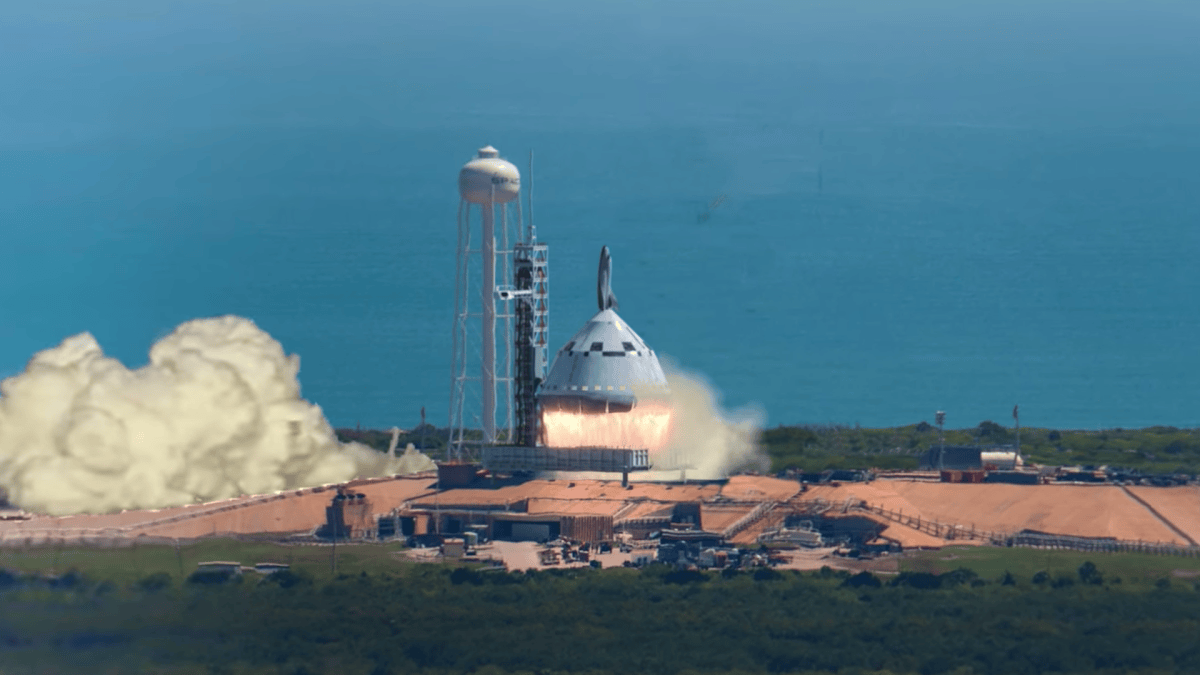
Chrysler's Radical Space Shuttle Design Was 50 Years Ahead of Its Time
The automaker's unorthodox plan included reusable rockets and a suborbital space airline.
The Drive
110 points · by rbanffy · 6y ago · 66 comments
... kind of. Like they say, conventional bell-nozzle engines are optimized for a particular altitude, while aerospikes are not, and it's true that if you're going to use the same engine across a wide range of altitudes, aerospikes will be more efficient on average across that wide range than conventional engines will. At any particular altitude, though, a conventional engine optimized for that altitude will be more efficient than an aerospike -- they're "jack of all trades, master of none" engines. And it turns out, with contemporary multi-stage rockets, we can and do use different engine bells at different altitudes, which negates a lot of aerospikes' prospective benefits. Were single-stage-to-orbit vehicles ever to be a thing, aerospikes might have their moment, but it turns out SSTO configurations just aren't very good at lifting much mass to orbit, so that seems unlikely.
It digs in much deeper than the usual offhanded, easy explanations like the, "We're stuck with bell nozzles because they were invented first," that this article offers.
    I've internally asked this question so many times,
    like, guys, shouldn't we maybe do an aerospike?
An SSTO could launch, orbit, return, refuel, and re-launch in the same day. For high-value cargo where the mass it not too much (c.f. humans) this might actually make sense.
Some things are impossible until they aren't.
It's not just about finding a new more energy dense but lighter weight propellant either, you need previously nonexistent alloys that can survive the intense heat, pressure, abrasive, and corrosive effects of a running rocket chamber.
One of the big challenges with aerospike engines is keeping them from melting. It's a difficult challenge for bell shaped rocket engines too, but aerospikes are more heavily impacted.
Depends what you mean. Performance wise they are not as efficient as multi stage expendable rockets, however they offer possibly the best operational efficiency of rocket system.
The venture star has a launch capability of 20 tons to LEO. Larger lifters like Boeing's proposed 'Big Onion' had a lift capability of 227 tons to LEO. Despite its large size, its fully reusable nature and simple design would have meant its operation would have been considerably cheaper than anything that has flown to date.
I suggest that it would be prudent to test at least one SSTO before the industry writes off the technology. Especially if we had one already 90% complete!
This counterfactual is directly related to the mindset that led to the “conservative” option going upside down value-wise. Instead of viewing the difficulties as being opportunity, the nation chose to play it safe. It lost the attitude towards doing things “. . . not because they are easy, but because they are hard, because that goal will serve to organize and measure the best of our energies and skills, because that challenge is one that we are willing to accept, one we are unwilling to postpone, and one which we intend to win. . .”
https://spacecenter.org/exhibits-and-experiences/starship-ga...
Instead they got infected with the SSTO fantasy, which can never work well. But it boxed them in a corner with the wrong fuel, wrong engines and forced-them to add super expensive SSRBs, which required putting the Shuttle on the side, which led to two disasters and a “reusable” launch system that had to be totally rebuilt between launches.
We’d still have Skylab if they had focused on manufacturing efficiencies for Saturn rockets instead.
In this case it’s not the shape as much as carrying way too much extra/dead mass, jet engines, aero spikes, and using a LH2 means much more massive tankage requirements.
I thought it would just be a booster like Falcon 9.
There have been proposals to build something just like that with a “plasma” door at the end that can snap open and closed to keep the atmosphere out of the tube. It still can’t get anywhere near orbital velocity, so the plan is to use it to accelerate a second stage that uses rocket engines after it is released to provide the rest of the orbital DeltaV.
The Problem is rockets are relatively fragile and the high gees and hitting an even thin atmosphere at Mach 6 would destroy them.
Look up “spin launch” for an even crazier idea that’s actually funded.
If you have one big push, you escape the Earth's gravitational pull. If your push isn't big enough, you fall back to the ground.
Which brings a very scary failure more - being hit by the payload that is mostly dead, but coming back to the ground at near orbital speeds.
I'm interested to know whether anything ever comes of this: https://www.wired.com/story/inside-spinlaunch-the-space-indu...
I'm sure I recall reading something on a forum somewhere from an anonymous former employee that claimed Spinlaunch was a mess and would never work.
It's still might be no good for scientific equipment, but for food and things of that nature might be okay.
I would question whether NASA didn't think they were still in the game or whether politics and pork-barrelling influenced whether they were in line for funding. Shame they didn't try and self-fund developing the engine.
https://youtu.be/___JNGJog0A (4min, amazing channel BTW.)