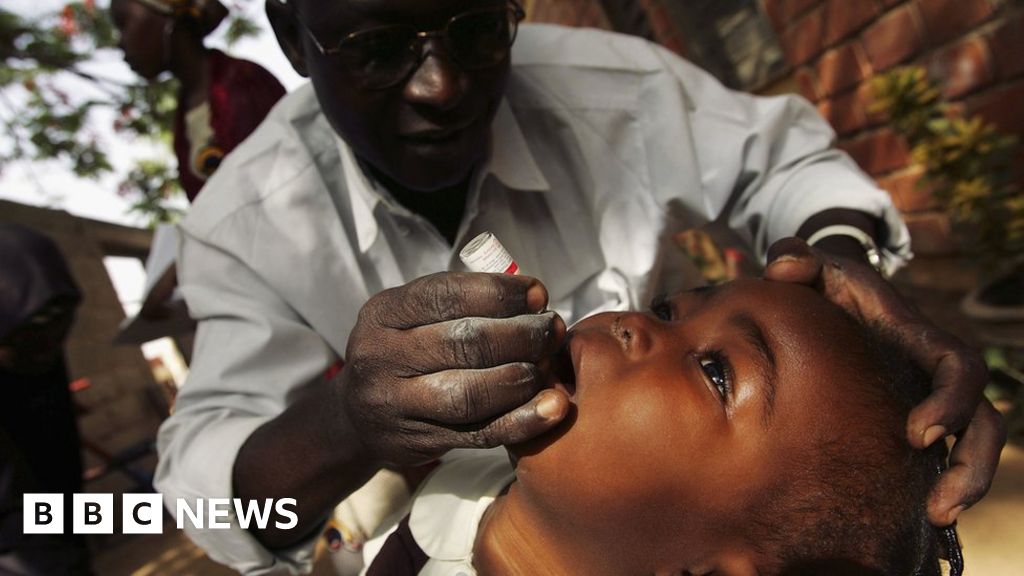
Africa declared free of wild polio in 'milestone'
Nigeria is now rid of wild polio having had more than half of global cases less than 10 years ago.
bbc.com
1387 points · by riffraff · 6y ago · 241 comments
Also important is the possibility of environmental reservoirs for the disease in nature. Hopefully not, but it is still possible.
Only continued vigilance can guarantee victory. Many areas were declared polio free once before, only to have it resurface.
...par for the course these days.
Throughout the world a child dies every 2 minutes from malaria.
https://www.weforum.org/agenda/2020/08/infectious-diseases-c...
I’ve been to South Africa twice. Most other Subsaharan countries have large malaria problems.
Looking forward to that not being a problem in my lifetime.
Mosquito release programs like this are now several decades old and have shown high efficacy with few environmental side effects where they have been tried. It is certainly more environmentally friendly than DDT. Meanwhile, the benefits are enormous and if done successfully in Africa could be directly measured in terms of human suffering.
A similar story that I found absolutely amazing is the story of the screwworm and its eradication from the US. Not the whole world, mind you (which feels foolish long term).
I am not trying to make a point. This discussion made me think of it and I wanted to share.
See the "appeal to nature fallacy" [1]
"Life finds a way"
They are. Take a moment to celebrate this victory :)
Probably less than 100 globally in a few countries. Bill Gates will get it.
Anyway, while it’s great, and we should be happy, 400,000 kids will die from malaria in Africa this year.
We could do more to save millions of lives over the next 10 years.
His foundation has spent $2.9 Billion so far on it.
https://www.gatesfoundation.org/what-we-do/global-health/mal...
Malaria is different in that there was not the same level of eradication infrastructure to leverage and different because it touches on drinking water and food chains in the non-human environment. Malaria is not mostly a vaccine distribution problem.
Would appreciate if someone could enlighten me. Surely there must be a good reason.
We also need to get rid of a vaccine-derived polio in Africa (and some places in Asia).
I think the statistics about it might be overestimating since people constantly say they have malaria, but rarely if ever have it. It means just sick colloquially in Swahili.
[1] https://www.who.int/malaria/media/malaria-vaccine-implementa...
1. Using malaria medication is advisable if you don't have access to good doctors and good hospitals. If you permanently live in a malaria area, it's not practical.
2. If you have quick access to a good doctors and good hospitals, it's often better to treat yourself once you are sick. ---> NO this is not travel advice <---. The malaria medications have a lot of side effects to use permanently; the expensive ones have less side effects and I believe pilots generally use such ones since risking getting sick has the potential side effect of a plane crashing.
3. The key is detection and treatment. You can easily die in an top EU or US or Singapore hospital if the doctor doesn't ever see malaria and you happen to have it. You have to test until you get a positive---even if it is a false positive, and then you test again. I personally know people who's parent died of malaria in a good hospital in South Africa, but in an area that is far from the malaria areas, and hence has doctors who don't test for it. I am not a doctor so I am not sure how one is treated once tested positive, but I do know many people who recovered very quickly due to the doctors being acutely aware of how to treat malaria.
4. Taking into account said things above, malaria is not a major threat. If you read stories about game rangers in the KNP of South Africa, many of them died from malaria in their later life because they were somewhere deep in the bush/lowveld and far from hospitals and couldn't be bothered with having malaria, yet again, and stopping their fun bush activities to go to the hospital 200km away.
5. My grandmother had malaria 6 or 7 times and died rather healthy in her mid 90s. My family actually actively avoided the malaria areas in the summer back in the late 1800s and early to mid 1900s by living on the higher escarpment. You could also read about Dr. Annecke and the efforts back then to combat malaria.
6. The countries to the north of South Africa don't have the facilities to treat malaria, generally, and with proper treatment and selective DTT application, you should be able to limit the ranges of the parasite. Yes, DTT is a bad chemical.
7. On that topic, malaria is caused by a parasite, so in terms of vaccines it's not clear what the mechanism behind it should be.
8. If you think about the Panama worm exclusion line that featured a while ago on HN, something like that would have made sense if Africa were a more developed continent. But in any case, the point is that the poor state of many things in Africa is part of the malaria problem.
9. Many other things about Africa is way cooler than the other continents. We still have lion and rhino, for one. There were many large predators on the other continents. So, "development" is something of a complicated word.
10. South Africa generally manages malaria well, so it is possible to contain it through holistic management. And no, holism is a word that belongs to Jan Smuts and you cannot steal it for your magic peanut oil business.
11. Yes, a silver bullet would be nice.
The rule with malaria medication is that either you take it consistently or you don't take it at all.
If you take it consistently, you don't get malaria.
If you don't take it, you get sick, you go to hospital, they put on a drop, you're largely fine.
If you take it inconsistently, you run the horrible risk of getting malaria, but not having proper symptoms, which means you don't go to hospital early enough, which means you end up with late-stage malaria, which is really bad.
If those plants are effective against malaria, it is inevitable that it should be applied in a practical way, which often turns out to be in the form of pills.
https://lucb1e.com/tmp/hn-whatsthisgraph.png What does this show?
Answer in rot13: Rnpu yvar vf n pbhagel, fubjvat yvsr rkcrpgnapl ng ovegu. Gurer ner fbzr boivbhf bhgyvref ohg 'orgjrra gur yvarf' vf nyfb n pbhagel gung qrpyvarq funecyl: Flevn. Yrg'f whfg abg qb jne ntnva, 'xnl?
You can find this graph interactively on the United Nations Development Programme website: http://hdr.undp.org/en/data (this graph can be found in (rot13) urnygu -> yvsr rkcrpgnapl ng ovegu).
And it was exactly because these tiny reservoirs were left, it came back to Karachi, and Mumbai.
[1] https://en.m.wikipedia.org/wiki/List_of_infectious_diseases
https://en.wikipedia.org/wiki/Prion#Diseases
https://en.wikipedia.org/wiki/Balamuthia_mandrillaris
https://en.wikipedia.org/wiki/Pseudomonas_aeruginosa
https://en.wikipedia.org/wiki/Macacine_alphaherpesvirus_1
https://en.wikipedia.org/wiki/Baylisascaris_procyonis
https://en.wikipedia.org/wiki/Orthohantavirus
Some of them we have no idea how to treat. Prions are 100% deadly.
> And there's another type of polio that's problematic. Sixteen African nations are currently battling outbreaks of what's called "vaccine-derived polio." This is a form of polio that stems from the oral polio vaccine used in lower income countries because it is cheap and easy to administer.
> The oral vaccine contains a live but weakened version of the polio virus. The virus replicates inside the child's intestine and eventually is excreted. In places with poor sanitation, fecal matter can enter the drinking water supply and the virus is able to start spreading from person to person.
https://www.npr.org/sections/goatsandsoda/2020/08/25/9058847...
https://www.who.int/westernpacific/news/q-a-detail/what-is-v...
Basically, the weakened form of polio that is in the vaccine, which usually survives in your GI tract for a couple weeks before being eliminated, can be passed onto others if there is a lack of basic sanitation (polio is primarily transmitted through infected fecal matter). If this is in a community with low immunization rates, the vaccine-derived virus can survive much longer than intended. This can actually provide a benefit to others, because they will achieve some level of immunity from the weakened virus. However, if the weakened virus is allowed to circulate for a long time (>1 year), it has the (unlikely) chance to mutate and become less weak.
Of course, the number of severe polio cases that have been avoided by the vaccine vastly outweighs the number of vaccine-derived cases. But I thought this was an interesting concept!
> ...more than 13 million cases of polio have been prevented, and the disease has been reduced by more than 99%. During that time, 24 cVDPV (circulating vaccine-derived polio virus) outbreaks occurred in 21 countries, resulting in fewer than 760 VDPV cases.
More here: https://www.who.int/westernpacific/news/q-a-detail/what-is-v...
I have heard that it might not be crazy to apply DDT sparingly and appropriately to this problem. To my knowledge, it was a big part of how mosquito-borne disease was virtually eradicated in North America.
Wetland habitat destruction is a real concern, but so is the untimely deaths of hundreds of millions of people.
She actually told me when she first came to America a doctor asked why she was in a wheelchair and she said Polio. The doctor didn't believe her!
My grandfather had polio and was lucky to survive. He spent quite a bit of time in an iron lung. Apparently it changed his personality significantly for the worse.
Finding Nash equilibria for #4 isn't easy but it's a good set of guiding principles and if you believe them, you should think about surrounding yourself with others who do too.
As a past contributor, it brings me great joy to see this milestone today.
Salk spent a large portion of his later life pressing for the OPV to be delicensed because he considered any risk of live vaccine infecting immuno-suppressed persons or of the weakened virus becoming reactivated unacceptable.
As I understand it the OPV was still in use in the US until 1999. It was an interesting case study in the different forces that kept a vaccine proven to cause some cases of Polio every year in use.
They say that about cowpox and polio sanitation played a major role, etc. And that we don’t look at other variables.
Some of the other news coverage like the Reuters article is a little better at correctly pointing this caveat out: https://uk.reuters.com/article/uk-health-polio-africa/wild-p...
It's not even clear that it's poasible to actually eliminate polio in developing countries with this vaccine or any existing vaccines. The developed countries managed it but they had far better infrastructure to roll out first the oral vaccine and then the inactivated vaccine to everyone, and also far better sanitation, and it's likely both of these things mattered - under-vaccination makes this problem a lot worse, and whilst the inactivsted vaccine protects people from polio there's some doubt as to whether it can stop them spreading it via the oral-fecal route due to poor immunity in the gut. The current hope seems to be developing and deploying a new, better live vaccine which cannot easily regain its original virulence.
It's a problem, but one that can be managed by the existing tools which brought polio down to this level - many countries switched from trivalent OPV or removed OPV2 precisely to avoid this scenario, and a new OPV2 vaccine will hopefully eliminate the problem in the affected areas:
http://polioeradication.org/wp-content/uploads/2020/07/cVDPV...
I've read about polio a few times, and every time I do I feel grateful to be born after they started vaccinating every child in the United States. It's a terrible disease and it would be amazing if it went the way of smallpox and (hopefully soon) Dracunculiasis.
https://www.who.int/immunization/diseases/poliomyelitis/endg...
If VAPP was the only problem it could easily be fixed just by eliminating polio and then ending the live vaccination program. Unfortunately, that would make the cVDPV problem worse because it's an actual, circulating virus that primarily infects people who haven't been vaccinated, and ending vaccination would increase the number of people at risk from it. As the document from 2015 you've found suggests, the folks trying to eliminate polio hoped that if they phased out the live oral polio vaccine carefully and in well-coordinated ways they could avoid major cVDPV outbreaks afterwards. This doesn't seem to have worked out as well as they hoped back then. In particular, this article and HN discussion from a few months ago which someone helpfully dug up is mostly about the failure of this endgame plan in Africa: https://news.ycombinator.com/item?id=21920406
http://polioeradication.org/polio-today/polio-now/this-week/
In 2020 there were 102 wild cases, and 295 vaccine derived cases. You have to go back to 2016 for wild cases to outnumber vaccine cases.
He's getting downvoted for the tone: People are assuming he is discrediting the vaccine by saying that. I personally don't see that implication, I just see a bare, and correct, fact.
         wild  vaccine-derived
  2015:    74   32
  2016:    37    5
  2017:    22   96
  2018:    33  104
  2019:   165  365
  2020:   102  291
I think that it is misleading to call the last four years "a long time".
Ironically this fact is often used the anti-vaxxers as an argument against vaccines.. when it's only been true because polio vaccination has been so successful at eradicating the real virus which was causing considerably more problems.
It's not entirely clear why OPV is more effective, but perhaps it matters that you eat it (when I was a child it was administered as a sugar lump) and so the attenuated virus is entering the body via the gut, exactly where a real working polio virus infects people. The more expensive killed vaccine is injected into a muscle instead.
[1] https://www.who.int/westernpacific/news/q-a-detail/what-is-v...
[1] https://www.who.int/news-room/fact-sheets/detail/poliomyelit...
They may have some more precise method, but with this estimation 11 or 13 millions doesn't seams to be too off.
And to be clear about it, children are not getting it by getting vaccinated, unvaccinated people can get it from recently vaccinated ones.
[1] https://en.wikipedia.org/wiki/Polio_vaccine#Vaccine-induced_...
Then in 2000, OPV was banned in the US. [2]
But the statement, while true, is misleading because of its intention to discredit the use of vaccines at all. Just check the graphs linked before the introduction of the vaccine. Night and day, as horrible as the vaccine caused cases are.
[0]: https://www.cdc.gov/mmwr/preview/mmwrhtml/00045949.htm#00001...
[1]: https://www.virology.ws/2015/09/10/why-do-we-still-use-sabin...
[2]: https://www.cdc.gov/vaccines/vpd/polio/public/index.html
The idea is that the body will (hopefully) learn to identify the spike and mount an immune response to that spike protien.
Then, when a real coronavirus comes along, the body responds to the spike protien on that virus.
PS: I’m not in the field, I might have missed some vaccination effort that’s using the real virus itself.
However we are talking about there being 21 cases of this occurring compared to pre-eradication infection levels in the 100's of thousands per year. So whilst your statement is sort of true, it is willfully misleading.
[0]https://www.npr.org/sections/goatsandsoda/2017/06/28/5344030...
Just before the first non-Russian CoViD-19 vaccine gets approved, so people can more easily accept its shorter/skipped testing phases.
Good to see wild polio is going down.