HealthcareIsDumb.com
Save money on health insurance by taking college classes.
HealthcareIsDumb.com
441 points · by antcas · 6y ago · 283 comments
He has a severe chronic condition.
Health insurance for him as a self employed person at the time was $4k/month
Tuition at the local public college at the time came with a senior discount for folks in his age group and insurance for $10k/year.
He loved the classes and saved a bundle on health insurance.
He needed a life flight and weeks of hospitalization related to his chronic illness. The insurance had him covered. I think it was a non-trivial payout for the insurance company.
The following year the insurance company changed the terms with the university to charge more if you didn’t live on campus.
My father went to a different school with a different insurer after that.
He’s finally on Medicare.
We shouldn’t tie healthcare coverage to employment in our country.
It’s stupidly expensive.
This is what markets do. They amplify political and financial inequality.
Anyone who thinks that competition will somehow magically fix this isn't paying attention to how markets actually work.
It's a huge chilling effect on employee turnover. Until ACA pre-existing conditions was a huge aspect of that. Even now IIRC when I changed jobs once I recall any existing conditions would not be covered for 1 month.
And it's the biggest cost increase over the past 2 decades and has soaked up almost all the profits that could have gone to employee salaries.
https://www.pewresearch.org/fact-tank/2018/08/07/for-most-us...
https://www.healthsystemtracker.org/chart-collection/u-s-spe...
I'm my own employer, and the exchange choices are shitty beyond belief. I pay $15K/yr for a family of 3 (that's excluding the considerable deductibles), and I'm not even sure to what extent I will be covered if I e.g. break a leg. The premiums go up every year like clockwork, and will likely go _way_ up this year, due to C19.
I'm thinking of just finding a clinic somewhere abroad if shit really hits the fan, and going without insurance in the US at all, covering my yearly physical out of pocket. It boggles the mind that politicians are proposing to sink trillions more into the bottomless money pit that is the US "healthcare" system.
Thing is, your boss may know way more about your health than you’d expect.
The entire system is broken.
Well, a bit less effective, but sometimes works, you can also complain to HR about the insurance.
I think from that alone you can safely conclude that HR departments don’t or can’t deliver things that employees need.
Employees are not the customers of HR departments and they won’t or can’t fix your health insurance.
Perhaps your anecdote is from before the ACA, but is it really productive to still be complaining about the way things were? Maybe spend more time making sure we vote for people who will keep it going.
And it is cheaper, because that part of it is tax-free.
All Marketplace plans must cover treatment for pre-existing medical conditions. No insurance plan can reject you, charge you more, or refuse to pay for essential health benefits for any condition you had before your coverage started. Once you're enrolled, the plan can't deny you coverage or raise your rates based only on your health.
Also, I think you may be confusing Medicare and Medicaid. I've never been covered under either.
Of course, as evidenced by people on this discussion thread, a lot of people are not aware of how ACA plans and subsidies work. Anyone who would even consider sticking with a COBRA plan after losing a job probably doesn’t realize they would come out much better with an ACA plan. When filling out the form you have to estimate what you’re whole year income will be... assume that you’ll be unemployed for the rest of the year when entering your yearly income. Even if you do end up getting a job in a month or two, you’ll just have to pay back some of that subsidy at tax time (the following April), but in the mean time you had cheap health insurance when you really needed it (while unemployed).
COBRA is just regular health insurance.
https://www.hhs.gov/healthcare/about-the-aca/pre-existing-co...
Where do you get your "information"?
The plan you had was $2,000 (wow, that's really a lot though) and your employer was willing to pay $1,980 (again, that's a lot compared to employers I worked for) in addition to your salary.
As in, if given the choice between building the current system and some alternative, there is no way you'd say, "for sure, build again what we have now, it's great".
Yet that's what we kind of do every year implicitly by continuing through inertia. Healthcare, financial/banking, transportation, rocket launches, etc.
I guess that's how a country gets old and slow -- too many legacy things that have to be supported or can't be changed without disruption to people's established habits or ways that they've come to rely on. (or make a profit from)
And it's not until some outside actor shows you it's possible that you're shocked into knowing that it can be done differently. Or forced to do it differently out of necessity now.
We are currently putting together a software system for managing parking contracts and in doing so are excruciatingly copying how those contracts are currently handled (often to an absurd level). Nobody thinks the current process makes sense, but here we are baking it into a mega project.
https://www.nationalaffairs.com/publications/detail/kludgeoc...
Kludgeocracy in America (2013) https://news.ycombinator.com/item?id=24310523
1) All the media is going to report is "[Politician] is caving in to the opposition".
2) The media will report misleading stats and not bother trying to actually understand the evidence gathered.
3) Nobody will point out or honour the part of the deal that involved an unroll if it didn't work.
Can't negotiate, can't compromise, can't improve. Fools errand to try with the press waiting in the wings. They might even be purposefully hiring ignorant people because they are more entertaining.
Compromise between the two specific parties that run the US government is not obviously reasonable. Completely ineffective compromises between a party who explicitly wants to preserve industry profits and another party who wants to appear like they do not while still maintaining their healthcare industry donor base - that they do often manage to come to an agreement is why our healthcare is not only the most expensive in the world, but also the most complicated.
Our large press is captive, not this force for extremism and disruption that you see it as.
This is how voting to hire politicians is going too..
I'd argue your critique would apply not so much to the industry, but to those in positions of power/influence who control and manage how the industry behaves - i.e. the decision-makers of the companies which own the media companies.
Although, in the case of healthcare pricing in the U.S., maybe not.
>The extreme detour of the recurrent laryngeal nerves, about 4.6 metres (15 ft) in the case of giraffes,[26]:74–75 is cited as evidence of evolution, as opposed to Intelligent Design. The nerve's route would have been direct in the fish-like ancestors of modern tetrapods, traveling from the brain, past the heart, to the gills (as it does in modern fish). Over the course of evolution, as the neck extended and the heart became lower in the body, the laryngeal nerve was caught on the wrong side of the heart. Natural selection gradually lengthened the nerve by tiny increments to accommodate, resulting in the circuitous route now observed
> Yet that's what we kind of do every year implicitly by continuing through inertia. Healthcare, financial/banking, transportation, rocket launches, etc.
Also on this absurd list: academic publishing
Healthcare is just like that. Patient pays doctor? That's fine, but what if we got some finance dudes in there? Maybe they could smooth out the costs for everyone -- fall out of the sky in your airplane, break every bone in your body, costs you $0. Just keep paying your monthly fee and you're covered. Sounds good, right? (Nobody really pays for healthcare, though; so they sold it to employers to use as a perk. "As long as you work for us, we'll cover the costs of any catastrophic health problem!" Kind of nice peace of mind.)
Ultimately, this is how people make money in capitalism. Find money, and insert themselves in the middle. When it gets to be too much, people push back. Amazon doesn't want to pay for UPS employees to have nice uniforms, a consistent route, and health insurance... so they found some randos on the Internet that will deliver packages out of the back of their sedan. The money saved is sucked out of giving people a decent life and into the coffers of one of the richest people in the world. No doubt, healthcare is going in this direction too. People are noticing the inefficiency, and stand to make a lot of money by eliminating it. (We'll all probably suffer, of course, because that's how it always goes.)
* The university already has the clinic that is funded by student fees and a bit from the university general fund
* Uninsured students are seen for free and just pay for supplies used ($10 for a lab test, $5 for an xray, etc)
* They wave all copays for students with outside insurance
* For students on the student insurance plan, they are expected to use the clinic for general/minor needs. In these cases, the university agrees to eat the cost and not bill the insurer.
So all the insurance company is paying is major medical expenses for services not rendered by the school. Its just like large companies that have an on site clinic to save on their premiums.
So technically, it does end up costing the school a bit more if students buy the insurance through them because the school pays for all the supplies that they would normally be reimbursed for. If more student use the clinic, the university will end up having to expend their budget. But in comparison to how much money the university already bleeds, the clinic is a pretty minor cost. I think the whole clinic costs less to run than they pay their athletic director.
One interesting side note was regarding students that have outside insurance. Many times, they don't even bother billing the insurance if its just an office visit. Because medical billing is such a mess, they realized that it was actually costing them money to pay someone to deal with it when the insurance will only pay them ~$40 anyway. So they'll only bother if there are additional procedures and they expect a reimbursement >$100.
Basically healthy young students are more likely to already be insured or be on their parents plans so they opt-out more frequently.
Wrote a thread with more deets the other day: https://twitter.com/AnthonyCastrio/status/129870277198685798...
Plus universities have better negotiating power than individuals.
Might bite the insurer's in the long term if a bunch of sick people sign up, but very sick people don't tend to stay in school.
~£250/per person/per month. Which is $330. Or $350 adjusted for inflation since 2017.
That covers everything: emergency room, ambulances, giving birth, cancer treatment. Everything: no copays (except very small ones (<£10) for prescription medicines). And it covers the entire population.
* Except dentistry. For some reason that is separate.
[0]: https://www.ons.gov.uk/peoplepopulationandcommunity/healthan....
That's why Medicare/Medicaid is cheaper per person even though they serve the poor and elderly.
The US healthcare system is a Rube Goldberg machine.
    +£2,033 paid per month
    -£  149 national insurance (healthcare, welfare, etc.)
    -£  198 income tax
    =£1,686 take home pay (=$2,224)
    +$4,148 paid per month
    -$  317 social security
    -$  357 federal tax
    =$3,474 take home pay
$1250 per month should go a fair way to covering health insurance premium, deductible, co-pays & drugs (these are all £0 in scotland)
Consumer goods made abroad are incredibly cheap in the US in comparison to the UK, but as a Brit living in the US I definitely relate to this observation I recently saw go by:
> As a friend of mine from abroad who lives here put you “you don’t really get that there’s a really high standard of living and nothing works“
Still lower, we're a poorer country, but it is quite a difference.
Also consider that everything isn't covered when your employer pays for your health insurance. Americans still have a lot of out-of-pocket costs.
And remember that there are a lot of people who are unemployed or underemployed, or work under arrangements that don't provide them health insurance at all. They also probably make a bit less than the median salary. So sure, maybe 50+% of the US could afford their own health insurance, but is it ok there's some percentage, regardless of how small, that can't afford it and has to do without? I say no.
It's just about the lowest per capita health expenditure in the developed world.
[1] https://knoema.com/atlas/Singapore/Health-expenditure-per-ca...
An annual primary care visit, cancer screening, vaccinations, and so on. So for example if you have medical need for a colonoscopy, it will be covered before the deductible has been met.
Would the reason be that British teeth are maintained like American waistlines?
This is largely explained by economic differences in the US. The poor have awful tooth health; the wealthy have very good tooth health. In the UK, the poor and wealthy are closer to the median.
https://www.cnn.com/2015/12/17/health/british-american-bad-t...
So I guess that the US is fatter, but the UK is still one of the fattest countries in the world. The BBC claims the UK is getting fatter faster than the US too.
https://www.bbc.com/news/uk-41953530
http://www.oecd.org/unitedkingdom/Health-at-a-Glance-2017-Ke...
Teeth are probably a myth. People see Americans on TV, of course they do extreme things to make them blindingly white.
Health insurance in the US is an untenable situation and I really just hope it explodes sooner rather than later.
The biggest issue, in my opinion, is how much of the cost is shielded by employer contributions that no one ever thinks about.
This makes it too easy for people with good employer-sponsored health insurance to scoff at and dismiss all the people who aren't in that situation.
When your employer is shouldering $20k in health insurance premiums without really telling you, it's easy to feel like the costs aren't a problem.
Yes and this makes it really suck if you happen to be a sole proprietor or self employed.
It's over $500 a month here to get insurance for a single adult for the absolute most basic insurance possible with the worst possible service you can expect.
I don't understand how society puts up with this. It's not that just the service is horrible and massively over priced but it's a torturous experience just to interact with anything related to medical insurance. Like having to wait 30 minutes on hold or spending weeks trying to resolve things, or spending a month trying to find a doctor who even takes your insurance, etc..
Suddenly instead of getting the best treatment plan for your issue, it becomes a game of trying to extort you for doing the minimum amount of work while making sure you pay as much as possible out of pocket while already paying for insurance.
And then on top of that, it's like btw, $500 / month please or you run the risk of being bankrupt if you step foot inside of a hospital for anything that's non-trivial.
Its horrible. I had one billing department lady in the US literally tell me when I complained about the exorbitant cost of a simple ER visit (in the thousands), "Well, how much is your life worth?" After the steam stopped coming out of my ears, I was able to come back with: if that's your position, then why stop at 5k? Why not charge 50k? Or 500k? Why not take everything I have or will ever have? She didn't respond, and just looked at me thoughtfully, as if I'd just given her a really good idea.
In Spain private healthcare is somewhat affordable, even full coverage plans, because everyone can walk away any moment.
AFAIK the situation is very similar in many other countries.
edit: I was incorrect, this is 80% of people get healthcare from their employer OR the government. Only 20% of people are responsible for paying for their healthcare separate from their employer (if they have one)
[1]: https://www.peoplespolicyproject.org/2018/07/30/mercatus-stu...
Relatedly, I like to joke that you can get a huge discount on delivering a pregnancy if you make sure you're on a European vacation when the baby comes due.
They'll come to you and super-apologetically explain that, well, you're not a citizen or permanent resident, so you haven't paid into the system and have to pay the full price of the medical services, which is sadly ... something like 500 USD. And then you laugh at how that's less than you'd pay with insurance in the US.
But if you have a partner, kids, and are a bit older then suddenly it can be quite expensive.
Health insurance is just a tax, with the premiums going towards paying for healthcare for the sick and elderly (in the US, people 55+).
ACA specifically capped health insurance premiums for the elderly as a multiple of a 21 year old’s premiums.
Otherwise health insurance premiums for 20 year olds would be $30 a month and $3000 a month for 60 year olds.
You cannot really judge a win w/o seeing what is/isnt covered, co-pays, deductibles, co-insurance, networks, and a variety of other factors.
Healthy people go in for annual visits and think "wow, this is great" not knowing what exception scenarios are like. Then people vote for politicians who uphold the status quo thinking everything is fine.
That leaves care that doesn't get covered by insurance of course, but people aren't on the hook for 20% of the bill that insurance covers.
I think you're still on the hook for the full coinsurance amount if you're at a hospital and a doctor from out of your network happens to step in the room without telling you they're out of network.
A few times a year I spend an hour on the phone arguing about coverage or an incorrect billing code.
This is all for peace of mind that if I get hit by a car or fall off my roof that I won't instantly be ruined by debt.
In the event of one of those accidents I fully expect to have to fight the company I pay over $10k a year to actually provide that "I'm broke but at least I'm not bankrupt" coverage.
Oh also, we need a separate plan to insure our teeth for some reason and most plans only cover $1500 a year. I needed to get my wisdom teeth out and ended up splitting it over two years so I didn't have to pay the full uninsured price.
Our "liberal" presidential candidate is painted as "radical" by the current president, and said "radical liberal" has said on multiple occasions that "people love their insurance"
I've considered trying to move to another country simply because of healthcare. I am immediately skeptical of anyone who thinks this is a reasonable system.
That doesn’t mean it wouldn’t be better than what we have now, but it’s disingenuous when people imply that all it takes is to change the “payer” and we’d magically fall in line with costs seen in Europe. The real issue is many-fold and in order to truly bring costs down its going to take a lot of sacrifices from the provider side as well. Most doctors, nurses, and others in the health care industry in Europe (and other places with single-payer systems) do not earn nearly as much as their counterparts in the U.S.
[0] https://www.commonwealthfund.org/publications/issue-briefs/2...
Generally, if you aren't making adequate progress in a course, you can be dropped by the instructor mid-semester/quarter or placed on academic probation, both of which can cause you to fall below the minimum number of credits needed to be eligible for healthcare coverage.
So while you may save some money on health insurance, you lose a potentially large amount of time due to having to keep up with coursework to maintain eligibility.
That being said, this may not be a problem if they are courses you are actually interested in and can dedicate time to completing.
This works out best if you're taking classes that are relevant to you so that you're getting value from the time spent as well.
Otherwise your goal should be to find the easiest most phone-in-able class possible.
Thanks, COVID!
My wife and I pay way less than $500/month, but her employer pays some of it so I'm not sure what the total cost is. When I was looking for it on my state's healthcare exchange it was also considerably cheaper than $500/month, but then since I was unemployed at the time, it ended up being free.
Healthcare in the US is a real problem that needs to be resolved, but it's not a simple situation.
The cost per capita in the US is apparently 85% than in Sweden [0] while the gdp per capita in the US is only around 27% more than in Sweden [1]. I'm not sure how current/accurate those numbers are, but they do fit in with everything I've read over the years.
> Healthcare in the US is a real problem that needs to be resolved, but it's not a simple situation.
I don't really understand this sentiment. There are so many other systems to look to for comparison. If you mean that powerful entrenched interests that would stand to make less money and they are hard to fight, then sure that's hard, but it's not like we don't know better systems. They are everywhere if we choose to look. I think the main problem is that too many Americans seem incapable of recognizing that the system there really is worse than many high-tax socialist countries. They don't really have any reason to believe this, but they know this deeply in their heart. It only hurts the US and plays into the hands of the aforementioned entrenched interests (which to be fair certainly work hard to propagate the lies that Americans later believe).
By the way, I'm both an American and Swedish citizen. I was born in Sweden, lived most of my life in the US, and am now back in Sweden. I definitely identify more as American than a Swede. In my experiences of the US and Swedish systems I'd take the Swedish one (i.e. the cheapest setup without any of the possible extra insurance which can be purchased extra here) over the US system any day of the week. I think the Americans who have knee-jerk reactions against "socialized medicine" are either totally ignorant or deluded. It's sad. Such self-defeating attitudes weaken American as a nation.
[0] https://www.businessinsider.com/personal-finance/cost-of-hea... [1] https://en.wikipedia.org/wiki/List_of_countries_by_GDP_%28no...
Even with a "gold level" insurance plan we ended up spending around $4,000 for an accident that occurred on campus that required an ambulance to the University hospital (1 mile away) and about 4 hours in the emergency room to get stitches and confirm that a head injury was not a concussion. It's hard to visualize how much money has been legally stolen from the American people over the last few decades due to the giant scam that is the health insurance industry. The combined salaries of every single doctor in America could be paid for with 8% of what we spend on healthcare every year. If you add in the salaries of nurses, pharmacists, drug researchers, etc. it's probably under 25% of what we pay. Unfortunately there are literally millions of middlemen and unnecessary administrators who soak up a very large percentage of healthcare spending without really doing anything.
Canada and Australia spend less than half as much per capita as we do on healthcare despite having similar levels of GDP per capita and better average life expectancies. If the US could save 50% on healthcare we could probably solve climate change single-handedly. This is not even an exaggeration, it's an illustration of just how much we spend on healthcare.
https://cougarhealth.wsu.edu/studentinsurance/insurance-cove...
https://inside.ewu.edu/bewell/optional-medical-insurance/
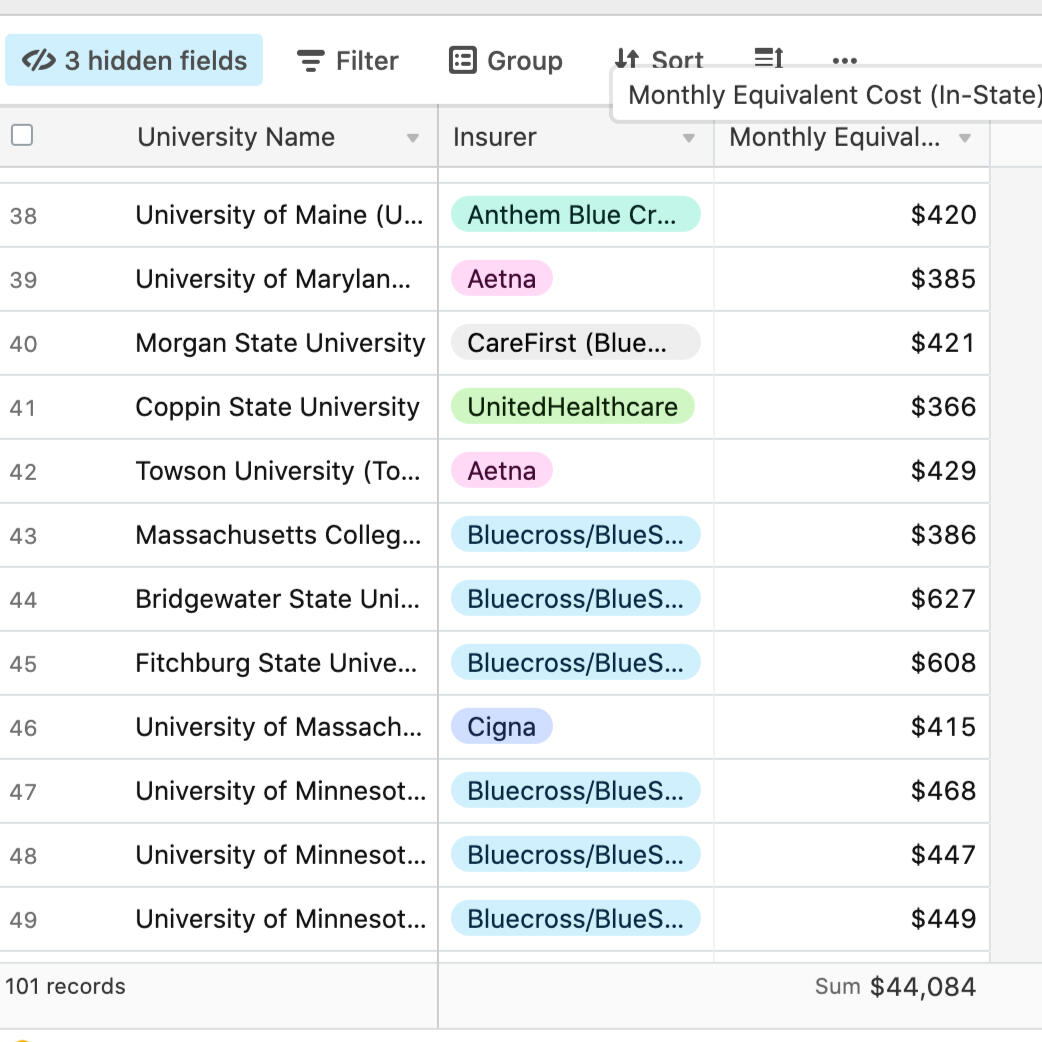
This spreadsheet is inaccurate, at best. Also, what kind of insurance matters. I can get you 50$ a month insurance that wont cover anything. Without context, this spreadsheet is a big list of rumours for you go look up and be disappointed.
(The argument being that there's got to be some kind of fraudulence-meets-loophole sort of thing going on for this to work at all.)
Maybe you could filter this list for those schools.
Or perhaps you could subcontract our your schooling online and just pay people to do the minimum required to get a passing grade. :-)
In the policy they require in-person classes.
How that's going to work this year with online-only classes is an open question.
On first blush, this looks like phenomenally good coverage for the cost. $1970 for the year. $7150 out of pocket maximum. 80% coinsurance after a $250(!) deductible.
The ACA limited how much cost discrimination insurance companies can do by age, and I am wondering if college plans are a workaround - it's not age descrimination, per-say. But the risk associated with students is much, much lower than on the marketplaces.
So they can do tricky stuff ACA banned like have low lifetime maximums, exclusions, and kick you off the plan when you drop out of school because you're too sick.
It’s a major hindrance to proper insurance mechanisms when your healthiest lives aren’t on healthcare.gov. Ideally everyone would be forced into the same marketplace subject to the same sick and healthy lives proportions so the costs are spread out evenly.
For the longest time, one of my early retirement plan is to simply go back to school, learn everything that excites me and enjoy the health insurance offered by the school.
Annual insurance fee is already calculated annually.
Source: I'm a Portland State alumnus.
The exception is when summer is the first time you attend and you want to start insurance before fall. Then you need to meet minimum hour requirements.
I'd guess most schools are similar because otherwise they'd practically force every student to take summer classes. But it's good to verify.
I'll include this when I build out v2.
I did the math with Auburn University and it's definitely off. Unless that school allows an entire semester to last a year? (1 credit hours * $430 per credit) + $2028 insurance cost / 12 = $204. I think it would be 2 credit hours, so: (2 credit hours * $430 per credit) + $2028 insurance cost / 12 = $240
Now the tuition is doubled.
The insurance premium stays the same though because that's already the annual rate.
The public insurance which covers 88% of the population gets 15 billion tax EUR annually, with total revenue of public insurances being 250 billion.
https://de.statista.com/statistik/daten/studie/192409/umfrag...
So most money comes from the insured people. The maximum you pay for the public insurance is 703€ per month, and it covers your children and non working spouse.
Just enroll in an University which cost around 280€ for half a year. This will get you a ticket which you can use in busses and trains for quite some distance. Usually a whole Bundesland (County or whatever the US equivalent is).
This is a fraction of the cost of a regular ticket and nobody checks if you pick an unpopular field like physics.
I know people doing this for many years.
And yes the US should totally get a proper public Healthcare system...
He even showed up there a few times.
Think sign up for a credit card using a cash back site to buy an easy jet plane ticket using a promo code to fly for free kind of thing!
More generally HN is a good place ;)
That not only requires your time, it might also require you to spend money on textbooks, etc.
Although maybe not if there are schools that let you drop all your classes but stay eligible for health insurance for the rest of the term.
One BIG caveat with these plans is that coverage ends if you leave school.
That's how the insurers cover their asses. They're able to provide cheaper plans because many of the sickest will drop out.
It's dumb.
Read this article by Charles Gaba for deeper insights than I can muster: http://acasignups.net/20/08/26/updated-how-much-can-risk-poo...
1. University: Has group of people they want to insure
2. Insurer: Measures risk of that group
You're either in the group or your not. Sick people drop out of school not because insurance is making them drop out, but because academics is hard to do when your health issue prevents you from doing so.
The people at fault are your representatives, who forgot about university group plans when drafting COBRA.
Wonder how long before these loopholes get shut down.
Realistically the minimum credit hour requirements might be increased at some schools, but otherwise if you take advantage of this system you're pretty much using the system as designed.
Insurers already account for the fact that healthy and insured students are less likely to opt-in for their student health plans.
You apply, you get admitted, you go to your first class. You meet young bright-eyed students.
"I want to be an oncologist! My aunt's battle with cancer really inspired me."
"I want to be a neurologist. The brain is just so fascinating!"
"I wanted health coverage."
A toy factory worker wanted to get his son a nice toy for Christmas, but couldn't afford it. So he sneaks out a single component from the factory every day. When he assembled it, it turned out to be a machine gun.
The topical American joke would be:
At a medical school graduation party, the whole class started discussing their future career prospects. It turns out that none of them would become doctors; all of them joined for the healthcare coverage.
Some common gotcha's are low lifetime maximums and exceptions. Also, the the sickest students are most likely to drop out of school and lose their coverage.
California is also an odd bird in general and a lot of their public schools didn't offer a student health plan for part time students that I could find.
It should be $0 and no hack required, for all, ideally at point of care (so no invoice).
I don't fully understand the need for this. Can someone explain?
This is included in the cost calculation (see notes section at the bottom for details).
Some (many?) schools you are enrolled automatically to the healthcare plan unless you opt-out.
...
> $500 per month.
jaw drops to the floor
The fact that "just" paying $500 per month (in premiums, I assume?) is considered an improvement...
You can go take a ballroom dancing class with a bunch of 20 year olds while getting slightly cheaper insurance