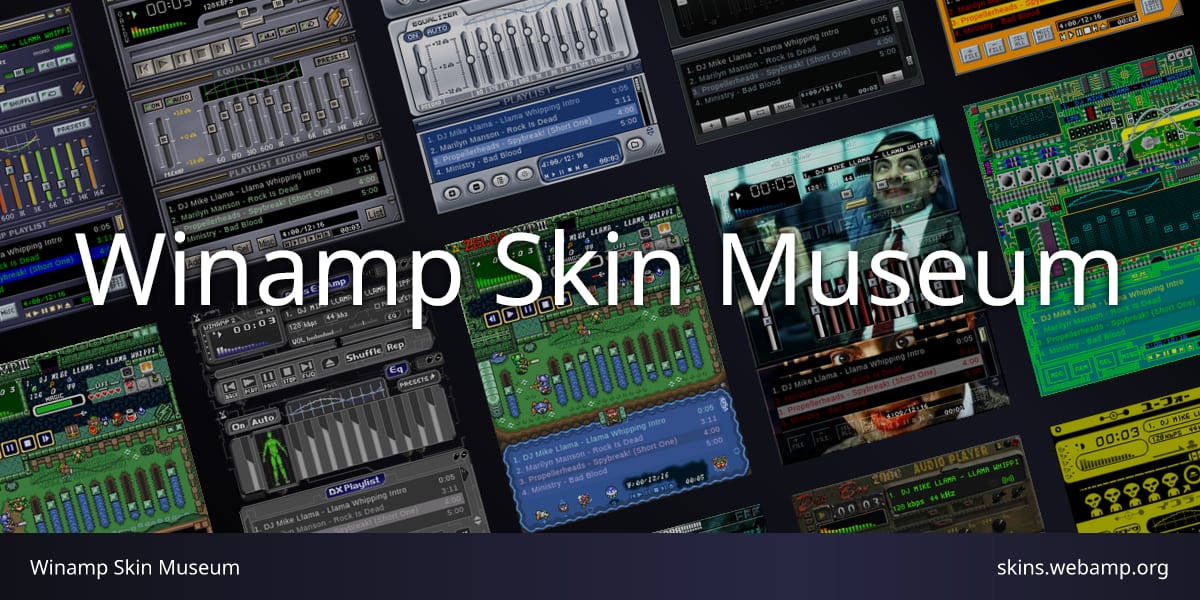
Winamp Skin Museum
Infinite scroll through 100k Winamp skins with interactive preview
Winamp Skin Museum
694 points · by 0-_-0 · 6y ago · 264 comments
In the last 20 years how have software music players changed? The files come from a subscription service easier to use and with much better metadata than tracks from Napster ever did. That's awesome! Also the subscription dictates you use their hot turd of software, with dreary spartan UI and zero room for functional customization to be had. Welcome to the future, now learn to like it or get called a luddite.
Most people are using less configurable computers: phones.
We can't easily install the software we want on our devices (iPhone especially, but Android also to an extent). Add to that the fact that we have to go through a distribution channel that takes a 30% cut. It's gross af.
The social media platforms took over from websites. Nobody really bothers with personal websites or blogs anymore since the majority of the population get their news from social media. Why spend effort building for the long tail?
Forum communities are dead because of social media. Facebook pages and subreddits are not the same.
There's one search engine, and it has a pretty big moat. This search engine built a browser and is now trying to destroy ad blockers via extension capability removal and web bundles.
It's pretty obvious that Google is trying to kill the web. AMP, steering away from semantic web, etc. They want everything to be Chrome.
Firefox doesn't have as much user share because of aforementioned browser.
We invented some cool protocols along the way (blockchain), but also lost a few that were really great (bittorrent, DHT).
IRC is pretty dead. Now there's Slack and Discord. Riot is a pretty distant third.
Apps and websites got SUPER BLOATED.
A few things have improved, though: Git is pretty freaking sweet, and Rust is the language of the future.
It's like when Link wakes up in Ocarina of Time after retrieving the Master Sword. Except in our case, everything's suddenly shiny, but feels plastic and artificial. We've discovered we're now renting everything and craftsmanship has withered away to a world of composability and integration.
It's a simple story: billions and billions of dollars chased after capturing and exploiting the average human user. Each company it super simple to adopt their platform. To do so they had to destroy the competition and create a moat. These negative externalities coupled with high concentrations of users to platforms has left a wake of destruction.
The indie, free and open web got knee-kicked by the giants.
Most of what you're describing is simply an extension of Eternal September. "We" haven't really lost any of these things. It's just that newcomers don't care about them so much.
And that's okay.
Why would I be upset that that some teen or 20-something, who primarily uses the internet to post and browse selfies on social media, does so from a phone rather than a IBM/Lenovo ThinkPad? Their main use case is Instagram or TikTok. A ThinkPad makes no sense for them. But I can still buy one.
Social media platforms "took over" in the sense of having more eyeballs. But so what? Few if any of those eyeballs are really interested in the things that I'm interested in from websites, blogs, etc. Moreover, websites and blogs are still around, and just as populated as they ever were. It's just that there's a bigger population on social media sites.
There ARE multiple search engines. DuckDuckGo even has good policies. True, none of them may be as good as Google. But pretty much ALL of them are better than Lycos, Infoseek, AltaVista, and all of the old-school competitors who lost to Google.
The only thing on this list that's a halfway decent point is Firefox user share. Just to the extent that browser engine monoculture gives Google a lot of power. But as long as the engine is open source, and there's a possibility of more privacy-conscious players leveraging it (e.g. Brave, Vivaldi, etc), then I can live with that.
The "positive" bit about Rust being "the language of the future" gives me the impression that you're mostly mourning geek culture being delegated to a side subculture, instead of being the dominant culture of the Internet itself. To an extent, it is a bummer to no longer be at the forefront of the hype wave. But to be honest, now that I'm middle-aged I don't so much care about being at the forefront of the hype wave anyway. As long as I have my crufty greyboard corner in the Internet's basement, I'm happy. And that doesn't really seem to be going anywhere.
The point is that the structure of the contemporary internet has caused their use case to be what you stated it is. What used to be a plethora of possibilities is now a small number of tailored experiences, and this is directly because of the heavy centralization of the internet.
You commented about OP's mention of rust but I'm curious to hear about your thoughts on DHT. The internet could entirely be supported by p2p infrastructure and maintain all the aforementioned properties, yet the predominant connotation of p2p is piracy. This is a more nuanced discussion than you give it credit for.
the switch to software as a service has reduced the ability as well as need for people to fix bugs in software and to in a sense even operate their own software. This is a loss. I used to teach intro CS classes at my uni and over the last few years even beginner CS students didn't know how to install an OS or do rudimentary networking stuff, skills people picked up in ca 2000 just by toying around with their desktop systems.
The entire thesis is faulty to begin with, people not caring doesn't mean that loss of skills isn't bad. We're also in a continuous decline of physical skills. People may not care that they can't swim, they do care though when they're drowning. (a statistic that sadly has been going up)
People don't care about their software being locked down because they don't even know what open software is like. If you're so coddled you don't get to experiment you don't care because you're stunted in development, not because the skills are not valuable.
> Most of what you're describing is simply an extension of Eternal September. "We" haven't really lost any of these things. It's just that newcomers don't care about them so much.
You're missing my point. I don't care that the tech stack changed. I care that everything is locked down and inherently inflexible.
Everything has become a rental and we don't have autonomy in the choices.
Because it used to be that you could start as a browser/gamer and transition to becoming a creator/tinkerer without having to change devices.
You can become a creator using the software available in the walled gardens, but only a certain kind - a content producer for the almighty ad engine.
The general purpose computer has not disappeared, but it’s no longer the first or default exposure to computing for young people. The phone or tablet is a plateau which will trap many who might move beyond it due to simple economics - it’s hard to justify yet another device if the phone or tablet can do everything that you need it to at the moment.
I care about this.
It’s the same reason I care about consoles versus pc’s. If all a young person has is a console, it’s difficult for them to realize they can change things, instead of just being a consumer.
I’m finding it difficult to put into words, but just this week I had to buy my three young children some kind of computer for school. The school suggested chromebooks because they were easy yet I just couldn’t bring myself to get them and got some refurbished macbooks instead.
The reason, I guess, is that I want my children to understand technology and to be able to hack it to suit their ends. I don’t want a media consumption device, I want them to have computers.
Literally the only reason that I can do the things I can do today is because when I was young, I had access to an 8-bit computer that I could easily write code on, even though I mostly just played games on it. If I’d had a console instead, my life would have been much poorer.
In fairness, this change hasn’t just happened with IT either. Cars have gotten harder to self-repair. Hardware has increasingly become disposable. Even the life of things like TVs have gotten shorter as they’ve become “smarter”. In general, consumers have gotten lazier and more motivated by pretty things rather than longevity. A trend businesses are very keen to encourage because it makes them more money.
It’s not all bad though. For example social networks and smart TVs have become a weird godsend during the lockdown. Would we have coped without them if we didn’t have them? Probably. But I’m still glad we had them.
This is absolutely true, but it's also true to say that they're very hard to find nowadays. You can in part blame the dominance of the major platforms, but I think the real culprit is probably SEO: it's very hard to out-SEO anybody with a marketing budget, or the kind of bottom feeders who are willing to spew out spun or other low-quality content that spams search results.
There's a bitter irony in realising that, back in the day, I used to bemoan the first page of search results being cluttered with "junk" from GeoCities or wherever, when I was looking for "real", "authoritative" information, whereas now I'd be much more welcoming of that kind of content appearing on page 1 of the search results.
And maybe that gets to the truth of it: good, interesting, worthwhile content has always been pretty hard to find online. You had to work for it 20 years ago, and you still have to work for it now.
It’s ridiculously dense. This kind of a device didn’t exist in the year 2000. So, while 90’s tech would be awesome on the surface, I am glad Apple is in the driving seat to manage my phone’s security. App Store is amazing, shitty software that spies on you doesn’t make it through (chrome extensions anyone?). Treat 30% as a privacy fee. You’re glad there is a T2 security chip on your device. And you’re glad Apple pays $400k a year for several top notch security engineers that work there.
This cannot be achieved by a bunch of Winamp hooligans and open source crusaders.
Replace Apple with your fav phone manufacturer.
Everything else, I agree. The internet has become a pile of shit.
It'd have all the same permissions and sandboxing guarantees that apps distributed over the stores do. The OS could even collect telemetry on the kind of requests these apps made to help quash bad actors.
It might have even prevented Javascript from growing into what it is today. We'd have a strong division between what is app and what is document. (I'm not bashing the Javascript/frontend folks! I just wish we'd had a dichotomy rather than stuff everything into HTML.)
I think WASM might stand a chance of doing some good here. It'd be nice if there was agreement between Apple and Google to build a cross-platform device SDK. They won't.
We need to defend HTML and our browsers from growing into the Frankenstein's monster Google is pushing for. If we lose that, we lose the war.
Pocket PC's existed.
Come to Urbit. It's not ready yet, but the hope was not lost.
Won't it mean then that Google kills it self ?
Facebook groups are sitting on so much information which previously would have been accumulated in forums, unavailable and totally useless except to serve ads for the members of said groups.
Owning a new album was exciting, because previously you couldn't listen to that album.
Getting a new mp3 player whose storage was suddenly measured in gigabytes was exciting, because previously you couldn't carry around that much music.
Getting a new phone was exciting, because it probably had a camera, or internet access, or the ability to edit files, or some other fundamentally new feature that your previous device couldn't do.
Spending a Saturday curating your music collection and updating metadata was exciting, because that couldn't be done for you automatically.
Each stage where some barrier was overcome - be it a small, personal barrier or a large, technological barrier - came with this intoxicating sense of progress and improvement and possibility. If you assembled the solution yourself from existing products - software or hardware - it was all the more potent of a feeling.
These days everything just works, amazingly well. That's a testament to progress, but it's also incredibly boring. There's little left in consumer tech to solve, by consumers or by companies. You have one miraculous device that does everything you could possibly want in your digital life, and does it really well, out of the box. It has as much bandwidth as you're likely to use, you can stream enough media to fill a thousand lifetimes for less than twenty dollars a month, it can shoot photographer-quality photos and orchestrate your smart home and play console-quality video games and run a fully-features office suite.
Progress is what gadget-lovers like us miss. Tragically, the the very act of indulging it erases opportunities for it.
It's the journey we find exciting - the difference from A to B.
I remember the intoxicating experience of using Spotify for the first time in October 2008, using IP address account tricks to access it from outside the UK. This was despite being a winamp- (or actually foobar2000)-loving music pirate.
Now, I don't think of it at all. I've arrived at destination B. What now? Well, there's desktop Linux on phones. That's fun and new, if you care about freedom, things being in the hands of the user, tinkering, and customisation. I'd go there, it needs some help.
The price to pay for this convenience is DRM and player lock-in (and all possible usage data being siphoned by said player). It is unfortunate, but as a user it's a price I'm willing to pay, even if reluctantly.
I don't know. I use Spotify as a radio replacement, but albums I like I try to buy as FLAC files. If they are lost, it's my own fault.
The only caveat is librespot only works with premium accounts.
Yes it is an official reason https://web.archive.org/web/20131219003849/http://www.winamp...
I totally miss that time period, it was just a great time to be into technology.
These are literally all the lyrics I could find, but maybe my Google fu is weak: https://www.spin.com/2016/06/gap-dream-college-music-stream-...
Luddites were against not receiving a piece of the larger pie, not against technology or progress.
https://qz.com/968692/luddites-have-been-getting-a-bad-rap-f...
For me? Not so much. I still have my music on Mp3s. The new stuff still plays as is did back then. Mp3 players never went away. I still occasionally use my old RCA Lyra but there is actually a healthy market for new models. My car still has an FM radio, but now I can plug a USB full of mp3s into it too. That isn't bad. Bluetooth and streaming has yet to become mandatory.
A modern version would probably be built on Electron, be a 500Mb download & require 8Gb RAM to just run (12Gb required if you want to change the skin).
I long for the days where things weren't so bloated.
It was just an experiment to see if it would work, but if you want something to hate-download check it out :P
Not want any more than that for a music player IMO
I used to think the same thing until a couple of weeks ago when an Electron app crashed and took down every other Electron app on my computer. I thought these things were supposed to be sandboxed.
Also think Winamp, hands down is one of the best pieces of software to withstand the test of time.
Winamp v2.92 still runs on Windows $LATEST. Geiss/Milkdrop Plugins and all.
Lets not forget the high quality audio output; its 834 KB (854,016 bytes) binary size and next to nothing CPU/MEM usage (Testimonial: left it playing my entire music collection in a forever loop and memory usage never budged more than it start with <3)
My primary music player still to this day and when on Linux Audacious or VLC
Of course other notable players: FooBar2000 Media Player Classic (MPC-HC)
I loved Winamp, but this has more to do with Microsoft maintaining backwards compatibility for a long time. Try running something from Mac OS 9 on a modern Mac.
And because you're emulating and not virtualizing, it works just as well on ARM Macs, too.
Screenshot: https://i.imgur.com/3usNwXz.png
Were you trying to bump up your Scrobble count, or what?
80M, for an MP3 player is peek 1999
Of all the things of the internet of old, Winamp 2.x, its skins, shoutcast and the visualization library are what I miss the most by far
"ProjectM" exists within Linux as well, but I've never gotten it to work properly on my laptop.
You know, it's funny how ahead of its time Winamp was in many ways.
You can play streams directly from there or via WinAmp.
I would watch the download finish, sometimes slow, sometimes fast, and then i would open up that track with winamp and my favourite skin.
I loved those nights as christmas. It was so intens and a totally new world for me.
Miss those days at times
It was a cigarette box with the llama on it.
Winamp, it whips the llama's ass.
What a trip down memory lane.
For those that aren't aware, the guy that created Winamp (Justin Frankel) is now working on a DAW called Reaper (http://reaper.fm). It's stellar for what it is as well!
https://skins.webamp.org/skin/d72ca73bdde779b18e8e8980962124...
(For reference, the XMMS default skin is on here too: https://skins.webamp.org/skin/dd26a8459c364a833e53ef0d994562...)
I remember that skin had an associated “uxtheme.dll” theme you could install on Windows XP, which was one of the best third party XP themes out there.
It is just that everyone seems to be making slight variations on the same Aqua and Metro inspired ideas the last decade or so.
Winamp, OSX Aqua, Sonique, Shoutcast, Windows 9x : all gone.
Rei and Lain -- still immensely popular across the internet.
edit : found my old favorite https://skins.webamp.org/skin/78deb012fc1bd1db7ccc00de2a28a1...
there's something nice about contrasting chickenscratch style hand-writing with graphing paper and the rest of the rectangular interface plastering the rest of the computer. Almost a squiggle-vision Dr.Katz feel to it.
https://skins.webamp.org/?query=mac%20os%20x%20aqua
I remember running with those for quite a while even though I only bought my first Mac in 2019
Oh wait, we already have systems like that in the US Federal government! Okay they’re not more than a century old, but ai can imagine scenarios where they will be. The programmers for these systems are in now their sixties and early seventies, with very very few younger engineers learning the old stuff, especially recent graduates.
We need a specialized CS program just for this.
I haven't seen this in what feels like forever. I use Foobar200 now.
I made this using Dreamweaver when it was still popular and useful. It had really nice slicing features for graphics at the time.
https://skins.webamp.org/skin/bfd4187850616fc9b4e433c4b632b6...
https://skins.webamp.org/skin/6edc6d5a5d07ceb361912824a17004...
> Winampify is a Web Client for Spotify using Winamp 2 skins
It's made by Rémi Gallego, who releases music as The Algorithm and Boucle Infinie.
The only one that immediately comes to mind is GPU overclocking software on Windows ala https://www.evga.com/precisionx1/
Anyway, please add the x11amp skin! It was something like this:
<http://daffyduke.lautre.net/pictures/png/x11amp.png>
  <http://www.x11amp.ml.org/>
<https://web.archive.org/web/19981206071453/http://www.x11amp.ml.org/skins.html>double horizontal https://i.imgur.com/4joQkPL.png
double both horizontal and vertical https://i.imgur.com/0MoiDdD.png
- https://skins.webamp.org/skin/cc24464c27369f14e2631c709eb095...
- https://skins.webamp.org/skin/efb2ac84260d283513e8b940de12cf...
There’s a top bar and then everything else is just all black.
Turns out it's not as good as I remember. Oh well.
https://skins.webamp.org/skin/8a466a39534e4be0dc6ca5cc0d6f5a...
I still think it's an incredible piece of art/design.
EDIT: Author has a twitter bot that tweets some of them, so I had a look over there: https://twitter.com/winampskins
I also remember some cool plugins, like the one that would put speakers left and right.
FEUEREIS is beautiful
Is this really the original team? Or a clever scam?
If you know, you know
ONE post? seriously?
I'm disappointed!