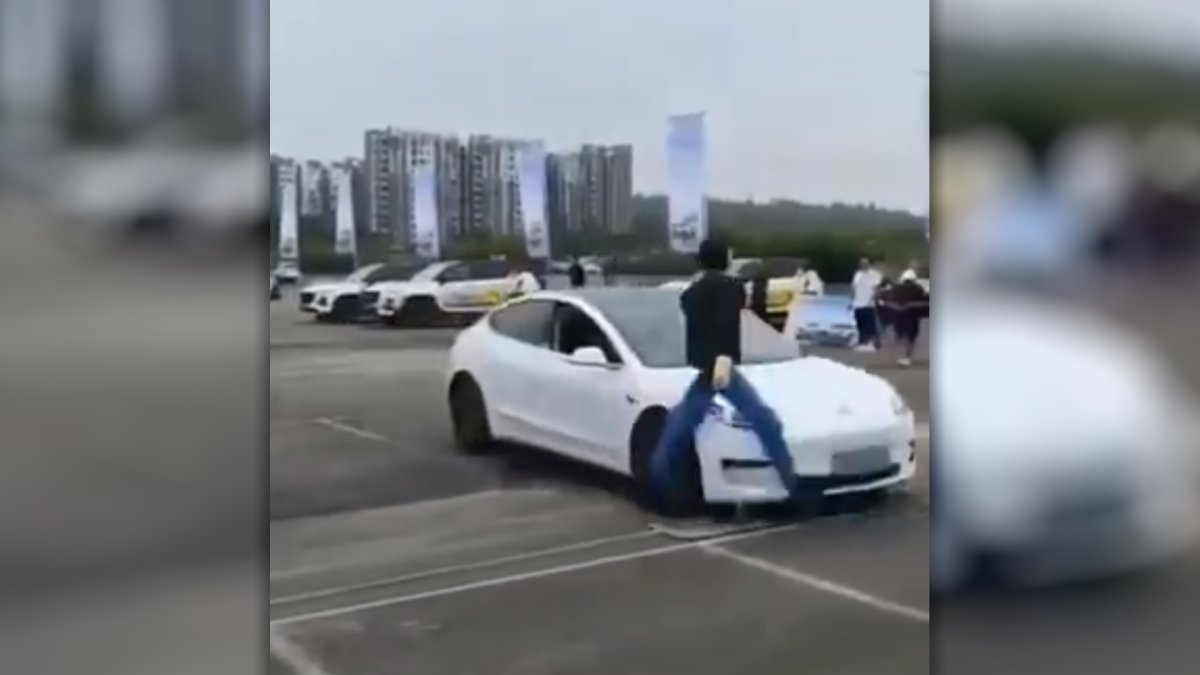
Watch a Tesla Model 3 Fail an Automatic Braking Test and Vaporize a Robot Pedestrian
That's a bit unsettling.
The Drive
66 points · by tomohawk · 6y ago · 111 comments
A pedestrian darting out from behind a car is known to be a tricky scenario, but some systems handle it at least some of the time. This scenario looked like the pedestrian was unobstructed and traveling in a predictable direction, so it’s pretty unnerving if it’s real.
Long story short, even in Teslas, even just autonomous braking and crash avoidance is a great extra safety layer, but far from something that should be relied upon. Tesla is reckless for selling it as something that can be relied upon to successfully pilot a car.
To your point about Tesla, they vigorously communicate that you (as do other manufacturers) as the driver are responsible at all times. We can go roundabout like we always do about this, but regulators have continued to allow these systems to be marketed and sold, and they're the authority. Why are we blaming automakers for garbage drivers? The driver is who you sue when they hit a pedestrian.
> To understand the strengths and weaknesses of these systems and how they differ, we piloted a Cadillac CT6, a Subaru Impreza, a Tesla Model S, and a Toyota Camry through four tests at FT Techno of America's Fowlerville, Michigan, proving ground. The balloon car is built like a bounce house but with the radar reflectivity of a real car, along with a five-figure price and a Volkswagen wrapper. For the tests with a moving target, a heavy-duty pickup tows the balloon car on 42-foot rails, which allow it to slide forward after impact.
> The car companies don't hide the fact that today's AEB systems have blind spots. It's all there in the owner's manuals, typically covered by both an all-encompassing legal disclaimer and explicit examples of why the systems might fail to intervene. For instance, the Camry's AEB system may not work when you're driving on a hill. It might not spot vehicles with high ground clearance or those with low rear ends. It may not work if a wiper blade blocks the camera. Toyota says the system could also fail if the vehicle is wobbling, whatever that means. It may not function when the sun shines directly on the vehicle ahead or into the camera mounted near the rearview mirror.
> The edge cases cover the gamut from common to complex. Volvo's owner's manuals outline a target-switching problem for adaptive cruise control (ACC), the convenience feature that relies on the same sensors as AEB. In these scenarios, a vehicle just ahead of the Volvo takes an exit or makes a lane change to reveal a stationary vehicle in the Volvo's path. If traveling above 20 mph, the Volvo will not decelerate, according to its maker. We replicated that scenario for AEB testing, with a lead vehicle making a late lane change as it closed in on the parked balloon car. No car in our test could avoid a collision beyond 30 mph, and as we neared that upper limit, the Tesla and the Subaru provided no warning or braking.
https://www.caranddriver.com/features/a24511826/safety-featu...
- They advertise and sell full autonomy under the name “autopilot”, which carries all sorts of connotations
- Correct me if I’m wrong, but they don’t actually prevent a driver from falling asleep behind the wheel, even if they vibrate the steering wheel. New Subarus have driver eye tracking built in - it would be trivial for Tesla to make sure the driver is paying attention, but they don’t really want to.
It might say it somewhere in the manual to cover them legally, but all signs point to them wanting the market to think their cars drive themselves.
You cannot mitigate away personal responsibility failures with technology bandaids. At some point, the buck must stop with the operator. (On my large shop equipment I let others use in my workshop, there are large stickers that very loudly proclaim "Not only will this kill you, it will hurt the whole time you are dying").
Because most people are bad drivers, most of those people realize it whether they'll admit it or not, and I truly believe that deep down most people recognize that they are one inattentive moment away from killing someone.
There is a desperate desire to be able to offload that responsibility onto someone or something else. "They came out from behind that car" instead of "I shouldn't have been going 45mph next to a row of parked cars." "They stopped short" instead of "I was tailgating."
If we can offload the responsibility it becomes someone else's problem and we don't need to change our habits of driving too fast, not paying enough attention to the road, and being too distracted.
This task clearly is very very hard to do, but tough shit: if you can't safely control a megajoule of kinetic energy coming down the road your computer shouldn't be given the benefit of the doubt.
Aside from the legs barely moving, the arms not moving - e.g. it doesn't look like a pedestrian the AI would be modeling from - it's driving out of context through parking lot lines.
Edit to add: the guidelines for using Autopilot, irrespective of what the name insinuates to you, requires the driver to be paying attention at all times and takeover if it's not doing what you expect; "BUt iT shOUld BE PerFeCT" attitude is dismissing one's personal responsibility - if you don't want to have to pay attention then don't drive with Autopilot.
If it's driving in a parking lot rather than a busy city street, shouldn't that have meant it can also safely swerve away from the obstacle in almost any direction?
I disagree. The test is not poorly done. Such conditions are trivial for a human to recognize. You will not be allowed behind a wheel if you could not avoid a dummy while driving.
If an AI can't recognize such trivial circumstances why would I let it take control when I'm going 60 mph on a freeway? That's like putting my kid on my lap and letting him drive... yeah of course I can take over control at anytime, but it's still illegal to do this and absolutely insane.
Let's put it this way, if it's insane and illegal to put a 7 year old kid on your lap and allow him to drive at 60 mph down a freeway (even when you have executive override abilities to take control at anytime) then why is it normal to have an AI (who would do considerably worse than a 7 year old at recognizing a pedestrian) do what's basically the same thing?
Is this Bad PR or is it a Tesla owner trying to justify his purchase?
There are a number of reasons a person's arms may not move as expected, a couple of primary ones being the person is holding an object or has hands in pockets. And of course, some people don't have arms, and they shouldn't be left out either.
This is similar to the FAA's "see and avoid" rule. It is mostly ineffective for obvious reasons, but is a good way to dump responsibility on one of the entities involved.
Probably best NOT to stop in that scenario.
It's the millions of "edge cases" that humans are pretty decent about making quick decisions on that make self-driving cars really scary to me.
The car should slow down for that scenario. It doesn't know if the situation is 100% safe, so it should apply the brakes and steer to avoid a collision using data from around the car to determine the safest course. Driving through a hazard is only an option for a self-driving car if there is literally no other option.
Cars are not people and they're not capable of making decisions in the same way people do. They should be taking the safest route all the time.
Do people here really just drive through road hazards without being cautious?
As I passed, I learned that the plastic bag was actually a dog that was (for unknown reasons) trying to cross the highway in moderately heavy traffic. It was pure luck on my part that I didn't hit the dog as it ran right behind my vehicle.
Sometimes even humans aren't the best judges in a split second of an object's estimated mass and/or whether it might contain some sort of soul. (I was around 30, and neither my cognition nor vision were noticeably impaired)
Edit: the second test is pretty bad for Tesla though, the dummy was stationary
You can infer that it is meant to represent a human, and thus likely to move across a crossing, but there’s no reason to expect a computer to read it as a human right?
The most obvious characteristic is distinctly not human (Legs don’t work that way), so it looks like some weird windmill, or one of those hot air moving men.
Everything else is magically repelled away. Like debris, crashed cars that don't look like cars, animals, stuff that fell of that truck, a soccer ball kicked from nearby field...
Here in the UK part of the driving law is that you should always be able to stop in time to avoid hitting something. If you're driving somewhere with poor visibility (eg a road with cars parked down the sides) then you should slow down. If you do hit something it's determined that you were driving too fast, so it's considered your fault and you have to have evidence to prove otherwise (eg a dashcam).
In the case in the video, seeing someone waiting by the side of the road should be enough to make a competent driver slow down a little.
I imagine the same is true in the US and China.
This is not a difficult scenario.
Until that question is settled in court I don’t think I’d feel comfortable using the self-driving capabilities of a Tesla.
No one expects all cars to always perfectly breake in all situations.
But Tesla breakes far from perfectly.
And this isn't the first time Tesla has worse then everyone else results in emergency breaking system tests.
If we're really talking about automated driving where humans are only passengers, that's an entirely different kettle of fish.
In other words, if the autopilot would break, but driver accelerated, what would the car do? Also, what SHOULD the car do?
I'm asking this because we have no idea how the tests were done: we're given a video of a moving Tesla hitting a dummy and breaking after.
I don't know how people can take any conclusions from this information, other than what is shown.
Disclaimer: I don't own any Tesla stock, neither I have any Tesla products.
Who wants to bet their astro-turfing squads aaa, sorry, PR teams will be all over this downvoting and disliking on every social media platform.
https://m.weibo.cn/detail/4551307186670198#&video
Still rooting for Tesla to figure this out!
https://slate.com/news-and-politics/2015/09/why-drivers-in-c...
2. Maybe Tesla uses not only cameras but also radar sensors. A blow-up dummy is transparent for radar. Real human is not. So it is OK to drive through balloons.
2. I would definitely prefer a false positive where tesla brakes for human shaped balloons crossing the street than the potential for plowing through a human because of a bad radar reading.
this video is obviously not unbiased but here you can see a Tesla plow through a dummy that is obviously not made of balloons https://youtu.be/tkAtRw51jGY?t=81
The second video had in car footage clearly displaying a visual warning and playing a collision warning sound. Because of concerns over phantom braking, these can be overridden by the accelerator pedal.
I wouldn't call it fake, but it is exaggerated.
I mean who knows, if it's not from a "best" journalistic resource than it could be some random dude in his moms basement spending millions of dollars to create several computer generated videos of a Tesla failing to stop for a dummy. People these days will believe anything.
It made me realize if we all had the same tech in cars in terms of safety and OS, we could be safer than human control and we were.
>Something made of wood or painted plastic, though opaque to a person, is almost as transparent as glass to radar. https://www.tesla.com/blog/upgrading-autopilot-seeing-world-...
For example (speculation):
1. the system knows how to stop when it recognizes stationary radar transparent structures (traffic cones or wooden structures)
2. the system has experience with plastic bags on the road and learned to drive trough them without stopping.
3. the visual system has learned to stop when it sees walking humanoid figure.
The previously unseen rivalry between 1+2+3 leads to delayed decision.
It's pretty clear from their long history of weasel-wording that the answer is no, but they also aren't saying.
Telsa tried to use the "His hands weren't on the wheel, look, he got an alert" argument in the NTSB investigation into an AP fatality. It was later proven that the alert was some 7 minutes prior to the accident.
I'm reading this with Firefox on Android. None of the Twitter links work, reporting "Cannot Complete Request
"Additional information about this problem or error is currently unavailable."
Is the problem Twitter or Firefox?
https://insideevs.com/news/377427/video-tesla-model-3-failed...
An interesting insight was that pedestrian what most early detected by the Tesla but it just decided to brake only just before hitting them...
[1] https://www.aaa.com/AAA/common/aar/files/Research-Report-Ped...
Here's BMW, Mitsubishi and others failing at the same thing: https://www.youtube.com/watch?v=7Y8JG7kepwc
The only reason you don't hear about it, is because hating on Tesla gets clicks.
Tesla legal says you couldn't possibly think Tesla has a self driving car.