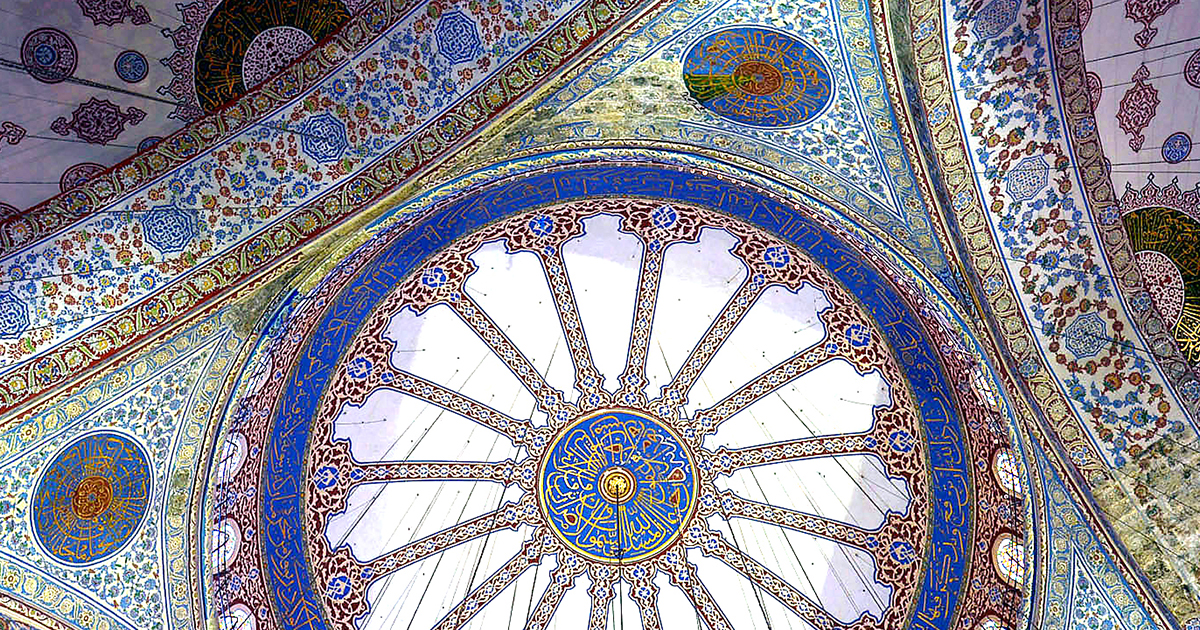
Why the Arabic World Turned Away from Science
On the lost Golden Age and the rejection of reason
The New Atlantis
266 points · by neon_evangelion · 6y ago · 388 comments
.. so far, so good. There's always the risk that the West might internally reject the scientific revolution. This paragraph is a useful reminder that historical "progress" isn't linear or monotonic.
This article is very good on the background in the era of the Caliphate and early scientific progress in medieval Europe. Where it falls down is the past century. We can draw comparison with the Meiji restoration; Japan went from insular agrarianism to a world power to collapse to continued scientific development through to the 21st century. As did much of the Far East. Why not the Middle east?
Anyway, excellent longread.
There are lots of theories, of course, but one I find interesting is that East Asia, in addition to never being colonized to the same extent as most places, emerged with national boundaries largely intact. The Middle East was under foreign control for, well, basically forever (Romans -> Ottomans -> mandates) and ended up with some pretty weird national boundaries. This encouraged a lot of strife.
There's also the oil theory; countries with huge natural resources seem to often struggle to develop normally.
Hittites -> Assyrians -> Babylonians -> Macedonia (aka Alexander the Great) -> Egyptian -> Romans -> Byzantine -> Mongols -> Ottomans
That area has been locked in war and conquest for pretty much all of human history.
In 334 B.C, he utterly beat the armies of Persia – Steve Harris
Can confirm. That's why Russia is sliding down scientifically. People gravitate to where money and prestige is, and when you have money squirting from the ground, that demands (and receives) disproportionate attention. Another side effect of this is that it suffocates technology and innovation by both depriving it of investment, and by shaping the tax structure that excludes the possibility of survival for most non natural resource businesses unless they cheat on their taxes. It's a complex problem without a clear solution. Only Norway has been able to manage it well so far.
That isn't directly related to "scientific development", but that, like most things, relies on economic and political stability.
For example, some people have pointed out when European colonialists set borders, they were more concerned with natural resources and the opinions of competing colonial powers than with what the locals thought of the borders.
Some people go further, thinking in at least some instances colonial governments intentionally created the situations for internal strife, as doing so could make regions easier to control. Set the borders so that area is 75% Religion A, 25% Religion B then you can appoint powerful local deputies from Religion B. Your powerful deputies will never support a popular revolution, as it'd make them lose all their power.
Later the colonial power leaves, but the borders stay in the same place - along with a generous helping of resentment and fear between the groups - and the stage is set for internal strife, political blocs formed along ethnic lines, and so on.
And if European colonists produced messed up borders, why couldn't Ottoman colonists have caused the same effects?
That doesn't mean ethnic diversity causes the problem - but there are several elements that set the scene for problems, and ethnic voting blocs are an easily measured component, though not sufficient on their own.
It’s not just a colonialism thing either; in Europe wars often resulted in territorial change; the territory was then the cause of the next war.
As the Mongols expanded, each time they encountered an empire, they offered them two alternatives: a) Pay tribute to the Mongols, b) War with the Mongols and their vassal nations.
The caliphate chose the war option, unaware of the true military strength of the Mongols, who they considered primitive barbarians. The result was the complete destruction of the empire, their infrastructure including libraries, and the death of most scholars.
However, parts of Spain were under Islamic control from 711 AD to 1492 AD, and Sicily from 878 AD to 1060 AD. It was there were books from Islamic libraries were translated to Latin, giving origin to the European Reinassance.
https://en.wikipedia.org/wiki/Mongol_invasion_of_Europe#Agai...
This defeat made the Islamic civilization become militaristic, less secular and lose their interest in science.
From there, it was a downwards spiral. Ottoman rule followed by the Arab revolt, Sykes-Picot and perpetual war.
It is very possible that the achievements of modernity have changed the game. That said, the game was (is?) rise and fall. Rising civilizations leave a heritage to be mined, so there is an overall direction of rise... but every one of the many scientifically advancing cultures in history has declined. It would be prudent to expect the same for ours.
That said, modernity has almost certainly changed at least some of the rules. Even the term "The West" has become complicated. Our civilization is now essentially global. A scientific invention in France immediately arrives in Seoul. A joke told in Houston is heard in lagos. A book popular here is likely popular there.
The practical link between Rio De Janeiro and Tokyo is stronger now than Baghdad and Casablanca then.
The Phoenician civilization didn't have a single government, yet we consider them a single civilization. The definition isn't a hard one with a clear "is" or "is not," but I think we're clearly there.
Also, even the politics is highly intertwined. Political turmoil or change in one place causes an effect in other places.
I find this statement problematic. The West is leading the current period of scientific revolution, as the Muslims, the ancient Chinese and Indians did during their periods of scientific achievement.
When Japan was conquered by USA in 1940s, the USA treated it with much more respect than the Europeans did vs the Ottoman Empire from WW1.
As a result, Japan was able to regrow into a world power. While the countries that formerly constituted the Ottomans are under a constant civil war (and major military groups, like ISIS, dream of re-establishing a religious empire of old: https://en.wikipedia.org/wiki/Ottoman_Caliphate)
Its not very hard to imagine a "cut up Japan", a hypothetical disarmed Japan where the USA would split between Britain / France / Russia / other members of the allies.
In fact, we can look to the (eastern part) of the Soviet Union to see how well splitting up countries went during WW2. The East / West Germany thing almost surely stunted Germany's growth back into its world standing.
--------
With that being said: the Ottomans were certainly in a decline by the late 1800s, before WWI broke out. But I can't imagine that WWI did those countries any favors.
Erm, Eastern part of Europe: the Soviet Union.
Whatever, I bet people know what I'm talking about. Cutting up countries is bad for their health!
the looming threat of communism from Russia and China played an important role in US's post-war policy in Japan and Japan's immediate post war recovery. While Japan was allowed to stay united as one, the Korean peninsula was divided, though the territory was never part of the WW2 theater. The Korean civil war led by the communist North likewise boosted Japan's quick recovery.
Well, when your region of the world has been torn asunder by everything, including colonial powers, fascist reactionaries and nationalists, liberal market economies, and international communism; the only remaining cultural artifact that you can call your own is religion. If you want to unify the Middle East, you have to do so under the guise of religion, and in practice that means conservative religious extremism. Iran is sort of a microcosm of this: they deliberately adopted theocracy as any form of secular government or economy was viewed as surrender to one's oppressors.
The only problem is that there's at least three dominant forms of religion in the area to unify under: Sunni and Shiite Islam, and Zionist-compatible Judaism. This has more or less created a local cold war between Sunni theocracies (e.g. Saudi Arabia), Shiite theocracies (e.g. Iran and half of Iraq), and Israel. These hostilities are often fought with insurgencies, which means lots of violence in the border areas between the three religions. This is not a great place to live.
Immigration law is quite complicated and fraught. Every country has a mostly but not entirely irrational fear of demographic shifts (see Texas and Israel), and so they heavily restrict who can enter their country. However, the demands of capitalism mean that most countries have to provide a practical immigration path for college-educated individuals such as scientists. Immigration for the working class is generally disallowed or heavily restricted as a form of labor market protectionism, which means there is vast disparities in who is and isn't allowed to leave a country.
This creates an interesting problem: it is very difficult for these countries to convince educated scientists to remain in their country. Scientists generally don't get along with theocrats all that well to begin with. However, we've also chosen the immigration policy that is most likely to select for (relatively) liberal emigrants and filter out more conservative ones. So there's a vicious cycle: it's easier for scientists to leave the Middle East, which makes the region more conservative, which makes more scientists want to leave.
Iran had a secular, democratic government. It was overthrown by the UK and US who installed a brutal dictatorship just so they could get their oil cheap, so you can kind of see how Iranians might conclude that “democracy” isn’t worth the paper it’s written on and the only defense is a bigger bunch of bastards than the other guys’.
https://en.wikipedia.org/wiki/1953_Iranian_coup_d%27%C3%A9ta...
However, the "We" is ambiguous: US or EU? Or Canada, Australia, Japan?
In the US I am pretty sure we are already on the decline.
I think it has to do with, during the industrial revolution and post-war, huge scientific advancements and tech grew the economy, fed capitalism by means of providing new desirable goods to consumers (e.g. dishwashers, nicer cars, etc.)
I wonder if we've reached a "peak" of consumer comfort where advances in science/ tech/ medicine are no longer frequent/ impactful enough to meaningfully satisfy consumers, (why do we care about exploring Mars?) so it's easy for people to reject it and say "we don't need science."
I wish society could pick its battles more carefully.
Problematically, to secure funding today, one is essentially expected to frame every condensed-matter experiment as the next transistor. Not only in grant applications, but increasingly also in the abstract and opening paragraphs of research articles. There's a marked contrast with older research articles in physics, which usually go straight to disseminating the results. (Needless to say that I prefer the old style.)
As a result, a great deal of funding and attention is allocated towards projects that simultaneously 1) Will not improve the quality of life of anyone, even in the long term. 2) Are "de-risked" to such extent that no new scientific insights can come out of them.
I got my PhD and left academia (because of this and petty politics around photocopier paper costs) and the only part I really miss is the teaching and the bright minds.
Solid rational investigative techniques go back a very long way. Even the Romans had a good understanding of how to prove a theory. Galen's work on the renal system for example involving public demonstrations on live pigs. The Antikethyra mechanism shows how advanced engineering could be in the Greek world at the time. The problem was there was no institutionalisation and formalisation of these methods to enable their systematic and sustained application, so they melted away when the thinkers and artisans, or small groups of them that made these advances died or disbanded. In the Arab world yes there were universities and medical schools, but these were the personal projects of particular rulers and their favourites that lasted a while and then melted away.
There was nothing wrong with the Arab world, or ancient China, or India. It's just that the several necessary ingredients for sustained progress in science happened to come together in Europe first.
It was really the switch over to valuing processes and methods, rather than facts and knowledge, that turbo-charged the rate of development.
In India Astrology is now being treated as a Science and the Modi government is considering allowing alternate medicine (Ayurveda / Homeopathy / Unani) "doctors" to prescribe allopathic medicines.
This when India's first Prime Minister sought to promote "scientific temper" in independent India:
> "[What is needed] is the scientific approach, the adventurous and yet critical temper of science, the search for truth and new knowledge, the refusal to accept anything without testing and trial, the capacity to change previous conclusions in the face of new evidence, the reliance on observed fact and not on pre-conceived theory, the hard discipline of the mind—all this is necessary, not merely for the application of science but for life itself and the solution of its many problems." —Jawaharlal Nehru (1946) The Discovery of India
And the constitution of India itself emphasises:
> [It shall be the duty of every citizen of India] To develop scientific temper, humanism and the spirit of inquiry and reform.
Political leaders are the key, and the answer to why science and culture flourish and die in any civilization. The west will experience this too.
- https://www.wsws.org/en/articles/2001/08/astr-a16.html - https://timesofindia.indiatimes.com/india/Astrology-is-a-sci...
Modi may well promote nonsense, but the institutions of higher education and science in India still exist and have enough prestige and social and economic momentum that I believe they will continue to sustain themselves. Similarly Trump continues to talk utter nonsense about Coronavirus, and even knowingly misled his followers throughout the first 6 months of the outbreak, but still has Dr. Fauci leading the medical response because even Trump can't completely sideline the scientific community.
I agree that as long as the institution is strong, it will prevail. But I don't agree with you that they can prevail independent of the political leaders in charge.
Perhaps our differing preception is because even though Trump seems to have a similiar retrogade and dictatorial mentality like Modi, western institutions - both democratic and scientific - seem to have withstood an attack on it by the Trump administration. But in India they have been nearly subjugated in the last 20 years or so.
In fact, it was the University Grants Commission - one of the highest body in India that decides on education - then filled with religious fundamentalists, that proposed the funding of BSc and MSc courses in Astrology and treating is as Science, on the urging of the right-wing government in power in 2001.
And I guess institutions like:
Defence Research and Development Organisations (DRDO), Indian Space Research Organisation, Baba Atomic Resarch Centre, Hindustan Aeronautical Limited, Defence Research and Development Laboratories, Ordnance Factory Board Council of Scientific and Industrial Research, Indian Institutes of Science Education and Research, Central Institute for Cotton Research, Central Institute of Medicinal and Aromatic Plants, Central Research Institute for Dryland Agriculture, Central Sheep and Wool Research Institute, Central Soil Salinity Research Institute, Centre for Sustainable Agriculture, Indian Agricultural Research Institute, Indian Institute of Food Processing Technology, Indian Institute of Horticultural Research, Indian Institute of Millets Research, Indian Institute of Natural Resins and Gums, Indian Institute of Plantation Management, Indian Institute of Soil Science, National Academy of Agricultural Research Management, National Academy of Agricultural Sciences, National Dairy Research Institute, National Sugar Institute, Nimbkar Agricultural Research Institute, Tamil Nadu Rice Research Institute, Central Institute of Indian Languages, All India Institute of Hygiene and Public Health, Sree Chitra Tirunal Institute for Medical Sciences and Technology, National Centre for Disease Control, National Institute for Research in Reproductive Health,, National Institute for Research in Tuberculosis, National Institute of Biomedical Genomics, National Institute of Cholera and Enteric Diseases, National Institute of Epidemiology, National Institute of Immunology, India, National Institute of Malaria Research, National Institute of Mental Health and Neurosciences, National Institute of Virology, National Research Institute for Panchakarma, National Tuberculosis Institute, Neurobiology Research Centre, Homi Bhabha Cancer Hospital & Research Centre, Indian Veterinary Research Institute, Advanced Research Centre for Bamboo and Rattan, Agumbe Rainforest Research Station, Arid Forest Research Institute, Jawaharlal Nehru Tropical Botanic Garden and Research Institute, Rain Forest Research Institute, Tropical Forest Research Institute, Himalayan Forest Research Institute, Centre for Forest Based Livelihood and Extension, Centre for Forestry Research and Human Resource Development, Centre for Social Forestry and Eco-Rehabilitation, Indian Council of Forestry Research and Education, Indian Council of Historical Research, Indian Council of Social Science Research, Indian Diamond Institute, Indian Initiative in Gravitational-wave Observations, Indian Institute of Science, Indian Institute of Sindhology, Indian Social Institute, Indian Social Institute, Bangalore, National Academy of Sciences, India, National Brain Research Centre, National Centre for Cell Science, National Centre for Polar and Ocean Research, National Institute of Ayurveda, National Institute of Hydrology, National Institute of Science Education and Research, National Institutes of Pharmaceutical Education and Research, Research Design and Standards Organisation, Xavier Institute of Social Service
emerged after 2014?? /s India didn't even have the technology to manufacture a safety pin when the British left India. Today India is one of the few countries in the world that has mastered medical, nuclear, space, missile, defence and agricultural sciences to be among the few countries that is self-sufficient in these areas. And that is because of the scientific temperement of the past indian government.
I have had Astrologers visit my house when Modi was no where around in the national political scene. And exploring alternative medicine is hardly specific to Modi government. Even WHO is doing it:
https://edition.cnn.com/2019/05/24/health/traditional-chines...
Though I agree that pseudo-science like Homeopathy should not be promoted in any way and ancient medical knowledge like Ayurveda should be strictly regulated and rigorously tested.
But did you treat these astrologers as scientists? The problem is not with astrology existing as it does in some form or the other in every country - the problem is in trying to promote it and give it some legitimacy by declaring it as a science!
That is what the religious fundamentalists in power are doing in India because they associate their form of astrology with their religion. If it is treated as science, would you like space launches or missile tests, for examples, to be decided based on the "auspicious" time figured through the "science" of astrology, even if the atmospheric conditions or not suitable for the launch at this time?
Take the first paragraph
> Contemporary Islam is not known for its engagement in the modern scientific project. But it is heir to a legendary “Golden Age” of Arabic science frequently invoked by commentators hoping to make Muslims and Westerners more respectful and understanding of each other. President Obama, for instance, in his June 4, 2009 speech in Cairo, praised Muslims for their historical scientific and intellectual contributions to civilization.
So first it says Contemporary "Islam" is not known for its engagement in the modern scientific project.
Then it says Golden Age of "Arabic" science.
Funny distinction. If you gonna use 'Arabic', use it everywhere.
Also another funny thing that the "Idealistic" president, Obama, who they say praised muslims for their historical scientific and intellectual contributions to civilization, had no problem working with dictators who are the main reason for the decline of scientific study in the region. And also had no problem supporting Al Sisi coup after the Egyptian revolution.
Edit: Adding that the Obama administration didn't want to admit it is a coup to be able to keep giving aid to the Egyptian military, which is prevented by the American constitution in case of a coup. Professor Chomsky always said that the US won't allow true democracy in the middle east. He even had a lecture in 2011 just after the revolution started predicting exactly what happened.
So the US uses its power to keep the situation as it is, then the very much honest westerners come and say that we are backward in scientific study. Thanks guys. You are very wise and honest.
Could the centuries of direct colonial rule by the Ottomans and Europeans played a role? The Ottomans were by no measure gentle but the Europeans were nothing short of barbaric. Take Palestine. To solidify their hold the British simply rounded up and executed fighting age men the moment rebellion started brewing.
The stakes are high and the Europeans knew this. The Arabs sat on oil. Lots of it. Colonialism is doomed to fail because the uncivilized eventually rise up (imagine that). Enter Sykes-Picot and neo-colonialism. Give them the illusion of being free, back brutal dictators over the people, and divide and conquer along sectarian lines.
Finally enter Israel. To really support for Israel Herzl, the founder of Zionism, wrote that Israel would “form part of a wall of defense for Europe in Asia, an outpost of civilization against barbarism.”. And they played their part. They are the wildcard ready to bomb any middle eastern country should they rise up and crawl towards independence. See all the nuclear power plants they bombed while they were still being built.
Because the ways Japan and Middle East were neo-colonized was different. After the bombs Japan wasn’t allowed to hold any army of significance and was enforced to have democratic institutions, which makes it very difficult for any dictatorial player to emerge, whereas in the middle east dictatorial regimes were not only embraced but even sometimes installed in the hopes that they could be easily controlled.
Authoritarianism wreaks havoc on meritocratic processes such as scientific knowledge production, intellectual property rights and other institutions democracies take for granted to flourish.
Having a true democracy would be a bless for sure, but don't think that will magically produce scientists, or revolutionary new points of view. You need to seed, nurture, care for and harvest decades later. And this is one of the causes of decline of science. Everybody is now planned, arranged and forced to fit in chunks of 4 years, so the people now in power can take all the credit.
As bad as dictators are, a stable dictatorship could ironically lead to a much more comfortable environment for scientists than a democracy. The first thing that many politicians do after stepping in power is to fire the scientists identified with the previous government (or discredit their work, or remove their funds...).
The author is also including in Contemporary Islam, SEA countries like Malaysia.
He also discusses Pakistan and ancient Indian civilizations as separate entities, which have geographical overlap, because Pakistan (and Bangladesh) is far behind India in terms of research productivity.
The theory that the US "does not allow" the establishment of academic institutions in Islamic countries is equally wrong.
edit - There is a common attitude among Arabs (evident in this poster's comments in this thread) that everything bad in Arab countries is due to some combination of the US and Israel. One of my teachers, a Jordanian, told me how his father would poke fun at this attitude: when something in the house would break, his father would ironically blame Israel for it.
American foreign policy in the Arab world is complicated. It seems to me that many Arab countries oscillate between Islamist democracies and secular dictatorships. The US prefers the latter to the former. I think it's fair to criticize this stance but my sense is that the US would support a secular democracy, were it possible. The Obama administration supported the secular opposition to Assad...but it has turned out that the biggest faction of the Syrian opposition are Sunnis motivated by Islamism, hence America backing away from Syria.
"A preliminary caution must be taken about both parts of the term “Arabic science.” This is, first, because the scientists discussed here were not all Arab Muslims. Indeed, most of the greatest thinkers of the era were not ethnically Arab. This is not surprising considering that, for several centuries throughout the Middle East, Muslims were a minority (a trend that only began to change at the end of the tenth century). The second caution about “Arabic science” is that it was not science as we are familiar with it today.[...]"
Its main point is that Islam's rules apply to public and personal life so universities and government budgets get controlled by religion. Fundamentalism retards scientific discovery. (I was taught fundamentalism as a child and I confirm this is true.) So when fundamentalism spread through the Islamic world, they stopped discovering new science.
A second point is that Arab culture doesn't value science. The Abbasid empire was controlled by Arabs. The empire translated scientific literature into Arabic for political reasons, not for the pursuit of knowledge. The existence of the large body of accessible scientific literature enabled highly intelligent folks to make scientific progress. The translation was not done in enduring institutions like universities. So the Golden Age of Arabic Science happened by accident, not because Arab culture or the empire valued scientific progress.
Yeh, that sums up the the article pretty well
In my opinion, blaming religion for any decline of science is completely accepted even if there's no direct correlation between both, which is very bad because it's creates a false believe that religious people aren't educated.
This is a common misconception - the church was fundamental to the development of the scientific methods, and a long list of scientific contributors were men(and was almost exclusively men) of faith[1]. To do ground-breaking science, you had to have free time and this meant you had to be independently wealthy, or had benefactor (e.g. church) sponsor your upkeep. I suspect clergy and peerage are overrepresented in science because everyone else had to work the fields (or boats) and upward mobility wasn't yet a thing.
1. https://en.wikipedia.org/wiki/List_of_Catholic_clergy_scient...
"Say: 'Travel through the earth, and reflect on how he [god] started the creation." - 20 Al-'Ankabut.
As long as it does not come in form of satiric cartoons, it seems...
Free speech without blasphemy laws, and being able to express new ideas or discuss new points of view without fearing to lose your life by that, is -absolutely- essential for having good science.
If you mean that some muslims won't accept some scientific results because of their islamic beliefs, then you are very much correct.
I would even say that some Quranic verses don't sound scientific at all, but it is somehow complex to judge it, since it is not intended to be a science book.
Anyway, this is far from my point. My point is the US wants the situation to be like that, period.
If you get rid of the dictator you end up like Iraq and Libya after Saddam and Gaddafi were removed. Its better to deal with the devil you know.
And it is very funny that you mentioned two countries which the US were responsible for their destruction.
Kidnapping is a risk for travellers in Egypt. Violent crime can happen. Take extra care if you're a women and alone. Terrorists have attacked places popular with tourists in recent years.
There are also some other possible explanations for the relative lack of success of scientific research in Muslim countries today that the article does not consider. First many of these countries are relatively poor and under-developed so if you are born there and have the opportunity to study science you are likely to be encouraged to go into more practical fields, like engineering, rather than pure research, which is very under-funded in these countries, again mostly due to overall lack of resources. Secondly if you really want to go into research your best bet is to emigrate to the west if that is at all possible. Again some of this doesn't apply to the oil rich states of the Persian Gulf, but I think the brain drain effect is at work even there.
It's important to remember that most people don't really worry about this kind of ideological questions, like whether studying in university is incompatible with Quran. Hell, most people don't even know what's in Quran. So at least in contemporary world, I think lack of Muslim progress is better explained by poverty and not through those ideological analyses.
To me this is bullshit. Most of these problems are caused by poverty. If you're poor you don't have good education, information, nutrition, health systems and all the like. And that causes all sorts of disadvantages people can't imagine. It's not character or genetics.
And THAT is the problem in any non-western country. The extent of brain drain by more flourishing economies are the prime reasons why certain countries are plagued by lack of education, lack of opportunity, spread of corruption, and spread of gang-like entities.
Note also that a significant portion of the current problems bogging these nations down stems from conflict along religious and sectarian lines (Shia-Sunni enemity).
That is far from the only reason. If you check metrics on HDI indices, economic and social freedom indices and other institutional performance metrics, you will see those countries having multiple problems. Those who emigrated are not doing so in the name of science but because they happen to have desirable, transferable skills and can leave their homelands.
> Note also that a significant portion of the current problems bogging these nations down stems from conflict along religious and sectarian lines
By the same token this is an oversimplified mischaracterization. Problems are due to authoritarian regimes with corrupt institutions; from higher education to a lack of functioning justice system, which both hamper things internally but also reduces foreign investment in those countries.
Not sure about the average person, but I do get a sense that scholarship is valued.
> ”Nothing in Europe,” notes Jamil Ragep, a professor of the history of science at the University of Oklahoma, “could hold a candle to what was going on in the Islamic world until about 1600.”
Before the portuguese (1498-1974?) and the spanish (1492-1976?) overseas empires, the arab world was in the middle of the prime trade routes between asia and europe. Afterwards, their status as middleman was increasingly cut out (especially once the dutch and then british got into the maritime empire game).
Science happens where there are rich people; rich people happen where there are bottlenecks in trade.
As they say in the asteroid belt: na desh walowda walowda peyeting; imim na xunyam sasating?
I was nodding all the way until "bottlenecks in"... and then the Expanse slang. Tsk tsk :)
Kowltim vedi fong bap unte kuwang. Depelesh imim ge sekrip. (Watch out for bottlenecks and corners. That's where money is made.)
Compare the parts of a program worth optimising...
Kowltim vedi fong bap unte kuwang. Da Dzhin im showxa desh deplesh imim du fashting gut. (Watch out for bottlenecks and corners. Amdahl's Law says that's where to make speedups.)
It can't be that simple. How do you fit there, for example, russian space exploration?
Two things happened in 1985: KSA opened the taps to full production, tanking oil prices, and the Plaza Accord weakened the dollar. Since oil is denominated in USD, this further kneecapped soviet hard currency income. While they were simultaneously attempting to fight a war in afghanistan, the real price of oil had dropped by a factor of 3. Elsewhere, as a result of the Plaza Accord, west germany used its stronger marks to buy out east germany as a fire sale from the Warsaw Pact, but I still have no idea what japan (or perhaps just the LDP selectorate?) got from its stronger yen, other than (averaged across the whole country) stagnation.
TIL Polan can into space: https://en.wikipedia.org/wiki/Mirosław_Hermaszewski (double checking received opinions never hurts, compare https://news.ycombinator.com/item?id=24737221 )
====
Conspiracy theory:
Compare https://news.ycombinator.com/item?id=24736853 and consider that anyone outside who for whatever reason had been modelling the soviet economy might have been able to show to the actors within it (especially after Gorbi's transparency reforms) that it was worth more in pieces than as a going conglomerate, in which case the implosion of the soviet union would have been the ultimate stakeholder activism geopolitical LBO.
If Mark Felt had been a Belter, he would have said du chesh peyeting instead of "follow the money."
That's a language which is still missing in Google's translator.
It is a fictional language :)
(sasating is not attested, but sasa is. I would draw the line between sciences and humanities as sasating and kengting)
(Anyone at google or yandex who cares to get cracking on this? The grammar is small and the vocabulary miniscule. Unfortunately the corpus as well...)
Edit: OTOH, maybe it may be useful to have a creole without extant sentiment analysis, etc. tools?
"Look at me still talking when there's science to do"
"With the rise of the Ash’arites, the ethos in the Islamic world was increasingly opposed to original scholarship and any scientific inquiry that did not directly aid in religious regulation of private and public life. While the Mu’tazilites had contended that the Koran was created and so God’s purpose for man must be interpreted through reason, the Ash’arites believed the Koran to be coeval with God — and therefore unchallengeable. At the heart of Ash’ari metaphysics is the idea of occasionalism, a doctrine that denies natural causality."
"According to the occasionalist view, tomorrow coldness might follow fire, and satiety might follow lack of food. God wills every single atomic event and God’s will is not bound up with reason. This amounts to a denial of the coherence and comprehensibility of the natural world."
Pretty sure the article was posted to HN to draw parallels to today's rise of constructivism and the decline of positivism as a philosophical reference frame in the West.
"Mohammed was not only a prophet but also a chief magistrate, a political leader who conquered and governed a religious community he founded. Because Islam was born outside of the Roman Empire, it was never subordinate to politics."
"Islam needs a state to enforce its laws, and the state needs a basis in Islam to be legitimate."
> [...] this view sees natural things that appear to be permanent as merely following habit. Heat follows fire and hunger follows lack of food as a matter of habit, not necessity, “just as the king generally rides on horseback through the streets of the city, and is never found departing from this habit; but reason does not find it impossible that he should walk on foot through the place.” [...] tomorrow coldness might follow fire, and satiety might follow lack of food. God wills every single atomic event and God’s will is not bound up with reason. [...] “Were it God’s will, we would even have to practice idolatry.” [...] “Nothing in nature can act spontaneously and apart from God.” [...] Mohammed Yusuf, the late leader of a group called the Nigerian Taliban, explained why “Western education is a sin” by explaining its view on rain: “We believe it is a creation of God rather than an evaporation caused by the sun that condenses and becomes rain.” [...] the 2010 eruption of Iceland’s Eyjafjallajökull volcano was the result of God’s anger at immodestly dressed women in Europe.
We often overlook in hindsight how unclear it was how the world works at its basics in earlier times. In other words, it could have turned out that way. It was partially luck that the West got it right. For all they knew, it could have been really God micromanaging everything with no humanly discernible consistency or laws to it. Certainly not ones that are as simple as Newton's laws for example. It was not at all inevitable that, say, the intricate dance of celestial bodies can be reduced to 3 laws of motion plus the inverse square law for gravity.
Unfortunately the following happened according to Wikipedia:
"The epitaph on his tomb initially read "First Muslim Nobel Laureate". The Pakistani government removed "Muslim" and left only his name on the headstone. They are the only nation to officially declare that Ahmadis are non-Muslim."
After many paragraphs telling that the reason is not simple, it finally centers in occasionalism.
> At the heart of Ash’ari metaphysics is the idea of occasionalism, a doctrine that denies natural causality. Put simply, it suggests natural necessity cannot exist because God’s will is completely free. Ash’arites believed that God is the only cause, so that the world is a series of discrete physical events each willed by God.
> Indeed, most of the greatest thinkers of the era were not ethnically Arab.
Yet the author perversely chooses to call it Arab science, and Arab Golden Age.
He then puts forward a completely unsupported theory that this is because “for several centuries throughout the Middle East, Muslims were a minority”.
Let’s follow Hillel’s tortured logic here:
- Most of Muslim thinkers of Muslim Golden Age were not Arabs.
- This is because Muslims were a minority in Middle East.
- Thus we need “caution” before we go ahead and call them Arab Scientists.
It is also necessary to correct Hillel’s implicit that most “Arab Scientists” were non-Muslim non-Arabs. The fact remains that most of these non-Arabs were Muslims.
Hillel is invited to offer a list of non-Muslim “great thinkers” of the era.
Arab money is making a mess in all sort of places. But it will not be permitted to mess with the history and heritage of the Muslim nations.
Science to me, is the application of the scientific method. This is to say that whatever is being looked at should be repeatable, and consistently provide the same results. Strictly speaking, when we say we know, we should be saying that because we have applied the scientific method personally.
The reality is that science in 'the West' does not provide us the knowledge we think it does. The use of the pronoun 'we' cuts to the chase of the problem - WE assume that our scientists have this. But step back and think about what it is to know - it can't be a case of trusting scientists. I should be able to take whatever is being proposed or claimed and verify it personally.
But no one - NO ONE - is verifying anything personally. No one is testing the claims. We all live in our silos, trusting that others are working in good faith. Trusting that the stories we are told are not just hearsay. We trust the results we are provided, without any verification. We trust that what we are provided are not stories, but are actual verifiable science.
My point is that no one is personally verifying science. On an individual level we cannot be sure that these are not stories and hearsay.
With the virus, has anyone here ever used an electron microscope? Did you see a virus with it? Why do you think it is a virus? Etc etc. The truth is our reason is actually faith too!
Science, as we do it, ie based on trust and without personal verification, is absolutely equivalent to religion. A comforting, explanatory story is provided and we believe we 'know' what is happening. Scientists are our priests and we take their pronouncements as gospel, without questioning them.
It's not about science. Society is impossible without trust.
^ except that scientists do check each other's work and occasionally find mistakes. Scientific progress is real and has provided concrete and undeniable improvements to people's lives, and this should give credibility to science as a whole. But I see your point, outsiders cannot understand nor verify science without the proper training and equipment.
The problem more widely, is that we trust others. Bear with me - I know this sounds bad. The fact is that we trust too much. We should be verifying all the claims that are made to us. We would soon learn discernment over what sources are trustworthy (friend's personal experiences - ie anecdotal evidence) versus evidence presented by those that govern us on the media (politicians + their megaphone the mainstream media).
This in itself is jarring - we know politicians are not trustworthy, but we think they are trying to do their best. But really what we have is a dog and pony show to distract us, and the governance is going on anyway.
The answer, in my opinion, is something like stepping up individually. We should test and present our results to those around. We would soon learn the difference between knowing and believing. And we would also learn to accept that we do not know - and that that's ok. If we don't know, that doesn't mean we have to accept any old story that's presented. We can defer acceptance as and when we have the data, without kidding ourselves. This is skepticism.
Well said, and it's not always so easy. Skepticism and critical thinking are in very short supply, that is true, and we should all try to verify as much as possible.
But really, most things cannot be verified by you, personally. We do stand on the shoulders of giants, and you will not be able to verify centuries of scientific progress all on your own, from first principles.
And this becomes even harder when you approach the softer parts of human knowledge such as economics or very recent discoveries that aren't fully settled. Most people are easily tricked by politicians and other evil actors simply because most things cannot be known for sure (immigration? interest rates? carbon taxes?), and the best one can do is to have educated guesses. And educated guess require education, which most have not.
So I don't see how you can live without trusting most of what you are said or living partially outside society. I guess a compromise between our point of views is the good old adage "trust, but verify".
> My point is that no one is personally verifying science. On an individual level we cannot be sure that these are not stories and hearsay.
You should hang out with more scientists. It turns out they count as "someone"!
> Science, as we do it, ie based on trust and without personal verification, is absolutely equivalent to religion. A comforting, explanatory story is provided and we believe we 'know' what is happening. Scientists are our priests and we take their pronouncements as gospel, without questioning them.
This is a grossly false equivalency. The thing with any scientific claim is that you could independently verify it; in practice, verifying modern scientific claims tends to cost tons of time and money, but nothing in principle prevents you.
https://en.wikipedia.org/wiki/Replication_crisis
"A 2016 poll of 1,500 scientists reported that 70% of them had failed to reproduce at least one other scientist's experiment (50% had failed to reproduce one of their own experiments). In 2009, 2% of scientists admitted to falsifying studies at least once and 14% admitted to personally knowing someone who did. Misconducts were reported more frequently by medical researchers than others."
Its not a joke.
Also, there is the question of funding in science. The government, the military and private corporations basically provide all the funding.
Do you think they fund things that are not in their interests? That good food would be more effective than medicine? Stuff like that?
If they fund a study that produces data that is contrary to the general narrative, do you think that will be published?
Do you think they will fund those studies that are against their narrative?
I love science, and the scientific method. But, not the science we have. It really is akin to religion - both are means of governance of the masses by controlling what is acceptable to think about.
The replication crisis is an alarming and embarrassing problem, driven largely by the slavish "publish or perish" incentive structure. But I don't think this relates to your original claim that "no one - NO ONE - is verifying anything personally. No one is testing the claims." It's through exactly those attempts at verification and testing that scientists are realizing that standards of statistics, transparency, and integrity are not good enough.
> I love science, and the scientific method. But, not the science we have. It really is akin to religion - both are means of governance of the masses by controlling what is acceptable to think about.
Science is inextricably linked to politics and society, as you rightly point out. Good science indeed can and should guide policy and governance, but calling that "controlling what is acceptable to think about" is wildly pessimistic.
Your argument has evolved into "scientists and science is imperfect due to various sources of bias." That's true, but I disagree that this makes science "absolutely equivalent to religion."
Science education very much rests on teaching and learning scientific methods and showing students how to prove the things they are learning.
Feel free to provide a specific example though, where you verified something at school.
I happened to go on to do Physics at University, although I transferred and eventually graduated in Computer Science. Of course the work you do there is more advanced, but it builds on the basic principles of investigation, verification and experimentation started at school. About 95,000 students study physical science subjects University level here in the UK every year.
If the Covid-19 situation taught me anything, it would be that it's apparently very, very easy to convince the vast majority of the population they need behave, think and feel in some way, based on 'facts' and figures that are unproven, incomplete, out-of-context, or based on 'science' that is not or only barely amenable to empirical verification. We (the world) are doing so many things at once now to try to handle the pandemic, but my impression of all of it, is that we really have no idea what we are doing, what works and what doesn't, why things seem to be out of control, and (controversially) how bad it actually is in the grand scheme of things.
IMO science is most definitely not comparable to religion, but I will concede that -for most people- its role in their lives is very similar.
That's not the impression I've got watching it all unfold in the UK. Sure there were a few charlatans at the extremes but the bulk of the messaging has been open about the fact there is a lot we don't know.
I agree too. But, I see science as an individual's pursuit. I really mean it when I say that science is something one should verify personally. Whenever you don't do that, you are accepting a story - without testing you cannot know anything, it is all in the realm of belief.
And you are right that most belief whether it is science/magic/religion its all the same thing. They want to naively trust and have faith. It would be endearing if it wasn't also susceptible to meaning that they can be lead as a herd. As an individual, it is very hard to stand against the herd. Whether that is avoiding being drowned as a witch, or being forced to vaccinate oneself for the good of the herd.
> But, I see science as an individual's pursuit. I really mean it when I say that science is something one should verify personally.
Sure. But you can't. You literally can't. And since you can't, it means, given this sentence, that you consider all science to be in the realm of belief. This is really sad.
> Whenever you don't do that, you are accepting a story - without testing you cannot know anything, it is all in the realm of belief.
To say they are "absolutely equivalent" is a massive stretch.
They trust science because they drive in a car, can video chat across the world, can play games with their friends on a screen, have devices that cook for them, automatically clean for them, etc.
You don't need to verify quantum theory to understand that you have a computer in front of you.
That's not blind faith.
Want to understand and test the veracity of some theories on electricity, gravity, medicine, etc, you can ! And a lot of those can be even tested at home with simple experiment. You can sometimes even find something new, or that one theory is wrong.
Want to test if god exists ? If heaven or hell exists ? If following some rules will grant you access to heaven ? You can't. There is no experiment that you can replicate that will prove any of those claims. You can try to find your own, in many way is is also scientific, but there is many religions and people have been trying to prove many of those theories for eons without any advancement.
Comparing science and the belief in scientific theories as similar to a religious faith is just wrong if you stop and think about it for more than 5 minutes.
Nobody personally tests all claims, even professional scientists have to accept some prior claims until they have some reason to believe they're incorrect.
Trust is necessary for science to extend beyond the efforts of an individual, but trust isn't the same thing as faith.
I am not a scientist, but yes. It’s not that hard to directly access most scientific tools. Verification takes effort, but random verification should reasonably give you confidence and can be a fun project on it’s own. https://www.youtube.com/watch?v=EVbdbVhzcM4
PS: One of the most famous experiments off all time is replicated whenever you can something. https://en.wikipedia.org/wiki/Spontaneous_generation
If you look at a video, do you believe its true? Take a look at this one, to see the problems: https://www.youtube.com/watch?v=nFLs6nufCj4
You really cannot trust what is presented on a screen. There really is no equivalent to personally testing science or any thesis personally. You will be illuminated, rather than falsely believing you 'know', when all you know is a story.
We trust the process because the process bears fruit - computers, cars, power, electricity, cell phones, cures of disease, antibiotics, etc. We experience all of these things daily. Now black holes and hawking radiation? Perhaps these things are a bit harder and require leaps of faith - but that is reality in a specialized modern society.
You trust the car mechanic to know what's wrong, although sometimes you encounter a fraud who will lie to make more money. That doesn't make all mechanics bad.
A skeptic looks for individual evidence to support every independent assertion, where a conspiracy theory is based on the assumption that individual truths are linked. Using multiple different takes to make a video is independent of the accuracy of the experiment. A trained crow would be able to fake what a crow learning to solve a puzzle does.
When you design and it works - that is what I am calling applying the scientific method personally. When you test other's papers you should have a 100% confirmation rate, unless you are making an error in methodology. It seem to me that you did not find that.
I'm not raising my standards high. When I have not personally verified something, I would say - that I haven't verified something. I just wouldn't say 'I know'. This a statement of reality - it is not a standards thing. There is no faith involved.
But most people, it seems to me, would take it all on trust and step out to say 'they know'. I would say their standard are too low. That they are acting on faith - they are believers.
Thanks again for your comment.
Sure, _in theory_, I would be glad to know enough, to have enough time and to have enough money to verify every scientific theory since the dawn of times. In practice, it's been totally not scalable for a single person for about 500 years. _Careful trust_, with verification systems in place, is then the second best choice we can make.
The difference with religion lies in the fact that you do _not_ have to blindly accept everything. If you doubt a specific scientific theory, then by all means, put it to the test! But no, you won't be able to do that for science as a whole, not because "we're whining children who like conformting stories" but simply because of the blunt fact that our time here is limited.
We don't require verification of science above and beyond its contribution to our ability to predict and control the world. As the famous slightly cliched saying goes: all models are wrong, some models are useful.
There are some people who think that the point of science is to move us closer to truth. Some of those people are actual scientists, most of them are not.
Do you, blame yourself? Accept that everything else is true? Accept that nothing else is true?
My position is that I am happy to continue as before, but I won't overstate my case. I won't say 'I know' when I don't. I can accept that what is presented as true, may in fact be true, but I don't know it. I would be lying if I did.
So, when you say viruses, or atoms, or whatever exist, but you have not personally verified that, you should be clear that you do not know. You may think such-and-such is the case, but if you state something without personal verification, you run the risk of repeating a lie, and misleading the next person.
First, you check for external factors which may have affect the test. If you can confirm you cannot reproduce past results, you may consider discussing with other people about your findings, and publishing if no one can find a reasonable explanation. In any case, you are happy because that's how science progresses.
> My position is that I am happy to continue as before, but I won't overstate my case. I won't say 'I know' when I don't. I can accept that what is presented as true, may in fact be true, but I don't know it. I would be lying if I did.
Sure, and that's the point of science: there is no truth, only better and better models. But we won't stop using the verb "to know" altogether. Knowledge is not a binary thing (you know or you don't).
The difference is that you don't need faith. With enough motivation, you can probably get to see the virus on an election microscope. It is difficult. Just operating an election microscope is an art, and getting the necessary security clearances to work with deadly pathogens can be tricky. Almost no one does it, but sometimes, a crazy enough guy spends way too much time challenging a well established theory. Most of the times, the results are the same as what mainstream science says, but there are a few exceptions. This random poking keeps science in check.
The current pandemic is good at exposing the "non-faith" aspects of science. Covid is not airborne, ah, maybe it is, hydroxychloroquine works, no it doesn't, case fatality rate is 5%, no, 0.5%, no, 1%, it attacks the lungs, the nose, you keep immunity for a long time, no you don't, yes you do, etc... It is constantly changing, and this is science at work. A priest will not change his mind, he will not receive a new revision of the Bible every week. That rarely shown aspect is a bit unsettling to those with a faith-based view of science, but totally normal for those who are practicing.
Modern academia has its problems. We often talk about the "reproducibility crisis", but the simple fact it is widely recognized as a problem sets it apart from religion.
And BTW, while I am an atheist myself, I am not against religion. Religion offers stability and answers that science is unable to provide, and both can coexist.
No, if you start with cellular life you will not get to humans every time. You can't even be sure you will get to fish or other animals with internal skeletons.
So many random things can be different at each step of the chain and there are so many steps, millions of them.
I would expect that you were presented with Darwin and evolution at school and accepted. With no verification. You were propagandised. Just like creationists.
You're in the wrong forum.
Each science article is extensively reviewed. First when you need to force yourself to read previous articles in the same field. Second by your boss and other members in the team. Third time by a peers system, and is not easy at all to pass. Sometimes must be corrected two or three times more. Often is rejected and sent to other journal, that will require the same process. Journals can ask for your laboratory notes and raw data and repeat the calculus by themselves. Is not unusual.
After an article is published anybody can point to something found incorrect on it.
So the truth is that science, the real science, is extensively reviewed. There are groups specially prone to fraud, and many articles are garbage, but are most the exception than the norm.
Your analogy is, frankly, awful and way off the mark.
Edit, to add an example: a patient listening to a doctor who has set many broken bones about how the doctor is going to set that particular patient’s bones is nothing like a religious adherent listening to a priest who has never spoken to god about what god says and expects of the adherent... that’s just absurd.
And, at high school level, basic science is tested and experiments are repeated.
So at the very least, some people learn proper scientific thinking, while others just learn to repeat "facts".
In contrast, everything that religion is, is just memorization of some old ideas, and treating personal anecdotes and made up stories like they are statistically significant data.
Then you study DNA at school, you experiment a bit with drosophila, you read about Mendel and evolution, and it makes sense, doesn't it? It isn't faith, it well calculated trust.
> Science is absolutely equivalent to religion
And that's why we see people smitten by lightning every day.
We call it Social Constructionism. It's the basis of all knowledge in society. Whether a concept exists or whether it's believed to be true does not necessarily have anything connected to an objective reality, all you need is making it believable (different groups of people and different societies have different standards on what qualifies as believable). Demonstrating it by direct observation using the scientific method can achieve this goal, creating a mythology or writing a textbook can do it as well. At the end of the day, you must start from an existing concept and assume it is true. Theoretically, You can start from simple and self-evident concepts and derive everything from first principles. However, in a modern society, the existing body of knowledge is too large for any individual to independently verify and too useful to refuse. Even the verification of the simplest fact can be non-obvious and expensive. Thus, we assume they're true without verification. And often, what we have accepted are not even technically accurate.
Now, I'm not interested in discussing any particular issues in the thread, but I'd like to use this chance to talk about my pet theory on the psychology of conspiracy theories... An interesting thought exercise: Consider the shape of the Earth. Now, design a physics experiment to provide empirical evidence for a spherical Earth, preferably also it's rotation. Requirements: This should be practical within the ability of a single individual, and should be as easy as possible. Only minimum pre-existing concepts should be used. The result should be as obvious and unambiguous as possible without too much interpretation. It should be able to defend itself from any challenge on its technical inaccuracy or alternative models... I think it's actually a non-obvious problem. It's amazing how much domain-specific knowledge it requires. Flat Earth conspiracy theorists have cherry-picked numerous arguments to support their positions, just to name a few...
* Bedford Level Experiment. A number of sticks were placed in an 6-mile uninterrupted straight line. Optical observations were made. Experiment failed to detect any curvature, or that the data showed the curvature was not outward, but inward. Many modern versions by Flat Earthers can be found in YouTube videos, often on lakes or sea - objects and buildings well beyond the horizon can be seen by telescopic lens. Laser beams have been detected 15 kilometers apart, etc. Why? Atmospheric refraction. After atmospheric effects have been corrected, the data will definitely show that the Earth is indeed a sphere. But from now, to interpret the data, you suddenly need a model of atmospheric optics, which is far from obvious and requires many additional concepts. Then, consider the cost and difficulty of this naive experiment - For an individual, it's already high enough and unpractical for a city dweller. Thus, all optical experiments are doomed? Radio based observations are even trickier than optical observations.
* Foucault Pendulum. It's the most famous physics experiment to show the Earth's rotation, but the instability of the original, unpowered pendulum is notorious, even minor imperfection in mechanical construction or startup can create unwanted mode of oscillation, such as an elliptic oscillation which can totally mask the Earth's rotation. For powered pendulum, a careful and complicated mechanical analysis is needed to show that the pendulum has no preferred direction of swing,. Thus, Flat Earth advocates reject Foucault Pendulum as a valid experiment - any expected result is refuted as a coincidence or the result of the experimenter's biases.
* Gyroscope. An accurate and sensitive gyroscope, such as a Laser Ring Gyroscope, can sense the Earth's rotation. But gyroscope observations are rejected by Flat Earthers in general - the raw data output is noisy with random drifts and noise, aquisation of useful data heavily relies on algorithms and data processing. They argue that the algorithms can be biased to show a rotational Earth. Of course, it's not the case, but then you need to justify the entire subject of statistics and digital signal processing, good luck with that.
* Astronomic and Geodesic Measurements. Examples include observing the fixed stars and showing their variation in altitudes, or showing the sum of a triangle on Earth is greater than 180-degree, etc. Many of these experiments require an individual to travel great distances, many geodesic measurements also require accurate navigation, which can be disputed.
Of course, obvious experiments that produces strong evidences do exist, good candidates can be lunar ellipses, sun rise and sun set, timezones. But it's just a rhetorical question, I used the absurd example of Flat Earth to illustrate the point of non-obviousness of personal verification - indeed, many people who believe the Earth is a sphere have proposed these experiments to Flat Earthers, while making the mistake of not realizing their limitations, which in turns strengthens the beliefs of many Flat Earthers that "people are too brainwashed to see the truth". If we move away from Flat Earth and step into more advanced subjects, obviousness completely disappears, and only domain-specific knowledge remains, which are heavily dependent upon preexisting results.
In my opinion, it's how numerous conspiracy theories are created. The conspiracy theorists will simply tell you: why do you assume they're true? It's entirely possible that everything you know is false. And all the gaps in your accepted knowledge can be exploited by them to make this point. And ultimately, you may come to the conclusion that the entire body scientific knowledge is a hoax. Then, one may ask, how can people build anything in engineering? The conspiracy theorist will tell you, the truths are carefully and systematic distorted in a way that appears to be self-consistent, enough for some applications, but it's distorted enough to kill truth. And since any pre-existing results couldn't be trusted and one is unable to derive or verify anything from first principles due to limited time and resources, science is hence rejected.
Conclusion: The theoretical and epistemological foundation of many conspiracy theories are the equivalent of Reflection on Trusting Trust - they claim the vast majority of knowledge is manipulated for malicious purposes, in the same way that the hypothetical attack by Ken Thompson claims one's compiler could be backdoored and no program in one's computer can be trusted.
> We call it Social Constructionism. It's the basis of all knowledge in society.
I object already! Knowledge does not reside in society. A library cannot know, nor can a computer. Knowledge that state that a man or woman over something in the objective world and can be objectively confirmed. You and I can know. It is not a societal exercise.
You raise the flat earth. And you say:
"I used the absurd example of Flat Earth to illustrate the point of non-obviousness of personal verification"
Well, having given a bunch of detailed examples to show why it is not possible to prove a spherical earth, why do you call it an 'absurd' theory? How was the earth being a sphere proven to you? You are supporting my point that people believe they know but are in error. Belief has no part in knowledge.
I wouldn't object to you saying 'I believe the earth is spherical', or 'my hypothesis is that the earth is a sphere', or that 'a sphere is the best theory to explain the movement of the planets'. All good. But to say 'you know', when you were only taught and shown imagery on a TV - that's overstepping things!
Did you 'know' that the film 'Independence Day' was true too, seeing as you saw that on TV? Or did you know it was false, because someone told you it was fiction. Why are you happy to assume film images are false, but news images are true?
Knowledge may or may not reside in society, but all practical effects and consequences of knowledge reside in society. A concept does not exist in an abstract and metaphysical world where you can go and find. And it's not possible to develop any concept, including scientific concepts, without social interactions. Thus, some (not all) Social Constructionists believe the process of scientific investigation is largely a societal exercise, and I don't find it's an unreasonable argument (I didn't say I agree, I say it's not unreasonable). For example, when one use the language of math to describe the physical phenomenon, some will represent it in terms of vectors, others will show it using complex numbers, or alternatively explaining it by a matrix. In practical, all are valid and useful, but their mental pictures are different. These concepts only exist in a society (an interesting article on this issue is Would Aliens Understand Lambda Calculus? [0]). Of course, if experimental physics is something to be accepted, it must explain observed phenomena and makes predictions. But how you exactly imagine the concept of "force" (or even this concept itself) and how you describe it in language depends on the history and culture of your society. Thus, I think it's fair to say that societal exercises are at least one part of any scientific investigations.
> Well, having given a bunch of detailed examples to show why it is not possible to prove a spherical earth, why do you call it an 'absurd' theory?
First, I didn't show it is impossible to prove a spherical Earth. I simply showed examples that some experiments are not as "obvious" as many have thought, and there exists practical problems. I also showed how these problems can be fixed and a spherical Earth can be demonstrated, by taking additional phenomena or concepts into accounts, which makes the experiment more difficult and non-obvious. But just because you cannot solve a problem for once doesn't mean the problem is impossible to solve. Speaking of atmospheric refraction, you can repeat the experiment in different time of the day, in different seasons, or try adjusting the heights of the objects, and you'll find strong evidences of atmospheric refraction, and how Flat Earth results are experimental errors.
> why do you call it an 'absurd' theory?
As I already mentioned in the original comment, arguments by Flat Earth advocates are 100% cherry-picked. They say the experiments are unable show a spherical Earth, not because they're serious experimenters, but that other experiments or additional concepts that would show a spherical Earth are intentionally ignored. For example, under some conditions, optical observations can show a spherical Earth, but it's not published by Flat Earthers. On the other hand, results show a flat Earth is published as a definite conclusion, and the concept of atmospheric refraction is rejected for being unnecessary and too complicated. However, if I use the same standard, I, too, can publish a single spherical Earth result and call it the definite conclusion, but this time, Flat Earthers will suddenly start rejecting my results on the basis of atmospheric refraction! Also, suggestions of improvement of the experiment that would clarify the problem will be intentionally ignored.
Oof, that's a handicap. I never knew of this strain of thought until now. It's not unreasonable until you accept the failure of theodicy (or observe the long-term consequences).
Being a people of the book can get you far, but at some point you need to stop being a people of the book, and become a people of all books.
The links to the UN report seems to check out, but on the other hand I've heart that publishing is not a very lucrative business in Arabia and most translations are fan translations
And in the Maghreb, French has become established as the language of literature and magazines, so those peoples are doubly aloof from MSA.
Let's assume it is true and Sunnis followed Ghazali and stopped thinking, pondering and doing research work but what about Shias and other factions of it? Why did not they produce something amazing in science? One can't blame Ghazali for all the mess, especially when he was not followed by all Islamic sects. I will not blame Islam or Quran either. It is something else, probably some kind of excuse or laziness. I wanted to say that the "Hunger for Heaven" might have made them not to use brains but then I see non practising and liberal/modernist Muslims, they did not do anything remarkable either.
I guess it is a culture, some kind of viral disease like thought that propagated in entire Muslim world and it affected regardless of someone is practising Muslim or not. Being a Pakistani muslim I observe that people have no interest of asking questions, they never ask questions. They accept things as it is which is quite irritating. They just accept things as a "gift of God" and prefer to move on rather than finding out WHY is it around.
And while we Muslims undoubtedly carry the biggest blame for our demise- lets' not forget the west has real interest in keeping the status quo- a free thinking, rational government is fundamentally at odds with the fundamentalist dictators west has been supporting (e.g. in Saudi arabia) for past few centuries.
Maybe the golden age was a byproduct of imperialism. Not many naked imperialists out there anymore, but the arguments are easy enough to make. The US, The USSR... both with some stunning scientific achievements (eg nuclear physics, space travel, physics) achievements during their most imperial, post-war years. The British. The Dutch. The Chinese. The Mongol empire(s) were pretty intellectually advanced.
Maybe it was multiculturalism. Circa 8-13th centuries, most muslim countries were pretty diverse. They had muslim leadership, but the plurality was still Christian, Zoroastrian and such.
Maybe it was capitalism. Muslims were traders, especially relative to medieval Christendom.
Maybe it was societal youth. Ibn Khaldun^, IMO greatest of the arab (and ethnically arab) golden age scholars, had a theories parsimonious with this.
Maybe it was "the flame of western civilization." As the article states, they did inherit the post Byzantine world of Greek culture which passed through roman hands from the Greeks. The Greeks themselves inherited it from the Persians, so maybe it's the flame of Persian civilization, or even back to Sumerians if you like your narratives grand.
Maybe religion. Quranic culture requires literacy, and a theological education was common to nearly all of those great scholars.
Maybe it was conquest. The national confidence of a conquering nation.
I don't see a way to pick one idea from another. History is not deterministic. We can reflect though, that Ibn Khaldun is the most noteworthy originator of the (now very western) idea that history does have a logic of this kind.
^Genuinely a forerunner to Smith, Marx & such. A lot of Scottish enlightenment may have been catalyzed by the translation of his "Muqdima."
It seems there's a lot of hubris in Science, just like Imperialism, Art, etc. - and you need a lot of 'excess wealth' to delve into things that are not 'subsistence'.
The Renaissance probably would not have happened without the concentration of wealth in Venice and nearby areas. I mean who on Earth is going to pay for those weird/crazy instruments to be made and for creators full time to come up with this insane 'symphonic' concoctions. We take it for granted now but what happened was a miracle, and that's just in music.
Any one of them can be challenged with counterexamples. EG, a great modern cognate to Venetian lords and bishops pouring money into prestige projects are the gulf Emirs. Yet...
> A preliminary caution must be noted about both parts of the term “Arabic science.” This is, first, because the scientists discussed here were not all Arab Muslims. Indeed, most of the greatest thinkers of the era were not ethnically Arab. This is not surprising considering that, for several centuries throughout the Middle East, Muslims were a minority (a trend that only began to change at the end of the tenth century). The second caution about “Arabic science” is that it was not science as we are familiar with it today. Pre-modern science, while not blind to utility, sought knowledge primarily in order to understand philosophical questions concerned with meaning, being, the good, and so on. Modern science, by contrast, grew out of a revolution in thought that reoriented politics around individual comfort through the mastery of nature. Modern science dismisses ancient metaphysical questions as (to borrow Francis Bacon’s words) the pursuit of pleasure and vanity. Whatever modern science owes to Arabic science, the intellectual activity of the medieval Islamic world was not of the same kind as the European scientific revolution, which came after a radical break from ancient natural philosophy. Indeed, even though we use the term “science” for convenience, it is important to remember that this word was not coined until the nineteenth century; the closest word in Arabic — ilm — means “knowledge,” and not necessarily that of the natural world.
> Still, there are two reasons why it makes sense to refer to scientific activity of the Golden Age as Arabic. The first is that most of the philosophical and scientific work at the time was eventually translated into Arabic, which became the language of most scholars in the region, regardless of ethnicity or religious background. And second, the alternatives — “Middle Eastern science” or “Islamic science” — are even less accurate. This is in part because very little is known about the personal backgrounds of these thinkers. But it is also because of another caution we must keep in mind about this subject, which ought to be footnoted to every broad assertion made about the Golden Age: surprisingly little is known for certain even about the social and historical context of this era. Abdelhamid I. Sabra, a now-retired professor of the history of Arabic science who taught at Harvard, described his field to the New York Times in 2001 as one that “hasn’t even begun yet.”
My opinion on the matter is that, in the islamic world, religious careers are more socially rewarding than scientific ones. Thus the best minds seeking a good social position go the religious studies instead. The idea of science is also not really important to a lot of muslims, who views their holy book as a revelation that explained the world already.
The failure of those best minds to produce results is an artifact of non-reason based education (in my country there was a huge emphasis on rote learning) and a lack of institutional support.
My friends in the West from other Muslim countries have corroborated this. It's always the bottom tier of students or the particularly devout that end up in the clergy.
Ironically, a more “originalist” reading of primary Islamic texts would be more politically liberal than rulings which were issued centuries after the death of Muhammad -- these later rulings severely restricted the conditions under which people could rebel against their rulers.
Later, clergy aligned with the rulers, such as Wahhabists in Saudi Arabia, took an even more absolutist position which made any public criticism against rulers a form of rebellion which is punishable by death.
These perversions are, of course, a failure of the clergy. But they have been set up to fail by the political regimes which designed these systems, as well as by their societies which reinforce and legitimize the intellectual caste system.
In a very sketchy way:
- you may have excellent scientists and prestige for science, but no institutional structure/ecosystem to support, promote and benefit from it;
- you may have lousy clergy but a well-working institution/structure of religion that helps with its prominence over society.
(and the other way around, and mid-ways as well)
I do really doubt it.
In fact, you would be considered a loser if you didn't have a degree or knew maths really well in my family. Which I don't agree with.
The problem in the arab world is more political, with a bunch of people staying in power and using media and force to stay in power. It also doesn't help that the west cry for more democracy but propels and supports those same dictators to stay in power to help their interests.
Western Europe developed into an economic powerhouse during that time, both through population growth and later and concurrent the industrial revolution.
That didn't happen in the islamic world (and many third world countries), or only "under the boot" of the Europeans.
So now the lesser developed countries are catching up in terms of population numbers but lagging in terms of wealth. And with that, in their investments in science.
"Salam was an Ahmadi Muslim, who saw his religion as a fundamental part of his scientific work. ... In 1974, the Pakistan parliament made the Second Amendment to the Constitution of Pakistan that declared Ahmadi to be non-Muslim. In protest, Salam left Pakistan for London." [0]
https://books.google.co.jp/books?id=d2tF-L00-X8C&pg=PA216&lp...
"My late friend, the distinguished Pakistani physicist Abdus Salam, tried to convince the rulers of the oil-rich states of the Persian Gulf to invest in scientific education and research, but he found that though they were enthusiastic about technology, they felt that pure science presented too great a challenge to faith. In 1981, the Muslim Brotherhood of Egypt called for an end to scientific education. In the areas of science I know best, though there are talented scientists of Muslim origin working productively in the West, for forty years I have not seen a single paper by a physicist or astronomer working in a Muslim country that was worth reading"
"The epitaph on his tomb initially read "First Muslim Nobel Laureate". The Pakistani government removed "Muslim" and left only his name on the headstone. They are the only nation to officially declare that Ahmadis are non-Muslim."
Curious, because I think to a pre-modern philosopher the pursuit of knowledge and mastery is itself the pursuit of vanity & pleasure.
After all, (pace Aubrey de Grey) all men will some day die, no matter how much knowledge they have or what levels of technological control over the natural world they achieve.
It then gives statistics for Iran and Turkey, neither of which are significantly Arabic speaking countries, by which point you realise they're conflating ethnic-linguistic groups with the most region's most popular religion.
So by the time it's quoting Bernard Lewis this feels like the old Zionist reductionist talking points you periodically hear from right wing conservatives bashing Islam. A quick search of the publication shows why this isn't an accident. "Islam has no tradition of separating politics and religion", well neither did Christianity, until it did.
This is not to say the state of education there is fine, nor can it be said people there are happy about it either. Every one of those countries have had nascent democracy movements crushed by their governments with the help of foreign backed interests and companies. We're supposed to buy that it's just Islam, please don't look at NSO Group and Finfisher cashing in on the strangulation of reform - reform led by, yes, students, academics and other such terrorist armies of the night.
The usual Western triumphalist brain farts in discussing the Islamic world are present:
* exaggerating the extent of separation of Church and State in Christianity.
* exaggerating the marginalization of non-Muslim minorities in medieval Muslim societies and framing it as unique while completely ignoring the treatment of non-Christian minorities in Christian societies in the same period (hint: not that great)
* implying that Muslim success are a fluke and it's failures reflect the true nature of Islam
You know in 1980 some blowhard could have surveyed the world's Catholic countries and noted how many of them were under authoritarian regimes. Said blowhard could have then wrote a long essay detailing the authoritarian history and nature of the Catholic Church, linking it to present political conditions. He could then contrast it with the nature of Protestantism and success of Protestant nations, explain away France as an outlier to due to lingering Huguenot influence.
"From Latin America to Spain & Portugal to the Philippines the unquestioning obedience to an unaccountable organization in spiritual matters has primed the Catholic world for predisposition to dictatorship" he would solemnly declare. "Contrast this with the marketplace of ideas that exists in the Protestant sphere and the idea of the worshiper having a direct relationship to God rather than an intermediating hierarchy".
You get my point.
From Wikipedia: "In science and philosophy, a just-so story is an untestable narrative explanation for a cultural practice, a biological trait, or behavior of humans or other animals."
Based on that background, we know that the cause of the famous decline has little to do with religious doctrine. The Golden Horde of Mongols destroyed the Golden Age of Muslims. Simple enough.
West should count its lucky stars that Muslims took the brunt of the Mongol destruction.
Another opportunity was missed to even breathe a word about the Crusades whatsoever.
Finally even I was insulted to hear about "Avicenna, also known as Ibn-Sina." By those who knew him best and first, he was known as Ibn-Sina, but he also later became known to faraway mispronouncers and romanizers as Avicenna.
Thanks :)
How much science would get done in the US if everyone in the 50 largest cities is killed or enslaved and the cities are razed?
Vikings, Mongol attacks, Turkish attacks, the 30 Year War...
An interesting question why was Baghdad so unique that its loss led to disaster. Could it be that the rest of the Muslim world was, by this point in time, not very interested in science?
European science survived such events probably because of its polycentricity. There was no single point of failure.
The Mongol invasion was a unique event in Eurasian history. They make every other invasion and conquest seem tame by comparison. If you have a choice of facing Macedon, Rome, Napoleon, Nazi Germany, the USSR or the Mongols never choose the Mongols.
It was the first and only time a single power could have destroyed all other civilizations and came very close to it. To the point where they managed to destroy both the Polish, Hungarian and Romanian crusader armies within days of each other, with minimum casualties and would have continued depopulating Europe to the English Channel if the Khan had not died and the majority of the army returned home for a civil war.
The reason Europeans aren't riding horses fighting a rear-guard action against the Aztec conquistadors is because the Mongol court liked silks and perfumes enough to not raze every city they conquered.
I highly doubt Mongols have anything to do with that.
During the siege of Baghdad, the Mongols destroyed the Grand Library of Baghdad which contained countless precious historical documents and books on subjects ranging from medicine to astronomy.[1]
To think these invaders are glorified today makes me sick. In my opinion, not only did only cause the decline of the Arabic world, but they also severely impacted the technological development of the world as a whole. Some of the works in the library were believed to be ancient manuscripts from Greek sources.
1. https://en.wikipedia.org/wiki/Siege_of_Baghdad_(1258)#Destru...
1) Introduction of paper.
2) Latin translations of the 12th century from Toledo and Sicily, former Islamic territories.
3) Higher education (Madrasas -> Universities)
4) Philosophical reforms of the church that made science legal (Averroism -> Scholasticism), paving the way to Secularism.
Can down voters please explain why you disagree? (Unless hn is just overrun with deluded brainwashed lunatics.)
1) Because it is not a widely accepted POV, although there is overwhelming evidence for it.
2) Because Classic Islamic philosophy is often seen as mistaken by Scholastic philosophers (even if Scholastic philosophy would not exist without Averroism) and those philosophers are the precursors of modern philosophers.
3) Because Ancient Greeks are considered Western but Islamic caliphates are not.
4) Because the Crusades were associated with significant revisionism, including book burning of Arabic books, which makes it harder but not impossible to susbstantiate this POV.
5) Because some people (usually the far right people that listen to historically inaccurate podcasts and radio shows) believe that the West civilized the world and a POV that sounds opposite to that and credits their religious/ideological adversaries cause them to become very, very upset.
1) You have something to print on
2) You have content worth printing
The introduction of paper to Europe and the Latin translations in Toledo and Sicily (cities in former Islamic territories) are the answer to 1 and 2.
Paper is cheap, scalable, durable and portable. Pre-paper technology such as papyrus, parchments, tablets and carvings have issues in those regards.
Greek literature from Archimedes, Aristotle, Apollonius, Euclid, Diocles, Galen, Hippocrates, Ptolomy, and many others, was reintroduced to the West through those translations.
Some Arab countries have money but have to use it to buy western consumer goods rather than invest it in knowledge or their own production capacity -- otherwise a coup might happen.
Autocratic Arab rulers are also understandably reluctant to invest in human capital. Knowledge and critical thinking are the basis of any scientific endeavor, but will also undermine their rule.
Finally sustained progress in science needs democracy to ensure technology is used in the interest of the many and not against them by the few.
To get things right, the Arab street needs "only" to get rid of their inept ruling class and cut the influence of their Western overlords. Islam is not the problem and will adapt to the new political rule, much better than Christianity could ever do.
Notable examples of regions afflicted by the same problem are the entire Soviet bloc. And China. And yet these are typically at the vanguard of scientific and technological development.
The Soviets beat the Americans to space under exactly that class of autocratic ruling elite.
"Born into a Persian family in Khuwarizm (present-day Xorazm Province, Uzbekistan), Muhammad ibn Musa al-Khwarizmi (also known by the Latin form of his name, Algoritmi, circa 780–850 AD, 164–236 AH) was a Muslim mathematician, astronomer, and geographer, and a scholar in the famed House of Wisdom in Baghdad. Al-Khwarazmi wrote Kitab al-Jabr wa-l-Muqabala (The compendious book on calculation by completion and balancing) around 830 AD, with the encouragement of Caliph Al-Maamoun, the reigning Abbasid caliph of Baghdad in 813–33 AD. It is meant to be a useful work, with examples and applications for everyday life, in areas such as trade, legal inheritance, and surveying. The mathematical term algebra is derived from al-jabr, one of the two operations he used to solve quadratic equations. Also, the words algorism, algorithm, and arithmetic stem from Algoritmi. Similarly, his name is the origin of the Spanish term guarismo and of the Portuguese algarismo, both meaning digit."