Meet Face ID and Touch ID for the Web
People often see passwords are the original sin of authentication on the web.
WebKit
757 points · by Austin_Conlon · 6y ago · 355 comments
There is another world in which Apple just pushed 'Sign in with Apple' and created yet another federated identity provider rather than true, 'secure element'-based FIDO2 authentication.
Having saw Epic's developer account terminated by Apple, I would definitely stay away from any "Sign in with Apple".
(FWIW, the only 2fa with "Sign in with Apple", if you don't own any Apple hardware, is SMS.)
That said, it's generally true that any dependence on a platform is a form of risk. There are documented examples of Google kicking people out of their ecosystem unexpectedly too.
Federated sign-in schemes may be a good idea if they help your users create accounts and authenticate more easily, but it certainly seems smart to offer more than one, including your own email-based option.
Actually, it's clear that they intentionally got their _app removed_. The termination of their entire Apple account was a step I wouldn't have expected Apple to take because it underlines the fragility of their authentication system. Now, player who signed up to Fortnite on their phones can't continue to play anywhere else, probably making them regret using the Apple sign-in in the first place.
I generally consider any federated login that doesn't have an external email address attached to be fleeting, possibly disappearing out of the blue. I've lost some minor accounts when I deleted my Facebook account with services that didn't offer an email alternative. Developers, at least make adding an email/username and password optional once I've signed in with another service account, because that account might just disappear altogether one day!
Nevertheless, the suspension still clearly highlights the fealty you are expected to give to Apple being a dev on their platform, or else.
As a developer, I use my preferences as a user to steer my choices, but recognize that the world doesn't revolve around Apple so would allow other options.
> Having saw Epic's developer account t...
Since I have zero need to deliberately violate Apple's App Story policy, I don't worry about this overmuch.
That may be true today, but their policies are a moving target. Who knows what they'll be like in a year's time?
Honestly, I find this to be the distant second behind no account. I treat my password manager as my SSO provider in some sense.
Unless of course they block you for whatever reason. Then the process of getting back access has nothing to do with convenience, security, and privacy...
I would stay away from any "Sign in with.." service as a user and as a product owner. You're affectively giving away a major control of your users to a third party.
And as a user, why would I trust my password to the website that rolled their own authentication over the big companies?
It's similar to publishing on medium (or Huffpost, from a few years ago) as opposed to your blog. You'll get more reach in the former case, but have much less control. For that matter, it's similar to serverless vs code everything and host it in a server on a rack somewhere.
Engineering is all about the tradeoffs.
So, how would I make that call? I'd think about how much it mattered to have control of the auth experience vs the easier onboarding of customers. I'd think about the risks of having the auth yanked out from under me (I'm not aware of any cases where this happened). I'd think about the value add of auth to my app; in most cases it's slim to none. I'd also look at what the auth provider allowed me to know about the user when they deliver an authenticated user to my application.
I think in general auth isn't a huge differentiator for most applications, and offloading it to a social provider, as long as a chunk or most of the target market has an account (github for devs, linkedin for sales folks, google for, well, people with an email address), is a good choice.
Don't forget, you can provide both; I've worked at companies with only social login, but don't think that's very common.
Disclosure, I now work for a company which provides auth software (link in my bio).
But as long as that service has quality 2FA options with (ideally) Webauthn, it's much less of a concern.
You may also get users that you wouldn't have otherwise. It's a trade-off. Lowering friction tends to increase conversions.
Or probably they will terminate it if they don't like your business
I do not know if other terminated accounts get this "luxury".
https://www.theverge.com/2020/9/10/21431396/epic-sign-in-wit...
Apple commented they weren’t doing anything to stop Sign In with Apple working, but I have to wonder if there’s a lie of omission in there. Like “We aren’t doing anything deliberate to stop it, but it’s going to stop as a side effect of terminating their developer account.”
Either that or Epic was lying outright.
https://www.theverge.com/2020/9/10/21431396/epic-sign-in-wit...
And IIRC it all still works anyway, so this sounds like Epic either being confused about itself or lying to make Apple look like the bad guy (more).
And bear in mind that anyone using any third-party auth (like Twitter, Facebook or Google OAuth) could have their developer accounts terminated for violating the rules, same as Apple. I guess the key takeaway here is "if you're relying on someone else's services, don't flagrantly disregard the service's rules publicly in order to start a lawsuit and then try the case in the court of public opinion", but I think that's good advice for any service.
Not the only ones that randomly gets their accounts terminated.
Based on how apple has -insane- fragmentation and security for different aspects of the company, I would doubt any employee that isn't directly tied into the store accounts would know the whole details. (Source: GF worked for the department that did art/design for the apple stores, no one had access to their room, and they had more secure rooms that only a few employees had access to).
FWIW google has the same issues.
Don't trust a company with an account that you can't get a human on the phone for to review shit.
0: https://daringfireball.net/linked/2020/09/29/epic-games-unre...
According to Epic, Apple said they were going to turn it off and then changed their minds. Apple's position is they were never going to turn off Sign in with Apple for Epic.
[1]: https://twitter.com/FortniteStatus/status/130416143288864358...
I have devices logged into my iCloud account at a datacenter, that end up getting my 2FA for my other devices.
I have a iPhone, iPad, Macbook, do you think any device I actually use all the time gets the 2FA code ?
Sometimes, the same computer i’m using to login gets the code which is kinda pointless.
I have to always use SMS to get my code because of this.
If you don't renege on your agreements with Apple as part of a public pissing contest, and you aren't in the business of misleading customers and creating deceptive apps, it's unlikely they'll revoke your developer account.
I wrote about it here (long post):
https://news.ycombinator.com/item?id=24827031
I haven't quite processed this entirely yet. Part of me feels one or more adults on the world stage need to get behind what I will call a canonical approach to login, authentication, account recovery, password policies, etc.
In some ways I equate this mess to what happened back when fire hydrants were not compatible with every hose coupling fire departments used. In other words, it was a mess and people got hurt.
Standardization is good. Or can be good. After this weekend I can't help but think that this is another area where the web needs to seek standardization. I get the feeling that every n-th developer is rolling their own approach and the result is an absolute mess.
Not advocating for an Apple solution, just saying that I had a revelation this past weekend and what I learned does not speak kindly of how this important aspect of online life is being handled.
- "small" players like Mozzila who don't have a big enough marketing budget or leverage from existing products to drive adoption.
- large companies who are willing to throw large sums of money into this with the goal of monopolizing auth, and using that monopoly to manipulate related markets. In the non-Apple cases (Google, Facebook, Microsoft), it also involves collecting data on users for ad targetting.
It feels like a little like the first day we start to understand how "Big Tent" (in the OpenStack sense) FIDO2 ecosystem is. You can do whatever, make anything, and call it FIDO2; it's all duck typing: looks like a duck, quacks must be a duck. No implementation details are required, no transparency is needed, everything can be totally vendored way way up, and the standard will welcome you. Your platform is welcome here. This post is about how to use & prefer that platform, over the more common means available.
For sure this is overwhelmingly a good thing. It's by design that we allow platform authenticators in WebAuthn. Apple is allowing their closed, proprietary security technologies to seamlessly work on the web without making webdevs jump through hoops. It's a good thing, and this will really help Web Authentication for sure.
Still I have some wistfulness. It's a good user experience, it's great. It's a win for devs, it's a win for users. Still there's some larger context I can't quite put my finger on, when I see "authenticatorSelection: { authenticatorAttachment: "platform" }". The web is letting more of the native platform shine through, and that's good, but it also forgoes some of the knowability & commonality that resounds on so much of the rest of the web, and while the immediate impact is extremely good, I still think there's some kind of hard to describe ultra-slow-motion civilization-scale loss that's also passenger to this successful commingling of web and platform.
News like this where we can tell people "it already works because we made the right decision" is fun.
I think about Apple Pay for web - it started out as a proprietary API, and then the Payment Request API standard was developed and they added support for that.
It's in Apple's interest to help develop and support standards like this because they mean more adoption of their platform features.
What do you mean? All Mac models introduced since 2016 support USB-C.
If Safari had changed the spec that comment would probably have begun with "It's a shame they had to change the spec..."
> Safari's approach means you have very specific codepaths, and if you do something async...tough luck
I'm no expert on it but this sounds more secure, no?
> APIs like clipboard (want to copy something
On a side note, I really wish non-explicit copy/pasting/clipboard snooping would die.
iOS 14 has exposed a bunch of apps that read your clipboard without any explicit paste action. It's creepy and we can only hope that it's not malicious. A bunch of big names including Discord are guilty of this.
I don't follow. They are breaking the spec anyways. A simple timeout would be equally spec-breaking and a lot easier to understand and use.
The weird async-callback-chaining doesn't actually limit any nefarious behaviour. It just requires the code author to carefully stay inside their arbitrary happy-path. A simple timeout after a user gesture is just simpler. Furthermore this is something that you can't test without buying a thousand dollar device.
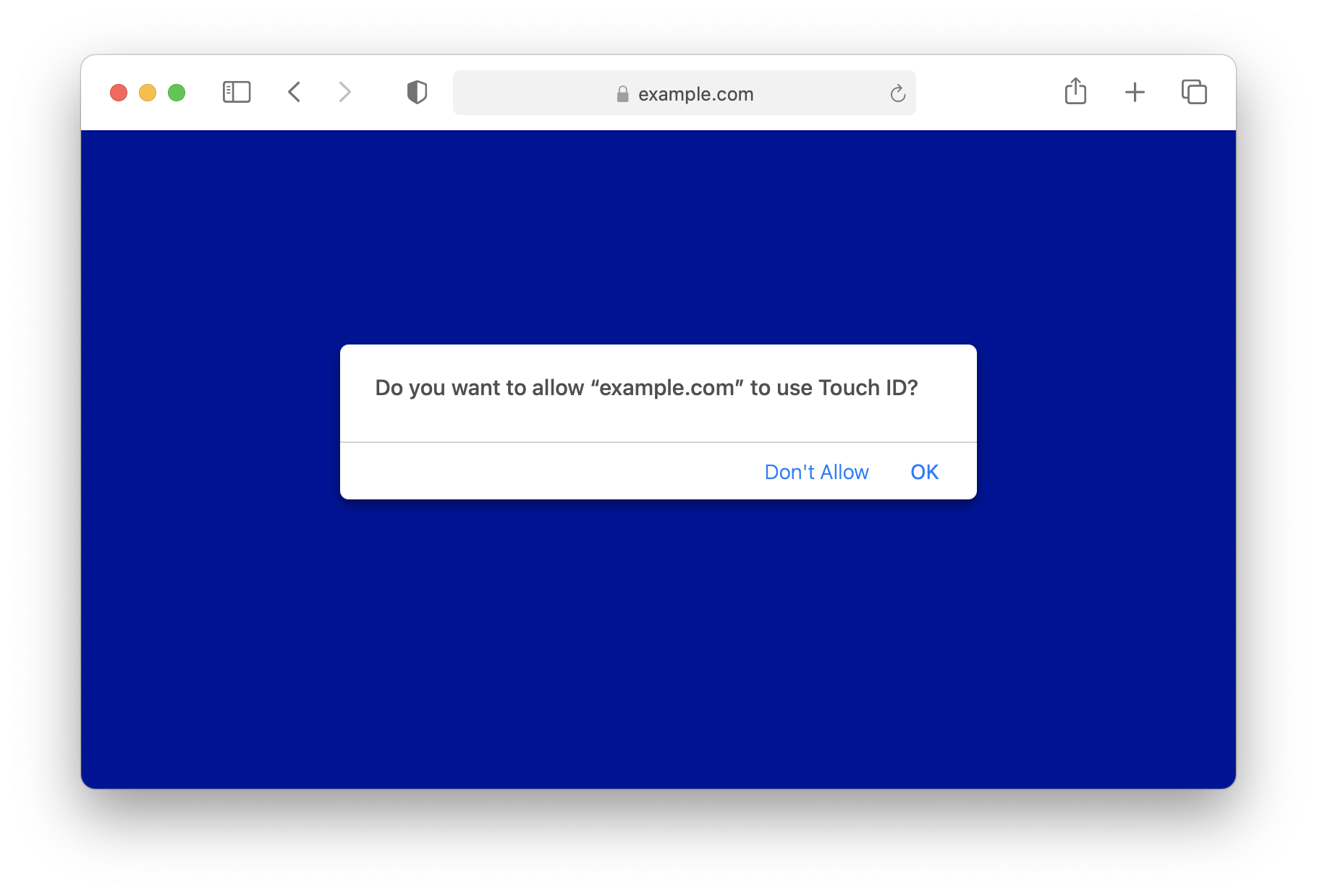
I would imagine most non-technical users aren't well-versed in how Apple's Secure Enclave (or other competing solutions) manage authentication, and so I wouldn't be surprised if "allow example.com to use TouchID" would give many the impression that the website is asking to access their biometric data.
Ideally, the prompt should reflect the actual model, though I'm not sure how one might pose that in an accessible and succinct way.
This is already a very common pattern on ios devices - every app that wants to allow touch or face ID based login uses such prompts, so users are used to it.
TouchID has a single failure mode (and a half) that isn't that common. Wet / dampness. Solution, dry your finger, try again. Gloves are the 'half' mode as what can you expect, you can't access the finger.
FaceID has no less than 3 FREQUENT failures and a myriad of other smaller less frequent ones. Occlusion, distance and light.
Occlusion - Have your face resting on your palm... fail. Have a hat on, fail. Have a mask on...
Distance is an interesting one, but for those of us with terrible eyesight, it is constant. Phone call / text at night? Put the phone up to my face to see... FaceID fail (too close). I have to move it back away so I can't read it to unlock... hoping it did unlock before I move it forward again to read it.
Light - This really shows up when outdoors in the sun. The IR sensor gets washed out and can't work. It isn't that bad, but it does happen frequently enough to notice.
The other thing that is SO annoying about FaceID is that is has no idea WHEN you want to use it... see a face 'I must SCAN IT!' Oh, that is someone else, now you are locked out and need your password. Pick up your phone, SCAN! Oh, that is your pocket, now you need your password. The latter can be turned off, the former, not so much.
I ALMOST bought an 8 instead of a Xs when I finally upgraded, but OLED pushed me over the edge. I do love the screen, but I scorn FaceID daily and was hoping for TouchId to return to the 12. Fingers crossed for the 13, lol.
I've been using Face ID since the xs, and so far my experience is, outside of mask wearing, much better than Touch ID. But I also try not to touch my phone when I'm out (and as such am wearing a mask). I even occasionally can't use Touch ID on my MacBook because of a damp finger, and that sees far less usage than the phone.
I think early on low light (or rather barely any light) was a problem, but I can unlock it in a dark room these days... not sure what that means for accuracy... but it works well.
These are definitely failure modes, but I would put them in the niche bucket.
I do miss Touch ID, but that had its own problems (gloves, wet fingers). So one would hope there is a solution that has both. I'd personally be just peachy with a fingerprint sensor on the back just like the Pixel line used to have. I mean, how much is a fingerprint sensor manufacturing cost? $5?
Under the hood, [bio]ID generates a one-time token with a signature that serves as a superior substitute to a password.
If your face or fingerprint don't happen to be around, you can always use the password for the same account to reset it. If you have legal concerns about being coerced into using a biometric system, you should disable it.
One of the problems "biometrics shouldn't be a password" is meant to expose, is that you can't reset a biometric if it leaks. By keeping the biometrics inside a device at all times, the T2 system substantially mitigates this risk. I'm fairly certain you can remove a device from your Apple account, and the ID system will no longer work, even if provided with your face or fingerprint.
Second, the primary threat identity providers (and their users) deal with are remote, impersonal hijacking of accounts, where the password is either guessed (because it existed in a leak) or the user was phished.
That's the primary value of something like this. Attacks where someone can lift your fingerprints or has your device are real but much much less common.
Think like this, when you go to visit your grandmother and knock on her door you don't have to provide a password. You don't have to provide anything, because the human brain is capable of determining your identity in less than a fraction of a second. This is why as soon as your grandmother opens the door she'll have a smile on her face and welcome you in. That IS biometrics. Now machines can do the same. It's the oldest and most secure form of authentication in human history.
1) A password is secret
2) You don't leave copies of it lying around everywhere
3) You can change it periodically
4) If discovered, it can't be traced back to you
No, biometrics can only be a username. It can never be an acceptable password.
Websites are not receiving your biometrics in this context, and your biometrics would be meaningless to the website if captured and somehow provided.
Your biometric signature is stored solely inside the Secure Enclave in the Apple device.
If and only if the Secure Enclave recognizes you via your biometrics will the Enclave uses a non-transferrable key stored only in the Enclave to attest to the website that you are the user "JoeAltmaier".
- The key is secret.
- The key is kept in only one place.
- The key can easily be discarded and a new one made.
- The key is never given to anything outside of the Enclave, so... I'm not sure how it could be traced to you, besides the whole fact that it is being used to authenticate you, which is necessary.
Sounds pretty acceptable to me as a password. The usability issue here is that a website needs to be able to accept a different password from each device you own, since the password is non-transferrable, and you might accidentally drop your iPhone to the bottom of the ocean.
Good news: FIDO2 is an entire standard built around this concept, originally intended for use on YubiKeys and similar FIDO2-compliant USB sticks.
Apple is building an implementation of FIDO2 that uses the iPhone that's already in the person's hand.
If the Secure Enclave is compromised (which does happen sometimes), then Bad Things could happen... but that's also what happens when a password manager tool is compromised.
If your view of fingerprint auth is "a picture of your face is the password" then of course it sounds stupid. It's actually "a face with the correct features attached to an alive human" which is much harder to fake.
The whole point of biometric auth and all the advancements in the industry are about correctly identifying alive humans and the strength of any system that uses biometrics is directly related to that. You can say current systems aren't good enough at this yet for your personal thread models but it's real security, and beats the hell out of a 4/5 digit lock screen passcode.
Biometrics are closer to a public key than a password.
Compare biometrics with identity:
1) Your identity is not secret. Your mother knows you, your entire school knows you, your neighbour knows you, when you go anywhere the police may ask for your ID at any time and knows you. Biometrics is the same.
2) You don't hide every day from the world. You don't cover your face (ok maybe before COVID) when entering a shop ;)
3) You cannot change who you are. You shouldn't have to and shouldn't want to. Same for biometrics.
4) If your identity is discovered then of course they know who you are. Same applies for biometrics.
So yes, biometrics isn't passwords, it's identity. Username + Password is a workaround to establish a person's identity and will never be as good as a biometric. The fact that you can have multiple usernames but only the same right index fingerprint is proof that biometrics is superior in establishing your identity than username + password.
What you’re describing is essentially using a fingerprint instead of a private key or password for logging into a server via ssh.
The way this works is more akin to using a private key to login via SSH, but that private key is protected by a fingerprint instead of a password.
Ultimately the security comes from not sharing your private key, rather than the mechanism used to protect that key.
It's straightforward to configure Active Directory / Group Policy to require biometric and password factors for interactive authentication.
The main reason not to allow _only_ biometrics is to disincentivize chopping fingers off (well, it's more because [it's still surprisingly easy to fool biometric systems](https://www.theguardian.com/technology/2014/dec/30/hacker-fa...)).
There are extremely high-security biometric auth systems that you would have a much harder time fooling. The high-res retina scanners that take a 3d map of your eye and detect blood flow would be a much better assessment of what's possible.
I'm not sure what the UX is when moving devices though.
If the machine can prove that you are indeed you through biometric authentication, why take another step for authorization?
Now, if biometric authentication becomes the norm, how will a wife suffering domestic abuse justify using a password?
However, I think touchID is susceptible to being robbed since if you have your bank account or Apple Pay enabled to transfer cash with touchID as authentication, then you can be robbed while you’re passed out drunk or roofied or whatever.
The code snippet elides two really important values: userIdBuffer and challengeBuffer. I get why - they're complicated and not very exciting to the intended audience. But they're also vitally important, so I think it would have been worth putting it non-zero effort.
userIdBuffer needs to be some sort of unchanging unique identifier for the user. Probably pick suitably large random values in an indexed table or something. It might be tempting to stick the row ID from your user table or similar in here, but that's actually a bad idea you'll likely regret.
challengeBuffer needs to be actual random bytes. Hey, the Javascript interpreter has... No. The random bytes need to be chosen fresh by the backend server where you're authenticating users. And they must be actual cryptographic quality randomness, not a Mersenne Twister from your utility library.
That would be a pretty quick and painless way to verify that I am, indeed, a human, with no unpaid labor involved.
This would mean being forced to use proprietary hardware or closed-source authenticators, because that’s the only way to control authenticator certificates.
Until you configure a 2FA device (TOPT in my case) they'll send you a temporary code to your email address.
So password alone is worthless, and mailbox ownership is verified on every login.
Also, I made a point never to use the "login with X" feature, no matter what X is.
I always sign up with my own email.
Case in point, I tried to log into Patreon earlier today, they insisted on sending a code, and it never arrived. I tried several times, no email. I have a record of every email sent to my address for the past several years regardless of spam status so I can be 100% positive they simply never sent it.
In the end I had to give up. I can't log into Patreon today, because of their insistence on sending me an email even though I'm logging in from a computer I've used many times before.
I am increasingly seeing failures where sites seem to be blackholing outgoing email, I suspect based on the destination domain, and unaware that they are even doing this / extremely insistent that they are not. I've gotten login-email failures like you describe from a couple of sites, and seemingly similar failures from those "email your kid this story" sharing systems on two news sites my mother uses. In all these cases, the messages simply never arrive at the destination SMTP server.
The outages have been affecting their authentication (login and sending emails) as well as the API.
Their status page is also very slow to update. This shows a fraction of the outages that myself and others have experienced. https://status.patreon.com/
I don't really recommend this setup, I'd really prefer to cut Google out of the path entirely, but I can't do that without abandoning my email address.
Fastmail Support claimed they never received any mail (ie it hadn't bounced) but DigitalOcean Support would insist I check my spam folder for the 500th time.
Ultimately, I just swore to never use their services, primarily because I... could never log in and actually use their services.
I think it's fixed nowadays but I wasted so much time on that issue.
the concern isn't what if the biometric data is leaked, because the biometrics are only used to allow local access to your phone. the concern is what if the private keys stored in your phone are leaked. and the secure enclave makes that as close to impossible as any other existing solution.
So, does my iPhone create a private key (which my Face ID data) on the phone itself, then the browser ask the phone to do something to authenticate the user? I am lost here.
To log into a website, your iPhone checks to see if your face is your face, and if it is then unlocks your private key to send it to the website. If it can't identify your face, then it won't enter your password.
Sending your actual facial data to a website would be bad because you can't change your face, so if you give your face to one site, then that site could use it to log in as you to other sites. But by just using it to unlock a private key, you (or apple on your behalf) can still change or de-authorize your private key, and use a unique one for each sites. Basically all the good practices you're supposed to follow when you use a password, and they aren't giving any site any special data that they could use anywhere other than their own site.
And if you’re targeted by individuals who are sufficiently motivated to steal your biometrics and the physical device, then neither the password nor the biometrics will be enough to protect you.
Because the password that the average user is using is shared among 100 sites and has been leaked 10 times over, and meanwhile there is nobody dusting their leftover coke can for prints.
See: https://www.macrumors.com/2018/12/16/3d-printed-head-android...
Article: "I was ushered into a dome-like studio containing 50 cameras [...] The final model took a few days to generate at the cost of just over £300."
I don't how that can be characterized as "easily." Possible, yes, but not easy. And it still didn't fool FaceID.
> 3D Printed Head Fools Android Face Recognition, iPhone X 'Impenetrable'
Like when someone takes your picture? Nothing.
Otherwise there is no way to login from any other device.
An alternative is that you can authenticate a new device from an existing device along with a re-auth on that device to verify it's them. Discord has a feature similar to this with it's QR login system.
Instead of with Yubikey where if the attestation key is compromised, and it is blacklisted, they disable every single last device manufactured with said attestation key.
all future attestations. U2F/webauthn doesn't actually provide a revocation mechanism.
> Instead of with Yubikey where if the attestation key is compromised, and it is blacklisted, they disable every single last device manufactured with said attestation key.
it is important to note that there is not a "the" attestation key. there are many. "disabling" one, to the extent that is even possible, disables only the group with that key.
So if an attacker tampers with the physical device, they can revoke the key for that particular device so that it is no longer trusted (the way I am reading it) vs yubikey where if an attacker has messed with one key, there is no good way to revoke attestation for that one device.
Attestation is a statement that the hardware and firmware are genuine, with the trust model being based on genuine hardware/software. You would not typically revoke anything - third party trust in that hardware/software combination would go away. That might be for example all iOS versions below 14.2, or all iPhones before the A14 chip.
If your service cares that much about key policy, you remember the attestations of each key so that you can change how they apply to security policy. That might be, for example, allowing someone to authenticate into a lower security level until they re-register the phone after upgrading their operating system.
In that sense, Yubico has a disadvantage in that their security policy does not allow firmware updates, so any firmware compromise will permanently tarnish those manufactured keys.
In that pre-announce video Apple dared to insinuate that attestation by current devices is de-anonymizing, when that isn't universally the case. And that their flavor of such would be "actually" privacy preserving. At the time, I figured this (a remote service) would be how they would address it, as the secure hardware probably doesn't have the burned in capability. Largely due to Apple needing to do it their own way.
Now of course, like the "normal" U2F attestation, this is private between the client and the service. But in Apple's case, like DOH, it is not private between client and Apple. IOW, a decrease in privacy, but marketed as an increase! LOL, classic Apple!
They go even further in their blind denial by stating:
> this approach avoids the security pitfall of Basic Attestation that the compromising of a single device results in revoking certificates from all devices with the same attestation certificate.
without recognizing or acknowledging that there is still a single point of compromise, but now it's a cloud service which many engineers have access to and presumably isn't 100% impervious to outsider attack either. So yes, it may avoid the single device security pitfall (resulting in a largish group of devices requireing to be revoked), but it trades it for an even bigger pitfall of all devices everywhere needing to be revoked!
It's sad that the reality distortion field has to be extended to privacy and security. Apple could easily just present their take on it without confusing the issues for the sake of marketing.
Further, it's up to the site to decide whether to use an anonymous attestation or not. The user will not be informed either way. With "standard" attestation, it's up to the user in their decision of what token (security key) to buy, and is always in effect. That said, a non-attested enrollment, if done correctly on the client side, doesn't give up privacy; just security.
To answer your question, it depends what you mean by "taking on". Yes, Apple is assuming some risk. They are not taking on any liability in the legal sense.
Most hardware devices use batch attestation, where some group of (say, 100 000) keys all get the same private key. This does still provide some data for correlating users based on make + model + batch of their authenticators.
ECDAA was meant to be an approach to solve this with pairing-friendly curves and crypto, but the industry stayed clear of this as an unproven algorithm.
Apple (and the rather similar SafetyNet approach by Google) use a service. The interaction between the device and this service is black-box and we do not yet know how much information is exchanged. By its nature, this service can change in the future and we will not know.
However, it _could_ be limited to an RSA or EC-based DAA attestation from the Secure Enclave, a curve point on P-256, and a SHA-256 hash value to embed. There's no reason Apple needs to know either the specific piece of hardware or the site a user is going to.
> Further, it's up to the site to decide whether to use an anonymous attestation or not. The user will not be informed either way.
Several browsers will give the user the option to not send attestation if a site asks for it, to the point where capturing attestations is a UX-impacting action. You could say the UX impact is intentional - not only do basic attestations leak some tracking information, but they limit user choice in how to authenticate.
In order to revoke a specific device without cooperation of the device itself, which is one of their advantageous claims, they do.
Disregarding that property, Apple needs to know that the "CSR", ie attestation request, is coming from the secure enclave. That means that the "CSR" needs to be signed by some key. If the CSR signing key is unique per device, Apple receives device-specific information. This can't be an ephemeral key, as there wouldn't be a chain back to the secure element. If OTOH the CSR signing key is shared, it is probably exposed, or at least accessible for malicious signing, via the now known T2 compromise. There is much to be gained by such an exploit, so this isn't merely a thought exercise.
This complexity is all avoided by on-device attestation. EPID or EPID-like scheme could have been used, vs batch attestation.
Honestly, Apple is derelict in not describing this in more detail. Had they not made claims, it would be ok. But they are directly claiming to be better. I think we can be 100% certain they are aware of this depth of detail internally. Apple is not amateur hour.
Disclosure: I work for Pramati Technologies which developed and owns ThumbSignin.
> Credentials can only be cleared for all via Safari > History > Clear History… on Mac Safari or Settings > Safari > Clear History and Website Data on iOS & iPadOS.
Edit: Oh. I guess the "for all" in the article mean that this only works if I clear the complete history for all sites? I did not try that.
Edit2: Cleared all website data. The two test accounts are still there.
It could just say "Touch ID to login" on the Touch Bar and wouldn't it be enough? If the user prefers otherwise, they simply won't touch. Doesn't the popup create extra friction (unless I'm missing something)?
I see a lot of confusion in the comments, so it is not just me. Why the article couldn't be simpler?
Maybe I am just stupid, I don't know.
I love technical content that does not shy away from from going in depth
If you want to see it in action you can try out a demo at https://webauthn.io
Authentication is something you KNOW. Strong authentication is something you KNOW, and something you HAVE.
Something you ARE is great for identification, but terrible for authentication. Something you are cannot be changed like a password.
And the courts can't yet force you to reveal secrets from your mind. But you can be compelled to use your fingerprint to unlock things.
I believe there is a hardware limitation that the MFI protocol only works over the lightning port and not the USB-C port, so they work for third party browsers on iPhone and not iPad Pro or the new iPad Air.
> Like Face ID and Touch ID for the web, security key support is available in Safari, SFSafariViewController and ASWebAuthenticationSession.
Sweet.
They already support this for things like FIDO hardware keys and other biometric hardware. It's also supported by Firefox.
Develop & give away a verifiable, open-source hardware & software solution for a silicon root of trust, with a focus on security through transparency[1]. Google will organize & make available the world's information on how to secure systems well.
Yes, this is intended for, among other uses, implementation of a FIDO2 universal 2-factor security key[2].
[2] https://github.com/lowRISC/opentitan/pull/1125/files#diff-6d...
That would surely be more awkward than using the already built in SEP and authentication system.
Bad actors can get your face and your fingerprint. Some of them already have it (governments, banks, Apple, Facebook, etc). And changing your face or fingerprint is practically impossible.
1. Have access to your phone
2. Be able to spoof the phone's authentication mechanisms (whether that be fingerprint / face)
In this regard, it passes the 2FA test (something that you own, and something that you are).
While it's true that you can't really change your face or fingerprint, this facilitates moving away from the "password repeated across multiple accounts" landscape of insecurity.
From an epistemological point of view: I don't know if they have it.
From a security point of view: they have your fingerprint.
Ultimately you do have to trust your platform if you're going to use a platform authenticator to some degree.
But the alternative in the FIDO2/webauthn space is something like a Yubikey which has no biometrics; it just takes a simple tap. And can be easily removed from your computer. So in that comparison, the fingerprint is purely additive security. Even if it's adding nothing to a serious adversary, it's still dramatically reducing risk to a less-skilled local attacker.
FaceID and TouchID both record any data they need in parts of the enclave that can't be used for anything else, and cannot be extracted. The information that they do store is not a picture, and cannot be reversed even in the case where someone does manage to get that data.
They have repeatedly documented how these features work.
Similarly touchid and faceid aren't sending your touchid/faceid data to a third party (because again, even if they wanted to, they can't), they're simply gating access to credential data on successful local authentication.
I shudder to think of a future where websites will have to implement some version of Apple's In-App Purchases program and give 30% of the revenue to Apple or else they won't be allowed to render on Apple devices.
Edit: I'm kind of surprised by the downvotes, given I thought HN was pretty big on personal privacy. Just thought I'd stir up the discussion, that's all.
Edit 2: I personally think U2F is the way forward here, not Face ID or Touch ID or other biometrics.
The main alternative to biometric ID is a PIN. Those are seldomly changed, and are relatively easily shoulder-surfed. I've seen children who can't even read yet learn their parent's iPad PINs. If you're afraid of the police, surveillance needs to be your threat model.
There's some ways to prevent being forced to use face unlock if you see it coming, by squeezing your phone: https://www.macworld.com/article/3236793/how-to-quickly-and-...
I think a strong password on my phone is important, rather than a simple PIN, given it's my second factor for nearly everything.
>To use Face ID, you must set up a passcode on your device.
>You must enter your passcode for additional security validation when:
>The device has just been turned on or restarted.
>The device hasn’t been unlocked for more than 48 hours.
>The passcode hasn’t been used to unlock the device in the last six and a half days and Face ID hasn't unlocked the device in the last 4 hours.
>The device has received a remote lock command.
>After five unsuccessful attempts to match a face.
>After initiating power off/Emergency SOS by pressing and holding either volume button and the side button simultaneously for 2 seconds.