1080 points · by antipaul · 6y ago · 1137 comments
https://news.ycombinator.com/item?id=25065026&p=2
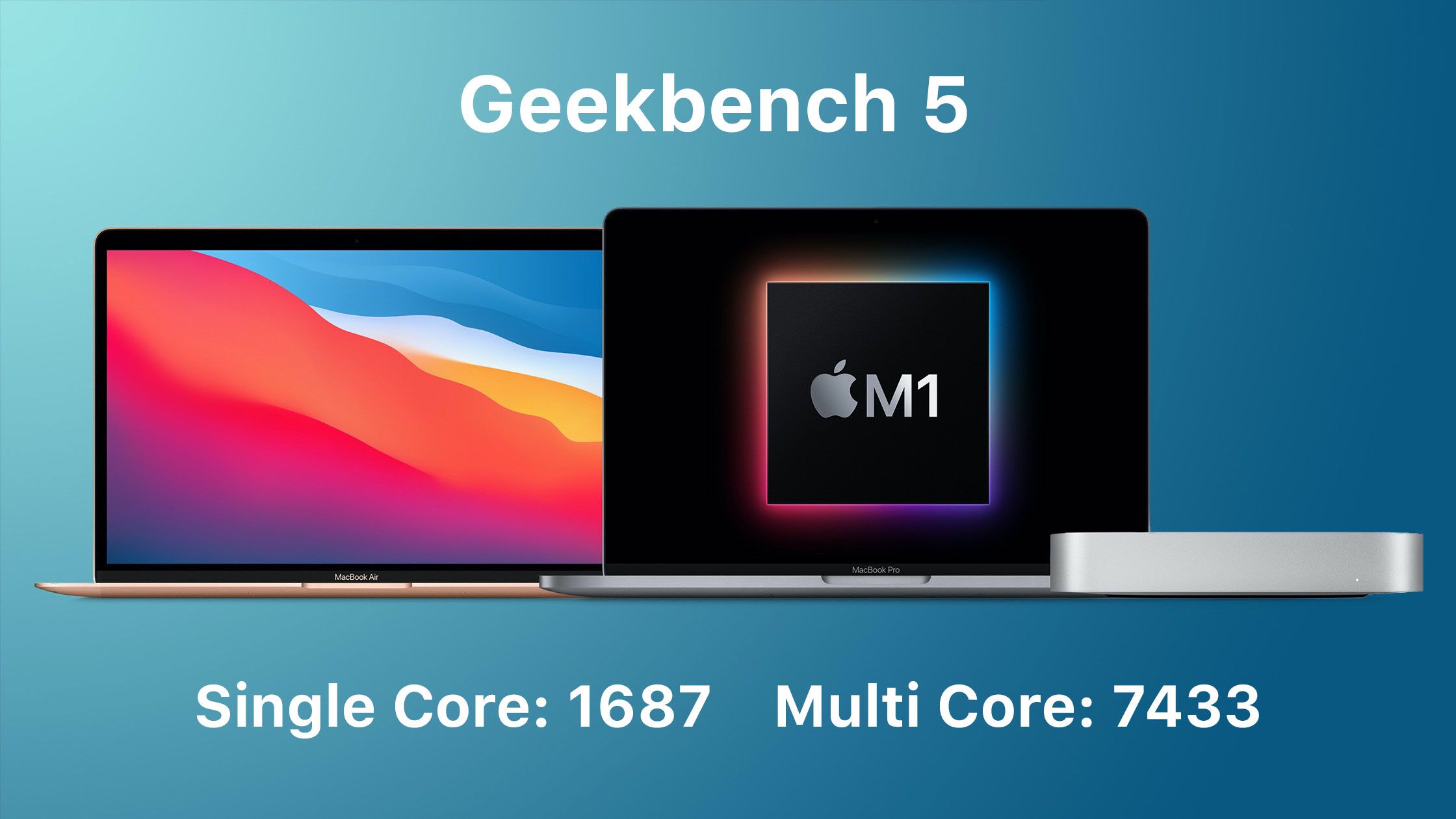
> The Mac mini with M1 chip that was benchmarked earned a single-core score of 1682 and a multi-core score of 7067.
> Update: There's also a benchmark for the 13-inch MacBook Pro with M1 chip and 16GB RAM that has a single-core score of 1714 and a multi-core score of 6802. Like the MacBook Air , it has a 3.2GHz base frequency.
So single core we have: Air 1687, Mini 1682, Pro 1714
And multi core we have: Air 7433, Mini 7067, Pro 6802
I’m not sure what to make of these scores, but it seems wrong that the Mini and Pro significantly underperform the Air in multi core. I find it hard to imagine this benchmark is going to be representative of actual usage given the way the products are positioned, which makes it hard to know how seriously to take the comparisons to other products too.
> When compared to existing devices, the M1 chip in the MacBook Air outperforms all iOS devices. For comparison's sake, the iPhone 12 Pro earned a single-core score of 1584 and a multi-core score of 3898, while the highest ranked iOS device on Geekbench's charts, the A14 iPad Air, earned a single-core score of 1585 and a multi-core score of 4647.
This seems a bit odd too - the A14 iPad Air outperforms all iPad Pro devices?
My guess: in geekbench air and pro score the same, because geekbench is shortlived and not thermally constrained. In cinebench you'll see the pro pulling ahead.
Of course the iPhone chip isn't as beefy as the M1, but the results still speak for themselves.
https://www.anandtech.com/show/16226/apple-silicon-m1-a14-de...
In this view, it's entirely possible that the Air simply did not have time to throttle before the benchmark ran out.
It's a useless benchmark, what I want to see is things like time to compile a bunch of different software, things that take long enough for the processor/cooling to reach thermal equilibrium etc.
I.e. stuff that more closely matches the real world
https://www.anandtech.com/show/16226/apple-silicon-m1-a14-de...
It's really only intended to be one of many benchmarks to tell the whole story; of course Linus would attack that because it doesn't make any real sense in his use and isn't the full story for him. If Geekbench was not tested, it would not cover the majority of computing uses and it would weigh cpus that had poor turbo or burst performance unfairly high for most uses.
Geekbench is kinda like 0-60MPH times and other tests (like SPEC2006) are like top speed I guess? The whole story is between them.
Why would anyone (who is not forced) buy an Intel PC laptop when these are available and priced as competitive as they are?
- locked bootloader - no bootcamp - can't install or boot linux or windows
- virtualization limited to arm64 machines - no windows x86 or linux x86 virtual machines
- only 2 thunderbolt ports
- limited to 16GB RAM
- no external gpu support/drivers - can't use nvidia or amd cards
- no AAA gaming
- can't run x86 containers without finding/building for arm64 or taking huge performance hit with qemu-static
- uncertain future of macos as it continues to be locked down
This is, arguably, a disadvantage of any Mac.
But Apple Silicon may actually improve the situation over time, as having the same GPUs and APIs on Macs and iOS devices means there is now a much bigger market for game developers to target with the same codebase.
Citation Needed.
Apple detractors LOVE to bring this idea up, but there's nothing to it in any real sense. Do Macs ship with a checkbox filled in that limits software vendors? Yes. This is a good thing. Is it trivial to change this setting? Also yes.
Anyone who buys a Mac can run any software on it they like. There is no lockdown.
I.e. "We raised the walls on our garden further"
Balls to that, if I buy hardware I want to be able to run what I want on it or it's not a general purpose computer, it's something else.
This has been a claim made about the Macs since the T2 chip came out. It was strictly false then (you just had to boot into Recovery Mode and turn off the requirement that OSes had to be signed by Apple to boot) and we still don't know for sure now. Apple has stated in their WWDC that they're still using SecureBoot, so it's likely that we can again just turn off Apple signature requirements in Recovery Mode and boot into ARM distros.
Whether or not that experience will be good is another thing entirely, and I wouldn't be surprised if Apple made it a bitch and a half for driver devs to make the experience usable at all.
>- virtualization limited to arm64 machines - no windows x86 or linux x86 virtual machines
True, but this isn't a strictly unsolvable limitation of AS and more like one of those teething pains you have to deal with, as it is the first-generation chip in an ISA shift. By this logic, you could say that make doesn't even work yet. Give it some time. In a few months I expect all of these quirks to be ironed out. Although, I suppose if you're concerned about containers it sounds like you want to be in the server market, not the laptop market.
>- only 2 thunderbolt ports, limited to 16GB RAM, no external gpu support/drivers, can't use nvidia or amd cards, can't run x86 containers without finding/building for arm64 or taking huge performance hit with qemu-static
See above about "give it some time".
>- no AAA gaming
I mean, if you're concerned about gaming, you shouldn't buy any Mac at all. Nor should you be in the laptop market, really. Although, this being said, the GPU in the new M1 is strong enough to be noted. In the Verge's benchmarks, Shadow of the Tomb Raider was running on the M1 MacBook Air at 38FPS at 1920x1200. Yes, it was at very low settings, but regardless – this is a playable framerate of a modern triple-A game, in a completely fanless ultrabook ... running through a JIT instruction set translation layer.
>- uncertain future of macos as it continues to be locked down
I disagree. I know we were talking about the M1 specifically, but Apple has shown that the future of ARM on desktop doesn't have to be as dismal as Windows made it out to be. Teething pains aside, the reported battery life and thermal performance on the new AS machines have been absurdly fantastic. I think, going down the road, we'll stop seeing x86 CPUs on all energy-minded machines like laptops entirely.
I thought Google, Microsoft, Nvidia, etc. were all pushing streaming gaming services that will run on any hardware with a decent internet connection. I would imagine the hardware video decoder in the M1 chip would allow 4K streaming video pretty well.
There are enough people who do not want to deal with MacOS and Darwin regardless the hardware specs.
Also the way of least friction is usually to use whatever the rest of your team uses. There are even relevant differences in Docker for MacOS vs Docker for Linux that make cross platform difficult (in particular thinking about host.docker.internal, but there are certainly more). Working with C/C++ is another pain point for cross platform, which already starts with Apples own Clang and different lib naming conventions.
Going away from x86 makes this situation certainly not better.
A walk in the part to anyone that had to deal with coding with C or C++ across UNIX flavours.
That said, my wife returned the macbook air she bought 3 weeks ago in favor of this new one, so I'll be able to test on that machine before I dive in.
Mark my words, this is going to be a massive shit show for people using those ecosystems, for 5 years if not 10. It already happened with the PPC transition.
“ fun fact: retaining and releasing an NSObject takes ~30 nanoseconds on current gen Intel, and ~6.5 nanoseconds on an M1”
https://mobile.twitter.com/hhariri/status/132678854650246349...
“…and ~14 nanoseconds on an M1 emulating an Intel”
as a power user I will not be touching anything apple ARM until all my hundreds of software apps are certified to work exactly the same as on x86_64. i will not rely on rosetta to take care of this. i need actual testing.
besides this, 8GB of RAM is how much a single instance of chrome uses. i run 3 chrome instances, 2 firefox and 2 safari. and this is just for web.
this could be a good time to jump the apple ship. it's pretty clear their focus is not their power users' focus.
as such i was looking into a lenovo thinkstation p340 tiny. you can configure it with 64gb ram and core i9 with 10 cores and 20 threads for less $$$ than what an underpowered 6 core mac mini is selling for.
Apple is at day 1 of their two year migration to Apple Silicon. Your judgement seems not just a little premature.
Their focus is not on power users ? They just completed the first, small, step of the migration to ARM. They only updated the very low-end models, those who were never targeted at power users anyway, and we're seeing that their cheapest, lowest-end models are whooping the i9 MBPro's ass.
Sure, the features and RAM may not be there yet, but again, these are the low-end models. If we're seeing this level of performance out of an MBAir or Mini. I can't wait to see what the Mac Pro is going to be capable of.
Depends on the definition of "power user". Music producers, video editors, and iOS developers will be served quite well.
> lenovo thinkstation p340 tiny. you can configure it with 64gb ram and core i9 with 10 cores and 20 threads for less $$$ than what an underpowered 6 core mac mini is selling for.
When making that calculation, one should also take power consumption into account. $ per cycle is very low now with the new CPU.
Let's back up a second: Tim Cook said this transition would take place over two years. This is just the first batch of computers running Apple Silicon.
I certainly hope and think that Apple can come out with a beefy 16 inch MacBook Pro with 32 gigs of ram within the next two years. Also, in that time I imagine everything in Homebrew would be ported over natively.
So for things like software development where you compile frequently your projects, the new Apple computers are a little slower than similar computers with AMD CPUs.
So even when taking only CPU performance into consideration, there are reasons to choose other computers than those with Apple Silicon, depending on what you want to do.
Of course, nobody will decide to buy or not buy products with "Apple Silicon" based on their performance.
Those who want to use Apple software will buy Apple products, those who do not want to use Apple software will not buy Apple products, like until now, regardless which have better performance.
That's exactly the reason why you would chose Apple Silicon right now where you can choose between Intel and Apple SoC. There are of course other reasons such as battery life and price.
I'm not an Apple fanboy, and I'm still very displeased with many of their decisions (touchbar being #1 on MBPs). But if you consider the packaging (small, light, sturdy, now-decent keyboard), and consider their performance, and then consider macOS, I think they are more than competitive.
Even if you match every spec, including size/weight and durability, it comes down to Windows vs macOS. Ironically, macOS is free while Windows is not, but macOS is worth more (to me and many others).
I'm not an Apple fan, but the change in value is stunning. I don't need a new laptop currently...
Plus there's the brouhaha about Electron apps.
I for one really wouldn't mind if Apple would build a native app to replace Electron apps, e.g. a chat app that works as a good client for (what I have open right now in Rambox) Discord, FB Messenger, Whatsapp and multiple Slack channels. Or their own Spotify client. Or a big update to XCode so it can use language servers for VS Code and it's viable to use for (what I do right now) Typescript, PHP and Go development.
They have more than enough money to invest in dozens of development teams or startups to push out new native apps.
One day I'll switch away from Chrome in favor of Safari as well. Maybe.
(I am taking recommendations for native alternatives to apps)
X86 code translated by Rosetta2 on the M1 retains/releases objects TWICE as fast as native x86 processors.
https://mobile.twitter.com/Catfish_Man/status/13262387851813...
For me atm thats a dealbreaker.. but I still want one
$1200 for the Macbook Air with 16GB RAM in USA. No touchbar, no garbage keyboard.
You might be better served by wiping it and installing Linux though
iPad pro - the current 2020 gen iPad pro has A12Z (essentially the same chip as 2018 A12X with extra GPU cores) - significantly older chip than A14. I think there will be an A14 iPad Pro refresh with mini led display in early 2021.
I see that statement a lot, and yes, at some point that is going to happen.
But the analysis seems to fail to take into account what utterly amazingly low power devices these chips are. So while it will happen, it might take a long time.
https://browser.geekbench.com/v5/cpu/search?q=Macmini9%2C1
https://browser.geekbench.com/v5/cpu/search?q=MacBookPro17%2...
https://browser.geekbench.com/v5/cpu/search?utf8=%E2%9C%93&q...
it looks like they're all in the same ballpark (i.e. the Air is not leading others, just comparable).
I also imagine not all customers are ready to jump on ARM day 1. Some will want to wait until the software ecosystem has had time to make the transition.
Seems pretty obvious to me that there will be another more higher end variant of the M1, though maybe the only difference will be the amount of RAM, the number of GPU cores, the number of supported USB4 ports or something like that, not raw CPU performance.
Either way, it seems obvious to me that the M1 is their low end Mac chip.
That will be interesting to watch.
Server farms are going to switch rapidly, one leading Mini server farm just announced a 600 unit starter order, and the CEO noted that Big Sur also made significant changes to licensing to make its use in server farms easier.
Apple released a killer low end SOC in the M1. It contains the highest performance single core processor in the world along with high end multi core performance. But it’s limited to 16Gb and two USB4/Thunderbolt ports, so it’s targeted at the low end.
When the M2 is released mid next year, it will be even faster, support four USB4/Thunderbolt ports and will also come in 32Gb and 64Gb versions.
Greatness takes a small wait sometimes.
I wouldn't buy a Pro now because I would wait for the next version, but I wouldn't trade a current Pro for a new Air just for the CPU bump...
Has an interesting comparison of an iPhone 12 mini doing similar work to an i9 iMac
Now I haven't dug into the details to verify both produced the same results. I believe most of the difference is from software encoding versus hardware encoding. the follow up tweets suggest similar output.
it does show how workloads can cause people to jump to conclusions on simply one test and not having all the details to support the conclusion they desire to arrive at
iPad Pro is still on an older generation of SoC (A12Z), while the iPad Air just got the new A14.
Well yeah, every year for the last bunch or years the A series of chips have had sizeable IPC improvements such that the A12 based iPad Pros are slower than the new Air. Apple's chip division is just industry leading here.
For what it's worth, I have a fully specced out 16 inch MacBook Pro with the AMD Radeon Pro 5600m and even with that I'm regularly hitting 100% usage of the card, and not to mention the fan noise.
Looking forward to a version from Apple that is made for actual professionals, but I imagine these introductory M1 based devices are going to be great for the vast majority of people.
cf. Anandtech article from 2003:
I've become something of CPU collector in recent years, and I have a nice line of p6 cpus from thePentium Pro -> Pentium 2 -> Pentium 3 -> Pentium M -> Core 2 that conveniently sidesteps those awful Netburst p4 CPUs.
It feels like this (p6+) microarch has finally run out of road and needs a rethink. What 'saved' intel was a change in philosophy rather than chasing MHz they chased power savings. And with Apple's new chips that history is repeating itself (and appears to be with a similar outcome).
It's an exciting time for hardware again because Intel and AMD are going to have to react to this and I think there's still legs to x86, it's survived everything thats been thrown at it so far...
Also, some one, some day, had to disrupt it. Maybe this is it, maybe not.
I bought i486DX for $20 month ago, as a memo of my first CPU.
[1] https://www.anandtech.com/show/12689/cpu-design-guru-jim-kel...
Edit: hadn't clicked through to your article. my comment is redundant
https://www.macworld.com/article/3572624/tsmc-details-its-fu...
And it's doing this while using more than an order of magnitude less power (10W vs. a TDP of 125W for that Intel part).
That's stunning.
That's the wrong conclusion to make. For instance, the Lenovo ThinkBook 14s (with a Ryzen 4800u) with a 15W TDP posts the same Geekbench multicore scores [1] as the M1 Macbook. But the ThinkBook isn't in any way faster than the top-end iMac for real world compute intensive tasks.
The M1 certainly looks efficient, but there's little you can conclude from a single benchmark running for a very short period of time.
And it’s 45% slower in single core.
Most importantly, the M1 is estimated to cost Apple $65, the 4800u is a $300+ part.
That said, it's promising and I'm really curious to see where this development will lead to in a few years' time.
iOS/iPhones/iPads already smoke every other device in running javascript. Apple Silicon may end up being the best thing to ever happen for Electron apps.
Does the M1 performance have to be ramped down during sustained use due to exceeding thermal envelope of the fanless MBA? Of the fan’d MBP?
We’ll know soon enough!
Nevertheless, because Apple has chosen to not increase their manufacturing costs by including more big cores, the multi-threaded performance is not at all impressive, being lower than that of many much cheaper laptops using AMD Ryzen 7 4800U CPUs.
So for any professional applications, like software development, these new Apple computers will certainly not blow away their competition performance-wise, and that before taking into account their severe limitations in memory capacity and peripheral ports.
My XPS15 regularly throttles and sounds like it’s about to take off.
By the way, “throttling” refers to CPU _slowing down_ despite cooling working at full capacity, so loud fans in itself isn’t one.
e: Another way to explain thermal throttling would be “thermal fading”, like brake fading on a car. Whether brake fading is considered a design fault or a feature that allow bursts of stronger brakes is semantic.
Thin and light is great for short bursts of activity, but, when you need sustainable heavy usage, you'll need a bigger computer, even if it's just to have a bigger heatsink.
https://www.reddit.com/r/macbookpro/comments/gs6bal/2019_mbp...
We have no idea what the M1 would look like. Though it's likely. I imagine they wouldn't have taken the fan out of the Air if that was a big concern.
It will be very interesting to see what the performance will be of the more "pro" chip that overcomes those limitations that they'd put in the 16" and iMacs
I wonder if that includes AirPlay screens, or just wired.
Doesn't seem very "pro" to me. The MBP16" intel has 4 x USB-c ports, can drive two monitors, and can have >= 32GB ram.
But regardless of professional requirements, "Pro" in Apple's product line just means "the more expensive slightly better version." Nobody's arguing that AirPods Pro are the wireless earbuds of choice for people who make money by listening to wireless earbuds.
I'm a Sofwware Engineer / pro photographer / videographer.
I sling code from time to time, edit thousands of RAW files from my cameras and edit together 1080p footage day in and day out.
I did that for years on a 2013 MBA with 8GB of RAM. Now I have a 2015 MBP with 16GB of RAM. It's perfectly adequate.
Again, what definition of "pro" are you using, and how is that relevant to professionals with other occupations?
The two limit seems to be for 6016x3384 which I assume is 5k.
I still bet on the i9, but it'd be interesting to run a test.
Anandtech's deep dive provides several examples of advances in Apple's core design that didn't involve magic or breaking the laws of physics. For example...
Instruction Decode:
>What really defines Apple’s Firestorm CPU core from other designs in the industry is just the sheer width of the microarchitecture. Featuring an 8-wide decode block, Apple’s Firestorm is by far the current widest commercialized design in the industry. Other contemporary designs such as AMD’s Zen(1 through 3) and Intel’s µarch’s, x86 CPUs today still only feature a 4-wide decoder designs
Instruction Re-order Buffer Size:
>A +-630 deep ROB is an immensely huge out-of-order window for Apple’s new core, as it vastly outclasses any other design in the industry. Intel’s Sunny Cove and Willow Cove cores are the second-most “deep” OOO designs out there with a 352 ROB structure, while AMD’s newest Zen3 core makes due with 256 entries, and recent Arm designs such as the Cortex-X1 feature a 224 structure.
Number of Execution Units:
>On the Integer side, we find at least 7 execution ports for actual arithmetic operations. These include 4 simple ALUs capable of ADD instructions, 2 complex units which feature also MUL (multiply) capabilities, and what appears to be a dedicated integer division unit.
On the floating point and vector execution side of things, the new Firestorm cores are actually more impressive as they a 33% increase in capabilities, enabled by Apple’s addition of a fourth execution pipeline.
https://www.anandtech.com/show/16226/apple-silicon-m1-a14-de...
This seems like a really cool piece of technology, and I'm kind of bummed that everyone is so cynical and pessimistic about everything these days (albeit understandably so).
As another datapoint Ian (of Anandtech) estimated that the M1 would need to be clocked at 3.25Ghz to match Zen 3, and these systems are showing a 3.2Ghz clock: https://twitter.com/IanCutress/status/1326516048309460992
You can check the clock speeds: https://browser.geekbench.com/v5/cpu/4620493.gb5
Up to 5050MHz is stock behavior for the 5950X and it's using standard DDR4 3200 memory.
M2, M3... that is when I think we will see stellar performance against things like Ryzen.
Now things are settled a bit I thought may be it isn't as bad as I thought . Had the MacBook Air Priced any lower, it would have seriously hurt their sales of 16" MBP. Once MacBook Pro transition to ARM, with a rumoured of Mini-LED Screen refreshed as 14" and 16". ( MingChiKuo has been extremely accurate with regards to Display Technology used on iPad and Mac ) So MBP wont be lower in price but offer more features ( Mini-LED is quite costly ). And possibly an M2 with HBE? I am not sure how Apple is going to coupe with the bandwidth requirement. It would need to be LPDDR5 Quad Channel at 200GB/s or HBM2 if we assume M2 will double the GPU core again.
May be only then Apple could afford to offer a MacBook 12" at $799. And educational price at $699. Although I am not sure if that is enough, Chrome Book in many classes are going at $299. Apple doesn't have to compete dollar to dollar in pricing, but 2X difference is going to be a hard battle to fight. But at least it would allow Apple to win key areas in Education market where TCO and Cost are not as stringent.
May be Apple will do just one more Final update for some Intel Mac like Mac Pro ( At least I hope they do for those who really need an x86 Mac )
Oh M3 in 2022, Still within the 2 years transitional period, I think we are going to see a 3nm monster Chip for Mac Pro. When Intel is Still on their 10nm. And I think 2022 is when we will see an Apple console. Cause I dont think the Mac Pro Monster SoC volume is enough for its own investment. Some other product will need to use that, and Game Console seems like a perfect fit. ( At least that is how I could put some sense to the Apple Console rumours )
Apple is already doing quite well in the low-end education market with the base model iPad. These are competitive with Chromebooks on price. They also do a better job of replacing paper with Notability or GoodNotes and open up project opportunities with the video camera. Most kids seem to be fine with the on-screen keyboard, but that part is not ideal without an external keyboard/keyboard case.
Apple often has 2-3 future generations in development. This was just the first complete design they turned into a product.
That RAM design, tho...
I’m excited for whatever is next.
In the market, I think M1 systems will not alienate Apple-app-only users (Logic, Final Cut, Xcode-for-iPhone development) and may attract some purely single-page-application users.
Mostly, Zoom call efficiency will drive its broader adoption this year among the general population. If the Air is fast, quiet, and long lasting for Zoom calls, it will crush.
I won't buy one. I have a 32GB 6-core MBP that will satisfy my iOS dev needs until M2 (and a clearer picture of the transition has developed). But I might start recommend Airs to the folks sitting around our virtual yule log this year.
It'd be more surprising at this point if it _wasn't_ more powerful.
I hope your comment is sarcasm :P
>Whilst in the past 5 years Intel has managed to increase their best single-thread performance by about 28%, Apple has managed to improve their designs by 198%, or 2.98x (let’s call it 3x) the performance of the Apple A9 of late 2015.
https://www.anandtech.com/show/16226/apple-silicon-m1-a14-de...
It's almost certainly better per watt, which I'd expect because the 5950X (and the 6-core 65W TDP 5600X, which also tops the MBA multi-core Geekbench result) are still desktop processors.
I use Mac at work, but Linux at home, if the hardware isn’t competitive....
- Given that you can't add ram after the fact and 256GB is anemic the cheapest laptop that is a reasonable choice is $1400.
- The cheapest desktop option is $6000 with an 8 core cpu or 8000 with a 16 core.
- The average end user spends $700 on a computer
- We literally have marketing numbers and a worthless synthetic benchmark.
I think it entirely fair to say that the new macs are liable to be fantastic machines but there is no reason to believe that the advent of apple cpu macs marks the end of open hardware. Were you expecting them to sell their cpus to the makers of the cheap computers most people actually buy?
Not really. The M1 may objectively and factually be a very good CPU, but it comes bundled with the cost of being locked into a machine with a locked bootloader and not being able to boot any other OS than MacOS.
And many people will find such a cost unacceptable.
The 5950X cores are actually reasonably power efficient. Anandtech has nice charts here: https://www.anandtech.com/show/16214/amd-zen-3-ryzen-deep-di...
TL;DR is that 5950X cores draw about 6W each with all cores loaded at around 3.8GHz per core. They scale up to 20W in the edge case where a single core is loaded at a full 5GHz.
> And the M1 is running at a lower clock.
Comparing a power-optimized laptop chip to an all-out, top of the line desktop chip isn't a great way to compare efficiency because power scaling is very nonlinear. The AMD could be made more efficient on a performance-per-watt basis by turning down the clock speed and reducing the operating voltage, but it's a desktop chip so there's no reason to do that.
Look at the power consumption versus frequency scaling in the Anandtech chart for the 5950X: Going from 3.8GHz to 5.0GHz takes the power from about 6W to 20W. That's 230% more power for 30% more clockspeed. Apple is going to run into similar nonlinear power scaling when they move up to workstation class chips.
If you really wanted to compare power efficiency, you'd have to downclock and undervolt the AMD part until it performs similarly to the Apple part. But there's no reason to do that, because no one buying a top of the line 5950X cares about performance per watt, they just want the fastest possible performance.
Comparing to an upcoming Zen3 laptop chip would be a more relevant comparison. The Apple part is still going to win on power efficiency, though.
Almost like they are completely different CPUs with completely different design goals...
This is the first of their CPUs. The iMac will almost certainly be running a higher end CPU which at the very least supports more RAM. It's likely the 16" MacBook Pro and the higher end 13" MacBook Pro will share a CPU with the iMac the same way the Mac mini and the MacBook Air share a CPU.
EDIT:// sorry, i misread/skip the "chip" part.
Also notice this result is using clang9 while the MacBook results are using clang12. I assume clang12 has more and better optimizations.
Doing it while not burning lots of Watts and being energy efficient is what Apple aims for.
And I doubt that AMD and especially Intel will offer an alternative here soon. Desktop yes, but not on mobile.
You can see all Air results so far here: https://browser.geekbench.com/v5/cpu/search?q=MacBookAir10%2...
1.5x single-core perf.
M1 MacBook Pro vs Intel MBP (top specs) show same performance: https://browser.geekbench.com/v5/cpu/compare/4652718?baselin...
Likely because GB5 doesn't run long enough to trigger thermal throttling on the M1 MBA.
M1 is beating all CPUs on the market in single-core scores: https://browser.geekbench.com/processor-benchmarks (M1 at 1719, vs AMD Ryzen 9 5950X at 1628).
Anandtech on the memory-affinity of GeekBench vs SPEC:
> There’s been a lot of criticism about more common benchmark suites such as GeekBench, but frankly I've found these concerns or arguments to be quite unfounded. The only factual differences between workloads in SPEC and workloads in GB5 is that the latter has less outlier tests which are memory-heavy, meaning it’s more of a CPU benchmark whereas SPEC has more tendency towards CPU+DRAM.
2. Even if he didn’t need it, why assume he didn’t want it?
3. Why are you assuming that money is an issue for him?
Many don't even want to pay for the MacBook Pro's Touch Bar and many will probably see an Air's fanless design as an advantage over Pro, even if its CPU is throttled a little more often in sustained high CPU workloads. Complete silence is just that good. And it's going to be so much cheaper.
I think the star of the show yesterday was definitely the MacBook Air.
Current (and presumably future) macOS does this and you can’t turn it off, except with Little Snitch. New APIs in macOS 11 means that Little Snitch will no longer be able to block OS processes, so it will require external network filtering hardware.
I’ll likely end up with Linux on the 16”, and use the new one for things that are not secret/private.
https://appleterm.com/2020/10/20/macos-big-sur-firewalls-and...
Looks like it will be impossible to use Apple Silicon (without external network hardware) without revealing your track log to the CIA. How cool is that?!
Jonathan Morrison posted a video [0] comparing a 10-core Intel i9 2020 5K iMac with 64GB RAM against an iPhone 12 Mini for 10-bit H.265 HDR video exporting and the iPhone destroyed the iMac exporting the same video, to allegedly the same quality, in ~14 seconds on the iPhone vs 2 minutes on the iMac! And the phone was at ~20% battery without an external power source. Like that is some voodoo and I want to see a lot of real world data but it is pretty damn exciting.
Now whether these extreme speed ups are limited to very specific tasks (such as H.265 acceleration) or are truly general purpose remains to be seen.
If they can be general purpose with some platform specific optimisations that is still freakin' amazing and could easily be a game changer for many types of work providing there is investment into optimising the tools to best utilise Apple Silicon.
Imagine an Apple Silicon specific version of Apple's LLVM/Clang that has 5x or 10x C++ compilation speed up over Intel if there is a way to optimise to similar gains they have been able to get for H.265.
Some very interesting things come to mind and that is before we even get to the supposed battery life benefits as well. Having a laptop that runs faster than my 200+W desktop while getting 15+ hours on battery sounds insane, and perhaps it is, but this is the most excited I have been for general purpose computer performance gains in about a decade.
[0] https://www.youtube.com/watch?v=xUkDku_Qt5c
Edit:
A lot of people seem to just be picking up on my H.265 example which is fine but that was just an example for one type of work.
As this article shows the overall single-core and multi-core speeds are the real story, not just H.265 video encoding. If these numbers hold true in the real world and not just a screenshot of some benchmark numbers that is something special imho.
Generally, HW encoders offer worse quality at smaller fie sizes and are used for real-time streaming, while CPU-based ones are used in offline compression in order to achieve the best possible compression ratios.
That is a big deal as it means Adobe, Sony, BlackMagic, etc. will be able to optimise to levels impossible to do elsewhere. If that 8x speed up scales linearly to large video projects you would have to have a Mount Everest sized reason to stick to PC.
A large body of encoding software is however, perfectly capable of taking advantage of them.
The comparison is kind of silly.
First of all, adding this hardware encoder to the Apple Silicon chips definetly has a cost, and you pay it when you buy their products.
Second, there are Intel CPUs available with hardware encoders (google Intel QuickSync). The only difference is that you can choose to not pay for it if you don't need it.
Dedicated HW for specific computing applications are nothing new, back in the 90s you had dedicated MJPEG ASICs for video editing. Of course, they became paperweights the moment people decided to switch to other codecs (although the same thing could be said for 90s CPUs given the pace of advancement back then).
Thing is, your encoding block takes up precious space on your die, and is absolutely useless for any other application like video effects, color grading, or even rendering to a non-supported codec.
Incidentally, this is philosophically the idea behind processors with built in FPGA capability. The hardware acceleration would just be a binary blob that could be loaded in and used when necessary. It could be continually updated, and provided with whatever software needed it.
Now, the thing is: intel's AVX512 instructions are supposed to accelerate this sort of work, but in practice they are getting lapped by the T2 chip. That signals that apple's ability to tune hardware designs to the needs of content creators is greater than intel's.
I think I would be excited if it were not built by Apple. That functionally means it’s only going to be in Apple products at a 300% markup.
We could even compare some cross platform apps across both OS and cpu and see how the total package performs.
https://www.anandtech.com/show/16226/apple-silicon-m1-a14-de...
And then there is the OS which is getting more and more locked down so that you can not run unsigned software without increasingly difficult workarounds.
On one hand, alternative OS support on macbooks has gotten worse and worse over the last few years but it is sad to see the final nail in the coffin.
Locked bootloader only booting stuff signed by Apple.
So these CPUs can only be used to run MacOS, no Linux or other alternate open platforms.
Gotta take their 30% cut of everyone's revenue.
This isn’t risk free, issues having to do with supply and process and frankly geopolitics can cause problems. But it looks like they’re off to a good start.
i was hoping for a good ios opensource replacement, i guess now i'll soon have to wait for a good laptop competitor as well.
I feel like i'm stuck in a jail made out of gold.
"Rosetta is meant to ease the transition to Apple silicon, giving you time to create a universal binary for your app. It is not a substitute for creating a native version of your app.”
https://developer.apple.com/documentation/apple_silicon/abou...
It's not really Apples to Apples (even if it is in name), so to speak.
I'm testing on is the 2019 core i9 2.3 ghz. Apple "Genius" bar tells me this is expected, no replacement in warranty. Maybe the 2020 is better, but after getting this as an answer I wont be buying another apple macbook.
The prior 2018 Core i9 Apple MacBook Pro had previous issues with insufficient power supply to the CPU core (this might be fixed, but I can't even sustain it due to thermal throttling, so I can't really tell).
Last thing I need is a MacBook Air equivalent with an unnecessarily loud and annoying fan.
If anything, it's a bonus to have the fan so your can have prolonged boost performance while the MBA chip will throttle under continuous load.
I think I would rather take a small performance hit and some heat than have Apple quick to pull the trigger with a fan blasting noise as I’m trying to focus (if yield comparable stats).
Will wait for more info. If this chip is really that much more efficient hopefully we are back to the good old days where MBP fan is tolerable. Otherwise I’m all in on Air
So happy Apple is dumping Fantel chips
Apple no longer sells computers. You can rent some shiny gizmo from them to run software of their choosing provided by people they deign to allow on their platform and in a manner they approve of¹. It's not really yours anymore.
¹ "But you can still do X". Well, and last year you could still do W, and the year before that V.
They could do that because they've been selling overpriced products.
This doesn't excuse years behavior not respecting their customers on (price + performance) divided by bugs.
https://www.realworldtech.com/forum/?threadid=136526&curpost...
https://www.realworldtech.com/forum/?threadid=185109&curpost...
Personally I'm not convinced, until I see something like SPECint/SPECfp results.
https://www.anandtech.com/show/16226/apple-silicon-m1-a14-de...
I’m also interested in seeing what M1 can do once people get their hands on real hardware running on Mac OS where so many more details can’t be hidden like in iOS, but all signs point to it being an absolute monster.
This is an interesting thing to say considering that 1. most apps on iOS use large dynamic libraries and 2. Apple silicon Macs run on 16K pages, just like iOS.
The more interesting thing is the power efficiency, which doesn't have that much impact on single thread performance because higher power CPUs don't actually use their entire power budget for a single thread. But that's an impressive multi-threaded score for that TDP. It gets stomped by actual desktop CPUs for the obvious reason, but it has better multi-threaded performance than anything with the same TDP. Though that's also partially because the low-TDP Zen 3 CPUs aren't out yet.
What I'd really like to see is some benchmarks that aren't geekbench.
New MBA has a 1719/6967 on gb 5.3.0
I'm just making sure everyone understands that it does not mean Air will have the same real life performance as Pro or Mini. If you compare top MacBook Air 2020 (Intel)[1] with lowest MacBook Pro 2020 (Intel)[2] their results are almost identical, but their real life performance was not even close - Air starts to throttle after just few minutes of work. At the moment there is no reason to believe that Apple's CPU will behave differently (after all, the fan is in Pro and Mini for a reason).
[1] https://browser.geekbench.com/v5/cpu/4652268 [2] https://browser.geekbench.com/v5/cpu/4653210
Power/thermal management looks very good - low heat and long battery life without sacrificing performance.
Presumably the Air will have to throttle performance for some workloads, but not in this benchmark apparently.
I wonder what the world is going to be like when companies own entire stack including all hardware (even things like cameras and displays) and applications (including app stores).
There is going to be no competition as any new player would have to first join an existing stack that keeps tight grip and ensures competition is killed off before gaining momentum.
So, basically, dystopian future with whole world divided into company territories.
Until Intel stops making huge amounts of money, I'm not sure, as a company, they're in huge trouble. Apple isn't going to be selling the M1 to other companies and other companies have proven they don't have the mettle to spend what Apple is spending to make chips like this. Really, AMD should be a little worried since they have some counterparty risk getting all of their chips made by TSMC. At least Intel controls their own production.
Chip fab is probably a short term risk but not a medium long term one, as the situation with Huawei has made it very clear to world governments that having competitive chip fab capabilities is incredibly important from a geopolitical power point of view. I would expect to see significant investment by various governments in the next ten years into addressing it.
(If you have a proven skillset in that area and no particular ties to the country you live in I would look into buying a yacht.)
source: https://finance.yahoo.com/news/intel-now-ordering-chips-tsmc...
By buying stock you say: I believe the company is going to be better than the market thinks it is going to be.
this is what some of the intricate systems related to technological progress and markets we're dealing with converge on, yes.
In these terms, I'd rather look at this with a different perspective: the platforms are becoming more mature.
Think of it as an organism; there is nothing natural about outsourcing the control flow of your own components. My intuition for natural design would be something along the lines of microservices (like our biological organs), organically defining the greater entity they themselves form (the company).
Apple is just one illustration of systems getting out of control. Think of international politics, or edgecases in financial markets. Our systems didn't escape us, because they were never truly under control.
Therefore, this isn't dystopian. It is dystopian from a reference frame within wich you claim to have control, but you don't, and you never had. To exercize any control over technological and economic progress is _way_ beyond our individual scope, by a margin of at least one level of abstraction.
Instead, this is a transition from one system (one with decentralized and autonomous components (subcontractors et al)) to the next (one with organic components).
Within our current game, that feels dystopian, but that won't matter, because it won't be the same game anymore. Iteratively, that is.
> If you still own any Intel stock it is probably good time to dump it.
The market already has the information you have, so it is unlikely that your evaluation of Intel's expected future profits is significantly better/more insightful that others'.
This is religion
Intel can still do as many mistakes as they feel like it, and AMD better hold on to their game console deals.
Those are supposed at just as much of a disadvantage compared to the new Apple Silicon Air and Pro.
That's where shock comes in.
my only pb are the smears on the screen, otherwise i think i'll keep it for another 7 years.
AMD Radeon Pro 5600m memory bandwidth is 394.2 GB/s (2048 bit HBM2)
https://www.techpowerup.com/gpu-specs/radeon-pro-5600m.c3612
- All M1 models only have 1 Thunderbolt Controller, thus can only handle 2 Thunderbolt ports on all announced models so far.
- All M1 models only support 1 monitor, but up to 6K.
- No M1 model supports >16GB of RAM or 10GB Ethernet.
All of the above seem like bandwidth limitations to save cost that a future "M1X" or "M2" or "X1" would be extremely likely to fix, and that's where you'll see the bandwidth increase.
Where did you find this? In the Macbook Pro 13 landing page I find the specs per Thunderbolt port which states the display capabilities for each while not restricting anywhere to just one monitor.
So I'd would expect 1x monitor per Thunderbolt port leading to total 3 displays for the Pro ARM model: one internal and two external displays. I assume the restriction you refer to just applies to the Air model.
> Simultaneously supports full native resolution on the built-in display at millions of colors and:
>
> One external display with up to 6K resolution at 60Hz
For laptops, you can use an external dongle. It has its uses, like for a NAS on a 10G network for video or other data-intense work.
- An 8x cdrom narrowly beats 10meg ethernet.
- 1x dvdrom narrowly beats 100meg ethernet.
- ATA133 narrowly beats 1gbit ethernet.
Original SATA is 1.5gbit, so 1Gbit ether bottlenecks us to 1999 storage speeds.
It's an apples and oranges comparison. The M1 GPU is an integrated solution targeted at the cheapest Macs. The 5600M is external GPU targeted at $4000+ top of the line Macs.
There's no reason that higher end Apple silicon machines can't also use external GPUs like the 5600M (after development, of course).
Actually, very, very few tasks on a desktop can stress a CPU enough to saturate the bandwidth on a single task.
Proper HPC programs written to have absolutely zero cache misses can. A javascript eating 1GB of RAM to show some text, and pictures, cannot.
And even the raw GPU processing power AMD Radeon Pro 5600M is 5.274 TFLOPS vs M1 as Apple rated 2.6 TFLOPS
It's a downgrade in GPU processing power for the user.
That said, I am definitely waiting for at least one generation to pass before I jump on the train.
I’ve been through this before. It will be great, but Apple is a master at smoke & mirrors. Things will not go as smoothly as the sizzle reels make it seem.
I think their new architecture will be awesome. Personally, I look forward to being able to debug iOS Bluetooth apps in the simulator, and I think some of the new form factors will be pretty cool.
But I can’t help but notice the current dearth of AAA apps that are already universal.
A transition like this is a big deal; especially if you have an app with thousands of function points, as it requires a complete, top-to-bottom re-test of every one.
In the unlikely case that you won’t find issues, it will still take a long time. Also, most companies won’t bet the farm on prerelease hardware; instead, using it to solve issues. They will still need to test against the release hardware before signing off for general distribution.
Also, I have a couple of eGPUs that I use. I don’t think the new architecture plays well with them.
I’m hoping that the next gen will obviate the need for them. They are a pain.
Docker still doesn't run on Apple Silicon Macs, so the migration path is already disrupted here.
Many use cases, especially when it comes to microservices can almost always better served by something else
https://browser.geekbench.com/v5/cpu/compare/4654605?baselin...
Opinion: Pretty and impressive story
https://ark.intel.com/content/www/us/en/ark/products/130411/...
Mid-2015 15" MacBook Pro vs MacBookAir10,1 https://browser.geekbench.com/v5/cpu/compare/4643216?baselin...
Hence why in that multi-core result the 4c Intel is way closer to the 8c M1 than it "should" be.
I’d love to see one of these go head to head compiling a large project etc.
Which makes it even more impressive.
https://browser.geekbench.com/v5/cpu/compare/4306696?baselin...
Single core similar and multicore 50% better for MacBook.
https://browser.geekbench.com/macs/457
M1 is comparable to baseline Mac Pro on multicore performance and better on single core performance. And several thousand dollars cheaper (and smaller).
Assuming they can build it (and they have implied that they can scale their silicon designs up in terms of cores, power, and clock rate), an Apple Silicon Mac Pro will be a pretty interesting machine.
If they wanted to, Apple could even bring back an Apple Silicon powered Xserve, or the legendary, mythical, modular desktop Mac (I know, now we're in the realm of pure fantasy, but one can dream.)
Given their performance/watt, this sounds like it could be potentially game changing.
The Vega II is even faster (but quite a bit more expensive).
https://browser.geekbench.com/macs/mac-pro-late-2019-intel-x...
If you want to make an apples to oranges comparison that’ll really be the one to make.
You can certainly choose to view this as a step towards bolstering the walled garden... but my money is on Apple wanting to innovate and knowing that they can. Vertical integration does a lot for efficiency, cost, etc... as well and not just keeping people in your walled garden.
People forget: Apple has been shipping their own silicon for years. If you had stellar cpus you could make in house, wouldn’t you rather use them instead?
That is my point. Now EVERYTHIN is in the M1 chip. Nobody will be able to fix it, not even Apple.
How is Apple so far ahead even with the same instruction set?
Apple is ahead because they have more money than Arm, Qualcomm, Samsung, etc. combined.
This feels like once again Apple is 5 years ahead of competition just like when iPhone came out.
Apple is a vertical. They own their market, so the investment has more predictable returns.
Single customer. Apple can optimize directly for iOS workload and consider nothing else.
Intel sells into the general market and has to hit sometimes conflicting goals so that Dell, HP, Lenovo, etc. will all buy their chip.
I'm not a fan of Apple's domineering business strategies, but this SoC is impressive. I have to imagine AMD and Intel will follow up with something similar (a tightly integrated SoC aimed at higher performance applications).
Intel, Qualcomm, Microsoft - all have to build products that work for the lowest common denominator. Loss of focus is a major problem.
Apple has a handful of products. One OS. One developer platform.
This kind of agility is extremely powerful. They can switch fabs whenever it makes sense. They can switch ISAs whenever it makes sense.
Contrast with Microsoft, that has to support so many hardware platforms. They’re not helping themselves with so many software frameworks - Win32, WinRT, .NET, MFC, WinJs? I’ve lost count.
Intel is handicapped stuck to their process nodes.
Qualcomm, while they’ve effectively captured the mobile SOC market, they too have the same problem. They can’t control what handset makers do. So they can only go so far.
Apple can make a single CPU core and mix and match that with variations. Things get a lot easier if you just have to deal with yourself e2e - even as far as retail sales.
And any thoughts and expectations around using the (fast?) M1 Mac Mini for web and java dev?
I'm right now getting frustrated with my company's lead times ordering a new HP Zbook laptop. (Its not like I particularly want the Zbook, its just that's what devs get here.)
But I'm a remote home worker, and I'm thinking "M1 Mac Mini available next week. Its like 1/3rd cost of a high end laptop and probably outperforms it, and is silent...?"
- openjdk is being ported to the new hardware but it's not there yet. I'm not sure if it works with the emulator; or how well.
- if you use anything by Jetbrains, like I do, you'll likely have to wait for them to use that and package up a new release. It's a resource hog as it is and emulation is not going to improve things probably; assuming that works at all.
- things like android studio that rely on virtualization for running simulated phones will likely need upgrades too; but since the emulated hardware is arm that should be doable.
- things like docker which most server side developers like me won't work until Docker releases an arm version. Then the next problem is going to be that the vast majority of docker images out there are x86.
- If you are a web developer and want to test on something else than safari, you'll have to wait or accept worse performance of chrome, firefox, edge, etc. in emulated mode.
- pro hardware with >64GB; 16 GB is a non starter for me. I upgraded to that in 2014. I'd frankly want that dedicated to GPU memory in a modern setup. If you are a pro video or graphics user; I imagine those are not strange requirements. If your workflow involves third party tools and plugins that are x86; I'd wait a couple of years before even considering. Long term, this could be great; short term it's going to be rough depending on what you use.
- Also nice would be for things like opencl (Darktable) and games to work. I have a few steam games and X-plane. I expect that Steam Mac is going to be once more decimated. With the last release 32 bit games stopped working. Essentially all of the remaining games are x86 only. I look forward to seeing some benchmarks of how these are running under rosetta 2; but I don't get my hopes up. I'm guessing, Apple is looking to unify the IOS and Mac gaming ecosystem instead and is actively working to kill off the PC gaming ecosystem on mac. This will be an app store only kind of deal. Likewise, if they finally make moves in VR, it will be ARM and app store only.
So in short, for me it doesn't make sense to upgrade until most of that stuff is covered. None of it is impossible but it's going to take some time. I would be in the market for a 16" x86 mac pro but of course with this transition, long term support for that is very much going to be an afterthought. I might have to finally pull the trigger on a move to Linux.
So add dozens of tabs open in a couple browsers, maybe a VM or 2 and 16GB or ram is going to be insufficient.
But this is different. There's the convenience factor here. How far does M1 have to go before commodity DL training is feasible on commodity compute, not just GPU?
You will see much higher specs on the Mac Mini Pro, MacBook Pro 14/16 and Mac Pro planned for next year.
Video editing's all done on disk isn't it? It's not like editing programs are loading a 20 GB file into memory?
Even just 8 GB has never given me any problems with video editing.
What am I missing here?
It's just that... swapping data in and out of ram is far slower than clock speed, right? So if the bottleneck is RAM, would it make sense to get the most RAM? (ie: Intel Mac)
I'm using Tableau Desktop in my daily work and until it is available on this new platform - these Macs are not an option for me even if they are 10x more performant. I guess there are a lot of professionals that are constrained in a similar manner. So we will see if M1 is adopted in such scenarios at all.
Final Cut Pro is one of the options for the new Macbook, on the item's page.
Apple lead the fray again, it's incredible.
Here is the image: http://www.cgchannel.com/wp-content/uploads/2020/06/200623_A...
For GCC targeting arm64 macOS, the dev branch is at https://github.com/iains/gcc-darwin-arm64/ currently.
For Rosetta, everything runs except virtualisation apps.
I’m not sure if it supports it immediately, but this isn’t a difficult change, so it will certainly come soon.
Wouldn't it be awesome if Apple's CPU/IC design segment became a separate company and sold these CPUs and maybe SoC by themselves?
I think that would make a big dent into AMD/Intel market shares. Since Apple's part/die should be quite a bit smaller than most of the x86 dies, the fab costs should also be smaller and so should the final price.
This thing ONLY EXISTS in the first place because of Apple's continual vertical integration push, and because other parts of the business were able to massively subsidise the R&D costs necessary to come up with a competitive SOC in an established market that's otherwise a duopoly. If their CPU/IC design segment were its own company, the M1 would never have seen the light of day. Period.
Furthermore, this chip is not meant to be a retail product. It's optimised for the exact requirements that Apple's products have. The whole reason why they're able to beat Intel/AMD is because they don't have to cater to the exact same generic market that the established players do, but instead massively optimise for their exact needs.
I genuinely don't understand how can anyone who wishes to break up Apple not see that these things?
Eh, that's some very biased thinking.
In the real hardware world of both mechanical and electrical. I can approach a company and say "we want something with these specs, we'll buy 10 million pieces per month, what can you do you us?" and that kicks off R&D efforts after some ground contractual agreements to commit both parties.
You know, exactly what Microsoft did with AMD when they commissioned unique SOC designs for their consoles with a host of never before implemented features such as direct gpio <-> ssd io.
This seems pretty grounded.
> The whole reason why they're able to beat Intel/AMD is because they don't have to cater to the exact same generic market that the established players do, but instead massively optimise for their exact needs.
I'm less convinced of this. Their exact needs seem to be making laptops... and so these chips would make interesting candidates for other laptops, if split off from Apple.
It's never going to happen, and an independent company might struggle for R&D money, but if these prove to be better laptop CPUs there is a market there.
Everything from the memory model, to the secure enclave for TouchID/FaceID, to countless other custom features, are parts that other SOCs do not need to have present on the die, and cannot optimise for.
For good or bad, this is truly a piece of engineering that could only have come out of Apple.
It doesn't make much sense for the Macbook Pro to have a lower score than the Macbook Air.
Assuming it is sampling error?
Intel is now #3
Check out for example the per core power charts that Anandtech does: https://www.anandtech.com/show/16214/amd-zen-3-ryzen-deep-di...
Compare for example the 1 core power numbers between the chips. The 5600X 1 core result is 11w @ 4.6ghz, whereas the other two chips boost higher and hit 4.8-4.9ghz 1 core turbos, but it costs 17-18w to do it. Huge increase in power for that last 1-2% performance. So you really can't or shouldn't compare more power-concious configurations with the top end desktop where power is infinite and well worth spending for even single digit percentage gains.
And then of course you should also note that the single-core power draw in all of those is vastly lower than their TDP numbers (65w for the 5600x, and 125w for the 5800x/5900x).
On my 10980xe it will cause the CPU to reach peak temperatures for 30s or so but only during specific workloads. Typically those utilising AVX-512.
And the GPGPU: https://browser.geekbench.com/v5/compute/compare/1800719?bas...
Also the i7-1165G7 is a 12-28w part, configurable by the OEM. I'd assume the XPS 13 is running it at top spec, but that'd also need validation.
I'll be interested to know how much active cooling and binning real do for Rustc or LLVM compilation times.
I'm hoping the rest of the PC market benefits from this increased market for ARM compatible desktop software. ARM has less of an issue with patent encumbrance and more competition. Desktop CPUs could get a lot cheaper in the future if ARM Windows and ARM Linux get more use as well as Mac.
(In case you didn't know, you can run ARM Windows now (sort of unofficially, you'll need to google)! App support is a bit spotty, but it can also run 32 bit x86 apps through a translation layer (why it's limited to 32 bit I don't know, I guess it's easier to do?))
Edit: The Switch is ARM too, so there's a reason for some AAA games to come to the otherwise small market too.(for traditionally Console/PC games, I'm aware mobile gaming is a huge market, it's just not one I find to produce much quality output)
From Apple’s somewhat uninformative slides, we should expect peak power draw around 15W? The A series draws half that for > 90% monocore performance, so scaling seems on target.
So can anyone comment on how we should interpret these benchmarks:
a) Across the various Mac models (i.e. why buy a pro vs the air vs the mini). If they all benchmark the same, what am I paying the difference for?
b) The M1 chip vs a ryzen desktop (naively interpreting this its punching up near a 5950X, which seems TGTBT?). How do these chips compare against the larger TDP competitors if portability and batteries aren't an issue?
b2) Compared to the AMD mobile chips? (i don't have much insight into these)
c) someone else on here posted a Tiger-lake intel chip benchmark beating the M1. Now that makes even less sense to me now, because now there's an intel mobile chip beating the top of the line Ryzen desktop?
Help out an honestly confused individual.
The pro and the mini have fans so they should be able to maintain these speeds for longer than the air which will presumably have to throttle down as it heats up.
These types of results make me hopeful for the future of Apple hardware. I've always been a huge fan of OSX, but I was pretty sure this MBP would be the last Apple laptop I would buy. Looking forward to being wrong.
IMHO it is reliable across different Arch/CPU/OS.
https://www.realworldtech.com/forum/?threadid=185109&curpost...
I just ordered the new silicon MacBook Pro and I fully expect to record a full album on it using Logic X. As presumably Apple rewrote it from the ground up for the silicone, I expect to be absolutely blown away.
Excited because x86 has been stagnant for years. I'm not an EE but my understanding is that its a pretty messy architecture with lots of "glue and duct-tape" fixes.
Nervous because, although x86 had flaws, since pretty much everything ran on it allowed for more open environments and development practices & fewer walled gardens.
I am not at all an expert in this field so my remarks are based on my own observations and performance benchmarks from experts in the industry. For example, this graph from Anandtech shows the stagnation (or at least slow improvements) in x86 performance gains while performance gains from Apple have been massive.
I'm looking for those 2% computers "in the same class" (from the apple keynote 2 days ago) that are faster than these M1 laptops. From the looks of it they surpass their Apple store siblings, but how about x86 PC laptops? I'm currently shopping for my next dev machine, in the lighter side of the form-factor.
I've seen some name-dropping here and in other threads, like HP Zbook and Lenovo, but I'm completely out of the loop since I moved to a fully specced i7 2014 Macbook Air back in the day and.
I'm starting to wonder if Apple's "faster than 98% of PC laptops" is an understatement, at least within its class.
I think Geekbench 4 reported memory latency, but it's not in v5. Does anyone know of a benchmark of this directly?
> fun fact: retaining and releasing an NSObject takes ~30 nanoseconds on current gen Intel, and ~6.5 nanoseconds on an M1
> …and ~14 nanoseconds on an M1 emulating an Intel
https://mobile.twitter.com/Catfish_Man/status/13262384342355...
I won't be replacing my workstation this weekend but then, I won't be updating it to Big Sur just yet either. I am getting a new personal machine sometime in the next year though I don't imagine I'll be buying an Intel Mac.
Everyone is on Xcode these days and using much higher level frameworks. Adobe and Microsoft already announced early 2021 availability of native binaries.
Besides, Rosetta 2 is even more impressive than the original was. I’m betting it will be a breeze. 6 months in and almost everything will be native.
https://developer.apple.com/documentation/apple_silicon/abou...
[1] https://browser.geekbench.com/v5/cpu/search?q=MacBook+pro+16
Last time I read, Windows ARM version isn't ready for everyone yet not to mention there's no transition kit at all for everyone to move.
Why would anyone use Windows anymore unless your infra site needs IE?
[1] https://www.extremetech.com/computing/315733-64-bit-x86-emul...
[2] https://www.microsoft.com/en-us/surface/business/surface-pro...
I can see Unreal Engine not being available for Apple Silicon for quite a while. During the presentation of the new notebooks, Apple showed quite a bit of gaming. If there are no Unreal Engine titles for Apple Silicon, this could hurt them.
Single thread: 1015 Multi thread: 7508
M1 is far ahead of the 3.2Ghz Xeon in my machine single threaded and I suppose having double the cores(vs M1 Hi-po cores) helped me in that respect. The fact that I paid 5 grand vs a ~1500 dollar portable is not lost on me here...
While we're there we may as well a bunch more cores...
Something “previously not possible on a portable” specific to Apple’s other strengths.
A future MacBook with an M2 chip will be an even better buy, and software availability will be even better.
MacBooks are due for a new industrial design, so it makes sense to wait. If you absolutely need a new computer, that's a tricky place to be right now.
Hopefully they'll reverse that decision. (or their GPUs in the higher end machines will have to be really good)
You need to be competitive on single thread performance to have a chance at datacenter. Amdahl's law is still very relevant. Up until very very recently, the CPUs were not up to par.
The air is basically 50% faster... incredible.
Funny how he is more ambitious about genetic algorithms.
https://www.microsoft.com/en-us/surface/business/surface-pro...
But Apple absolutely dominates:
https://browser.geekbench.com/v5/cpu/compare/4648107?baselin...
And whilst they are under NDA you do often see them running anonymous benchmarks like Geekbench.
2020: "I'll build a Hackintosh, its slightly cheaper"
They could be identical, and the choice is just different thermal envelopes. Active vs passive cooling can make a huge difference for some work loads.
Would love to see a non-Intel chip + OpenBLAS beating out Intel + MKL
Interesting times.
How much thermal paste are they planning to use on these things?
so now they only have to fix their OS and their keyboard or just revert to the versions from 8 years ago.
Everybody throws the term around and no two people have the same definition! What in the world is an actual professional? There are professional journalists that just need a browser and text editor. There are professional programmers working on huge code bases in compiled languages that do need a beefy machine, and there are professional programmers that just need a dumb terminal to ssh into a dev machine in the cloud.
And then of course what the largest subset of people seem to mean is professional video editors or content creators. What percent of the working population are video editors? Some tiny fraction, how did that become the default type of professional in the context of talking about computers?
And then a lot of things that people also complain about like how replacing the wider variety of ports with usb c or thunderbolt is contradictory on a “professional” machine also don’t really make sense. Professionals can use dongles like anyone else. In fact many professionals will have more specific needs that require a single a way, for instance having a builtin sd card reader doesn’t help a professional photographer using cfexpress cards.
I would say that generally, a "professional" user of pretty much any tool, is someone for whom the tool's quality is a constraint on their professional productivity.
A professional paint user is an artist. A professional telescope user is an astronomer—or a sniper. A professional typewriter user is a stenographer. A professional shoe user is an athlete.
In all these cases, it's the quality and innovation in the tool, that's holding these professionals back from being even better at their job than they already are.
Also, take special note of the case of the stenographer: professionals often require special professional variants of their tools, which trade off a longer learning curve for a higher productivity ceiling once learned. A stenographic keyboard takes years to learn, but all non-stenographic keyboards cap out at 150WPM, while stenographic keyboards allow those trained in their use to achieve 300+WPM.
And to make one more point: a professional car driver isn't a race-car driver. A professional car driver is a chauffeur. Rolls-Royce's cars aren't famous for how luxurious they are to drive; they're famous for having all the amenities needed by professional drivers — chauffeurs — to allow them to efficiently cater to their clients' needs. Limousines are the same kind of "professional tools" that stenographic keyboards are: they increase chauffeuring productivity.
> How did [video editing] become the default type of professional in the context of talking about computers?
Because all tech vloggers and most tech pundits — the people who review tech — edit videos as part of their jobs, of course ;)
Never met a single engineer who didn't want faster build/test cycles.
If I’m a professional driver, but my passenger likes being discreet for example, then maybe I drive a Camry instead of a Rolls Royce. In your case, you probably don’t need a professional-grade laptop.
Me however, also a professional programmer, I run about 10 docker containers, a big ide, and lots of other hungry programs. I definitely am less limited when my computer is faster.
Programmers have to deal with compilation wait times, lack of RAM slowing down workflows, network latency, etc. We have to wait for the computer to do their job.
I await the day that I won't have to deal with this and computers would be as fast as our train of thought(human input latency nonwithstanding). But I won't hold my breath.
You can be a professional, without being a professional user of all your tools. In fact, for any such tool, there's probably only one or two professions that are professional users of that tool specifically (i.e. where that is the tool that constrains their productivity.)
Many professions aren't constrained by any tools, but rather are constrained by human thinking speed, or human mental capacity for conceptual complexity. These people aren't "professional users" of any tools. They're just regular users of those tools.
So, to sum up — when a tool is described as being "for professionals", what that means is that the tool serves the needs of people who are members of a profession whose productivity is constrained by the quality of that tool. It doesn't mean that it's for anyone who has a profession. Just people who have those professions. They know who they are. They're the people who were frustrated by the tool they have now, and for whom seeing the new tool elicits a joy of the release of that frustration. An "ah, finally, I can get on with my work without [tool] getting in my way so much."
-----
Programming is a profession that is most of the time constrained by thinking speed. (Although, some of the time, we're constrained by grokking speed, which is affected by the quality of the tools known as programming languages, and sometimes the tools known as IDE code-navigation.)
Very little time in a programmer's life is spent waiting for a build to happen, with literally no other productive tasks that they could be doing while they wait.
(Someone whose role comes down solely to QA testing, on the other hand, tends to be a professional user of CI build servers. Faster CI server? More productive QA.)
Obviously it depends greatly on what kind of software you are writing, but at all my dev jobs, I eventually end up waiting for some amount of time while the CPU heats the room up.
Notably, VIM is inevitably more gentle on my CPU than VSCode and similar.
Now, I can say hey if you get one of the new macbooks / mac minis, you can run your iphone apps natively. He probably will be one of their first customers.
I wouldnt be surprised if there was a huge 'professional' market that is untapped. not the traditional professional market but the ones which want something as simple & familiar as a iphone, on a desktop.
e.g. In this definition, if you use a PC at your office and a laptop at home for non-work stuff, your work PC is being used by a "professional" and your home laptop isn't.
Think about it: the M1-based MacBook Air has better CPU and graphics performance than Intel-based laptops—including Apple’s—that are targeted at professionals.
[1]: https://daringfireball.net/2020/11/one_more_thing_the_m1_mac...
The point is not a professional using a computer, it's a professional computer user - someone who doesn't just use a computer to do their work, but someone for whom the limits of the computer are the limits of the work they can do.
It comes from an era when computers were so genuinely slow that doing almost anything - even using page layout like Pagemaker, or setting up just a single track song in a DAW, had tons of render lag. Even spreadsheets would take significant amounts of crunch time to run their calcs, in the very early days. This meant that most work done on computers, with anything larger than a "toy/hello-world" dataset, was going to be painfully slow. That's why they called it "professional" - because you were actually using datasets large enough to burden the beast. Actually balancing a whole company's finances with a spreadsheet, rather than tallying up a little 10-item list.
I want to emphasize that "majoritarian" aspect of it - it wasn't just a few specific kinds, it was a majority of ALL kinds of work.
And that's changed.
We're now at a point where only a tiny minority of tasks done on computers actually have throughput limits based on the computer rather than the operator.
They get outsized influence because they're the ones that make the shiny youtube reviews (using their video editing skills).
In this context, a professional is someone whose productivity is limited by the power of the computer. A developer compiling large code base on their computer. A person doing video editing. These are examples. And maybe “professional” is the wrong term, but I think that is what people are aiming for when they use that word in this context.
For most people their ability to use the computer is the blocker. This also involves the ability yo make sane file format/compression decisions if they work with graphics or video.
People also regularly misplace their importance and prevalence in industry. For instance, you see more Linux than Mac in the big color and VFX houses.
It's important to trust and value your tools, which is how prosumers generally feel about their Macs, and they do make nice frontends for the computers that perform the actual work.
I suspect the M1 powered Macs will be hugely successful and very useful for multiple types of users.
(And the small storage, but that can be remedied with a NAS or other external storage, and then fast local scratch space only needs to be big enough for a couple of projects at a time)
In particular with Luma Fusion.
Most of the working population could get away with using basically any computer - if you're marketing a computer as 'Pro' you're talking to a specific subset of that. (Or you're just banking on it working as aspirational marketing and don't actually care about professionals)
I was just calling out the idea that professionals being a small portion of literally everyone is a useful argument to make. How many markets aren't?
I think it’s because youtubers like linustech etc are the type of people who review these laptops, they live in their bubble that only “real” professionals are those who edit videos.
And that's just web design.
Now open your eyes and look around your room. Everything you see was designed by someone, most likely on a Pro.
Pro to me = Provides more power. That's it.
Looking forward to the next MBP
Well, that is an easy question - actual professionals are people involved in making, marketing and distributing porno
Wouldn't it be easier to just create standard pagination links at the top of the comments page, rather than manually forcing a mod to post this "list of pages" comment on each and every article?
1) there is a more link at the bottom of the page, Dan started making these comments because the UI is too subtle and a lot of people miss the link
2) I believe that he’s said they are working on performance improvements so that all the comments can be shown on a single page to solve the problem completely.
The real prize is getting the software fast enough to just render entire pages again, which is what it did for most of HN's existence.
Apple, it's been good knowing you, time to move on.
They don’t want to discourage developers from using their machines because guess who works on MacOS? Developers using Macs.
Can't any other customer of ARM do the same thing, in principle?
Although it's worth remembering the m1 is just Apple's CPU for their low-end machines. They haven't announced their high-end 13" & 16" MacBook Pro, iMac and Mac Pros.
Also, I know Electron has a history of high-memory, but right now my Slack client is currently running at 500MB and my VS Code windows (3 projects) at < 1.5GB.
And even though my current MBP16 is spec'd at 64GB RAM, I don't think 16GB would probably feel all that slow these days.
But consider:
1. Apple just introduced their “starter” chip for everyday consumers. They would not WANT that chip to smoke their top-end Intel Macs, as it would cannibalize margins until the more powerful chips are ready.
2. This is a “two year transition,” with a team that has been shipping a meaningfully better chip every 12 months for about a decade.
From those two observations, I would expect that we’ll see an M1x or M2 chip in the next 12 months which nudges the 16”MBP to 20% or so better than what we’re seeing today, and 12 months after that the transition is completed with the introduction of the M3 series, where there’s an M3, M3x, and M3z for the low, mid, and max performance machines.
And when that happens, I expect the max-performance M3z is going to smoke anything else on the market.
This is not the first time Apple has had a “five-year lead” on the industry, and I wouldn’t be surprised if it takes Intel and AMD some time to catch up.
And frankly we should all be thrilled about that, because more competition and innovation is just going to accelerate our entire field. I can’t wait to see all the new stuff this will power over the next decade :)