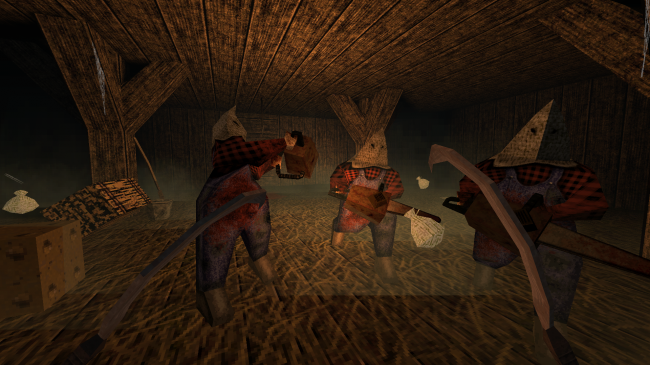
Dusk is how you make a '90s shooter for today
Dusk is a love letter to games like Quake and Doom, inspired by both Lovecraft & 90s PC shooters. It's being developled by one man from his teenage ideas.
Killscreen
158 points · by pmarin · 6y ago · 108 comments
I tried Unreal Editor a few years ago. The engine is really impressive, there's a ton of assets, high res textures, it's easy to create a natural looking terrain, but then bringing it to life is hard work and takes skills. Everything I built looked clunky, out of place, lacked details, lighting seemed off, it was rubbish. Minecraft fixes this problem. Everyone can build good looking stuff.
x100 this. Quake 1 was terrifying for me even though the pixelated graphics are poor by todays standard because my imagination would fill in the blanks making things feel way more scary.
Just take a look at these pixelated creatures. Coupled with the soundtrack from NIN and Trent Reznor and the gothic atmosphere they feel way scarier to me than what came after like Doom 3 or even Dooms of this decade. I don't now why but the recent Doom games just look a bit too cartoonish for me and not scary at all.
http://retrovania-vgjunk.blogspot.com/2017/10/the-creatures-...
I think perhaps the biggest reason why Doom 2016 and Doom Eternal don't feel "creepy" like the old games is because they are completely missing the point. The newer games are fun, beautiful, well designed games. However, instead of making a game that captures the essence of Doom its more like a Michael Bay version of Doom. Instead of desperately fighting never ending hordes of increasingly horrifying creatures from hell so you can get out in one piece and save the world, you're an unkillable demigod that's basically dunking on armies of demons for lulz. The whole way the story makes it seem like its a foregone conclusion that you've won. Its not a struggle, its just you punishing the hordes of hell that are powerless to stop you.
Aesthetically they nailed the look of the creatures although as you pointed out less can be more. The sound track is good but at some point the composer was consumed by his own pretentiousness (IMO Dusk's composer that replaced him produces far better "Doom" music). The combat is fun and if it wasn't a Doom game it would still be rightly lauded as one of the best shooters of the generation, but glory kills annihilate the flow of the game IMO and detract from any authentic feeling it may have had. Glory kills feel like shortened, dumbed-down quick time events that you're supposed to spam the entire time you play and quick time events always feel bad.
They are some of the best single player games I've played in years, but I was there with Id since the Commander Keen games and this does not feel like a Doom game to me.
I mean its literally a Doom game, but the franchise has clearly lost something and I feel like a lot of the people that preach about how authentically they captured the experience might be too young to have bothered to play it.
Doom II: Hell On Earth is IMO one of the top 5 games of all time. Quake 1 is also on the list. I hope some day we get proper remakes or spiritual successors that capture not just the aesthetic, but the feel and the point of the original games.
Dusk was a decently sized step in the right direction.
People flipped out when Doom 3 ended up being low light horror game and not a fast paced shooter.
Heck the lore of the Doom is that the protagonist is the 'Doom of demonkind'. Its the game where you are not locked in room with demons but they are locked in room with you.
> you're an unkillable demigod that's basically dunking on armies of demons
That is the 100% the core idea of Doom lore.
Tldr: The doom marine was entangled with 'hell' and at some stage was tricked that his dead son could be brought to life by a some demon deal - he came back as twisted undead. Doomguy got really angry and his anger propelled him to destroy all that is hell.
> They are some of the best single player games I've played in years, but I was there with Id since the Commander Keen games and this does not feel like a Doom game to me.
I have some mixed feelings about Doom Eternal as it sometimes feels like a puzzle and bit gamey. But Doom 2016 is quite literally a modernised version of Doom 1.
Doom was structured in such a way that when you started off playing it was practically survival horror, but when you "got gud" you were practically the unkillable demigod. That's what I loved about it: it was so open-ended. It could be that way because its engine was so limited. There were only so many possible level layouts, and only a few different parameters that determined how enemies behaved. Using those, you could construct a combinatoric explosion of battle scenarios that ran the gamut from balls-out arena battle to hunting down enemies in dark narrow corridors and everything in between. Furthermore, the level data was small enough that the entire level, and all objects spawned within it, could live in memory at once. This made each level feel like a living world. Enemies from a faraway part of the level you haven't reached yet can spot you and start chasing and attacking.
In Doom 3, Doom (2016), and Doom Eternal, the engine is so unlimited that the designers had to basically pick a playstyle in order to narrow down the solution space, just to get started. Doom 3 opted for a survival horror style while the latter two games opted for a Serious Sam/Painkiller style combat game: move to area, sweep all enemies, move to next area, repeat. They feel more fun and more like Doom than Doom 3 did, but there's still something missing. Not that I blame them for adopting a few modern shooter conventions. Had they made it a total "boomer shooter" I doubt it would have sold as well.
For me the games that best illustrate this are ancient Ultima games. Ultima I-IV have tile based symbolic graphics. Ultima V also is tile-based, but makes an effort to represent every torch, chair, brazier; as much detail as they can fit. Fallen Enchantress screenshots worked for me, but the game itself was a failure.
Mr. X of the RE2 remake was very good at this (for the first playthrough at least). The original amnesia monsters were pretty good for a bit too. Both grew kind of tiresome after you were familiar with their mechanics.
- Just like the 60s-70s in music, product people had no concept of what a marketable game looked like, and were willing to fund much more riskier ideas. - Video game team sizes and budgets were smaller, allowing designers much more leeway, as well being able to personally oversee the production much better. - Although Moore's law was a thing before and after the 90s, It's the advancement during that time meant that games went from pixelated abstract bleep-bloop affairs, to being able to render and simulate complex 2D and 3D worlds. - Feeding in to my previous point, people were literally writing the book on modern game genres, like RTS, Sim games (who thought that managing a city could be fun?), FPS, etc. - John Carmack, I literally cannot overstate how impactful his contributions were to the FPS genre. With the introduction of Binary Space Partitioning in games (first in Doom in 2D, then a fully 3D version in Quake), he elegantly solved occlusion culling, collision detection, and 3D level editors in a masterstroke, while allowing 3D games to run on the meagre hardware of the times. Almost literally every FPS game used a BSP to represent its levels for more than a decade (Unreal, Quake and Source sure did).
Unfortunately, the console era which came after, has put a brake to this breakneck pace of development.Console games, especially in the PS1-X360 eras, were dumbed down for both technical limitations, and gameplay: - Studios sought to appeal to the masses, who didn't always appreciate the complex mechanics. - You just can't make as sophisticated UI for gamepads as for keyboard/mouse. This killed of multiple PC genres on console, the RTS most prominent among them. - Due to the primary storage medium being DVDs/CDS in the console space, developers had to contend with their limitations, such as slow transfer speed, and abysmal seek times (yes even compared to HDDs). This meant that levels needed to be more linear, and player freedom had to be restricted. RAM sizes were also tiny compared to PCs of the time, further increasing the problem.
I'm sure there's a ton of stuff that I missed.
I don't think it'd be exaggerating to say that the 90s were, for 3D gaming, the equivalent of 1900-1910 for aircraft. The decade started with a few barely-functional attempts and ended with relatively polished and widely available products.
This meant that 3D became available to the masses, but the only way you could render graphics was the DirectX/OpenGL way, with triangles,Z-Buffers,vertex/pixel shaders.
Unfortunately this meant that other techniques, like voxel raycasting, spline surfaces and other weird techniques couldn't be accelerated, and became much less prominent.
So yeah, the analogy stands that 3D transitioned from a period of whimsical experimentation to a "this-is-how-we-do-things" mindset in the timeframe, while a number of otherwise interesting solutions fell by the wayside.
I don't know. I'm not big into RTS games, but one of my favorite XB360 games was Supreme Commander 2, which definitely falls under RTS.
The chunky thing was why making levels for DooM was so easy. Prodeus (early access) also has easy to use level editor, but currently the game has some design problems - such as dumb and slow monsters. Those in DooM were also dumb, but their AI was functional. They could swarm and surround you well enough. I honestly think Prodeus looks better than Doom Eternal, the art direction especially. But I don't need as much ketchup.
I think games like these (Dusk, Graven, Ion Fury etc...) will sell in part because players' expectations have changed. Players have also realized that if they want action reminiscent of old FPS games, they can't look towards AAA games because no AAA game will imitate the experience. It's too much risk. You need to give smaller studios a chance, and the only way smaller studios can make it work is by limiting visual detail.
I agree that the action was slower, however, Halo's real trick was designing a set of weapons that were fun to use, but were mostly horribly inaccurate. The sniper was the clear exception.
I did a controller VS mouse/keyboard competition with Halo 1 on PC vs the best console Halo player in my Battalion when we were deployed to Kuwait. We would both use the same weapons at the same time for most of the games to make it fair and objective since we were doing it out of curiosity. We were mostly even with the majority of the weapons. With the shotgun the console player had a clear advantage although I don't know why because I would have assumed a mouse would still be faster (maybe it was just me). When we were using sniper rifles, however, with my mouse and keyboard vs a controller it was like playing against someone that had never played Halo before. The mouse was just too quick and accurate and at that point Halo hadn't developed a really egregious form of aim assist yet. The funny thing about this last observation was that I was the one that had barely ever played Halo.
Note: I don't look down on people that prefer gaming on a console and I have enjoyed my Switch/PS4 immensely. For some genres an analog controller is objectively superior without purposefully implementing a software advantage to balance things out like many games choose to do with aim assist. I do tend to agree with Shroud's opinion that when it comes to competitive play at a certain level of MM rank they should just have separate queues for each controller type. Ultimately its a tradeoff though because if queues for a game like COD:Warzone were forcibly separated the game's community on PC would have died completely after a month or two like previous games did.
Maybe that's the exception that proves the rule?
Goldeneye and Turok would like to have a word, if you have a moment.
It was subtle, but it was there. I remember getting frustrated with the fact that it dragged the target reticule towards center of mass, which made headshots trickier.
This is from memory of fifteen years ago, so I might be mistaken. I did play the original on Xbox obsessively, FWIW.
A lot of this is probably lighting. Lighting is hugely important for things to look good. Not just photorealism high-res whatever. Dynamic raytraced super expensive lighting looks good. Old school, fake lighting where everything is automatically lit is also good. Poorly configured lighting is very bad.
Minecraft has good enough lighting by default. Unreal does not. I don't care much about high quality graphics, but I don't think I agree with your hypotheses about lower quality being better for imagination though. It's just another sort of uncanny valley.
If you want the 1 minute laydown on good enough unreal light: * Put a directional light in the scene * Set it's property that says its a sun * Set it to mobile (so it doesn't try to bake things) * Add a sky atmosphere and set all of its light scattering colors to black (so it gets its colors realistically from the sun)
As a non artist, the lighting and atmosphere functionality of unreal is probably my favorite feature: https://youtu.be/SeNM9zBPLCA?t=932
Hmh, not sure. I agree on lighting being very important, but RTX-Quake looked just weird too. But imagination probably plays a role in games like doom where enemies are barely more than a couple pixels. It's like horror movies are scary because of the stuff that is only implied through storytelling and sound, as these things then happen directly in your brain and not on the screen.
Certainly ray traced lighting isn't going to be good if the logic of what makes, blocks, and transparently passes light doesn't look good.
But I think that there is another aspect - polishing gameplay & pace. Contemporary shooters often have too many cutscenes, too many things to add to the story (and equipment, and everything) that distract from instead of complement the experience. The minimalism of games like Doom, with a fast, uninterrupted pace, is still a masterpiece. Fine-tuning mechanics is hard.
A pattern I see each time there are discussions about games, is to compare games in the past, actually played, with contemporary games, as observed in reviews or youtube videos (which, additionally, biases towards AAA-games, since they have more coverage).
To answer the parent:
> Just the other day I was wondering whether these old games were just so much fun because I was much younger and it was simply something new and exciting to me, or whether there's something else to it.
This is the nostalgia lens, and there are a couple of reasons.
The first is that today the gaming landscape is considerably wider than it was, because the barrier to entry is considerably lower, but one instinctually considers just the AAA games, and additionally, the noisier ones. There has been "one" Doom and Quake for some time, and with reasons - there was one Carmack only. Today there are plenty.
Second, one forgets very easily how games could have poor mechanics. From the article:
> But not everything from the past is being included in Dusk. “I want to avoid unintuitive navigation and overly obscure puzzles,” Szymanski said. Not everything transfers so well into the present day.
> A pattern I see each time there are discussions about games, is to compare games in the past, actually played, with contemporary games, as observed in reviews or youtube videos (which, additionally, biases towards AAA-games, since they have more coverage).
+1 to that. A lot of AAA games are designed with every moment being a handcrafted experience. That is, some sort of scripted thing is happening that couldn't happen organically by normal mechanics. Older AAA titles tended to just produce a solid set of mechanics and just let them speak for themselves.
But there's plenty of good stuff that still leans into that approach.
Doom 2016 & Eternal are back to the game - with fast-paced mechanics, and (though, I cannot bear Doom Eternal demon piñata glitter, vide https://medium.com/@pmigdal/doom-2016-vs-doom-eternal-ui-sid...). Dusk has a nice, gloomy mood, fast (and respecting players - in terms of challenge and difficulty). Ultrakill has g(l)ory kill mechanics, IMHO better than from Doom Eternal (even if not as visually appealing).
> Second, one forgets very easily how games could have poor mechanics.
Mechanics is hard. Kudos to Szymanski for polishing the mechanics, not the story or graphics glitter.
> [T]here was one Carmack only. Today there are plenty.
Well, Carmack is unique. His focus and attention to detail are second to none. Plus, there was another John - Romero. In Doom, he was designing and obsessively tweaking all parameters. (To the extend, I compare these Johns to John Bell, and Albert Einstein. No, it is not a joke: https://crastina.se/theres-no-projects-like-side-projects/.).
Whenever I see a game with super detailed forests and houses and human models, it's almost impossible to get interested in it. It's too real and bland. Maybe it's a mental association from seeing a bunch of cheap Russian and Chinese games on Steam that use premade assets.
I think RPGs especially have paid a big price as fidelity has gone up. The move to voice acting lost us rich, broad textual interactions with every NPC, the waypoints-and-cutscenes that give us almost film-like narratives mean that role play is now largely limited to a small number of paths (good/evil or strong/stealthy). The complexity of these games has really gone down overall, and while they’re often wonderful storytelling experiences you’re right it’s far less _your_ story in many modern games.
Even AAA action-adventure games are now like watching interactive tv.
No micro-transactions, no limitations by console platforms, no huge worldwide marketing campaigns and TV adverts.
Just developers trying to make the games as fun as possible so more people would buy a copy when magazines gave it a good review or people showed their friends when they were over.
I personally am looking forward to a return of the wobbly skin model skinning from Kingpin!
He's done a bunch of great animations (eg The External World, The Horse Raised by Spheres - youtube) and games (Mountain, EVERYTHING - steam/consoles) that epitomize it imo - very worth a watch/play
But, then Id started to make a comeback; games like the Wolfenstein reboot which were more about over the top violence again, and Doom which made FPS games fast again (if it wasn't for the constant scramble for ammo it really would've captured the 'old' feel even better I think). That one's criticized for having too much platforming in it though, but other than that it's still a fun / fast paced FPS games.
Alongside there's been the Serious Sam franchise which never stopped feeling outdated, lol. It's a weird one because the gameplay of that one seems to be focused on kiting.
Kiting works artistically with rocket launchers!
From the older days, it's one of the big reasons teenage me preferred Unreal Tournament over Quake III Arena. In the former, the rockets had a nice exhaust plume and were slow enough that if you were strafing while shooting, you got to see a nice view of a missile in flight[0]. In Q3A, the rockets were just glowing blobs with a small trail behind, rarely giving you nice visuals. I always favored railguns because of a nicer trail.
Serious Sam, back in those days, also had a very nice missile trail visual, and coupled with the outdoor gameplay (giving rockets many seconds of flight), I just loved kiting and unloading rockets at the coalescing piles of enemies.
--
[0] - Let's ignore for a moment that real-life rockets would be much faster.
Scott McCloud made the same point while discussing Abstraction in comics in his book 'Understanding Comics'. The more abstract the representation of a character is, the more easily a reader can project themselves onto that character and identify with it.
This is highlighted in this video: "I Hate Immersive Sims" a.k.a. "Why is Half-Life 1 so compelling". https://www.youtube.com/watch?v=HByDGHl7PNc
There's another upcoming game I'm keeping an eye on - Hrot. It's a solo-dev effort with a home-made engine written in Pascal (!) set in a pre-revolution Czechoslovak(-style?) state. I have no idea about the developer's track record in gaming and haven't played any of the early-access stuff, but it's got a good look and the tech demos show some fun stuff so I'm kinda curious how it will turn out: https://www.youtube.com/watch?v=xovpHxsVRTQ
I even broke my "no early access games" rule and picked up Wrath: Aeon of Ruin from 3D Realms. Absolutely love it so far.
Maybe I'm easily pleased but this new boomer shooter era has made gaming fun for me again.
In my opinion games won't "grow up" as a medium if game designers let others shame them into implementing stuff that doesn't make games better. Like, meaningful moral choices, versus a game letting you play in a number of creative ways. Making a fuss about non-lethal approaches to challenges. The more cutscenes and story you add to a game, the more it becomes a graphic novel. Games aren't about telling stories. They're about generating them. That's what games do best and no other medium can come close - not radio, not movies, not books. The best games are the ones with a ton of mods, with a vibrant community, speedrunners inventing challenges and categories by themselves rather than relying on a programmed system of achievements. No one complains about lack of a story in basketball, chess or soccer!
Games are more about acting than theatre (playhouse) is. Only a few people act in a play, the rest are watching. In a game, everyone expresses himself through actions. The core of a game is acting, in a simulated world or within a set of rules. Games are not about immersion - you can get immersed in a book or a movie. Immersion is just something many best games do.
I have spent the last two or three years trying to find a fun android and/or console game (outside of some switch games), and I've never been able to put my finger on why the games in the app store, and many, many PC games are just not fun. But this is it.
They're not fun, they're a targeted level up system designed to be just hard enough to keep you from breezing through (until you die two or three times and can watch an ad to get a bigger gun), with level progression just slow enough to make you want to pay for experience.
They're not fun. Commander Keen and Leisure Suit Larry and Doom and Deathtrack and Hexen and The Lost Vikings and System Shock 2 and those kind of games were fun. I thought it might just be because I'm 35-45 years old and am being very 'get off my lawn' about it.
But that's not it. Those games were designed to sell because they were fun. New games, especially mobile games, are designed to be free and addicting enough to get you to spend real money.
Because simple gameplay loops like that keep people hooked to play them for longer. It's the cynical behaviorist approach to game design, and especially for online games that rely on people playing for longer times and/or paying for more content, that's a great way to extract money from players. Also, game designers are very much aware of it.
[0] https://twitter.com/Alucard__C99/status/1328887200944189445
Fortunately, the independent games development scene is healthy and booming - it's the easiest time for any given person to make a game than it has ever been in the history of our civilization. Many indies are simply not concerned with making money off of it. It's more of a hobby, a creative endeavour of self-expression, with a chance of fame and fortune.
Of course, not all indies have any idea how to design games, either.
I am _really_ enjoying it, even though I did play it in my teenage years already. Stoked to play Doom II for the first time when I'm done.
I think a lot of the problem is the commoditization and merging of genre's along with the overwhelming dominance of a small number of game engines.
This means that a modern RPG pretty much plays the same as a strategy or shooter. Which makes everything feel like a remake of something you have already played. Particularly as the games don't really have differing artistic styles anymore either because that is more a function of how the game engine works than what texture selection or lighting effects are used.
Maybe the best way to describe it, is that modern games are "cold".
In the West this is mostly carried by indie studios now.
Quake 3 was an attempt to get a little of it back with some results.
Basically, simplistic physics model in Quake has a special quality that lets you move effortlessly, at great speeds, as long as you are willing to spend time to learn it.
So the question is, does it have the physics?
Does it allow you to jump out of lege at huge speed only to change your mind midway and get back to your starting point? Does it allow you to jump over huge distances not normally designed for the purpose? Is it possible to exchange a little bit of your health and a rocket to fly off in the air in a carefully selected direction?
As to graphics, I don't remember anybody playing Quake competitively and using stock graphics look and feel. I have been personally using software renderer with a ridiculous mipmap setting that caused all textures to go away except for entities. It caused all enemies and entities like health boxes to stand out and be much more visible / targetable from long distances.
https://www.youtube.com/user/Gggmanlives/featured
GMan and Civvie make jokes about each other pretty regularly because their audiences cross over so much.
The game plays a lot like Magic Carpet.
Also sounds a little like Quake too, but its hard to match the Trent Reznor/ Nine Inch Nails soundtrack of the original.
There are quite a few “wow” moments in the game.
For those that like these games I also recommend Amid Evil. The game is excellent and well worth a look for many of the same reasons.
Some of the other “boomer” shooters have been a bit hit and miss. Ion Fury was good but Tbh is a bit easy. prodeus is okay in bursts and wrath of aeon is solid but like the original quake can get a bit boring. Some of the other FPS games in the same vain have been "I've played it for a day and probably won't play it today".
These days I am playing Doom mods via GZDoom and there is soo much there now you could just play doom mods and never play anything else.