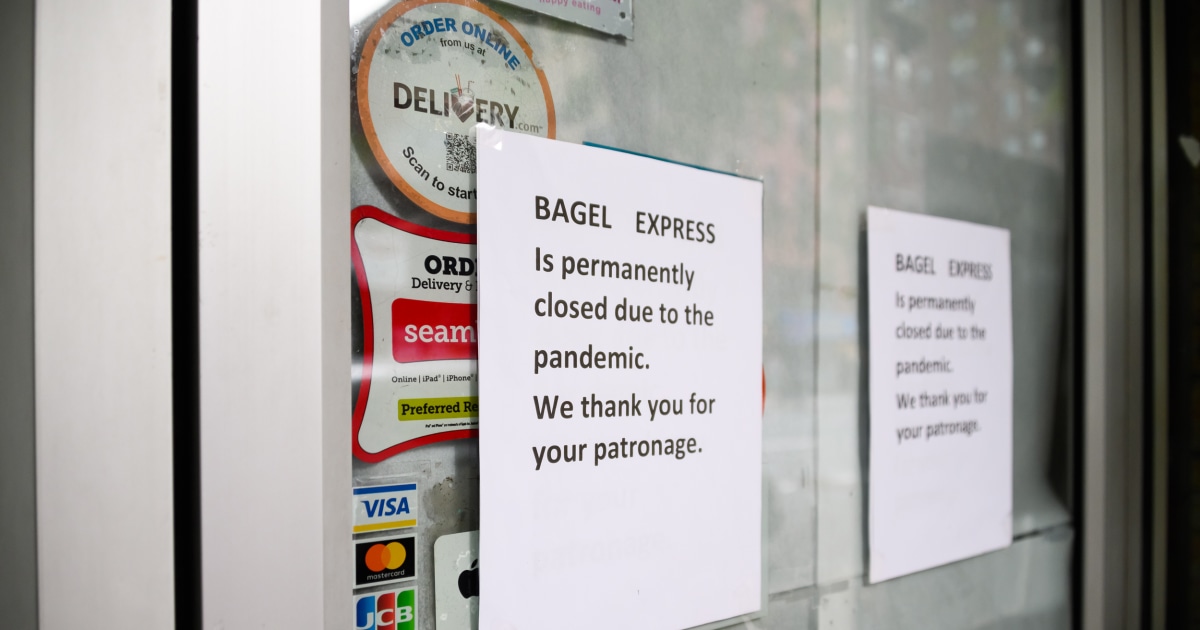
Almost 60 percent of business closures are now permanent, new Yelp data shows
The types of restaurants with the highest closure rates include breakfast and brunch places, sandwich shops, and Mexican restaurants.
NBC News
109 points · by elorant · 6y ago · 123 comments
They continue to bleed my wife's family business for 100 bucks a month - an extortion fee - otherwise all our reviews are removed (by which I mean all our positive reviews which are all we have) and are replaced by negative / fake reviews.
I cannot express my deep, unyielding absolute disgust and hatred for Yelp strong enough.
I would love to create an alternative, but I just don't see how viable that is even though I'm more than capable tech/coding-wise.
Edit/additional info: That $100 is the least we can pay a month; there is no lower amount.
basically google review is like the opposite of yelp. if somebody posts trash it will be their forever. even after the business died.
If the pattern is that predictable, I'm curious if you could gather enough data to successfully sue Yelp for defamation?
You don't know that. No one knows that. Having money doesn't magically mean automatically winning court battles.
Aka, something like 'YelpEvidence.com' where businesses can catalog this routine behavior, and gather the kind of information a law firm could actual use. It might be enough of to force Yelp to change their ways.
It's all possible, but simply asking for $100 is a lot easier because the power disparity is so huge.
Then there is the fact that is Facebook ever shows interest they can easily crush the entire market - they don't need to make immediate money and the identity of the reviewers is better known, providing higher quality score.
That being said, I've heard everything about the ratings business is a lie, so there seem to be insiders claiming that there's a lot of fuzziness to the problem.
I'm assuming that manual curation of reviews is necessary here, it may not be.
Did they tell you this outright?
Connect the dots.
Their reputation is so poor among some circles now that I don't see them staying in power 10 years out. They're going the way of the BBB.
As a result, you're safer searching for certain types of businesses on Google Maps, but even Google has "GOOGLE GUARANTEED" and possibly other paid-for indicators which make me not trust their results.
The market incentives are so bad among rating and business directory sites that I can only imagine that at this point, only a mutual company dedicated to business directory services can survive long-term. I don't think any exist right now.
EDIT: In fact the background check and screening are free. The Guarantee only appears to refer to the refund guarantee.[2]
Disclosure: I work at Google, and knew some people on the team.
1. https://support.google.com/google-ads/answer/7549288?hl=en
2. https://support.google.com/google-ads/answer/6226575?hl=en&r...
It's bad here. I'd say at least 1/3 have lost their jobs and are having a really hard time finding work. More uber/lyft signs have popped up in cars in the parking lot. One of my neighbors had to move their family of 3 from an already-small 2br to a 1br (2 kids). I don't know how they can make it work. There's more people who sit on the sidewalk curb and drink cheap beer and chain smoke. They're nice folks (I talk to them), but they can't find work.
On the flips side, anyone who can WFH is doing better than ever before. They save money by not driving, eating out, or doing the other things they'd normally do. I've also seen A LOT of brand new cars show up, presumably buying because of low interest rates. WFH folks seem happier than before.
The disparity between the haves and have-nots looks like it's been rapidly accelerating. If you always stay in the HN bubble, you won't see these people. They're 'invisible', but I assure you they are real. They need help, and they're not getting it. It's honestly very, very sad - it makes me sad. My empathy is on overdrive because it's so easy to see myself in that position. If I hadn't chosen tech, I'd be right there with them with a 6-pack, Marlboros, and no hope.
This pandemic to me shows the fundemental problem with a lot of the fancy economic theories we've been living off of and the parasitic "financial engineers" fundamental failing. You can play all the games you want with numbers and spreadsheets to make it look like there is more money than there actually is, but you can't magically change the amount of stuff their is to buy. As such it doesn't matter what measure you use or what KPI you look at for the economy, if there isn't enough crap being produced for people to buy it at a reasonable price there isn't enough crap to buy, and telling people the economy is doing great when I can't afford a roast for dinner doesn't mean jack to me or anyone else.
If you want to actually help the economy you helicopter drop stimulus checks. The lower 95% spend more money when they have more, the top 5%/1%/.01% don't see a meaningful difference in their spending power.
I think this is a bit simplistic. This is also how you get hyperinflation.
Perhaps the government should just have a clean separation from money, much like they do from state?
Infact for the last 15 years I have made it a point to monthly expenses be less than 50% of my net income, which meant living with family, having room mate, Driving a very old car or doing other things to lower my expenses.
They spend it on consumption and bid up the price of inputs while the people who own the businesses collect profit. I’m not sure thats any better than what the govt is doing now.
Instead, by purchasing large amounts of junk bonds, the Fed basically backstopped Wall Street, leading to the all-time highs in the stock market indices. The stock market completely decoupled from the economic reality on main street
I had friends 'in the market' who felt the rebounds after 9/11 were suspect already.
1) Inflation. You're living it. The stock market is inflationary. Printing money creates inflation. Yet somehow they will make everyone believe 2020 saw 2% inflation. The market is telling us it expects inflation to be higher; maybe. You don't want to hold cash or low interest bonds going into an inflationary period.
2) Global demand for US equities. If there is a global financial crises/disruption, and there should be, people view US stocks as safer than all other stocks. Money managers would be moving out of other stocks and into US stocks. Demand drives up price. It needs no further rationalization than risk management with limited optionality of where to put their money. US stock prices could be ridiculously overpriced on fundamentals but may still be viewed as safer than their emerging market alternatives.
Unemployment and suicide is already high here. Many feel a lack of future. We had been doing better but there was some backsliding these past few years. This has just sealed its fate for a decade or more. I'm lucky in my position but many haven't been.
That is a recent trend due to our governments selective action. Back in the 1929 crash it was the rich wall street types who lost everything and were jumping from tall buildings to their deaths.
The 1929 crash coincided with the great Dust Bowl, where many family farms were destroyed by a dust storm.
All those farmers left their broken farms, and went to the city looking for work... Only to find that the great depression wreaked the cities too. Back then, a much larger portion of America was farmers.
The state didn't do that well with Covid, mind you, but the local economy isn't dead, either.
Here in Phoenix, AZ, things are basically normal. People have masks on when they're indoors, but businesses (including restaurants and bars) are all open. A rough metric I've been using since march is how far backed up the cars are from the stoplight in front of our house at rush hour, and it's pretty much back to where it was in February.
I've completely lost track of what you can do where in this country, and I think a lot of places are more open than I realize.
Restaurants are a really nice to have thing when your worn out from work and you do not want to have to think about cooking.
I think there is another aspect to this that goes beyond restaurants and more towards small businesses in general. If we consider that Yelp does more than just restaurant reviews, this fact of 60% closures is going to have a huge impact on state budgets with the loss of tax revenue.
And I'd argue the money is being spent somewhere, so the state won't have a total loss. It's likely offset by the fed stimulus spending, for now.
Somewhat related anecdote: I looked at a liquor store for sale. In a low-mid income area. After consistently growing sales ~$100k/year, 2020 is over a $1M increase over 2019. Of course, seller wants to base multiple off 2020 which is obviously needs an non-recurring item adjustment.
Economically and in the aggregate yes. A few years from now, if you want to get a burrito or a bagel, you'll be able to. If the goal of society is to ensure reliable access to relatively interchangeable goods, the current policies support that.
Personally, though, I believe our societal aspirations should be a little higher. Each of these independent restaurants are owned by and employ real people and going out of business is an irrevocable chapter in the narrative of their life. That's a chapter that didn't have to happen for many if the federal government had made different choices.
Likewise, these restaurants are real, tangible parts of the history and fabric of a place. Seattle without Pike Place Market is not the same Seattle. New Orleans without Cafe du Monde is not quite New Orleans. When that history is destroyed, it is gone forever. And when a culture destroys their connection to their past, I think they lose some of their ability to invest in the future.
You don't think that's gloomy?
https://www.sba.gov/sites/default/files/advocacy/Frequently-...
Just because you don't enjoy something, don't be so happy for others misfortune please. For some going to restaurants are their highlights of the week and for the people working there, their paychecks
Even before Covid, the sit down restaurant service with it's hostess and waiters and 3 course menus seemed to be going the way of the movie theater. Who has time, who has energy, and who wouldn't be just as happy getting Doordash and eating in the comfort of their home and probably watching a movie at the same time? Fewer and fewer people it turns out.
Well, I'm just one data point, but I vastly prefer going out for dinner (and sitting down, getting a menu, having a waiter) and going in person to a movie theater to doing those things in my same-old living room that I see every night. I don't know just how in the minority I am, but there are some of us who think it's worth the extra money you pay to have the experience.
Who has time? I do, when I'm on a date. Takeout isn't the same. (When you're married, you can get takeout and take it home, but that's... kind of lame.)
Also, when it's bad weather (hot/cold/rainy), takeout leaves me with the question of where I'm going to go to eat it. Not to the park when it's 35 degrees (whether Farenheit or Celsius). In my car? That gets old. At home? Where?
Often this would allow restaurants to serve upscale food at cheaper prices due to low overhead. Even with their successfully efficient business model, many are closing permanently.
Your comment sounds dramatically bitter.
I'm not saying we should just do that, but in terms of raw efficiency, the only issues is freshness vs. transport/timing etc.
Otherwise - you don't make your own butter, grow your own food, or make your own furniture either.