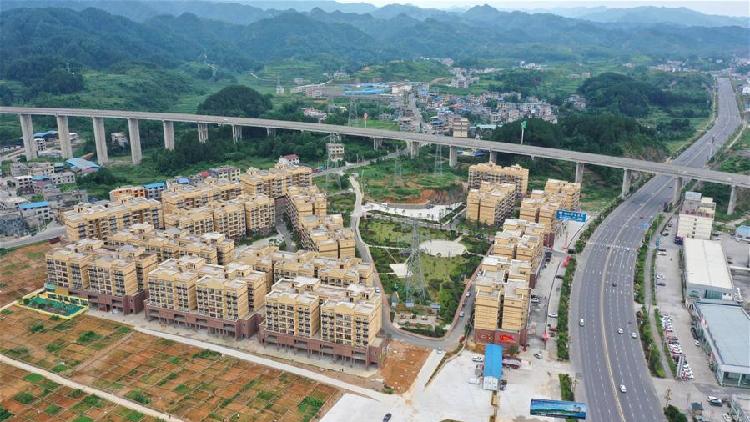
China delists all remaining poverty-stricken counties
China has removed all remaining counties from the poverty list after the last nine impoverished counties, all in southwest China
news.cgtn.com
74 points · by absolutelyrad · 6y ago · 113 comments
How do you explain Poverty of India then? It doesn't suffer from one person in power.
India and China were roughly equal in population and GDP if you go back in time before the start of the British empire
Lifting that many people out of poverty is nothing sort of a miracle
Any source for your claims?
The truth:
India population in 1800: 169 million [0]
China population in 1800: 322 million (nearly double India’s)
As for GDP:
China’s GDP (PPP) per capita in 1800: $316K [1]
India’s GDP (PPP) per capita in 1800: $177K
Note this is per capita. Factoring in the population difference, China’s overall GDP (PPP) was almost 4 times that of India. Hardly “roughly equal”.
I’m using 1800 as a reference year since it’s easier to find data for it.
And GDP (PPP) in 1980 (IMF estimates): [2]
China’s GDP (PPP) in 1980: $305K
India’s GDP (PPP) in 1980: $381K
India’s GDP in 1980 actually surpassed China: 4-5 times growth compared to China! (from 1800 to 1980)
This proves the grandparent comment that “IMHO, the root of our previous poverty is arrogance and one man in power (see Mao's policy which had led nation wide famine just because he want to surpass US in a short time”.
India’s population growth nearly doubles China’s (from 1800 to now) . Not surprising that, on average, more Indians are poorer than Chinese.
[0] https://www.visualcapitalist.com/the-population-race-a-300-y...
[1] https://www.youtube.com/watch?v=4-2nqd6-ZXg
[2] https://en.wikipedia.org/wiki/List_of_countries_by_past_and_...
if that was the case there'd be fewer poor countries on the planet. The Chinese government has made many mistakes, a lot of them quite terrible, but a lot of progress over the last few decades also is the result of successful and active governance. Statecraft is not something that just happens or that is trivial.
Even just creating an open environment and the sort of conditions that let hardworking people do what they want is difficult, successful ecosystems are built, they don't happen because everyone at the party office just drops their suitcase and goes home.
And you forget to say that the amount of people verged into absolute poverty by CPC is also the biggest shame of human history.
Nowhere else in history few hundred million people verge forcibly degraded back into stone age out of somewhat moderately industrialised economy.
Chinese people have nothing to thank communists for. Any opinion differing from this is preposterous.
When the CPC took power, the GDP per capita was 54 USD in 1952 (earliest date in https://en.wikipedia.org/wiki/Historical_GDP_of_China).
If you chose your words carefully and still state "forcibly degraded back into stone age out of somewhat moderately industrialised economy", one would expect the GDP per capita to revert to 1 USD. In reality, GDP per capita grew to 89 USD in 1960, at its worst reverted to 71 USD during the height of the famine and recovered 3 years later to 98 USD.
And millions of very real starving Chinese did no need your data.
Statistical data of every Eastern bloc country was faked, and the data you cite is fake.
And ceded 1m+ square kilometres to USSR.
> The generation he fucked over have nothing to be thankful for, but the generations that came after does, 30% bad is going to shrink with each year as Chinese comprehensive power grows
Unless the country is not steered back into the abyss, which is seemingly is the case. They blew it all.
> China to credibly deter against external forces, situation is still far from good for many, but it's better than what most countries could accomplish, and considering sheer Chinese scale, many Chinese are thankful for the outcome.
Every Chinese citizen I know, hates the party with deep, deep passion, and that includes not so few party members themselves.
> CCP build modern China to credibly deter against external forces
You have to really turn on the TV.
I feel, you are in denial of objective reality under influence of virulent Xiism.
If that wasn't enough you could trivially look up how many lawyers end up imprisoned or worse.
It's not even a bit silly to argue China has anything near a working legal system, it absolutely doesn't.
>takes away a lot of freedoms
pick one?
How much has the one child policy contributed to this?
https://npcobserver.com/legislation/civil-code/
Comprehensive rule-of-law for the plurality for the majority of cases is largely on the horizon. Rule-by-law will of course co-exist for signifiant state matters, but that's a typical balanced arrangement for any competent state.
>satisfaction rate among locals was over 99 percent
>About 1.88 million people living in poor mountainous areas have been relocated to urban areas
>Various supporting measures have been taken to ensure that at least one person on average in each relocated household gets employed.
Reads like an Onion article.
There's a reason this book: https://www.amazon.com/gp/product/1442256885/ref=ppx_yo_dt_b... spends so much time talking about the problems with government-supplied housing, income, jobs, education, etc ... it makes it nearly impossible to not side with whatever the gov says.
Of course they would if they can. Those are two different governments: the government-supplied job is supplied by the local government, while the surveyor is sent by the provincial or central government. Complaining to them about the local government is an opportunity to have the central government step in and rectify the issue.
Of course local governments know that as well, and to avoid having people tell on them, they use all kinds of tricks to deceive the surveyors. Depthpaper magazine published an investigative report last year https://mp.weixin.qq.com/s/hXPd-mFNnnxQheR7tB64WQ on a particular case where the local government was ordered to stop trying to interfere (so their deception failed). One thing they did was to find out in advance which households would be visited, and then they handed out various goods bought in advance, to make it look like that family had been enjoying a relatively high standard of living for quite some time.
Since the central government's success rate at detecting cheating local governments is probably not that high, I expect that there are still a lot of counties that are officially above the poverty line but actually still below it.
Complaints are typically viewed by default as unpatriotic, obstructionist borderline sabotage, and only a fool would make one.
I've been to rural China, and it tracks with the improvements I saw. But maybe that's anecdotal, do you have more insight on the matter?
If anything certain muslim regions are far from happy.
"Certain Muslim regions" really means only Xinjiang and the Uighurs living within (and some of the much smaller Kazakh and Kyrgyz population, too). The Muslim minority in central China has long since assimilated to the Han majority in their political opinions.
Take anything you read with a grain of salt.
The average annual net income of impoverished people in these nine counties has risen to 11,487 yuan (about $1,740)
Still, it's a major achievement, even if it was achieved with some highly questionable moves - (forcibly?) relocating 2M people to cities
https://www.ntd.com/ccp-covers-up-virus-surge-in-shanghai_52... https://www.ntd.com/chinese-city-goes-on-full-lockdown-after...
Everyone can check if the hospitals are overfilled, the foreign reporters would be more than happy to say so if it were the case.
It could very well be that China chose to sweep it under the rug and has many more people dying than reported. But the number could still be perfectly average, which is not that much. And perhaps below since most of SE Asia seems to be doing very well regardless of policy. China could have 50 times the per capita death rate and would still be below average.
Certain wards are overflowing, hospitals as a whole aren't. Many if not most didn't have that much excess mortality. Not hard to cover up at all by simply not admitting people and/or providing sub-optimal care (in which case you'd have much more effective capacity).
That would create a lot of angry people who'll complain that the ward is overwhelmed, which would be counterproductive if the goal is to hide a huge case load while claiming zero local infections.
They probably do have more cases (like all other countries do as well), but the measures are way more effective if you don't have to care about people's personal freedoms.
Original title: "China delists all remaining poverty-stricken counties"
Pretty big difference there.
As for concentration camp: [1] https://www.youtube.com/watch?v=ouobrLVpKIQ
The methods are not not great (hey the end justifies the means, right? seems to be popular mantra these days, even in the USA) and they sometimes come at great distress to human rights (forced factory staffing... but hey, your'e getting paid right?).
Yes. It is the story of the century and a massive achievement. Testament to what good government can do.
Economics is a zero-sum-game; if they lifted everyone in China out of poverty, then poverty is exported to other countries or the nature paid all the costs.
Edit:
Nature is a silent sufferer in the economics. It acted as cushion to our misadventures, a-bomb(wars), oil-spills, co2 & other gases, industrial wastes, nuclear wastes.
For a person to become rich, they have to earn profit dishonestly; if profit is shared equally nobody is richer. Somebody is getting short end of the stick to make someone else richer.
If everyone is self-sufficient through out their lives, then technically there is enough to go around. Otherwise, one who holds the resource in high demand won't share it fairly.
Simply put : Income disparity will thrive in resource hungry society where resources are held by few members. Even in self-sufficiency, if population grows then nature has to pay the price. Resources are finite for all kinds of life on earth. If one thrives some other suffers.
Anyway, now it's downvoted; wasted my time wording it.
The short answer is, "because there has always been". The longer answer is about distribution, effort, and capability for populations. There's also the issue of individuals who choose not to participate or concern themselves with their own well-being.
It's almost assured that there is uneven distribution of goods in every economic model leading to a complete breakdown of availability for some.
In an egalitarian utopian socialist/communist system, there are inadvertent gatekeepers who create an uneven distribution from corruption and opportunity cost. ie Distribution work that is hard is avoided when there's plentiful and ongoing distribution work^.
Any economic system that is not explicitly egalitarian has gatekeepers by design and you end up with uneven distribution. I don't see any way around these issues, even with automation...which has to be maintained by humans and you end up with the same issues.
^I think the USPO is an exceptional marvel as an egalitarian service which actually works, albeit by making cost/benefit choices about what areas to cover. To whit, this is a compromise that still leaves some without mail service, akin to mail-poverty.