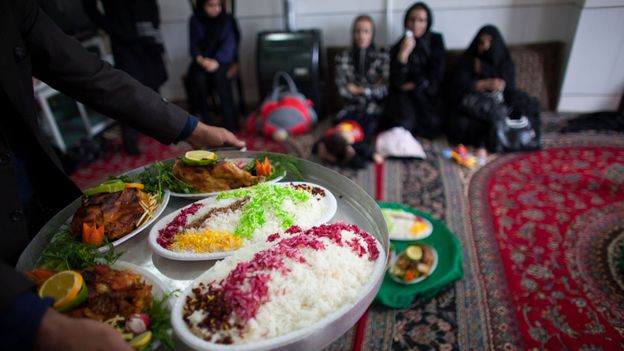
A form of etiquette where yes means no
In every social interaction, from buying groceries to negotiating a nuclear deal, this highly valued behaviour dictates how people should treat each other.
bbc.com
112 points · by monort · 6y ago · 80 comments
With other Iranians, I have no problem reading and sending social cues; with non-Iranians taarof makes me come off as super nice and kind. But what happened, when people repeatedly took me on on my taarofs, I grew silently very spiteful and distanced myself from them. If a guest is staying late we never ask them to leave, we ask them to stay for dinner and that is a cue that I am about to inconvenience myself and you have to leave, but more often than not, in situations like this, I ended up having a guest over for hours and then overnight lol.
It took me a while to rewire my brain to set the boundaries explicitly, and I have to admit it is still excruciatingly painful for me to reject someone; makes me feel very rude. Nonetheless this approach works great, I dare say a more straightforward culture allows for a better mental state by allowing explicit and clear boundaries for oneself.
I didn't think someone else would reinforce my points throughout the thread. Thanks for your experience; sorry you had to go through this, and it's great to see someone else embrace a more direct approach.
My favourite example, to show just how pervasive tarof is, was the occassion I was at the supermarket checkout of a large supermarket chain. The young cashier refused, several times, to accept my money. This, at a very western-style large supermarket chain. Of course, I paid. However, a similar thing happened to a Canadian guest I was once travelling with. At a mini-mart, he tried to purchase a bottle of water but the guy at the counter refused his money. The Canadian took the offer at face value, and left.
A few minutes later, a very sheepish guy come down the street asking the Canadian if he wouldn't mind paying. Iranians will understand just how only-in-Iran this situation is.
One thing basically every foreigner who has visited Iran will agree on - tarof or not, Iranians are the warmest, most welcoming people on the planet. The truth is that an Iranian will never understand just how much fun it is being a foreigner in Iran, we really are treated well (tarof or not).
https://www.npr.org/2020/11/27/939437147/australian-professo...
The fact that you decided to post it, says much more about you, than Iran.
The article mentions this a little.. "in a hierarchical society such as Iran, where favours and services can be interpreted according to the stratum of the provider, this behaviour “produces social stability, because when both persons are doing this, they achieve equality”."
This is sort of similar to how strict dress codes (black tie etc.), despite being associated with the more pretentious elements of society, are actually deeply egalitarian. By telegraphing exactly what is and is not allowed, variation is diminished and stratification by social class is harder.
It obviously has its negative elements (and definitely adds friction to each interaction), but in an increasingly atomized world I find these tiny holdovers of tradition refreshing.
What always apalls me is foreigners traveling in Iran who rave about how hospitable the local people are, without bothering to learn about tarof. It is likely that the vast majority of invitations to people's homes were not sincere, and by taking locals up on their not-actually-intended offers, those foreign travelers are probably causing great inconvenience (which their hosts will however do their best to mask).
I've been to Iran and taarof never even crossed my mind as a possible impediment to learning the language. (Amusingly, I stayed with some Iranians that didn't speak anything I spoke, so I was forced to learn some Farsi, which was a lovely time!)
And the Iranian people _are_ very hospitable, taarof aside. When I traveled to Iran I was invited into many homes, and I know the invitations were sincere because I was being accompanied by Iranian acquaintances most of the time, doing the translating. For one particular example of Iranian friendliness, in college an Iranian friend of mine was concerned that I wasn't eating healthily enough, so every time he saw me after that (most days of the week) he made me sandwiches.
Furthermore, taarof is part of the Iranian culture. These little cultural differences are what makes this world beautiful, and not some mass of efficiently-communicating Soylent-drinking robots.
> Furthermore, taarof is part of the Iranian culture. These little cultural differences are what makes this world beautiful...
Even Iranians themselves often don't find tarof beautiful. One might claim that tarof is a "part of Iranian culture" in the same way that chewing paan is "part of Indian culture", i.e. it's ubiquitous, but even many local people would find the world a better place without it.
100% taarof - there was another Persian with you, and the custom therefore could absolutely not be disregarded with the solo foreigner. Even if you were alone, the mere potential that you might understand the custom compels its use by your hosts.
> For one particular example of Iranian friendliness, in college an Iranian friend of mine was concerned that I wasn't eating healthily enough, so every time he saw me after that (most days of the week) he made me sandwiches.
Also very likely taarof. Even my mother does this in spite of my persistent requests for her not to (specifically when I invoke my unhealthy relationship with food in order for her to stop) because she feels an obligation to do so in spite of my pleas. It's a custom she can't shake.
I'm speaking from direct, immersive experience when I say that the complexities of taarof are very likely to be misinterpreted by those not truly and thoroughly immersed.
And it is absolutely one of our culture's worst traditions. It absolutely must go.
As for the sandwiches: well, he also did it for a fellow Iranian, and I am pretty confident that I wasn't misunderstanding the situation: the guy just has a massive heart, and I've seen him do everything he can to help other people.
And as to your opinion about taarof, well, I'll just say that I have met many Iranians that simply regard it harmless, amusing, or an important part of their own culture. Iran is a big country, and just like you can find Americans that hate their own culture's habit of asking "how are you" with no sincerity, there are others that find it important.
Oh dear, this is a really dangerous conflation of 2 different practices. You really ought to distinguish for everyone here instead of trashing the whole culture. You're not talking about the same thing others are talking about. Taarof'ing (pretty literally: "offering") can mean multiple things, and it's critical to distinguish them:
1. Offering things expecting you to refuse them. You know, like you go to pay for a purchase and a shop owner pretends to refuse the payment. In such cases, they would be offended if you accept their offer.
2. Offering things in general (generally food...) because they've just been trained to by the culture. In this case, they're "worried" something negative might happen on your end if they you don't take their offer. (You might be offended, go hungry, not have a place to sleep, etc.)
Foreigners talk about #1, but you're talking about #2.
And these are VERY different things.
Your mom making you sandwiches (effectively forcing you to eat them) is NOT #1. She is NOT offering it to you expecting you to refuse it. (At least not due to taarof; if she might have some other beef with you that's another matter.) If it's either of these, it's #2. And in all likelihood, it would be only partially #2—a lot of it is just her being your mom and being overly enthusiastic (obviously some cultural part to this too) about making sure you're well-fed.
However, foreigners care about #1—about offending the person making the offer by accepting the offer. Your mom is emphatically NOT going to be offended if you take the sandwich. Like the native making a sandwich for the person you replied to, she is much wants you to take it and is 100% sincere in that. Heck, she'll be offended if you refuse it!!! Unless I guess, you know, she's doing this for the 500th time and she's hoping you might finally start making the sandwiches yourself, but again, that's only because you're her kid and she wants to see you improve in her eyes, not because of the taarof tradition...
This made me wonder what taarof prescribes about translating taarof prescribed offers.
What hasn't been mentioned so far - even local Iranians are not always 100% certain if a situation is involving tarof or not.
Also, if you learn to speak like a Tajik, Iranians will probably think you're dim, or at least sound like it.
But yeah, I remember eating out alone in one of my first nights in Iran, so already marked as a weirdo, of course, and the waiter says "Qabel nadare!" when I ask for the bill, and I'm very confused, and I get out my dictionary because I don't know the word, and he just starts repeating the phrase louder and louder at me like they joke about the English doing when someone doesn't speak English... it just wasn't a good time for anyone. I did pay, though.
I actually like Khujand more, it is definitely more multiethnic than Dushanbe.
> Also, if you learn to speak like a Tajik, Iranians will probably think you're dim, or at least sound like it.
It depends on what you are learning Persian for. Quite a lot of Westerners who have studied Persian have done it out of Middle Eastern/Central Asian areal studies needs, or because they wanted to learn to read the wealth of Persian literature. In those cases, going to a Persian-speaking country can be helpful because direct immersion can boost one’s vocabulary learning, but in the long term one doesn't intend to actively speak the language so much, and so it doesn't matter much if one initially learns a variety of Persian that some Iranians find distasteful. Note that even if one learns Persian within Iran, inevitably one would be picking up regionalisms that people from other parts of Iran nitpick – Iranians can be such snobs about dialects and accents from within their own country.
But we won't tell it to your face. We'll be quite nice to you up front (taarof) and then will backbite like nobody's business.
If you want to learn Farsi (or Tajik), please, go to Tajikistan. For your own good, learn it there instead. Or Kabul, for that matter.
Would Iranians expect foreigners to understand and play along? Surely not.
I definitely didn't perceive that the invitations were anything but sincere at the time, but now I'll never know for sure.
Oh man, I found your comment depressing to read (though I'm glad you wrote it). It's so frustrating to see one comment like that do so much damage. Ignore the comment you replied to.
For anyone traveling in Iran: with one semi-exception (the case where you have a local translator; see below [1]), if they're are inviting you over, they're really, truly, genuinely happy to have you as a guest. Not only is hospitality just ingrained in the culture (even after taking this stuff into account), but as a foreigner, nobody will think negatively of you in any way for accepting their offer (and this applies even in the case of that caveat [1]). They'll be very delighted for you to say yes. It's really that simple.
The people who need to worry about this already know who they are. (e.g., local relatives/acquaintances who already live in the same community and know they're playing in the same game.) If you have to ask if it applies to you, it doesn't apply to you. End of story.
For more mundane offers about things other than being a guest, you may have to rely more on your common sense and not take initial things at face value, but it's not that complicated, and it'll still be hard to offend people if you miss here unless you're completely clueless. Say, if you go by something and try to pay and they tell you "oh don't worry about it, you're welcome", either they really mean it, or they don't and you should pay anyway (like you would anywhere else on the planet). Though even if you take it literally and walk without paying, they'll figure it was their mistake and not yours. Unless you were buying something ridiculously expensive like a car/jewelry/etc...
[1] The one semi-caveat to this I can think of is if you have a local translator with you. In that case, yes, chances are the offer might not be intended to be taken literally, and they might play the game expecting the translator to play along or convey (or have conveyed) things to you in an intelligible manner. And if the translator fails, they might get a bit turned off by the translator. But in that case, it'd be concerning the translator, not you. And honestly even in that case if the translator has any common sense they will pick up any relevant cues later and relay them to you at some point. (Say, if they invite you over for lunch and then ask you to stay for dinner, the translator will very quickly realize if the dinner offer is sincere or not, and let you know.)
Tajikistan and Afghanistan do not have nearly this level of indirection (misdirection?) integrated into their cultures, and yet they both speak variants of the same beautiful language (Tajik/Dari). I'd strongly support either, and Tajikistan has the support of the DoD, so that's naturally a better answer for Americans with interest.
fun fact: tarof also exists in Turkish culture, they just don't have a specific word for it.
The attention to detail in this sketch is glorious. And that's coming from a westerner who never heard of tarof before this. So I'm probably missing even more of the detail that actually exists in it.
It's one of the most annoying and arguably toxic aspects of our culture. I understand it; I understand the perceived need for it, but I submit that it paradoxically does the exact opposite of what it intends to accomplish ("social equality") because it directly diminishes the value of whoever ultimately "loses" the exchange, oftentimes whoever perceives a greater debt to the other person, which is generally the person of lesser social rank.
"Taarof represents the kind essence of Iranian people. In our culture, it can be impolite to express ourselves in very a direct and objective way,” but it in fact demonstrates a kind of disrespect for both the other person's time and validity, and I'd argue that by enforcing systemic dishonesty, it's one of the main culprits of another far darker aspect of Persian culture:
Backbiting. https://iranian.com/1998/10/13/people-of-extremes/
---
Do not emulate this. Do not let this aspect of our culture become a part of yours. If you seek to be kind, do so by being kind, not by being nice.
As a Persian aspie I feel this wastes time, and I prefer the blunt and direct communication style of the Dutch.
The comments about our hospitality and generosity being fake is unfair and unfounded. It's also very self centered of someone to have such claims based solely on their experience and perception. Iran is a big county with different cultures and very different behavior between generations. Do American boomers and GenX behave the same?
The comments about our language not being understandable because of taarof is also laughable. I have never done taarof. My friends and family don't do taarof. My driver and food delivery guy get paid over a mobile app. My barber outright asks for tips. People who have chain migrated out of Iran ages ago and higher middle class people are not representative of all Iranians. We are just like you and everybody else.
I think the younger generation has a bit less issues with these shenanigans, but I don't hang out without enough "real" (aka not raised in the US/live in korea) Koreans to know for a fact.
The surprise comes after the host leaves the paid bill on the table.
It’s gone so far as to put a card on file before arriving with no limit, which leads to folks not picking a place to meet in advance, and a lot less predictable locations to meet :)
Here is a little anecdote. I once saw a baker giving free samples to some tourists. I was there at the bazar to buy some souvenirs, so I decided to also try a sample, only to be told that “they do not give out samples”. Funny thing is, the tourists didn’t even want a sample while I had approached him with the explicit intention to buy (which I decided against after his treatment). But I don’t think he really cared as long as he got to have a positive interaction with the tourists.
I suspect a big factor contributing to this culture is how the Iranian public have been isolated, due to both the sanctions from the outside, and the Iranian government from the inside, to the point that foreigners are regarded as exotic people to be treated better than “ordinary” locals.
> “Ghabel nadare,” he said smiling, indicating that he wouldn’t accept it.
> Scratching my head, I insisted. Again he protested. Giving up, I thanked him in Farsi and left the vehicle with a grin on my face. “All is well,” I thought, incredulously.
> “He was taarofing,” my friend Reza later explained. “Of course he expected you to pay. And you should have insisted more.
This is confusing, I say that as a Pakistani whose culture also has Taarof. Here is a TED talk[1] by someone with Persian parent and she states in this talk that a shopper, by insisting to pay for an item, insulted the shopkeeper.
Here's an example: my friend was not in the mood for breakfast. The host took it as a sign that he was taarofing. He insisted that he wasn't. His persistence was seen as a sign that he really wants breakfast. The only way to make it stop while being polite was to take a bite. He was furious!
It sounds from your story that the answer is no, but I wonder if it's different between close friends or family members where there's less pressure to be impeccably polite.
I agree with the other poster who hates it; it’s an obnoxious method of social interaction only enjoyed by people who like drama.
There is of course also "Be khoda tarof nemikonam" which is "I swear to god I am not tarofing", after this it is usually acceptable/expected to stop it.
Edit: Article also mentions the rule of three
> There is an unwritten rule of two or three rounds of offering and refusing in taarof.
Isn't this the very definition of politeness, anywhere in the world?
I read the beginning of the Wikipedia article on Taarof:
> In the rules of hospitality, taarof requires a host to offer anything a guest might want, and a guest is equally obliged to refuse it. This ritual may repeat itself several times (usually three times) before the host and guest finally determine whether the host's offer and the guest's refusal are genuine, or simply a show of politeness. If one is invited to any house for food, then one will be expected to eat seconds and thirds. However, taarof demands that one can't go ahead and help themselves to more food after finishing their first helping. Good manners dictate that one must first pretend to be full, and tell the host how excellent the food was, and that it would be impossible to eat any more. The host is then expected to say one should not do taarof ("taa'rof nakon" - similar to "don't be polite!"), for which the appropriate response would be to say "no" two or three times, then pretend to cave in to the host's insistence and pile on the food
To be honest, in this particular situation, I don't see much of a difference (if any) to the area I am coming from (rural southern Germany). In my home area, it would certainly seem very strange to accept an offer to eat at someones house right away, without the usual "no, that's very nice of you, but I don't want to cause you any trouble", etc. dance. Eating for example at a relative's home, you would never ask for a second, and if a second was offered to you, the polite response would be to decline first. The host would then say something like "but really, there is so much left, don't be polite", and this would go on for 1-3 rounds, during which you are more or less expected to offer your second to other guests.
Regarding the taxi episode from the article: a few years ago, we were stranded in a snowy village in Austria. It would've been 3 hours by foot to our hotel. A friendly local drove us there. During the last minutes of the drive, I tried to offer this person some money out of gratitude, and it was a very long conversation that circled around my wife giving me discrete hints to offer him some money (but in such a way that he would be able to see that she was giving me hints), him politely hiding that he had noted her hints, me offering him some money, him refusing, me asking if he really didn't want to take any money, we are so grateful, etc. In the end, he didn't take any money, and it was clear he didn't want to. But it took nearly 5 minutes to clear that out.
The difference with taroof is that it goes beyond simple politeness into something that's sometimes even extreme. This anecdote will sound a bit insane out of context, but my dad would sometimes walk up to the door and lock it when guests wanted to leave, begging them to stay and eat more food.
You are correct that it is indeed rooted in politeness and hospitality, but I think what sets taroof apart is how much further it can go.
Maybe it’s my Americanism, but I’m absolutely happy this is not how it works here. “Yes is yes and no is no” works better for me.
Problem is, you are used to those things and don't see them from inside your culture.
Cultures that both value and extend hospitality are the best. Shows a value of humanity above all the other hubbub.
It felt odd not to answer a question asked of me, but I'm used to it now.
For example, people routinely ask "how are you?" as a polite greeting without actually caring (or wanting) to hear about the deeply personal thoughts of another person's feelings.