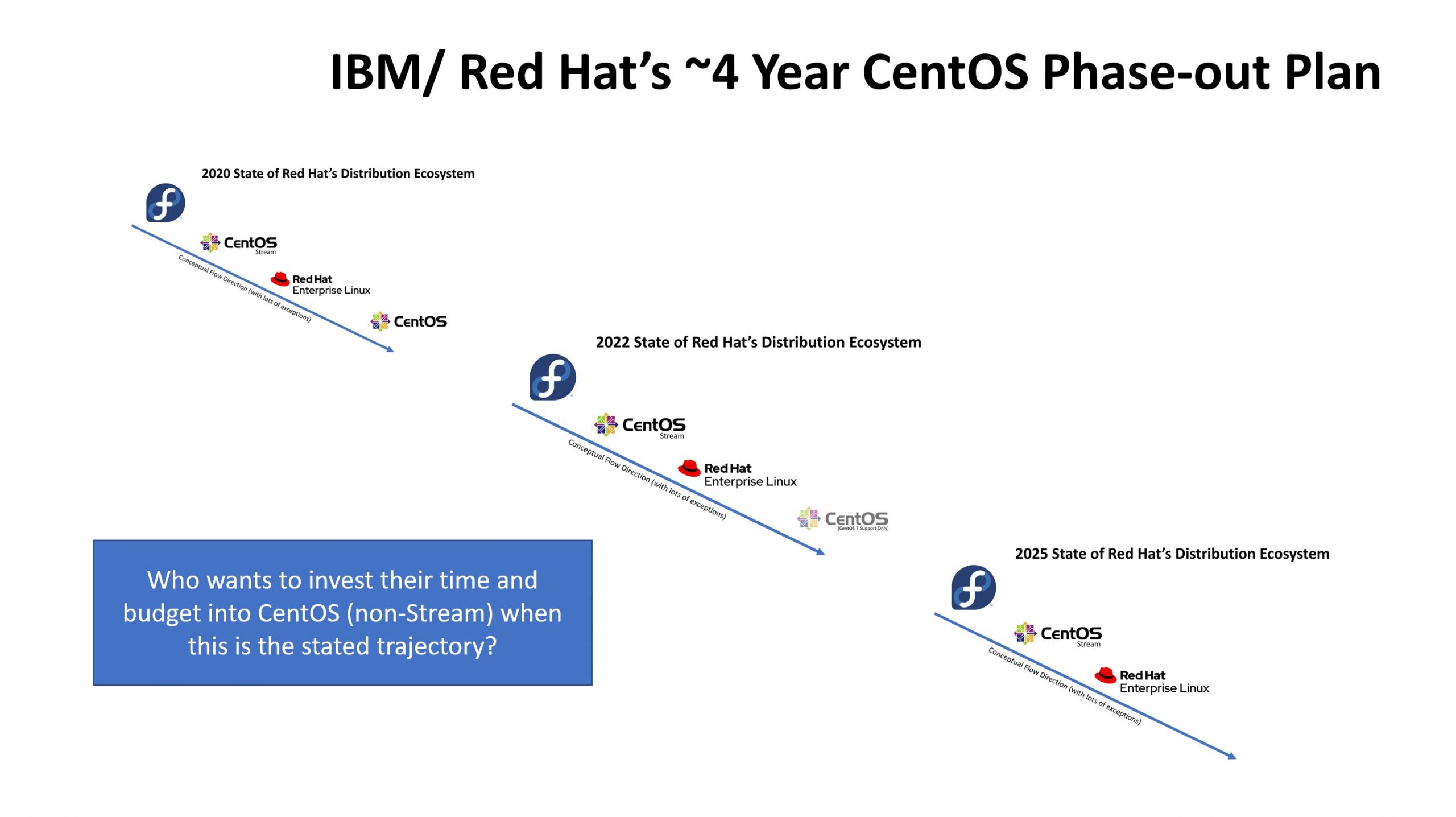
Red Hat Goes Full IBM and Says Farewell to CentOS
Red Hat made the decision to effectively end the CentOS project by curtailing future updates and support for CentOS 8 and anything beyond
ServeTheHome
222 points · by vanburen · 5y ago · 318 comments
The other day I commented that I took my Pinebook Pro off the toy shelf and loaded up Manjaro. I commented on HN about how much I liked the user experience. The first reply I got was something about the drama with some dude named Phil. Alternatively I’ll put my head down for a while and forget about the lineage of the various options and then something will crop up about this or that distro is going away, being repositioned or whatnot.
Why does this matter? Because I want to use it for real work and I don’t want to spend time planning a long term OS strategy. There are other things to worry about. I’m far from alone in this. That’s why folks reach for Mac OS and Windows.
Downvote away, but I really do want to love Linux. I just don’t want it to be so hard to love.
Meanwhile over on Debian/Ubuntu/PopOS/Plasma, I can finally run the latest games (thank you Steam & Proton!), edit video with pro grade tools (thank you DaVinci) and I still have a great coding environment... Oh, and thanks to cloud based office software, that's no longer an issue.
So far, I have converted back to macOS, which is equally bad from UX perspective, especially the hardened security - I just don't want to opt into every program getting the permission to run, send notifications, access this and that. It's just too much.
I think I will give one of the more non-corporate Linux distros a try. Or, maybe it's Pop, but ideally it should be Debian based, just not with the "outdated" experience.
Had you chosen Fedora with KDE you'd probably have 0 problems. I'm using it without any drama for 11 years and I keep suggesting it to co-workers and friends.
Wayland has done so much harm in the Linux ecosystem and that gives me a lot of grief :(
> That’s why folks reach for Mac OS ...
A conservative Linux distro choice is way more stable than Mac OS is in regards to "sudden" changes you need to deal with. And on the time scales we worry about CentOS or Debian, Windows has its pitfalls too.
In all cases, if you need a long-term strategy, it's always going to involve some level of preparedness to handle a change.
If you want to keep up with all the distros and their individual going-ons, that's your choice. You can use Linux just fine without doing so.
With the number of changes that have happened with Apple's, Microsoft's and Google's various OSes over that period it's hard to say that GNU/Linux isn't being held to a higher standard here. CentOS being the trademark-stripped knockoff of a corporate OS is the reason for the instability - when you deal in corporate OSes, you're subject to the business strategies of their sponsors. Some would say (weasel words) that the strategies of the sponsor of CentOS have been the source of instability and conflict across Linuxen for a long time now.
+1 on Debian. It's as drama-free as it gets. I mean, the distro is criticized for being too boring and too stable and too rock-solid and too unsurprising. Those descriptions are also used to describe power lines and sewer lines, i.e., reliable infrastructure.
That's absolutely a reasonable point of view -- for your use case.
From the perspective of a variety of folks, including corporate IT, makers/vendors of drop-in appliances and other folks, the changes to the CentOS product will be disruptive.
This is because production servers and appliances generally need to run, for extended periods (measured in years) the application set specifically designed and implemented for the particular set of software versions on a particular OS/distro.
For many of the above folks, CentOS fit that bill nicely, as it reliably tracked (that is, was slightly behind) a commercial (i.e., you need to purchase a support contract to access updates and support from the vendor) Linux distro (Red Hat Enterprise Linux -- RHEL), but did not require any support contracts or fees above those for hardware, installation and administration.
The problems for the above implementation/management/administration strategy comes out of changes to the CentOS long term support policy.
CentOS (with versions 6 and 7) provide(d) a ten year support window for those versions and promised the same for CentOS 8 (released in 2019).
Many of those who had chosen CentOS for it's free (as in gratis[0]) access to the commercial RHEL platform took CentOS (whose developers/maintainers were hired by RedHat[1] to continue that work in 2014) at its word that support for CentOS 8 would also be supported for that same ten year span, updated their environments and applications to the latest version.
That promise of support has now been rescinded, as CentOS will now be the gamma/release candidate version of RHEL and will lead RHEL slightly rather than trail it.
AIUI, there are many reasons for this change to CentOS development, the biggest being that Fedora (the community project that RHEL used as its Beta platform) is now so far ahead (via its rolling release schedule -- for example the RHEL/CentOS 8 kernel is v4.18 vs. Fedora 33 kernel v. 5.9 -- more than two years) that it's no longer providing that utility.
I absolutely understand why some folks are upset, but claims that "CentOS is dead" and the like are rather hyperbolic in my estimation.
Disclosure: I have no financial interest in IBM or Red Hat, nor am I a user of CentOS
[0] https://en.wikipedia.org/wiki/Gratis_versus_libre
[1] https://lists.centos.org/pipermail/centos-announce/2014-Janu...
LFS for the win!
Gentoo anyone?
Likewise on the Windows side, the SKUs vary from release to release, group policies come and go, and generally they've increased their push into seeing Windows as a way to promote their other services and don't really care what you want from it.
It's fun to try other things like NixOS and GuixSD, but also have the warm blanket of "just put Debian on it" to fall back to.
"Are you tired of your Linux distro being bought out and crushed by IBM exactly one time in history?" Cut to a big dopey confused person shrugging. "Well then try Apple!" Dopey person smiles. Star wipe.
https://arstechnica.com/gadgets/2020/12/centos-linux-is-gone...
At least for Windows, can't you just quickly compare the ethical universes? I'm assuming that Phil didn't embrace-extend-extinguish other distros, Phil didn't secretly change Skype to break the encryption for LE, and Phil didn't upgrade the distro to do constant, inescapable telemetry and update arbitrarily downloading Gigs of data such that it interrupted a user's live broadcast.
In other words, if your decision is between Phil's distro and Windows, Phil's distro wins so it's the end of the story. And if the HN trolls you're responding to aren't claiming a 1:1 feature correspondence with "ethical" distro vs. Manjaro, who cares?
As the saying goes, Linux is like democracy: it's the second worst (widely-used) system ever, because all of the others are tied for first.
It’s easy to get sucked in.
I mean, they have a command line program to report a bug. That and their monstrously complicated packaging apparatus would make me think someone at Debian considered the sucking-in of people to be unethical and thus designed their maintenance polices to prevent it.
I haven't had to deal with any drama using Debian or the BSDs, personally speaking. Which I have been since 2000 or so.
Folks don't go for proprietary systems like Windows and MacOS because of theatrics around distributions, they just choose one of those stolid long-time favourites like Debian, Ubuntu or Mint and ignore the squabbling. Those who want to get a more hands-on experience might go for Arch, Slackware or even LFS.
If you don't want drama, use software maintained by people who have a life and don't have time or energy for drama.
But in the the Microsoft world, you at some point had Windows Mobile and Windows phone, and developing apps for those is the true meaning of being alone.
Ignore the drama and the dramatists. The software works well, and better than the alternatives on that hardware.
The snap drama is a ideological purity contest by people who should know better (aka use something else than Ubuntu if that pisses them off that much).
It's not like OSS community would have rushed to provide alternative packages for Flatpak, AppImage, deb etc.
Snap automatic updates are still the fastest way to update servers with latest security etc updates, keeping servers secure. That's the reason usage of Snap packages is increasing.
With Docker, recent drama was Docker Hub rate limits, so I had to move Docker base images from Docker Hub to Quay.io, so that Docker images could be built successfully.
This would be the problem; you treat Linux as a platform that one is supposed to love or not love as a hole.
Linux is not a platform; it s a component shared between a great many different platforms that are often quite far apart from one another.
These platforms often also share other things, or not, and don't Windows and FreeBSD also share several components?
I've noticed a common belief that completely unrelated, independently started and operated platforms have an obligation to coöperate because they share a single component, which most of them also heavily patch and modify.
> Recently I moved to Apple Macbook Pro 2019 (FYI before that I was using Linux Mint for years without any drama). But after using this very expensive MBP, I am not happy at all. Hardware is the best in class while keyboard is the worst in the class. But my biggest complain is keyboard layout. It is not ergonomic at all. In windows/linux, WINDOW key manages window manager while CTRL, ALT can be used to manage applications. On internet, many places it is mentinoed that, use apple COMMAND key as control key and OPTION key as alt key. Ok thats fine. But this behaviour is not consistent at all across apps. Many apps use CTRL key to control application additional to COMMAND key(e.g. in chrome/vscode, toggling tabs can be done using CTRL+TAB, not COMMAND+TAB). And this CTRL key is only one side of spacebar, very very unergonomic. Additionaly if you are a touch typer powered with mechanical keyboard, you can press CTRL key on windows layout using wrist. This is not possible on Mac as its first left key is FN.
After using MBP for couple of weeks, my hand literally hurt like mentioned in video. I dont think I can operate MBP for hours without looking at keyboard. In Windows you can do everything with mouse only. In Linux you can do everything with keyboard only. In mac, you need both and your hand hurts.
You can do that? If I get my wrist anywhere near high enough to hit a key, my fingers are about two imaginary rows above the function keys.
My God, it's been a long time (if ever) since I've seen so much misinformation out there. I mostly blame Red Hat for the very poor delivery, but tech people are not immune to the tendency for dramatizing, misrepresenting, and polarizing. Please stop spreading this. CentOS is NOT dead. CentOS is changing, but not all that much (yes, really).
I'll do my best to answer questions here, but I'm also going to rush a blog post to try and get it out ASAP that corrects a lot of this.
Edit: Here's the blog post. Excuse typos and other things, I rushed this ;-)
https://freedomben.medium.com/centos-is-not-dead-please-stop...
> If you are using CentOS Linux 8 in a production environment, and are concerned that CentOS Stream will not meet your needs, we encourage you to contact Red Hat about options
But, after reading your message I can partially see your point of view, in particular your gist seems to be that in the chain of development, CentOS Stream will sit where RHEL used to be, thus if you believed in RHEL as a boring, stable, reliable OS in the old world then so too should CentOS Stream be a boring, stable, reliable OS in the new one.
This logic makes sense, with one exception: this assumes that the standard for release quality remains unhindered pre/post swapping the position of RHEL / CentOS.
Before, Red Hat was incentivized to make sure RHEL releases were solid gold because paying customers were on the receiving end. CentOS releases were downstream of solid gold, making CentOS solid gold as well.
Now that the positions are reversed, what incentive does Red Hat have to make sure things are stable and low-risk before shipping to CentOS Stream? This is ultimately a matter of trust: if CentOS Stream gets a bad release, no paid enterprise server explodes. Quality no longer aligns with profit motive, a terrifying insight.
There's another issue, which I haven't seen talked about so far. With CentOS downstream from RHEL, there were the Release Notes: before updating from CentOS 8.x to CentOS 8.y, you could read the CentOS release notes (and the voluminous RHEL release notes corresponding to it) to see if there was any breakage to expect for your use case. For the security updates within a release, you could follow https://lists.centos.org/pipermail/centos-announce/ (sadly non-working for CentOS 8) and/or the voluminous RHEL errata pages corresponding to it.
With Fedora, before every update I glance at https://admin.fedoraproject.org/updates/ to see if there is any known issue with the update I'm about to do; this has saved me more than once (for instance, there was a broken selinux-policy update which would relabel the whole /home not long ago). I recall Debian had something similar (which shows you any release-critical bug recently filed for the packages you're about to install). Will CentOS Stream have something like that? If I run "dnf update" and see it's about to update bash, is there anywhere I can look to see what changed, and whether someone complained about the update?
> This logic makes sense, with one exception: this assumes that the standard for release quality remains unhindered pre/post swapping the position of RHEL / CentOS.
I don't really have an answer for that. It does seem like it would come down to "trust" and as a skeptical person I don't like that very much.
As I think about it more, while we have realigned some economic incentives for the better, it does seem (in addition to your points) there might also be an "incentive" to break CentOS from time to time, just to remind enterprises who are using it that "RHEL" is the gold standard and CentOS is "unsupported" D-: Knowing Red Hat and many of the volunteers that work on these projects, I would be shocked (and indeed would quit my job immediately) if such a thing were to happen, although it would be hard to prove.
That said such a thing would no doubt backfire. There would be outrage of course, and it would hurt the CentOS brand (which also hurts RHEL since these days the two are inextricably linked). We all fully expect another distro to "take the place" of old CentOS as a bug-for-bug rebuild (I'm excited about Rocky Linux personally) so not will there still be an option for that, but competition is great for quality of projects :-D
Anyway, much appreciate the comment :-)
I'll keep mulling it over as well.
That ship has sailed. Even if what you say is true, the public reaction this is change has tarnished all the Brands, CentOS, RHEL, RedHat, and IBM...
It will be a very long time to rebuild the trust, and honestly if RedHat stays the course and refuses to support CentOS 8 for the full life cycle I think CentOS will usage (and RHEL usage) will drop off a cliff
I have already seen several software vendors with RHEL only official support announcing they are working on debian and ubuntu certification, and since it seems CentOS Stream at the most will only be supports for a 5 year life cycle down from 10, I am not sure why I would not move to debian at this point. debian is just as stable, the one thing CentOS had over it was the 10 year support, that is gone now
Cutting 8 years(I think? have something like 2029 in the back of my head) of support from the thing a bunch of people just moved to, with no publicized plan what they'll have to move to instead in the next months(?), doesn't sound like "not all that much" for the kind of environments I've seen CentOS in. What's the plan for them?
Moving to Stream is an option immediately (see post[1] for more information about how CentOS is NOT unstable or "the new Fedora" or whatever else everybody is saying), but there are also forthcoming announcements about new free RHEL subs for individuals and edu institutions and the like. I don't know anything about those. I personally think it was terrible to announce the CentOS changes without those to accompany, but hey if I ran things everything would be perfect :-D
[1]: https://freedomben.medium.com/centos-is-not-dead-please-stop...
This is the surprising part. It seems like customer service 101 to have those announcements ready when this announcement was made. By not having those details ready in a timely fashion, they inherently devalue those programs.
Yep, if this had been for 7, it would’ve been just “meh” and move on to Arch BTW or something. But I just reinstalled new servers to move to 8 and now that was a waste of time.
Correct: https://web.archive.org/web/20201101131417/https://wiki.cent...
It was accurately described already in the press release and that killed it.
If there is backtracking it will make it more dead as it would break trust.
It’s dead. You killed it some more here by shouting down the community.
Edit: to clarify I have over 100 CentOS boxes which will not be running CentOS or RHEL next year.
What distro(s) are you thinking of migrating towards?
If you destroy something then create something entirely different with the same name then the fact remains that you still destroyed the original thing. That's not dramatising or hyperbole.
Which is exactly what we want.
> So, yes, it is different but, increasingly, most of the software you use will be using this type of model. Certainly SaaSs don't let you choose a dot release for the most part.
Not all of us are happy with having to follow the update treadmill. Software is a tool, like an electric drill; one doesn't update their electric drill every day, otherwise we would be wasting all our time updating and dealing with the fallout of updates, instead of drilling holes in wood. If you develop (or do anything) on top of software, you want a stable base, instead of one shifting all the time; one builds castles in rock, not in quicksand.
You could be right. But "we got rid of this thing (and gave something totally different the same name) because that's not the direction the software is heading" would be a different comment from the one I replied to, which was "this thing still exists, honest!"
No, this is totally wrong (which is why I'm trying to correct it). CentOS will be where RHEL used to be. It is trading places with RHEL. It's not "the opposite end of the scale in terms of stability." CentOS will be roughly a single minor point release ahead of RHEL.
Please read more about because that is super misleading and others are seeing things like this and propagating them: https://freedomben.medium.com/centos-is-not-dead-please-stop...
Regardless of what your blog post says, RHEL was not a beta for old CentOS. Old CentOS was a rebuild/copy of RHEL, bugs and all included. RHEL will not be a copy/rebuild CentOS Stream, so it’s not a reversal of roles.
Using outdated packages doesn’t make a distribution stable. It’s stable when its combination of packages and configuration has already been tried by a bunch of people, and confirmed to work, or has had its issues thoroughly documented with effective workarounds.
1) What in your opinion were the main use cases for CentOS before this change announcement?
2) How do you think CentOS Stream is still viable for those use cases?
1) I obviously can't speak for anyone but myself here, but in my use case, which I think is pretty common, is to use CentOS for production deployments of various web apps and services where a person prefers the rock solid stability of RHEL without incurring the cost, and does not need support to go along with it.
2) I explain this in depth in this blog post which is up now ( https://freedomben.medium.com/centos-is-not-dead-please-stop... ), but the short version is that CentOS Stream is basically going where RHEL used to be. If RHEL was too bleeding edge for you, then CentOS Stream will be too, but otherwise it will be approximately the same as RHEL used to be. I consider RHEL and CentOS to be pretty equal, with CentOS lagging a bit behind. Now they will be pretty equal, with RHEL lagging a bit behind. Packages going to CentOS are packages that would have gone directly to RHEL previously.
There will be another small difference: the number of updates. Just for fun, I started a centos:8 image in podman, installed the package which switches it to centos streams, and ran an update (which by the way partially failed with an error message, IIRC it tried to change /proc in a way podman doesn't like). Then I looked at the version of one of the updated packages before and after the update (IIRC it was bash), and looked at its changelog. There were several releases between these two versions, and I would expect each one of them to appear separately as an update within CentOS Stream.
That is, packages that would have gone directly to RHEL previously will be going to CentOS, but not all packages going to CentOS will be going to RHEL; we will also be getting all the intermediate steps.
Do we have an official word on that? Because it feels like QA could just as easily be priority tasked on the next point release RHEL and starve stream of QA while it carries on ahead. I guess this boils down to the workflow which there doesnt seem to be a simple guide of with this news.
And no, I wouldn't agree that they just swapped places. CentOS stream is a rolling release. Unless I am mistaken that's not how RHEL is built right now.
I can see a reason for swapping them in that adding RHEL goodies/licencing into the free version is easier than removing, but the release cycle change, dropping CentOS 8 and as you admit, absolutely shambolic official press release, with lines that reek of a salesperson trying to squeeze out a bonus, do not inspire faith.
It's not a co-incidence or an accident that the messaging around the community side of this CentOS announcement is confusing and unclear (they are letting the community members try and decipher what this all means for the CentOS project) instead it is intentional.
The bottomline, just like in that other case, is that the sales team at Red Hat cannot justify the hundreds of thousands of dollars they ask for supporting RHEL, when customers (or prospective customers) note that they can get the same quality from CentOS (stable release, regular bug fixes, community help).
CentOS, is COMMUNITY ENTERPRISE OPERATING SYSTEM
The community is dead, the Enterprise part of the Operating system is dead
Sure the CentOS name will be still around, but is clear that CentOS is now a Dev focused operating system not designed or targeted for Stable Enterprise operations with a community of Enterprise SysAdmins around it
If you believe the changes are "not all the much" then you are clearly not in touch with the user base of CentOS, outside of Devs that is
The changes are GREAT for devs, and Appliance Manufacturers. Maybe even for Cloud customers
But for us Old School, OnPrem sysadmins running CentOS for Stability, and Long Term Support, CentOS is most certainly dead
This is absolutely not true. Would you have described RHEL this way? If not, then you shouldn't describe CentOS this way either. CentOS took RHEL's place in the chain. Instead of Cent being downstream of RHEL, the two were swapped around.
> If you believe the changes are "not all the much" then you are clearly not in touch with the user base of CentOS, outside of Devs that is
Say what you will. I've been using Cent since 2012 and currently run numerous workloads in production on it. I've shipped SaaS products on top of it and have been responsible for widespread maintenance. I've been a package maintainer for numerous packages as well.
> But for us Old School, OnPrem sysadmins running CentOS for Stability, and Long Term Support, CentOS is most certainly dead
I know plenty of old school on prem sysadmins who run CentOS for stability and LTS (I'm one of them. I have 3 bare metal machines in prod at the moment running CentOS). I may go with Rocky for one of those machines (it's a router/load balancer), I haven't fully decided yet.
That said I agree with you somewhat, that is the one area where this change could be somewhat negative. However, with CentOS being week and months behind RHEL right now, do you see that as a good thing? Do you like having an unpatched system for days or weeks at a time when an embargoed security fix hits RHEL and has to wait for CentOS to build and distribute? I don't. Security patches are top priority for me.
Edit: Blog post mentioned is now live: https://freedomben.medium.com/centos-is-not-dead-please-stop...
This is absolutely a False dilemma fallacy, there is absolutely nothing technically or legally prohibiting RedHat from releasing patches for both at the same time. Nothing. It is a sales/marketing or a internal process choice to do it that way.
Changes to do this process, even moving CentOS to be ahead of RHEL is not the problem. The "rolling release" or non-release, or what every model they are calling it now with CentOS Stream is the problem. The fact that it will no longer be Binary Complete with RHEL is the problem, the fact that CentOS will be used as a "beta" (and spare me the marketing BS claiming it is not that) is the problem
> Would you have described RHEL this way?
RHEL is a targeted, Released Enterprise Operating system with a 10 year support cycle
CentOS was a targeted, Released Enterprise Operating system with a 10 year support cycle
CentOS Stream is not a targeted, released Enterprise operating system with 10 year support cycle. CentOS Stream is pseudo-rolling release with no point releases, used to build a targeted, released enterprise operating system.
https://linux.oracle.com/switch/centos/
Similar to forcing Microsoft or Google to prompt the user for their desired browser or search provider, it would be interesting if rhel was forced to prompt for a repo provider.
It would have been wiser to splash rhel support upgrades on CentOS gdm or cli cockpit than to threaten to kill a product.
Really, what were you thinking? Nazgul indeed! Fork you!
Old habits die hard.
For a community that depends on LTS, the sysadmins seem to make some rash decisions/drama. I think the logical decision here would surely be to wait and see what happens and make a decision in a year when support ending would actually become relevant.
Many many many companies, right or wrong, wait until the very list minute to upgrade their legacy systems.
Many of us are either still in the process or worse just finish our migration from CentOS 6 to CentOS 8, only to have the rug pulled out from under us.
The sheer impact this move will have on many organizations is what is driving this emotional reaction
If they would have honored the LifeCycle for CentOS 8, there would not have been the reaction you have seen
100% of the emotion / drama is coming from the choice RedHat has made to cut the supported life of CentOS 8 by 7 years. that is a DRASTIC action, and their belief that 12 months is "enough time" shows a clear ignorance of how the product is used in enterprise or they fully understand and are banking on the desperation of enterprise to sell RHEL licenses.
either way it drastic choice by RedHat.
What CentOS gave you until Stream was (with some delay) the "same" set of packages that RedHat released in RHEL, which was (hopefully exhaustively) tested by RedHat QA, including making sure that packages interact in a sane way. That's what earned RHEL (and by extension CentOS) that designation of stability. By virtue of being upstream, CentOS Stream could have a lot more updates (the kind that would previously be internal to RedHat). I doubt same level of QA can/will be invested for each update state (if it could be, RHEL would probably be a rolling distro). If you don't have a QA safety net of your own, the risk is higher with Stream vs 8.
You could hack point releases into Stream: wait for RHEL release, then dnf versionlock Stream packages to the same release versions as RHEL (assuming you can map versions of modular packages).
Red Hat demonstrated then exactly what it intended to do now.
The lie detector said that is a lie.
If shitting on some person on the internet makes you feel better, by all means take it out on me.
If I might suggest a subtle variation on the name and branding, it would be this:
RockOS: It Rocks.
A hard look at Springdale Linux is due, similar to the White Box Linux assimilation into CentOS.
Oracle also needs to get the converter script updated for CentOS 8, preferably in a manner that switches update streams fluidly.
https://linux.oracle.com/switch/centos/
The ship is sinking, get in the life boats.
""" Q: Wait, doesn't Oracle Linux cost money?
A: Oracle Linux support costs money. If you just want the software, it's 100% free. [...] Yes, we know that this is Oracle, but it's actually free. Seriously.
[...]
Q: Why are you doing this?
A: This is not some gimmick to get you running Oracle Linux so that you buy support from us. [...] """
Larry really wanted to punish Red Hat, and he did.
Red Hat people are still hypersensitive on the subject, believe me.
edit: RockyLinux and CloudLinux are joining forces, https://www.reddit.com/r/RockyLinux/comments/kanvwb/cloudlin...
That seems about as auspicious as one could reasonably expect. Awesome news.
Edit: why the downvotes.
There was a great feeling of abandonment then that is nostalgic in the death of CentOS now.
In the years that have passed, I saw a few licenses purchased in my workplace, then support suddenly stopped by corporate sources who instructed all license holders to convert our installs to Oracle Linux support.
I remembered my feeling of abandonment by Red Hat, ran the script without complaint, and all was well.
In later years, focus returned to Red Hat licensing, and I was strongly encouraged to reinstall my Oracle Linux systems (which had grown greatly, as they were free). I resisted vehemently, objecting to an inferior kernel (compared to the UEK), reduced hardware support, and the pointless inconvenience of license keys, activation, and renewals for a product of generally lower quality.
Fortunately, I have avoided this inconvenience.
In light of the decades of Red Hat's behavior, I will say one thing: you reap what you sow.
I'm surprised to hear you say that, because this is exactly why I personally won't touch anything from Oracle with a ten-foot pole; I'm not fond of RH yanking support, but we're talking about the company that is known throughout the industry for license audits and calls from legal as a sales strategy. Is there some reason why you trust this particular product more?
We like stability, if they were going to change RHEL licensing to capture CentOS enterprise customers they should have announced those changes ahead or in tandem with the CentOS Announcement
The CentOS Announcment as is read was "Hello Enterprise Users of CentOS, we know we promised to support CentOS 8 until 2029, April Fools, now we are going to cut support at the end of 2021, and maybe we will have some options for you early 2021 so call us"
This uncertainty and betrayal of trust is going to be hard to come back from
Nevertheless I'm optimistic and hope they announce it sooner rather than later. Hopefully the current blowback will move things along ;-)
It's pretty common for me to convert customers from Oracle JRE/JDK to OpenJDK/JDE when Oracle says they need to pay millions for no good reason.
RHEL but not CentOS also come with security/regulatory profiles like STIG which are necessary to run in certain environments like the DoD.
Red Hat also has a license to distribute Oracle Java that CentOS lacks and so it's not available in their repos. They also ship with the Cisco network drivers that CentOS again doesn't have a license to distribute.
One hopes this newfound revenue goes toward making Linux better, but we will see. Red hat employees work on a lot of core things.
Unexpectedly changing CentOS 8 after many had already migrated to it makes no sense and thoroughly damages Red Hat’s reputation in my view.
Perhaps Red Hat will consider continuing CentOS 8 under the same terms they had promised, while also releasing CentOS Stream. Many would value earlier updates over additional stability and make the switch willingly. The rest would avoid having the rug yanked out from under them without warning. Obviously, this dual path would require more effort, but it would engender more trust in Red Hat going forward even if we knew there would be no CentOS 9. It would also keep many from migrating elsewhere.
Even the tech teams inside large organizations aren’t IBM’s customer.
If fewer people, even people who will never pay, use CentOS, then (potentially) fewer people will explicitly target RHEL/RPMs, and there's a weaker case for enterprises adoption RHEL over its competitors.
CentOS led to people learning "how to use RHEL". While RH is going to try to bring developers and other non-commercial uses into free licenses, I'm not sure this will be enough.
An outcome like this was expected as far back as 2014 -- it just took longer than most of us expected.
As I've said before, CentOS hasn't been a "community" enterprise operating system for a long, long time now.
https://docs.aws.amazon.com/AWSEC2/latest/UserGuide/amazon-l...
(And there's pre-built boxes for Vagrant, etc. Search the Vagrant boxes to see it.)
You pay a pretty penny for those production servers. But you also need development servers, and staging servers. For those servers, RHEL would be a gigantic waste of money. It's the production servers you need enterprise support for, none of the rest.
CentOS was a downstream release of Red Hat, with the same packages from Red Hat compiled. It was, for the most part, identical to Red Hat without the support. This meant you could develop on CentOS Dev Servers and test deployment on CentOS Staging servers, and expect it to work exactly the same when you sent it to production. Lots of less licensing costs, same results.
Now, CentOS Stream will be upstream of Red Hat. Instead of getting the same packages as Red Hat, now you're getting the testing packages of Red Hat. You can no longer expect to get the same results from CentOS stream as from RHEL. The end of life for updates for existing CentOS releases has also been moved up drastically. By all appearances, Red Hat and IBM are essentially forcing companies to license and use RHEL on their dev and staging servers, by making CentOS Stream unusable for it.
Lucky for many, Canonical went and got Ubuntu certified for many of the same proprietary hardware and software systems that were previously only supported for proprietary linux distros. This means your dev, staging, and production can all be the exact same distro, and the only difference is which servers you're paying for Canonical support for. This is a recentish change though, so many companies locked into Red Hat / CentOS because of the clear path that was established between Development and Production. And certainly not every proprietary software/hardware is supported on Ubuntu, yet. Lots of companies won't switch (the structure of Red Hat to Debian is pretty drastically different), and IBM is counting on that.
If you're already a CentOS/Red Hat shop there will be much easier options than Ubuntu (nothing against Ubuntu, I use it for some things and it's great, but it's pretty different so all your automation will have to be updated for the most part).
If you don't want Stream then I expect Rocky Linux will be available long before end of 2021, and RHEL might be free for your use depending on what they announce in the next month or two.
Given that's an option, this recent redhat announcement is really shooting themselves in the foot.
1. 10 year vs 5 year LTS
2. Vendor compatibility, many enterprises non-free software packages only offically support RHEL / CentOS
3. Familiarity with tooling, while it is all Linux Debian and CentOS do have ALOT of difference when it comes to administration of the system. Due to 1 and 2 outside of web development, in the US most enterprise users of Linux (ERP System, databases, enterprise Java Apps, etc) are a huge part of CentOS's user base
Example: https://www.synopsys.com/support/licensing-installation-comp...
Secondly though selinux (once you learn to use it) is so powerful. I have seen it stop attacks in their tracks or render them inert (unable to call their C&C server for example because selinux blocks the socket attempt).
10 year support is also icing on the cake, although I typically upgrade a year or so after a new major release.
If you want to read more details about the changes, I wrote a long blog here: https://freedomben.medium.com/centos-is-not-dead-please-stop...
Happy to answer any questions you may have afterward, though if you post them here I may miss them but my email is in my profile.
Of course, users that just needed a free RHEL kept using it that way with the added bonus of corporate backing, so much that Scientific Linux said "screw it we'll just use CentOS".
They legitimately believe this is better. Maybe not for everybody, but for most. And for those who it's not better for they are announcing options in the next month or two for free RHEL access.
I just blogged about it if you are interested. There's a lot of inaccurate info out there as a result of poor initial messaging. I attempt to clear things up here: https://freedomben.medium.com/centos-is-not-dead-please-stop...
Dying as in lacking resources and developers - not users. They err really starting to lag upstream.
Does red hat own the CentOS brand?
Cynical answer of money aside, someone else mentioned the project was running into resource issues so they may have chosen RedHat over a slow inevitable death.
How come these people didn't help with CentOS? AFAIK it's been like two or three people doing almost all of the maintenance.
I'm not casting blame, I haven't helped much with CentOS either besides maintaining some small packages. But it's interesting to think about.
[0] https://lists.centos.org/pipermail/centos-announce/2014-Janu...
or compile your stuff with static libraries maybe?
An IBM mainframe is shipped in two boxes: a small one and a huge one. The first contains the computer. The second one the pricing table.
Mint only has desktop .iso images. No server .iso images without desktop. Mint also mixes packages from Debian and Ubuntu that would probably cause conflicts on server usage.
CentOS is usually used on servers, with server .iso images without desktop.
You have 3 main "base" distros/package mamagers:
Debian/apt
RHEL/yum/dnf
Arch/pacman/pkgbuild
There are of course many more but these are the overwhelming majority.
This means if I wanted to make my own distro I could do as little as take Debian stable as my upstream, rebuild a few packages with a s/Debian/MyDisro/g and change a few default packages and call it that.
Or I could track a mix of packages from Debian testing and stable.
Or I could decide I prefer to build everything my self but still use apt for my package manager.
This is of course turtles all the way down eg: Mint is based of Ubuntu which is based of Debian.
If you do "sudo apt update && sudo apt -y dist-upgrade" then it breaks Mint desktop menu. To fix it, you can install all updates with mintupdate, and then "sudo apt -y install mint-menu --reinstall"
[0] There are more of course, but those are the big two.
[1] I'm really only familiar with the Debian/Ubuntu space (Deb)
[2] See flatpak, snap, and nix/guix. Also some distros like Bedrock Linux let you have completely foreign environments mixing together.
Technically no, effectively yes.
You can install and use different package managers on different distros, but with the exception of things like cargo it's highly recommended to not, as you are likely going to break your system.
In other words, nothing good comes from trying to install two different package managers on one system.
At least we haven't bought any hardware yet... back to the drawing board.
What's not answered is why now, in the middle of an active CentOS release cycle? Smells like IBM/RH doesn't see growth in new enterprise customers/startups coming to Linux (going to clouds/k8s instead and focusing on creating Docker images for workloads). RedHat surely must've been fully aware that discontinuing CentOS would create a giant backlash. I guess, like me, few people haven't used CentOS as base for new builds anyway; OTOH corporate clouds (OpenShift, k8s) for big customers seems like an attractive market for IBM/RH.
Edit: a good outcome of this catastrophe might be to shift focus towards POSIX, LSB, and other means for portability which historically had strong following in the Linux and BSD communities
Introducing Linuxisms in ... Linux?
And the only thing they're extinguishing is a free (as in beer) distro that they controlled anyway (and choose not to continue putting resources into).
When they do it by screwing over their users, yes.
> Introducing Linuxisms in ... Linux?
Introducing non-portable ways of doing things that were previously portable to non-Linux OSs, yes. It's certainly a minor point since if anything some of those changes increased portability within the Linux ecosystem, but I can sorta see "introducing Linuxisms in areas that previously weren't Linux-specific" (ex. `service foo start` did the same thing on RHEL and FreeBSD; `systemctl start foo` isn't going to be a thing on any BSD).
I agree that screwing over your users is a bad thing, but I do think RH contribute a lot of time, money and effort in a way that benefits a larger Linux user base. Just by looking at Linux kernel contributions, RH are one of the largest companies contributing developer time.
> Introducing non-portable ways of doing things that were previously portable to non-Linux OSs.
I think SysVinit was going to be replaced sooner than later. There's a lot to be desired in a way that some systemd developers evangelized it, but the other major alternative (upstart) was also a Linuxism.
Even BSD systems are moving (or considering moving) away from it. From all the "standard" Unixisims, I think that's one of the parts that's aged the worst, and it was a matter of time before various operating systems (BSDs, Linux distros,...) replaced it.