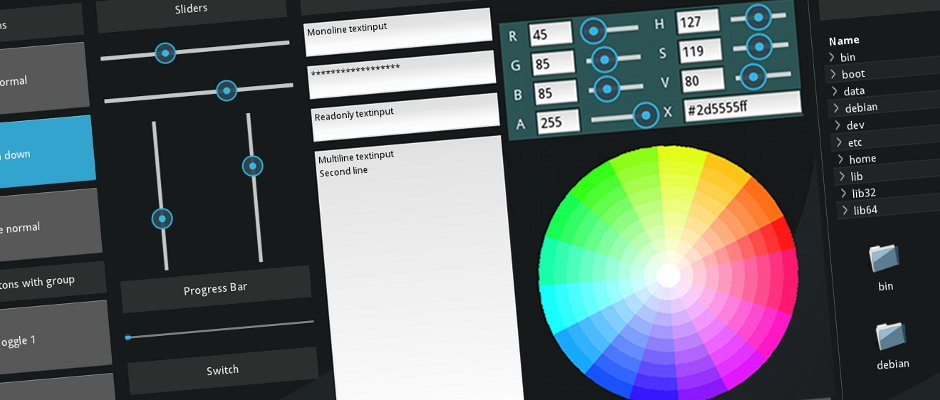
Kivy: Cross-platform Python Framework for NUI
Open source Python framework for rapid development of applications that make use of innovative user interfaces, such as multi-touch apps.
kivy.org
177 points · by ve55 · 5y ago · 55 comments
The question is, who actually uses these projects? The people developing them? Hobbyists? Language diehards? If you're a large company that just needs LOB apps, one would assume one of the aforementioned projects (or Delphi) would be sufficient. Who uses NativeScript, Ionic, QT on mobile, or obscure stuff like Sencha, Alibaba's Weex or Codename One?
RubyMotion at least has one famous app:
http://www.rubymotion.com/news/2014/04/08/rubymotion-success...
The downsides of Kivy are also the downsides of python; there is almost no design enforcement, no typing; if you want to do something stupid and dangerous, you're free to do so with no warnings, and you may not know it's stupid and dangerous. These are usually made up for by the large amount of time you'll have for testing, since you won't spend all the time you normally would fighting the IDE, toolchain, compiler, etc.
The part I like most about Kivy is that it's cross platform, android, ios, windows, Linux, mac, with almost no changes other than OS semantics like paths. I've built 5 large projects this year with it, mostly for custom CNC and motion control applications.
I've used Nativescript in production and it was wonderfully productive. I think it's biggest weak point is suffering from lack of recent support/ecosystem that hype usually brings.
The ability to use your frontend framework of choice (Angular, Vue, Svelte, Vanilla JS) is awesome, and I think can be incredibly productive for businesses (turn your frontend devs into mobile devs).
I advise everybody to avoid Nativescript for as long they self-qualify their project as anything serious.
The ecosystem, and upstream looks really much like the Wordpress plugin world, and is grossly unprofessional.
On the technical side, you will be always struggling with OOM, I/O performance, and the fact that you will be spending MORE time on native code for both Android, and Ios than if you did them separately.
Also, did you try either Flutter or React Native afterwards or go straight to native? Did you find them better?
At least it's better known that other random enterprise cross-platform solutions that seem to exist only on SEO-optimized listicles of cross-platform solutions such as Codename One, RhoMobile, Kony, Framework7, - e.g. https://www.way2smile.ae/blog/cross-platform-mobile-app-deve... (Again, what companies are actually building apps with these things?)
They've been great stewards so far -- improving the codebase and going after long-standing pain points, but it's worth mentioning.
[0]: https://www.reddit.com/r/nativescript/comments/gv968e/progre...
> Seamless interop with React Native. Use core React Native components with Vue.js syntax out of the box
In what sense?
I develop my front ends primarily in React, and other than hooks - which a lot of people have adopted anyway, and only extended the lib - the API seems very stable. The 3rd party library ecosystem may be wild because React is superpopular and people are publishing npm packages with half-baked solutions of dubious utility, but there's always a good library or two for 95% of tasks (good: regularly maintainted, fully-featured, well-documented, tested, typed, etc.).
I don't have any experience with RN so I don't know how things are there, but your comment seems to be about the React ecosystem at large and doesn't correspond to my experience at all.
- Needing shouldComponentUpdate to do anything nontrivial (it's a bad sign for what should be a library if people make "X demystified"[0] posts).
- The sheer amount of times React has been basically rewritten, with
- Hooks (to be fair Vue has this too, and it's not actually a bad feature, but as usual React introduced it in a near inscrutable way).
- Every react codebase cargo-culting into Flux (normally through redux) when all you really need most of the time is a simple AJAX call.
React had the initial idea, but it just feels like the stuff that came after (Vue in particular) delivered better on the simplicity we all wanted. There are so many little gotchas all over the place that people just paper over/memorize, when Vue 2/3 basically works as advertised right out of the box, need(ed?) less hacks, and you can get reasonably productive and performant in <1 day after reading all the docs.
Also I want to point out that "react" is almost always react + redux + react-router + webpack at the end of the day. The combined complexity is not worth it when compared to Vue in my opinion. These days if I want to use something, I do vue + vue-router + parcel and call it a day, and get productive much quicker though the ecosystem isn't quite as big. For uber-simplicity I like mithril[2][3] though -- but it falls down when you start looking at advanced features like SSR/rehydration.
React has the best third party support/ecosystem because of the amount of hype and OSS friendly companies that are using and benefiting from React. It also is the best corporate choice -- react developers are more fungible, you will benefit from more of the free work done by the F/OSS crowd, etc.
[0]: https://www.freecodecamp.org/news/react-shouldcomponentupdat...
[1]: https://backbonejs.org/#View
This is an interesting question, and one that (as Kivy developers) we wonder about ourselves. Others may have different perspectives, but mine is:
* Kivy is very much community built and community driven, it has no serious financial backing (though we are grateful for the donations we do get!) and a fairly small developer pool.
* Most of the commercial use of Kivy that I'm aware of is small companies using it for specific reasons that happen to make sense for them, usually involving some technical reason such as the combination of Python and a flexible drawing toolkit fitting both their dev interests and product requirements. I don't think there is a lot of commercial use, but e.g. one of the Kivy founders has been using Kivy commercially for many years in a variety of interesting projects.
* Kivy is not mobile-only or even mobile-focused, and the commercial usage reflects that. This is worth noting because people often think it was invented for mobile: it wasn't, it was invented to be very flexible, and this happened to make it mobile-ready.
* Most use of Kivy is probably from Python hobbyists, and may well be more weighted towards mobile since that's the most obvious standout feature as a Python gui toolkit (although not the only one).
I've been involved with Kivy for a long time, but never commercially - I got into it for fun while looking to make an app and strugging with an android development tutorial (turns out the instructions were just wrong for Linux...), and stayed with it for also fun. I'm most interested in the general principle that app development ought to be simple and easy for a wide range of tasks, and that in pursuit of this goal it does not have to be perfect. I like the idea that e.g. someone who has programmed a simple game or visualisation should be able to easily share it with their friends, on any platform including mobile. This is just my perspective of course, others do use it for other things.
I have a couple of my own apps that I think emphasise this perspective. Lazy Baduk (https://play.google.com/store/apps/details?id=net.inclem.laz...) is a Go analysis tool that bundles a superhuman AI: I threw it together in a weekend using some existing Python code I had lying around, because there was no Android app currently supporting the functionality I wanted. If I couldn't do that with Python, the app simply wouldn't exist. ColourBlind (https://play.google.com/store/apps/details?id=net.inclem.col...) runs the camera feed through a basic colour blindness simulation filter, I made this one just because I wanted to see what it was like and all the existing apps I could find were rubbish (in my opinion!). Even with the limitations of Python, I like mine much better than them.
Seemed like the simplest and most productive stack to build something like this. Has good support for postgres to get the data efficiently, charting and touch input.
Have you seen any examples, either production apps or tutorials doing so? Ironically, I've considered building a heavily menu-driven game in Flutter rather than using Unity, and seen an example of such:
https://www.reddit.com/r/FlutterDev/comments/iit6cf/i_made_a...
I should again recap that I’m a novice programmer, so this should be considered more a description of my thought process than advice. :)
Graphically, my game is mostly straight-forward, but being a strategy game, the complexity is behind the curtains in the AI, pathfinding and other game mechanics. I am very thankful to continue using my mastery of Python in this endeavor, and even though it doesn't provide game development conveniences out of the box (so it took time to get started, compared to say, Godot), it allowed me to utilize - and build on - my experience in the language. Doing this allows me to control the learning curve, especially when it comes to learning about OpenGL, and how graphics work underneath in general.
Don't get me wrong, depending on what you're looking to do, Kivy can have a stronger learning curve in itself, especially if you're doing this sort of thing for the first time (app development, specifically, but of course game development too). It took me until around 2016 - after playing with Kivy on and off - to become completely comfortable with all of its concepts. Aside from learning to profile and troubleshoot some graphics performance issues (largely my own fault, in my implementation), Kivy has been reliable and, like a well-designed door, I rarely consciously note that I am using it!
Outside of games, as I mentioned, I have also used Kivy for internal tools professionally. One was for (visually, analog curves) creating simulated plastic injection molding sensor signals, in order to create and provide data sets for QA Automation. The other was for a specialized AV company's (internal) usage as a job/bid/information management app. Another project required the ability to flip, pan and zoom images for a 3d mirror viewer hardware set. And, here in 2020 I used it to train non-automation non-coding QA personnel into making their own mobile apps, learn about event handling, and to get a glimpse into what a developer might be considering or thinking as they build software.
I've always been bewildered at why Kivy doesn't (seem to) garner more public attention. For what it aims to provide, it hits the mark quite well. I enjoy using Python the most, so I prefer to use it for most of my work, personal and professional. In that way, Kivy has allowed me to progress towards mastery of Python, without having to spend that effort on other tech stacks. (Having said that, I have experience outside of Python, just to be clear, it's not out of necessity.) As others I'm sure, I have a life outside of my job and side game project, so I have intentionally chosen what to invest my time in learning.
This turned into a bit of a ramble. Anyway. For me, it's a great fit, and I'm thankful that it exists, and people continue to build and refine it. I get to keep writing Python, and use it in more ways and places because Kivy exists.
Your point on web based approaches also doesn't seem to match reality yet as PWA are still the once and future destiny of mobile apps, much like \(currentYear) is the year of Linux on the desktop. afaik, it would seem like most mobile apps are still primarily native, and if crossplatform, possibly React Native or Xamarin, with some older ones using Cordova/PhoneGap/Titanium. Web based approaches are far from replacing native and cross-platform; most companies that support mobile web also have their own apps.
For example, stick to the basics and it works well. But do something off the beaten track like write a background service for Android and hit a bug and you're completely on your own, even if you offer to pay a core dev. I once hit another bug where Unicode couldn't be used in .kv files, was a one line fix but there were 70 unread pull requests and more even more issues untouched. Two or three heros try to help on the mailing list. I gave up but would like to try one more time with 2.0.
2) I prefer tkinter, a python wrapper for tk.
3) In regards to whether or not anyone still needs this, consider that tkinter search traffic bottomed out in June 2012, and has been rising ever since: https://trends.google.com/trends/explore?date=all&geo=US&q=t...
Nativescript angular can run both Web and native from 1 codebase if you like, but kivy is inherently hard to port
That said I don't think it's that bad, but the styling could be nicer.