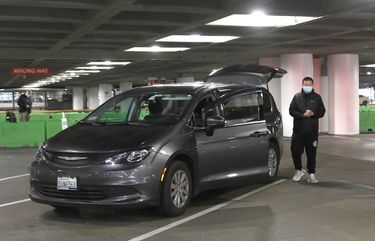
Uber will charge significantly more per trip as new Seattle law goes into effect
The increase comes as Seattle
The Seattle Times
128 points · by donsupreme · 5y ago · 331 comments
But if you're on the lower income scale and you need Uber to help you get between your second and third job (because you can't afford a car and public transit is unreliable) or you need it to get to a doctor's appointment, this kind of change is a big deal.
What will also likely happen is that ridership decreases at the margins. People won't cut it out completely, they'll just use it proportionally less. Drivers might make a little more, but fewer drivers will be able to make any money at all.
For example:
> But if you're on the lower income scale and you need Uber to help you get between your second and third job (because you can't afford a car and public transit is unreliable) or you need it to get to a doctor's appointment, this kind of change is a big deal.
If this is the problem we're solving for (getting you between multiple distant jobs that you desperately need to make ends meet), and have determined that Uber is the only or best solution, we have already failed. The solution to poverty is not serfdom.
A minimum wage is nothing more than a tool in our arsenal to fight poverty. I (and many economists) argue that it is one of our worst tools. A negative income tax is much better. It won't distort labor markets or risk driving up unemployment. And it's fairer in that the burden is shared collectively rather than just by some industries. Goldman Sachs doesn't get hurt by a minimum wage, but small business owners, such as those running a convenience store, do.
This is where we disagree.
Companies that employ workers below subsistence wages are actually being indirectly subsidized collectively by every single taxpayer.
Those underpaid employees are the ones who then go on to collect public benefits to make up the difference between survival and their take-home pay, and those benefits come out of our tax dollars.
Allowing employers to pay below subsistence wages is corporate welfare.
All this bill does is tip the scales back to where they need to be: if you as a business are not paying a living wage to your employees, you're effectively forcing the taxpayer to pay the part of the salary you're not interested in paying.
This is also the interest the state has in the matter, as not doing so negatively impacts the state.
No more mooching.
> Goldman Sachs doesn't get hurt by a minimum wage, but small business owners, such as those running a convenience store, do.
And I'm sorry but those businesses wouldn't exist without the government passively subsidizing them by providing benefits to the workers they're stiffing.
If these are the kinds of businesses we want more of, it should be via an explicit, active subsidy program. If not, they will have to go out of business or find a way to make the economics work. That's capitalism.
There is a fallacy here where you assumed society operates in a certain manner but provided no evidence to support that. The idea that people's standards of living is a directly a function of their skill level and not deeply influenced by other uncontrollable factors is a very contested and argued point of view. On the contrary, it's clear to see that despite individual productivity sky rocketing over the last 40 years, wages have remained stagnant.
Even the framing of your question is odd - who is the "society as a whole" that bares that burden, when most people who make up society are working class? Rephrased you could have simply stated that the majority working poor shouldn't cause undue burden on the aristocrats.
Lastly, I'll add that the state is already burdened in one way or another. Having a large amount of uninsured people due to corporations off loading their social contract creates a public policy problem. The state can't have people dying in the street or spreading disease because the vast majority of them are underinsured - and to solve these problems the state then increases taxes on everyone just so a corporation or two and get away with the bare minimum.
For companies who prefer to pay their workers as little as they can get away with, it is the tool of choice for those who recognize the meaning of 'wage-slavery'. Theories and promises about 'much better' tools haven't solved the problem. Raises do. A bird in the hand.
society as a whole already does that, as do other employers, who generally do cover healthcare, invest in the training of their workforce and so on, it's Uber and other 'gig economy' companies which by means of legal arbitrage are the exception.
And while it's fair to talk about the trade-offs between small, family scale businesses and minimum wage, last time I checked Uber did not exactly fall into that category.
Goldman Sachs is a red herring in this argument. The ones hurt most are the very poor who never have a chance to own such a business to begin with. And a business model that relies on cheap labor is not one that should be ethically allowed to exist in modern society IMO. Also as the sibling comment points out, all of society loses when business underpays it's employees and they are forced to permanently rely on transfer payments to make ends meet.
A minimum wage is the best way to use market mechanisms to eliminate poverty via an improved alignment of incentives. Businesses invest in additional capital to make labor more productive due to it's increased inherent cost. More productive labor can in turn charge higher rates. Which translates into higher total demand, which begets more investment and growth.
There are also ancillary benefits as well, many anti-immigration supporters (inaccurately) point to stagnating wages as a negative result of present immigration policy. A boost in minimum wages would take that rhetorical sleight-of-hand away from them.
This is quite wrong: minimum wages do not "fight poverty". The only effect that minimum wage laws have is to render low-paying job illegal. Minimum wage stops potential employers from creating low wage jobs. That's all they do. If unemployment rate is low enough then society doesn't notice, but if unemployment rate is high then people just work ilegally.
Why would any company ever employ anyone in the close-to-minimum-wage bracket? Amazon gets flack for employment, and Google gets none. Only one of those two has made room for any significant number of close-to-minimum-wage workers.
This is a massively perverse incentive that prioritises how rich people feel about themselves over how people without much actually live. IMHO, that's about as close to a working definition of evil as I can muster.
Semi-related: this is also why basic income will never work. Basic income will be seen, inevitably, as subsidising rich companies, which will lead to it being killed off.
The EITC is not a liberal or conservative issue. Every President Republican and Democratic since 1980 has supported it. I don’t know if Trump has said anything one way or the other.
There is already a minimum wage that people can go out and try to find a job for, but mysteriously, there have always been plenty of Uber drivers! Is it perhaps that by creating a minimum wage law, there are fewer jobs available? Or maybe they just like the convenience of working for Uber, even if they aren't guaranteed to make minimum wage after expenses. Or would you go so far as to suggest that these people are too stupid to know they are being voluntarily oppressed, but because you know what's best for them, you would help legislate them out of a job? (Make no mistake: higher prices will result in fewer Uber rides.)
The real minimum wage is zero. Just add a UBI and get rid of all the other market distorting AOC-economics. The resounding success of the gig-economy (in terms of labor supply specifically) is a side effect of a minimum wage that is too high, crowding people out of full time jobs. In the meantime, adding these minimum wage laws to Uber will just result in more people making nothing and fewer people having convenient transport.
Because people who don't use it don't want to pay for it. There is a lot of opposition to public transport that doesn't pay for itself. There is also the horrible feedback loop of "only poor people take public transportation" stigma, making it more difficult to break even.
At least in LA, the problem isn't "poor people ride public transportation." It's straight up "I don't feel safe." I tried using the Metro and didn't buy a car for nearly a year after I moved here, but there were incidents I experienced that made me abandon it. It had nothing to do with poor people.
"A survey of riders showed that women feel less safe than men during all stages of their transit trips — especially at night. For example, just 13% of women surveyed said they felt safe waiting for a train or bus after dark, compared to 30% of men." [1]
When 87% of women and 70% of men don't feel safe on public transportation that's a real problem and it's no surprise that people abandon it as soon as the possibly can.
[1] https://laist.com/2019/10/03/los-angeles-la-metro-women-publ...
It's not a requirement that these public services break even. In fact, (controversially) it's the opposite. [2]
[1] https://about.usps.com/newsroom/national-releases/2019/1114-... [2] https://en.wikipedia.org/wiki/Deficit_spending
If government spending is inefficient and Americans don't feel well represented by their elected officials, then fix it. Oh wait... it isn't that easy...
Offering someone money for doing something is not 'subjugation'.
- Someone is not able to make enough money to have a reasonable quality of life despite contributing to society.
- Society's rules do not provide an alternative (for example, because natural resources and land have already been claimed or because someone doesn't have access to capital).
It would not make sense for someone to willingly go along with a system that does not allow them to live a decent life. Therefore they must be going along with the system due to some form of coercion.
A situation where someone is forced via threat to go along with a system that does not meet their needs is subjugation.
The solution for this problem is also not forcing businesses and people into idea that in the real world makes little of no since.
Cause with this 25% hike many of those driver will lose their jobs when less people take uber. I know since uber pools been taken away I personally hardly ever uber unless its 100% necessary.
http://news.gallup.com/poll/237965/snapshot-uses-ride-sharin....
Granted, $50-60k annual salary might be middle-class in some parts of the country, but it's pretty clear that a huge fraction of the lower-income population in the United States do use ridesharing.
Median individual income is around $35K, median household income is a but above $60K. $50-$60K isn't typical of middle class in any sane class schema, but it's definitely above middle income for an individual, and nearly at it for a household, not “lower income”.
Well, in this line of thinking, you should just tell people to quit their third job and go drive an Uber, I hear they'll be paying more as a minimum wage...
There's no excuse to keep people in poverty because other people are poor.
He's public transit truly been destroyed like that in many American cities?
In a dense city like NYC, public transportation is the obvious choice. In a semi-dense city like Seattle, public transportation is a viable choice. In a nebulous agglomeration like LA, public transportation is hard to rely on.
In places like London, to my limited knowledge public transport is the only valid choice for transportation, as car traffic is in constant jam, parking is impossible to find and costs a fortune.
Countries like Belgium and Netherlands are highly urbanised and from my experience it's the same story - you do not take a car to go to work (if you work in the city/downtown). People even have jobs that they have in different cities and they take express trains everyday.
I agree though that US's suburban and car-centric model, with endless cul-de-sacs is not designed to have public transport. To retrofit public transport into this - is a colossal task, though it's also an effort to change peoples minds, that not relying on a car is "an attack on freedom" and public transport is not only for poor people.
I've lived in two places with busses. One is my current location in Norway, and I don't need a car to do my everyday stuff. The other was in Indiana. You couldn't always get home if you worked second shift and you couldn't get home from the bar: they also didn't run on sundays.
Slightly more common were taxis (but I've lived more than one place without this as well). The taxis were never reliable in the US: For example, my car broke. I called the cab company, who told me that it was impossible to order a car ahead of time and they couldn't give me a decent time to call - waiting time could be anywhere from 15 minutes to two hours. As you can imagine, it makes getting to work or to a doctor appointment difficult - especially if you are stuck outside before they opened.
City to city public transportation just doesn't exist most places.
Sure but this is a prisoner's dilemma situation.
This price increase allows drivers to earn a living wage which in turn decreases the number of people at the lower end of today's income scale. Fewer people will have the problems you're describing in the first place.
Do this over and over, and ultimately, nobody's left at the bottom.
On the other hand, if you reject all attempts to bring people out of poverty because there's currently people in poverty, well, you're never going to achieve a single thing.
This increase in wages also yields an increase in tax revenue, which can be spent to improve things like public transit, further ameliorating the situation moving forward.
Keep in mind this is a 25% increase in what many view as a luxury good, but the minimum wage is going up by... 25%. So, for everyone at the bottom, it's a net zero change. On the other hand their buying power in other areas of their lives actually goes up. So who is being hurt? I guess the folks in the donut hole?
>Do this over and over, and ultimately, nobody's left at the bottom.
You made huge unfounded leaps here. There’s no reason to believe a magic money tap will just pay for the increased costs. It’s just as likely to kill jobs.
There’s a reason setting minimum wage to $100k a year doesn’t work.
> It’s just as likely to kill jobs.
And that's fine, there's no reason that all jobs have to be done by humans. This is why wholesale reform needs to take place as well, including basic income. Not leaning into robotization of low-skilled jobs amounts to turning America into a renaissance faire as a make-work project.
People like you keep beating this drum in spite of the fact that every single initiative on that front has shown to be within the neutral or positive range for jobs within margin of error.
Yes, eventually a minimum wage will start to impact the job market--evidence is that we're a LONG way from that point.
Sadly at this point, "But think of the jobs" has been reduced to a shibboleth for "poor people (read: minorities) don't deserve to be helped." rather than a factual point deserving informed debate.
Do you have a source for that? Has anyone ever tried it?
Who is choosing to defect rather than cooperate in this scenario?
> This price increase allows drivers to earn a living wage which in turn decreases the number of people at the lower end of today's income scale.
This is unclear. If we find there are 5x low-income people who benefits from Uber for every Uber driver, and the increased Uber costs reduce the real income of those poor people by 25% per month, then it's making poor people quite a bit poorer. Adjust those variables and you might get different outcomes. Or maybe the demand for Uber rides is quite elastic, in which case Uber drivers will lose income because so many fewer people are riding that it doesn't offset the price.
You'd have to actually measure and find out. But overcoming deadweight loss problems due to artificial price increases is quite hard. I'd put money on this making low-income people worse off.
> Do this over and over, and ultimately, nobody's left at the bottom.
Sorry, this is abominable economics. If you "do this over and over" you're just transferring money around between groups in an extremely inefficient and arbitrary way. Also there will always be a bottom, unless we had exact equality of outcomes, which is for various reasons impossible (variation in life expectancy, for example, has all sorts of strange effects).
But let's assume that this means the people at the bottom still have a very comfortable lifestyle, which I think we all agree would be a desirable goal. The only way to actually produce that outcome is to produce more goods with fewer resources. Simply increasing prices here and there does none of that - it may actually produce less with the same amount of resources. In short, additional technology is required. Simply resorting to distributional tricks will not get you there, even first order. (Second-order and beyond effects would probably result in catastrophic economic damage, since many people would have strong incentives to produce less and no additional technology would exist that increases productivity. Again, the goal should be for people to produce more in less time and/or using fewer inputs.)
You're taking the parent way too literally. If you look at the rest of the post, they mention "number of people at the lower end of today's income scale" (emphasis added), "people in poverty", and people "hav[ing] the problems you're describing" (not being able to afford a car). Their argument is clearly that nobody will be left at the point corresponding to today's bottom, not that there won't be any bottom.
You talk about an ‘income scale’ and moving people from the ‘bottom’ of it. What do you think happens if you take the bottom 10 people on the scale and move them up 10 places?
I read the Power Broker [1] about Robert Moses' obsession of disallowing public transit in the public lands that under his control. That results miserable comutting for New Yorkers nowadays. Bob mastered the political system in a way that he can do obviously irrational things under public eyes, and without any fallout at the time, until the book was published much later after Bob actually has died.
I haven't researched extensively in US public transit, but I am inclined to believe that the public transit were handicapped intentionally through the market operators, in collaboration of the political apparatus.
I could not see any obvious evidence of this particular event being positive or negative. But, I am more sure that the political system in US is crippled to the point that it's not capable of producing long-term positive policy any more.
[1] https://www.amazon.com/Power-Broker-Robert-Moses-Fall/dp/039...
The problem is not in value-added services costing money. The problem is widespread poverty in the US, which bars the majority of its citizens from having a decent quality of life.
Most jobs I've had did not have a secure place to store a bicycle while I was at work. Oh, and the roads: Some places, I couldn't take a direct route because bikes weren't allowed on those roads (I lived a couple miles outside of town). The country roads that were available to me took longer. Not to mention that I had to share the road with cars (laws) and the cars didn't have my safety in mind.
And then you get into hygiene and weather. Few places had somewhere I could dry off in the rain: I didn't know studded bike tires (for snow) existed until I moved to Norway. Few places really and truly accepted a sweaty employee showing up for work either - and again, no place to freshen up.
Sometimes I would be lucky to have room to store snow/rain shoes.
Doesn't matter whether it is rent control or minimum wage laws. Government set price controls distort markets negatively.
In this case, the total number of trips taken on Uber in Seattle is going to drop because a certain percentage of trips will now become uneconomical to those riders: they will cost too much to be worth it.
Two negative things will happen:
1. In aggregate drivers in Seattle will make less money due to fewer trips. Demand for Uber drops as the price increases. A simple thought experiment confirms this: lets say that Seattle demands a flat $25/tax per ride. A lot of potential riders will pass.
2. Some percentage of riders will forego the benefit of uber trips due to the higher cost. Whether it will be drunks leaving bars or whomever. Some people who would take Uber at a lower price will not take it at a higher price. Seattle may see an uptick in drunk driving as a result of this.
Governments love price control because they give the illusion of helping: uber drivers will earn more per hour. BUT - they may work fewer hours and there may be fewer Uber riders working.
In summary, this will reduce the total income of Uber drivers in Seattle. It will also reduce the number of Uber riders - some of whom are likely to become drunk drivers instead. This is bad public policy.
That the unions and local governments are attempting to ensure a business isn't extorting labor out of the population is a _good_ thing.
Yeah, it sucks that taxis aren't cheap and also pay drivers well. It also sucks that we don't have light rail going everywhere. In both cases the implementation is just not economical. Therefore we need a different solution that doesn't sacrifice people at the altar of convenience
Taxis are absolutely terrible monopolistic businesses with absolutely no regard for proper service. Uber and Lyft thrived because taxis are so disastrous.
Yes! Exactly! These businesses create value with convenient apps and better logistics.
They should rely on that value, and not the value that they can extract from labor.
(The rest of your comment is so far removed from my understanding of "exploitation" and "free to choose any manner of employment available to them" that there is no way for me to respond to it meaningfully.)
The “unions and local governments” tacitly backed a criminal enterprise in the taxis. No thanks.
In this respect, minimum wages are literally systemic racism. They were started as a way to keep lower skilled blacks out of the workforce. In the 1930s, blacks had a lower unemployment rate than whites, but since the minimum wage priced them out of the labor market, they haven't been able to keep up.
Is that what you are really saying?
Because there is a difference between a government-defined living wage and the true economic value of any particular job.
Unfortunately, when the dynamic system finds a new equilibrium, people are surprised. To this day, people don't seem to understand that rent control suppresses supply leading to higher overall rents.
First is that the costs are hidden and complicated. We need a decent understanding of economics combined with an honest and deep analysis of the consequences of the specific policy to conceptualize why it's deleterious. Very few people will tick both boxes.
Second is that politicians want to be seen to be doing something. Even if leaving the market alone is the best of all options.
Supporting domestic industry, when cheaper global alternatives exist is a form of dead weight loss, but it prevents your middle class from being hollowed out and keeps your society healthy. The same can be said for living wages.
This is not necessarily true. What you're assuming is that the demand is highly elastic - that a small increase in price will drive a large drop in use. It's possible it is entirely the opposite, a small increase in price causes no practically no drop in use. This would result in higher total pay. Either way, this will likely be balanced by drivers stopping driving for uber, or more drivers starting to drive for Uber. Uber will have to account for this by shedding excess drivers.
In reality if it's true that Uber riders are highly sensitive to price, then uber's entire business model falls apart since the plan the entire time was to gain a monopoly and jack up prices. If it turns out that jacking up prices means a huge drop in ridership then the value of their busienss is actually way smaller than what they claim and they are likely unable to run a viable business while paying minimum wage.
Uber tested this out years ago when they first launched. In my city they offered ride passes that had a flat fare (of less than $5 per trip, within some threshold...I think it was within 20 miles). Then when they expanded they slowly raised the price of the flat fare before getting rid of it altogether.
In short, yes, we are generally conditioned to rely on these services.
Uber wants you to make decisions like choosing to live in a home away from public transportation because you know you can use Uber instead of the train. Once you've made that decision, your ability to walk Uber out of your life goes out the door, and you pretty much have to accept any changes that they make to the pricing.
I bike a lot more though which is good.
This ends up being amortized in per-minute increments, so that for every 15 minutes you’re driving a passenger, you make $4.
Now, this doesn’t mean that if demand is low in an area or its 2am and no one is searching for a car that drivers still get paid for time they drive around without working. There have been legislation attempts to do that, but they’ve failed (notably in California and other places).
You aren’t paid by any of these services for the time you spend seeking out a passenger — which is the same way taxi cabs work. Work time begins and ends with the ride itself.
That’s actually one of the criticisms made against these types of requirements, because there is an argument to be made that if fares rise too much, that will suppress demand (and especially suppress demand in lower-income areas), leading to drivers spending more time driving in circles trying to catch rides, so that their net income is less than it was before. The related part of that argument is that it will lower driver availability in areas that are hard to get to, leading riders in those areas with fewer options, regardless of how much they are willing to spend, because drivers are choosing to stick to heavily trafficked areas.
So a driver can still use both services, but they can’t double-dip, because it isn’t possible to drive two passengers at once (I mean, I guess it is, but that activity would get a driver banned from both services).
> However, Uber points to a study from Cornell University’s Industry Labor Relations School that found the median driver made about $23 an hour after expenses. That study uses a different definition of working time and makes different assumptions about driver expenses, among other differences.
> Under the new rules, drivers will earn a gross hourly pay of about $30.30 per hour, before expenses. The legislation will set new per-mile and per-minute rates for drivers while they’re carrying passengers, which are meant to be high enough to compensate for job-related expenses, time spent waiting for rides and time driving to pick up passengers.
The city found it to be just under $10, hence the 50% raise. Uber did their own math and found it to be $23. I haven't read either study but I don't trust Uber one bit with their calculation. Either way, they have to meet the standards of the law, not their own number they can define however they want.
It's hard to summarize, but I pasted the closest to a summary below. The Parrott and Reich study is the one commissioned by the Seattle Office of Labor Standards and City Council:
> At this point, there’s no real point in groping through the wage, expense or hours calculations for either study; the underlying data in the Parrott and Reich study is garbage, and both studies skew their analysis and recommendations in the direction that favors the one who commissioned their study. Instead, we should be focused on the key policy questions, and forcing city officials to be transparent about who they are prioritizing in the policy decisions they are making in setting a minimum wage. Once the policy questions are answered, there is enough raw data in the Cornell report to calculate out the proper minimum wage.
> The key policy question, one that drives so many others, is whether the city should prioritize full-time drivers over part-time and casual drivers. As we’ve seen above, it affects almost everything: what expenses to include, how much the system needs to try to maximize paid hours for full-time drivers, the economic model for the companies. According to the Uber/Lyft data set that Cornell analyzed, only 15% of TNC drivers are full-time, but for them the job is their livelihood. Should they be prioritized over people driving as a second job to help make ends meet or deal with emergency expenses? Should the city try to increase the number of full-time TNC driver jobs? Should the city be picking winners and losers at all between full-time and part-time drivers?
For example, one of the big differences in the studies was how they accounted for "working." One did with app open and the other did idle time that directly led to rides. So if Uber and Lyft are required to pay for idle time, how are they going to handle people that pass on rides and just sit idle? Do you get banned from the platform if you pass on x amount of rides? I'd imagine whatever the policy (not stated in the article) is going to get harsher if they aren't paid by the ride and rather by a combination of hourly and ride. Since it is clearly difficult to actually determine hours working. Or maybe I'm over thinking it and the amount of people sitting idle is actually really low where it isn't a big deal. Does anyone know?
[0] Berkeley released this comparison which is kinda odd and biases towards the lower wage study. The odd things are like #4 how they say the high wage study is void because it includes tips and technically the state doesn't count tips as hourly wage, but if we're talking about take-home that's an important number. https://irle.berkeley.edu/files/2020/07/Comparison-of-two-Se...
I wish EVERY policy decision was structured this way. Tell me the groups, tell me the trade offs, then say why you've chosen X perspective as paramount, and explain what policy helps most from that perspective, and the costs to other groups.
I am fully aware that is never going to happen, but it would be lovely if it did.
The flip side of this is a lot of drivers want flexibility in hours. It's a tricky problem because the gig companies don't set driver hours. As these laws take effect, it's likely flexibility in shifts will decrease.
I'm not against this. It just makes for weird comparisons.
For me, the essence of a good contractor relationship is a balance of power. It went best for me when I had multiple warm clients, giving me the ability to tell any one of them "no". This meant that they'd listen to me and bargain fairly. And if they didn't, well, I could walk and I'd be fine, especially since I was careful to keep a significant financial cushion.
Uber drivers face a tremendous power imbalance, and that was always the goal. Kalanick was aiming for a monopoly. He didn't quite get there, but given that they have 70% of the rideshare market and Lyft has the other 30%, it's close enough. With that sort of market failure, and given the eagerness of VCs to buy future market failure, there's no way I'd want to be a contractor in that market.
A more 'hands-off' approach would bolster ridesharing companies argument that a proper classification is contractor. But the picking and choosing has to stop for that to be the case.
We need DAs and enforcement actions that favor workers.
We need the IRS to automatically flag people with a ton of contractor income from a single source and let them know that they may have been misclassified, and that they may not owe nearly as much in taxes if so. And then we need the IRS to publicly scare employers into erring on the side of calling workers employees.
I fought a misclassification with a former employer. I was able to get a ruling from the IRS, but the employer never really faced any real punishment, even though it was in writing that he was playing tax games.
I think what it comes down to is that almost no one knows how to dispute it or that they even can dispute. And many employers will immediately get rid of you if you try.
I imagine many independent contractors would be paid less if they were employees.
I don't know about other countries, but in my country, Uber (and other companies) offers drivers a bonus for completing X amount of rides in Y days. Except that completing X-1 rides, earns you a pittance, far below a livable wage, and X rides earns you just above.
Also, X is also quite a large number. I don't think it's possible to complete it without working for 8+ hours during peak traffic time. So, in effect, drivers are not free to choose their working hours, if they intend to make enough money to live on.
I've heard stories from teachers who, working as contractors, make more than 2x the salary of equivalent employees. And they even get to choose their days off. Can we get some economical fairness, pretty soon please?
Where I'm from, it's the law that cabs should accept credit and debit, not only does it reduce tax fraud, but it also allow people like me to pay. Transaction fees are not that expensive, but believe me, companies that provide it to cabs drivers, does charge much more for it. Still it's less than 30%.
Again where I'm from, dispatcher does charge the drivers, and from what I read, it was not too far from 30% (which makes sense, they have to account for advertising, wage for dispatch by phone, and since Uber, for the development of a badly made app).
As a passenger, cash is far less convenient, and paying at the end of a ride is awkward, slow, and certain to change the dynamic with the driver.
The claim that corporations paying legal wages below a certain level are mooching off the state is an oversimplification. People are working for below a “living wage” and so the state provides lower or negative marginal tax rates to support them. It’s an unstated assumption that this is the corporations’ fault.
But we cannot presume from where these extra dollars are coming from, when the State legally forces corporations to pay more to these workers.
Maybe there ends up being less of the lowest value workers overall, costing the low-skill working population their jobs.
Maybe there ends up being a greater incentive and ROI to automate, shifting the cost/benefit analysis and driving greater investment to eliminate manual jobs.
Maybe the costs are passed on directly to the consumer, which directly reduces demand and therefore also reduces employment.
Maybe a greater share of corporate profits end up being spent on this labor.
Certainly it’s some mix of all of the above. You could put elasticity ratios on all of these effects and you can model how much of the added burden will fall on each.
The challenge is that of course the corporate profit numbers will move last of all. And that’s presuming that the margins currently in effect even allow for some slack.
What we saw here is that the Uber’s operating profit margins didn’t support the regulation, so prices had to move.
The fatal error is thinking that the State is somehow in a better position to set prices than the Corporation. A key piece of IP that Uber/Lyft have developed is their pricing algorithm. They know the supply curve for how much they can spend per driver to recruit, they know the demand curve for how much they can charge per ride. They price in real-time dynamically based on supply and demand. And they solve this equation systematically, to induce demand when they know they have excess drivers waiting for fares, and to induce supply when they have too many.
Their incentives are fully aligned (based on their commissions) to maximize total fare revenue.
My prediction is that this will drive down total fare revenue in Seattle and ultimate earnings per driver will be reduced although this will happen along with a reduction in fares per driver and the number of drivers. It’s possible the driver count will fall fast enough to maintain average earnings per driver, but I doubt it in this macroeconomic environment.
Ultimately if the goal is to force ride-share drivers to find alternate sources of revenue, I think this is a good solution. That’s not an invalid goal, but I think it’s the most reasonable expectation.
Going back to the original hypothesis, if you outlaw low paying wages, certainly there will be no low paying jobs. The question then becomes, what becomes of the low-skilled workers?
I have a theory, I’m not sure if it’s well supported in academia but it probably relates to a kind of Nash Equilibrium.
My theory is that people are generally pretty lazy, but that this is not by any stretch an insult. We search for shortcuts, low friction solutions, easy outs. We don’t strive for peak performance, we mostly look for good enough. The best we can hope for under such a hypothesis is this will force the hand of workers to avail themselves to higher paying jobs if they are able.
In the context of ride hailing, there is a large demographic where the push-button-get-job dynamic was extremely economically valuable. To the extent that they would accept technically “below-market pay” for the convenience of cramming in a fare between classes and dinner, or going out for a few hours at night to bank some cash.
But this is mainly a failure of properly accounting for the opportunity cost.
I’ve often felt that working is way more expensive than most people realize. Even aside from the high marginal tax rates when you stop getting free health insurance or food stamps.
Working a 40 hour week means you have to endure a flaky and expensive hiring process, you have to endure a flaky and stressful boss, you likely end up procuring food supplies at a higher cost than you might otherwise pay, and most of all you have to keep up your housing, hygiene, transportation, wardrobe, health, household, hobbies, and other engagements (e.g. education) all in a fashion that allows you to be reliably available during business hours in a geographic area that you can commute to which has an excess job available. All of that is actually extremely fucking expensive.
Uber lowers the marginal costs of employment very significantly. This is almost never properly factored into the analysis when people consider whether it’s a good idea to reduce the size of the on-demand economy.
So in the end, some of those ride-hailing workers will find ways to reduce their expenses, tighten their belts and forgoe the “cheap revenue”. Other workers will be forced to find more expensive revenue sources and be forced what we naively see as “upwards” but from an holistic perspective in a fully priced out economic model is almost surely a short-term loss to that individual.
An optimist would say it might lead to long-term gain, by pushing drivers out of a local maxima. I’d say that’s highly presumptuous.
[1] https://www.geekwire.com/2020/uber-raising-trip-prices-24-ne...
Of course, Uber and Lyft didn’t help themselves any by arguing vociferously for years that they weren’t anything like taxis, largely as a way to avoid having to pay drivers similar to medallion systems. Now, there were some good reasons for this, especially in markets like Portland, that used to have really restrictive pick-up policies for taxi cabs — and in areas like New York and Chicago, that have strict limits on how many medallions are issued and how many cabs can be on the road at once, but these companies can’t have it both ways. They can’t argue for years that they aren’t taxi companies and then complain if legislation means they have to pay more than taxi companies.
I’ve spoken to enough Uber drivers who used to be cab drivers to know that the alternative isn’t any better. That isn’t to say those people like Uber — but it’s not any worse than the taxi industry. It’s almost like we have to face the reality that essential jobs in our society, like drivers, are often poorly paid and exploited. And that it is systemic. But people don’t want to do that.
https://seattle.legistar.com/View.ashx?M=F&ID=8807285&GUID=6...
I think think this is the actual bill. So it is minimum pricing on time and miles backed into by hourly wages after utilization.
So 1.33/mile, but I think the time is total time not idle time like taxis, if so assuming an average of 30 mph add another dollar which puts it right at taxi pricing, and probably doesn’t include ubers fee.
“Uber points to a study from Cornell University’s Industry Labor Relations School that found the median driver made about $23 an hour after expenses”
Then they raise the price by 25%, because minimum wage adjusted to $17?
Uber, just admit that you faked the study.
(Submitted title was "Uber will charge 25% starting Jan. 1 in Seattle as per minimum wage law". Submitters: please don't do that.)
“I believe this will help my family to live,” Mahamud said.[..]
This man needs another job.
Put your business hats back on: Companies don't price based on some 'cost plus' formula (e.g., 'our cost is $100, a 20% markups is 'fair', therefore we'll charge $120!'). If they did, your soda would cost 10 cents (rough estimate). Don't ask what your software would cost.
Companies set prices to maximize their profits. When Uber's costs decrease, do they cut prices or take more profit? Do they tell this story when other expenses increase? This expense is no different than all their other ones in terms of its affect on pricing. When competitive SV salaries increase, does Uber whine and say they are forced to raise prices by the cruel demands of software developers? What about when the drivers' expenses increase, such as the cost of gasoline? On an economic level, pricing depends on supply and demand, and price changes depend on the elasticity of demand (among other things).
The new law merely causes Uber to share more of its profits with the drivers. If Uber wants to raise prices, that's their problem.
If you actually use the microeconomic model of supply and demand curves that you refer to when you talk about “elasticity of demand”, you’ll see that it is by no means clear that it will cause Uber to share “more of its profits” with the drivers. It all depends on shapes of the supply and demand curves, and the exact amount of minimum wage. You might very well find that the total amount of money paid by Uber to its drivers is reduced, as a result of fewer rides being taken because of higher prices of rides.
To know the actual outcome, you’d need the data that you don’t have, and that Uber only partially has. However, you seem very confident about the actual outcome, almost as if you assumed it before making an argument to justify it.
Profit margins can only absorb cost increases until they go to zero, after which point prices have to be raised.
Additionally, it is NOT good if companies are forced to reduce profit margins below what free market forces would place them at.
Profit is compensation for investors. Too low profits leads to under-investment and stagnation of productivity/wage growth.
That's not true. Businesses sell things at a loss all the time because that price still generates the most revenue. What good is raising the price if it reduces overall revenue? Consider when you buy something on sale.
> Additionally, it is NOT good if companies are forced to reduce profit margins below what free market forces would place them at.
It's not always free market forces. For example, businesses abuse their market and political power all the time, including to pay workers less.
Also, free market forces are useful tools, not scripture. They are not 'good' in themselves; like you and me, they are good when they do good. Like all tools, they are useful for some things and not for others; they have limitations.
This is completely ignorant of basic business operations.
Revenue that is less than expenses means the company runs out of money. Companies need profit. Revenue only helps insofar as it contributes to profit.
>>Also, free market forces are useful tools, not scripture. They are not 'good' in themselves; like you and me, they are good when they do good.
Free market forces maximize investment, with it, productivity/wage growth, so they are in fact good.
I recommend you study some Economics because there is very good evidence for all of this.