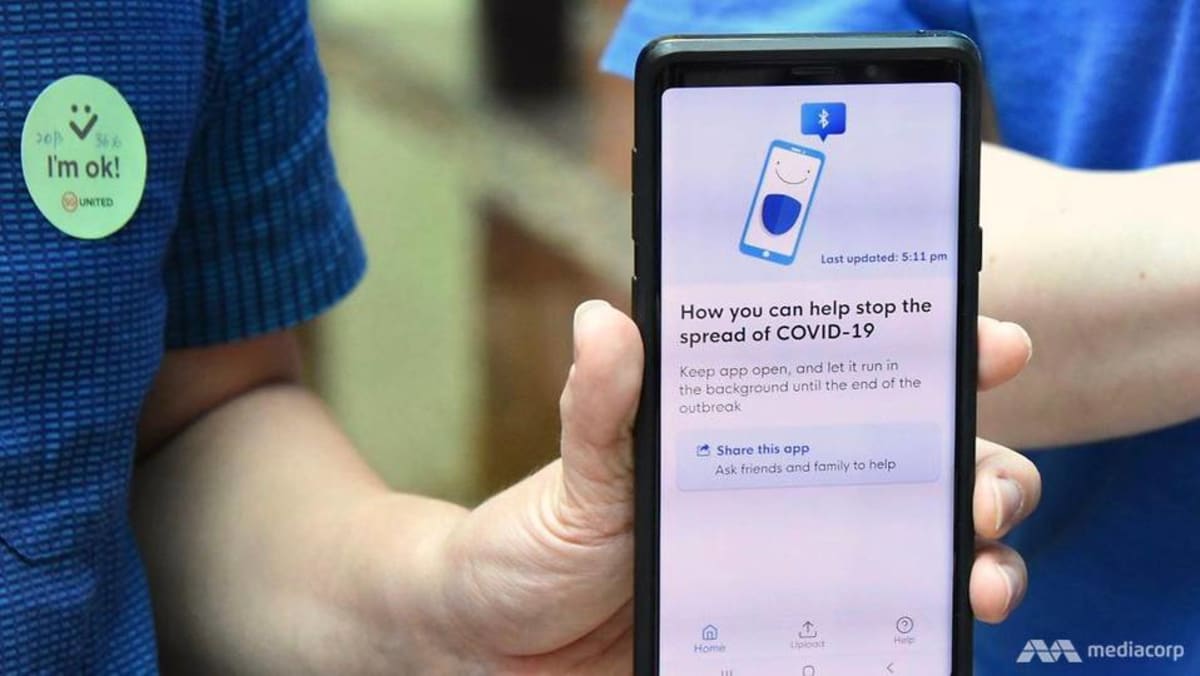
Singapore Police Force can obtain TraceTogether data for criminal investigations: Desmond Tan
SINGAPORE: The Singapore Police Force (SPF) can obtain TraceTogether data for criminal investigations, said Minister of State for Home Affai
CNA
146 points · by acekingspade · 5y ago · 137 comments
It was privacy first, well designed, and it works.
It was hamstrung by being opt-in instead of opt-out, relying on state level cooperation and misunderstood by people who didn’t even attempt to try to understand it (including here on HN).
As a result you now see dumber, less effective, less privacy conscious contact tracing in effect or governments relying on data brokers (all the other apps that collect and resell your data to third parties and are not opt-out).
It’s a shame.
https://www.apple.com/newsroom/2020/04/apple-and-google-part...
Tech like this is always abused by governments. Just look at how governments are attacking encrypted messaging services today. It would be naive to think same thing wouldn't happen for any popular privacy-first contact tracing app.
As a result of this we now have less effective, higher privacy risk implementations in place.
I wasn't fundamentally opposed, but as discussion went the way to maybe mandate usage, I thought it more prudent to abstain.
While technically there is nothing wrong with the implementation of Google or Apple, if they behave as specfified, I will not share any medical info with my smartphone as long as we do not have open systems in place.
The problem is understood and not accepted. These cases of third party ambition are a plain confirmation about the doubts many people had. You can ignore it but some people might not want to follow.
I have access to COVID tests through doctors in my family. I believe such tests would serve us better than these wellness apps. Scaling up the production would be possible within the budget that was used for tracing apps.
Could it facilitate implementing one? E.g. could a country push for changes to how the solution works within a given location?
The app does 3 things on your phone: 1) continuously exchange Temporary Exposure Keys with other phones with EN enabled, and 2) periodically download a list of TEKs, compare to locally cached list of TEKs to determine if you were in close contact with a COVID positive patient, and 3) in the unlikely event when you are tested positive, work with your Health Authority, use a one-time code to upload your TEKs to the key server.
If you are really paranoid, you can do 1 and 2 with just a battery powered Raspberry Pi Zero (someone has done that and was previously posted to HN but can't find it right now) which should be net beneficial to you. But if you just don't understand this framework please stop spreading FUD.
The existence of the first does not lead to the second.
It's another example of the persistent, naive belief amongst technologists that clever implementation can trump legislation.
If it is acceptable to use the data for contract tracing for, what exactly is the argument that the government should be using data for contract tracing but not other law enforcement? I can imagine a few arguments, but they all seem weak. The contract-tracing-by-app can of worms shouldnh't have been opened.
In those countries a lot of people dismissed the Google/Apple approach without understanding it which lead to a privacy worse approach that’s also less effective.
It is almost a case study on how you can't solve problems that are fundamentally social ones by throwing technology (old or new) at the problem.
You're absolutely right that it's a shame.
Sane policy and competent people to prioritize policy in order to lead effectively and move what needs to happen forward (massive categorical failure in the US on this bit, both in government and initial media response to the virus).
We also need the technical solution to consider privacy risk in the initial design so that we don’t implement something that can be abused later for other purposes.
This second part we have and it’s a great solution, but without the policy/leadership piece we can’t leverage it.
However, the apps built on top of the API have (at least in some instances) clearly fallen victim of scope creep - eg the UK app came with venue check-in functionality (which then suddenly became legally mandated and there was no separate check-in app so you were out of luck if your phone didn't support the API or you didn't want to enable Bluetooth) and a function which tells you how "risky" your postcode is which you can't switch off. There was even brief talk about it being extended to include "vaccine passport" type functionality.
This was, sadly, predictable, and is why many people simply won't trust it.
The other issue with the app-based approach is that it sadly appears to be pretty useless. At least the UK app appears to notify for far too many contacts, large numbers of which are false alarms of one sort or another (neighbours, people sat in different offices, etc). While using Bluetooth proximity was a good idea, I think it's fair to say at this point that in the real world it just hasn't worked.
I don’t agree that it’s useless, 15min of close proximity to a confirmed positive COVID patient within the timeframe is the best possible determination of exposure and people should quarantine if they get it.
I could be persuaded that too many are notified if there’s decent evidence of it, but with the massive case load/spread in the UK right now - I’m more likely to suspect that amount of people exposed is massive.
The issue in particular is that Bluetooth proximity isn't reliably able to distinguish between "next to but with a meaningful barrier in between" and "actually next to".
In my office, for example, we have areas adjacent to one another separated by floor to ceiling glass walls. People working on one side of the wall don't work with people on the other side and are not allowed to access the other area. There are quite a few scenarios like this (apartment blocks with thin partition walls between apartments, sat in a traffic jam next to another car, etc.
Are we so naive to believe that if only we adopted their “privacy conscious” solution, there won’t be less privacy focused solutions preferred by the government? Or that their solution won’t be forced to change to meet their legal requirements?
Your comment is case-in-point the kind of knee-jerk response that I was talking about.
Edit: You added the second part after I’d already responded. They developed a good model to do large scale contact tracing in a privacy conscious way. People rejected this with vague suggestions like your comment about how it could be changed to be the opposite of what they’ve developed. Most people didn’t understand how it worked at all or why the design was good.
As a result, worse less-privacy preserving methods are used.
What's surprising is that they disclose it. Perhaps he just wasnt prepared for the question
Some governments... We don't all live in a surveillance state.
The governments have 0 location data in possession when based on that protocol.
Where do you leave that's not a surveillance state?
And I think it was a genuine answer. This is a reply to MP, not a random reporter on streets.
At first, they explain the information is collected solely for medical reasons. Now they say they can use it as they please. Don't you see fallacy here?
I am sure it was a genuine answer - that's why I was surprised. Usually those things are sugar covered.
Technically not a fallacy (as there's no logical fault in what they said). Just falling back on a promise to the public.
Without a system that gives strong enough negative feedbacks to this kind of "usage", they will never go away.
Lack of negative feedback can be seen as a kind of positive feedback too.
The accompanying 1993 article for those who haven't seen it previously: https://www.wired.com/1993/04/gibson-2/
Firstly the fact that the leaders and all the population are squashed up against one another exerts a massive influence on the government. They're much more vulnerable to protest than other governments because they can't hide as easily. This makes them much more nervous and more willing to placate the populace than the government in, say, Myanmar, is.
Secondly they were competing with as well as trying to crush the communist Party. LKY co-opted a lot of their policies as well as trying to crush them. Note the essentially Soviet style housing and various effective social security systems. These were popular. This is a pattern that they have followed since (crush the opposition, steal their policies) and it helped fix their schooling system by bringing down class sizes in the 90s. Is that democracy? Kind of.
Singapore isn't proof that if you get the right dictator he can be benevolent. It's proof that the will of the people can be exerted through means other than the ballot box and that even a thug can do the right thing if he lives in fear.
Singaporean here. They've done well in the 55 years we've been around to make sure that people don't protest — people here value wealth and personal comfort over the thought of going to jail for their freedoms.
Even a solo person holding up a smiley face might get charged and indicted for an "assembly" in Singapore: https://www.bbc.com/news/world-asia-55068007
From my read of the situation, there is some worry that activists might be cracked down upon.
Unless they've changed the schema, it should be just a SQLite database [1].
Most people with some competence at app development should be able to access the data file on their (Android) phones, and delete any rows which might prove troublesome.
They could also just uninstall the app and wipe all data if they want.
[1] https://medium.com/@frankvolkel/tracetogether-under-the-hood...
https://www.health.govt.nz/our-work/diseases-and-conditions/...
Once it's mandatory to have such app it's game over. Doesn't matter what algorithm is being used, doesn't matter who developed it. It's insanely easy to abuse this. The government will simply deny there's any sort of backdoor and gaslight people who say otherwise.
By that definition there really aren't any entities that you can trust. Including family, friends, etc.
so, if you were within range of a device scanning wireless bands at a certain time in a certain place, light forensic analysis of your phone, wearables, car, etc. could place you in the vicinity of a crime with up to dozens of times the resolution of mobile network tracking
you bought the burner phone, the burner SIM card, disposed of them by ..burning, but drat! that blasted Fitbit got you fingered
and that's just one example of open involuntary surveillance. scanners can be small, cheap and housed anywhere with minimal electrical power. in urban areas it would be trivial to track permanently and store indefinitely someone's minute-by-minute position, especially in conjunction with known CCTV blindspots
The government is every bit authoritarian which at this point increasingly looks like a euphemism for totalitarian.
https://www.aristeon.net/2019/04/singapore-as-pioneer-of-cap...
https://freedomhouse.org/country/singapore/freedom-world/202...
If it's 'control' then why is birthrate high in many dictatorships? If it's apartments, why is birthrate decent in many ex-soviet countries full of apartments?
As for general societal progress, I am really not sure what are you talking about. There is no progress whatsoever.
Economic progress is a thing. https://www.worldbank.org/en/country/singapore/overview
> Singapore is a high-income economy with a gross national income of US$54,530 per capita, as of 2017. The country provides one of the world’s most business-friendly regulatory environment for local entrepreneurs and is ranked among the world’s most competitive economies.
> In the decades after independence, Singapore rapidly developed from a low-income country to a high-income country. GDP growth in the city-state has been amongst the world’s highest, at an average of 7.7% since independence and topping 9.2% in the first 25 years.
For example, labour laws are faaar from what people imagine of Singapores ultracapitalist image.
And the Australian Covid tracing app is a copy/paste from the public open sourced github repo the Singapore government shared.
I guess being part of FiveEyes makes any fantasy of me _not_ living in a surveillance state pretty lame...
The GitHub repo has a "reference" implementation of the published BlueTrace protocol [1].
Encryption keys aside, it's not possible to reproduce the Singapore TraceTogether builds currently released on both the iOS and Google App stores.
Apple and Google’s thing was late to the party too, both Singapore and Australia had published their apps before the in built OS exposure notification because a thing (and I’d ballpark over 90% of Android phones haven’t got OS upgrades available that let them use the Google one anyway, none of my Android devices have it, being stuck with no manufacturer support or locked down by carriers).
So Australia and Singapore pushed on with their non OS native versions of the apps, even though the Bluetooth implementation on iOS made it very unreliable if the app wasn’t running and in the foreground. (The Android version’s Bluetooth is more reliable, if just chews through battery at a very quick pace...)
The end result is almost no useful data has come out of it here: https://www.theguardian.com/australia-news/2020/dec/15/covid...
Just 20 “close contacts” identified, and the government stalling on freedom of information requests to find out if any active cases were identified from those.
The 'tracking for criminal cases' is clearly a 'bad thing' but ... it's also legit democracy with excellent universal healthcare and rule of law.
... careful with the easy characterizations.
> it's also legit democracy
If your interpretation of a democracy boils down to mere voting rights and choice, then sure, it's legit. But I think we should also consider the trickle-down effects of having the same party in power ever since the government was formed. Your ethics, beliefs, judgment, and mentality determines how you vote - it's not that hard to sway the majority to your side if you are always in total control of how lives are shaped across generations.
Edit: I’m getting downvoted. But I wrote this as a warning: that if you don’t value your privacy, then others, will make sure that you have no privacy.