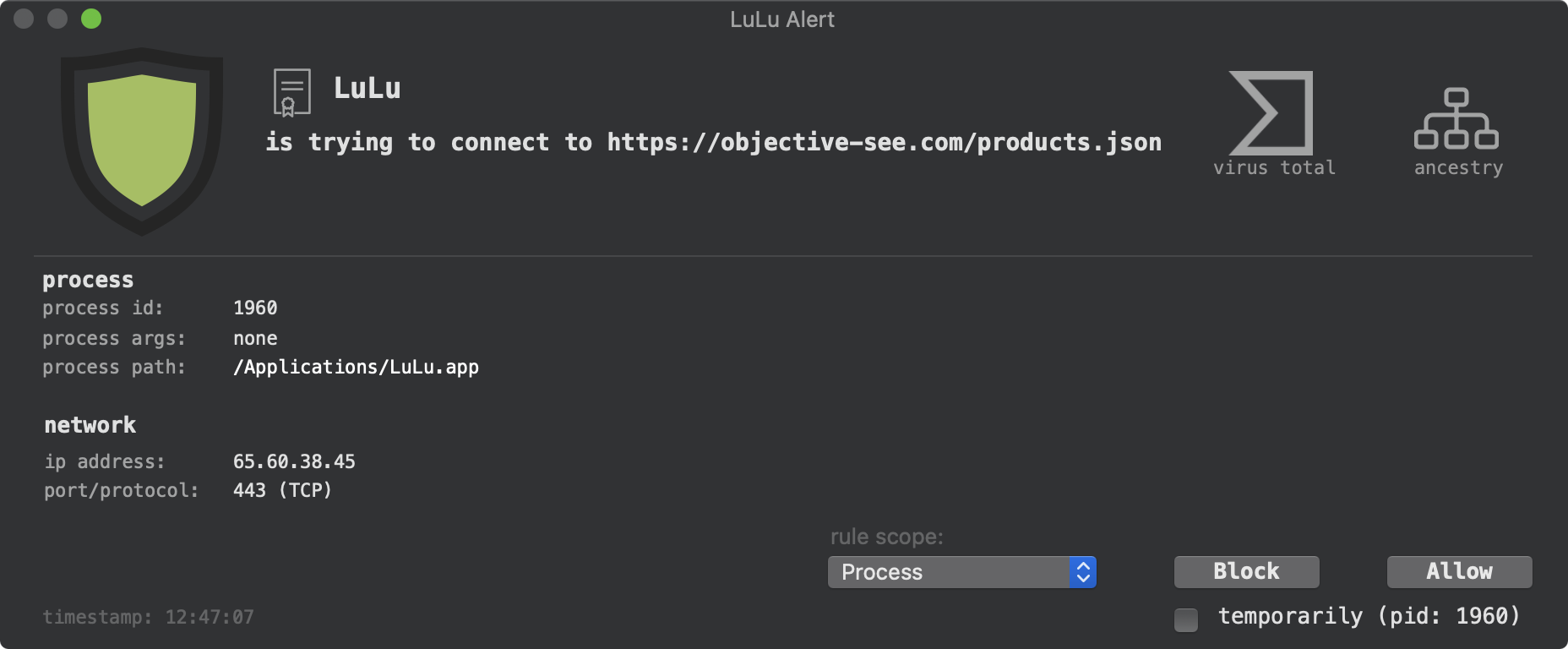
LuLu
objective-see.com
364 points · by tambourine_man · 5y ago · 150 comments
(bypass NEFilterDataProvider)
It's a gross invasion of privacy, and a security risk.
(By the way, even in Lulu, some Apple system software - apsd, automount, helpd, mDNSResponder, mount_nfs, mount_url, ocspd, sntp, trustd - are whitelisted and cannot be blocked by the user even if they want to, and that's bit disappointing).
There are currently 3 ways I know of to block them:
1. Exclusions Blaster https://www.vallumfirewall.com/eblaster/
2. Enabling Little Snitch 4.6 kext under Big Sur https://www.obdev.at/support/littlesnitch/245913651253917
3. Convoluted hack: https://tinyapps.org/blog/202010210700_whose_computer_is_it....
They say "that option could go away at any time", but that would require Apple to make SIP mandatory, and I still don't see that happening. There may come a time, however, where you need to actually disable part of SIP.
It's a natural outgrowth of a corporate "efficiency" mandate that puts functional groups together vs. cross-functional groups. That pendulum is ever swinging.
They never claimed to be the 'privacy king'. They just suggested it, and people took the bait.
Apple is a company, and as such are only allowed to care about their bottom line. If privacy aligns with their bottom line, they'll use it for easy advertisement and goodwill, but if it doesn't then they'll forego privacy just as easily.
I'm aware of Gatekeeper checking developer certificates upon opening apps over an unencrypted connection (so far; Apple is fixing that), but not sure where the gross privacy invasion or security risk is (in particular compared to existing alternatives, not some platonic ideal).
Here, FWIW, is what Apple says about Gatekeeper and Notarization. I'd be eager to hear any evidence that this is incorrect.
> Gatekeeper performs online checks to verify if an app contains known malware and whether the developer’s signing certificate is revoked. We have never combined data from these checks with information about Apple users or their devices. We do not use data from these checks to learn what individual users are launching or running on their devices. > Notarization checks if the app contains known malware using an encrypted connection that is resilient to server failures.
> These security checks have never included the user’s Apple ID or the identity of their device. To further protect privacy, we have stopped logging IP addresses associated with Developer ID certificate checks, and we will ensure that any collected IP addresses are removed from logs.
> In addition, over the the next year we will introduce several changes to our security checks:
* A new encrypted protocol for Developer ID certificate revocation checks
* Strong protections against server failure
* A new preference for users to opt out of these security protections
The same reasons that people use application firewalls on their system - Access to our personal data by Apple - intentionally or "accidently". Malware may be able to hijack Apple whitelisted softwares to do their mischief. (And please don't reply by saying we can "trust" Apple with our data - I don't, and if I have paid for a computer I consider it mine, not Apple's to meddle with it as they please).
As for the Gatekeeper incident, the only comment I have to add is that I really don't care about Apple's "apology" after they have been caught ...
Obviously that's a personal choice, but for me losing that level of control of my desktop operating system - and seeing this as the start of a trend that will only get worse - is not acceptable, so I will look to other OSes to do my work.
I'm sure Apple will continue to sell tons of Macs and that's fine...
Use a better OS. Seriously, just use Linux if you want that level of control. Most users are happy to give up control in exchange for pretty graphics, easy UI, etc.
(Ofcourse, the best solution is to not upgrade macOS and stick with macOS Mojave).
Over the years Apple expanded their frameworks library to reduce need for custom .kexts, but they are still supported even on M1 Macs (as long as they are compiled for ARM64).
So to answer you question - 'root' user on macOS is by default not a true root in unix sense, but can be trivially turned into one by booting computer in recovery mode and running single command in Terminal. Restart into recovery mode is required so that malicious applications cannot change it on their own, even if they would use unknown privilege escalation technique.
These attempts* go on 24/7 even with 0 apps open and the computer being idle.
* https://i.imgur.com/md2ykLl.png
helpd, geod, locationd, cloudd, the list of apps phoning home when your computer is idle goes on and on and on. Nevermind that they have the metadata to track every launch of every app on your OS.
Then you've got Adobe who is apparently convinced that by virtue of installing their software, they own the resources on your machine and network to their heart's content and spam non-stop phone-home messages to adobess.com adobesc.com adobe.io etc etc
Whoever figures out how to make a system-wide firewall that can block everything including "unblockable" Apple network traffic likely deserves (again: IMO) all the attention we can give them.
Not sure who to believe but I'll pass for now.
What got you annoyed?
I use Little Snitch 4. I very much dislike the GUI change in LS5. And it seems to be less user controllable.
I do not know anything about Lulu, except the developer seems like a decent sort based on the warmth here.
Did you purchase a Little Snitch licence?
I wonder why someone would go with LuLu if they've already paid for Little Snitch, when LuLu has fewer features.
"Objective-See", the name of the maker of LuLu, is a pun on Objective-C.
"Objective Development", the name of the maker of Little Snitch, is likely also based on Objective-C.
I'm not affiliated with them.
It's not completely stable yet, but we are making great progress. We'd love feedback!
Some features are paid.
It's not completely stable yet, but we are making great progress. We'd love feedback!
Speaking of a desktop (not a server) firewall I'm rarely even interested which host/port/whatever is a connection about. What matters to me is what app initiated it (if it's initiated from outside my PC it should be always blocked).
Iptables used to expose a field attributing a connection to a particular process but this feature was only available in old 2.4.x kernels IIRC.
How does this model work for commonly used programs like curl? Do you block it and can't use it at all in your shell scripts, or do you whitelist it and hope that nefarious programs don't use it to exfiltrate data?
I don't put sim cards in my phones anymore, and instead use a portable LTE VPN travel router (which runs OpenWRT, on which I have root) because of the things I learned over the last decade from apps like this.
There should be per-host, per-app permissions in any OS that claims to care about privacy, just as Apple recently added per-directory, per-app permissions to fight ransomware.
For example, a Sublime Text plug-in (TabNine), even if I allow permanently outgoing connections the plug-in has to make, LuLu will keep asking me for permissions next time.
There is an issue open for that matter but no fix yet apparently: https://github.com/objective-see/LuLu/issues/147
ZoneAlarm also used to be good, but used more resources and is not free - https://www.zonealarm.com/software/firewall (note that you do not need their crap browser extensions that it will ask you to install).
It comes with preset rules to allow most of the essential apps communicate with Apple but they can be overridden to stop my computer from even getting the NPT time.
VERSION 1.0.0 (08/09/2018)
I could probably live without LS, but the UAD support being withdrawn is quite concerning given the level of investment I have there.
Lulu has a quirky interface, but it's much clearer. Of course it also helps that it's free and open source.