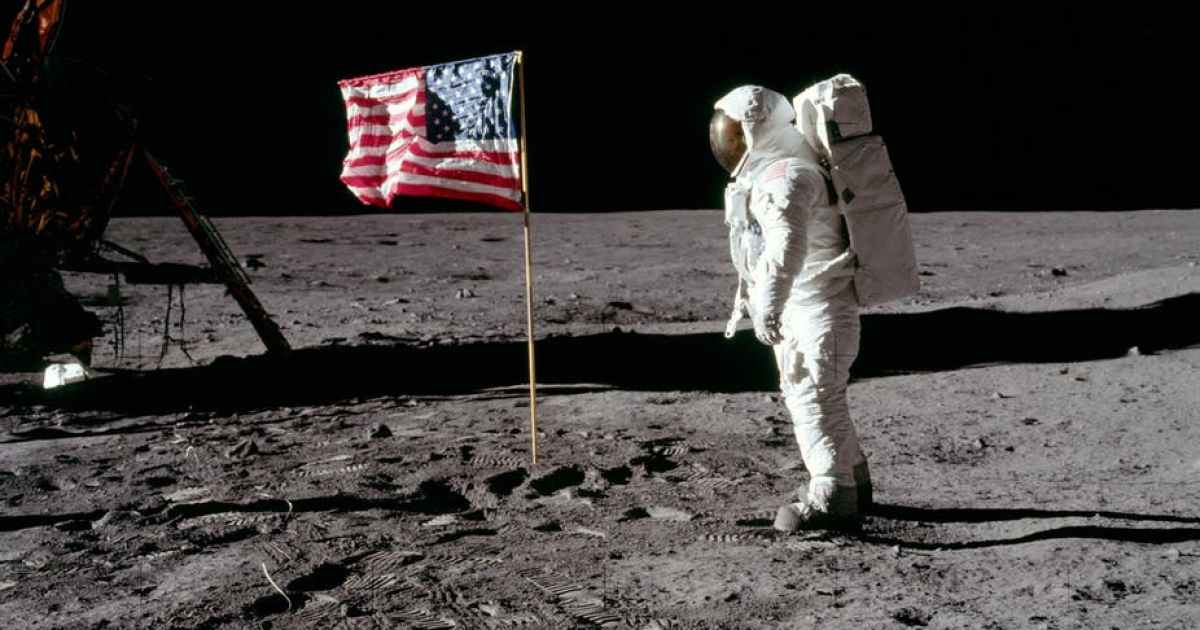
Neil Armstrong's bootprint (and other lunar artifacts) are now protected by U.S. law
Who cares what happens to bootprints on the Moon? All humans should. And thankfully the US Congress and president agree.
Astronomy Magazine
36 points · by vinni2 · 5y ago · 56 comments
Just kidding. But what's the point of legislating things beyond our control?
1. Your nationals can be expected to follow your laws.
2. You can use this as a stepping stone to asking other countries to normalize their laws to be similar to yours, or for a treaty negotiation, or for a UN decision.
The principle of this law isn't a bad one, and it should be extended to other early artifacts of lunar exploration.
You are certainly correct, if maybe only in theory. At the rate things are going, good luck with any country freely harmonizing anything with the USA. The USA is more likely on a steady course of becoming increasingly less relevant to anyone but themselves.
A different president is not going to change that. The country's international policies (current and past), in particular its use of their relative economical and military power imbalance, have been abusive for way longer than just this last president. Ordinary citizens around the globe have become increasingly more aware of this, often from experiencing its unpleasant consequences. It already has become harder for many foreign politicians to keep giving in to US power play, to how it essentially treats the rest of the globe as its own territory. Expect things to get a lot harder for the USA.
Meanwhile, a growing group of people looks at the USA's internal affairs, wondering why on earth anyone would take any guidance or example from such a nation. I guess that plenty of US citizens will blame that all on the last president (certainly in part for very valid reasons), but the problem extends way beyond that. Regretfully, the USA just can't stop itself, for what it does internationally (mostly unknown to its own citizens).
Feel free to shoot the messenger .. it won't matter.
While it is certainly true that the USA is loosing it's status as the world's only superpower, it is still very much the most powerfull country and will probably stay, if not number 1, at least in the top 3 for at least the rest of our lifetime. I wouldn't call that irrelevant.
Who cares about a U.S. law outside of US jurisdiction?
If the U.S. wants other countries to follow the same rules they need to make international treaties like the outer space treaty from 1967. That requires actual diplomacy of course.
Alas, Julian Assange for one, as an Australian citizen, indicted for breaking a US law while not in the US. The recent UK court decision not to extradite him to the US nevertheless in no way disputes US standing nor jurisdiction, and he remains in custody while the US appeals. So, we're all living in America.
Australian court agreed to treat his activity as having taken place within US jurisdiction despite him never leaving Australia.
If I'm a German citizen residing in France hacking UK hospitals, the UK very obviously would want brought to justice, which both France and Germany would happily agree to in this case, I'd imagine.
> As things stand at the time of writing, following the UK’s departure from the EU [...], the UK will no longer be part of the European Arrest Warrant (EAW) system. This means that, unless and until other arrangements are agreed, future extradition requests with European states will be governed, as with many countries outside the EU, by the 1957 Convention on Extradition, leading to increased costs, delay and complexity in extradition proceedings. Certain EU states already do not extradite their citizens to countries outside the EU. Three EU states – Germany, Austria and Slovenia – have already announced that they may even refuse to surrender their respective nationals to the UK pursuant to an EAW during the transition period.
It can be seen as a "small step" (pun intended) to creating something larger like the World Heritage Convention, via diplomacy as you say.
I cannnot believe that those types of claim and the advance of the Chinese Lunar Exploration Program is entirely a coincidence.
Of course, the situation will slowing evolve for decades before anything concrete comes out of it. And I do think the "common heritage" claim, even if doomed to fail eventually, tend to slow down the conquest by national powers. The situation in Antarctica is illuminating in this regard.
Many countries exercise extraterritorial jurisdiction laws and go after people who break them, this includes the US. If they can reach you, they will prosecute you if they want.
Normally this applies to the states own citizens but they will target foreign citizens who have hurt the state (see Assange).
Spying, poaching, abuse of children and war crimes are where some of these extraterritorial laws are exercised.
Cricket on the moon would sure be interesting.
This is a treasure of humanity’s achievement; and since there is no global governance body, it makes sense to start here.
apologies if I don't participate in this empire-building dream of US superiority.
it was the culmination and outcome from decades of measuring dicks between 2 super powers where one arrived quicker than the other. how is this not the same as when the DPRK is displaying their ICBM's and idiots in uniform goose stepping?
this kind of nostalgia is 50ies 60ies wishful thinking and no different than waving flags or rooting ones ego in nationality or religion. utterly backward but not unexpected for a country that values military achievements higher than the need for an affordable health care system etc.
Yeah they've been to the moon x years ago but these days they got thousands dying literally every day and 30% of the populace looks and acts like this: https://projects.propublica.org/parler-capitol-videos/