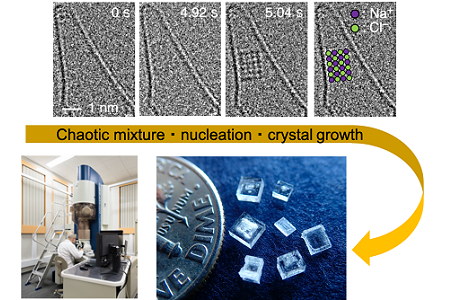
Crystal close up | The University of Tokyo
The University of Tokyo
664 points · by rbanffy · 5y ago · 125 comments
Hard to believe it’s not a computer model. I mean, I guess underneath there must be a hell of a lot of signal processing going on to render that video, but atomic-scale video is wild.
Funny that it looks kinda like MPEGS online circa 1990s.
The sensitivity of instruments like LIGO is hard to get your head around.
Even the movement of the crystal looks like a wave, but I don't know if that's because matter moves as a wave at the atomic level or if that's just an artifact from the camera.
Artifact of the imaging, note the time scale of the movie, it's much longer than any quantum oscillation. Each individual image of the movie is taken eons apart from the perspective of the crystal.
Given the timescales of atomic reactions, which IIRC is typically measured in nano- or picoseconds, this video is more like watching galaxies form I suppose.
I'm pretty sure in Quantum Mechanics systems like this the entire unit behaves as one and there's no real distinction possible regarding "which is which" if you were to try to identify individual atoms. It would be like looking at a standing wave pattern in water (or any other medium) and labeling one peak "Wave A" and some peak "Wave B". You can't really do it. Because for the standing wave pattern to exist at all it has to be the entire system interaction to cause it to emerge.
I'm not saying atoms are "Standing Waves" but I'm merely making an analogy. However even from some perspective you could even say any oscillating system of wave probabilities when taken as a "system" comprises a standing wave.
I'm not a salt nucleation expert by any means, but I'd imagine the process has a similar statistics as protein folding. Individual folding events (and nucleation events) are superfast but takes forever to trigger (a lot of stars have to align so to speak). This is why, from just looking at frames 1/25s apart, it looks like suddenly things appeared out of nothing, but really there were eons of time in between the frames in the video.
The grow experiment was at room temperature 298K. At this temperature the nuclei of the atoms behave almost classically. There are some important quantum effects between the electrons, but their mass is like 10000 smaller. The effects are small in the electrons in the lower levels that are close to the nuclei, but in the valence band they can be very important. Specially in conductors where the electrons are very delocalized, but this is not a conductor.
https://www.reddit.com/r/BeAmazed/comments/l2mtfx/separated_...
> Two novel techniques, atomic-resolution real-time video and conical carbon nanotube confinement, allow researchers to view never-before-seen details about crystal formation. The observations confirm theoretical predictions about how salt crystals form and could inform general theories about the way in which crystal formation produces different ordered structures from an otherwise disordered chemical mixture.
> To hold samples in place, we use atom-thick carbon nanohorns, one of our previous inventions. With the stunning videos Sakakibara captured, we immediately noticed the opportunity to study the structural and statistical aspects of crystal nucleation in unprecedented detail.
Creating shaped nucleation sites using carbon nanotubes (nanohorns?) sounds like a fascinating technology. I don't have access to the paper unfortunately - I'm curious what other types of crystals could theoretically be grown with this technology. The authors mention graphite - what about silicon? Could it be used to grow more regular crystals for use in electronics? With fewer defects, I'd imagine we could reduce the failure rate in manufacturing.
The website you're looking for starts with sci and ends with hub.
I'm amused that Chemists / Physicists also have the word "Polymorphism" and that it means something completely different from the programming term.
Seems like a good reason to stop using it [in programming], and the technique behind it.
Or am I completely mis-skimming the Wikipedia entry on panpsychism?
Mundane, that is even more amazing.
> What is your experience of your own Being-ness?
My electrons and nuclei are arranged in a weird pattern. If you ask them if I'm conscious, they can move another electrons and nuclei to type "yes". If you ask them if I'm lying, they can move another electrons and nuclei to type "no". It's just a strange pattern that simulates a delusion, don't trust them.
The immediate if indirect answer I can give you: I stopped feeling this sense of wonder, mystery, greater purpose of reality, somewhen during my university years. I only ever experience these feelings when consuming works of fiction.
The definition of consciousness is very much tied to how humans (or some scientists) perceive consciousness. I'm pretty sure my dog is conscious of itself and its surrounding. It just happens to have a less sophisticated consciousness than the one I have. Some animals might have a pretty high consciousness but they fail to communicate it to the humans.
I like to think that, somehow, Alan Watts and John Conway were digging the same tunnel, just starting from the two endpoints, and bound to meet at some point in the future. We just need a few more diggers of that stature (tall order, I know).
I have a paper by Anthony Cashmore that I will cite here later.
I especially like the chill-step YouTube videos some people assemble and publish. I download them with youtube-dl and listen to them on my phone at night while drifting off to sleep.
At 61 years of age, the philosophy he describes (Advaita Vedanta / Zen Buddhism / Taoism) brings me great comfort.
Does this feeling arise because those atoms move? Or is it the self-assembling behavior? Is this the same feeling some people have when they see a door suddenly close due to the wind, as if some spirit is responsible? I remember feeling like this as a kid. But getting older, I realized that this feeling of agency behind everything is unfounded. And the feeling faded away.
Of course, maybe it is true! (That felt good to say :)
Those two are... sadly quite different than the TFA video. Those are cartoons, steeped in artistic license, accommodation of animation software limitations, and artists regrettably but intentionally prioritizing "pretty" over a misconception-spawning lack of resemblance to reality. Think of a video of Saint Trump's day, with frames selected to show him floating along, limbs unmoving, through a deserted White House. Problematic when learning biology. Not a good source of ground truth.
Not as cool as experiment of course
You should throw up some videos of these somewhere, if you have the time.
> Straight away, they noticed a statistical pattern in the frequency at which the crystals emerged; it followed what’s known as a normal distribution, which has long been theorized but only now experimentally verified.
https://www.geoffreylitt.com/images/article_images/enhance/g...