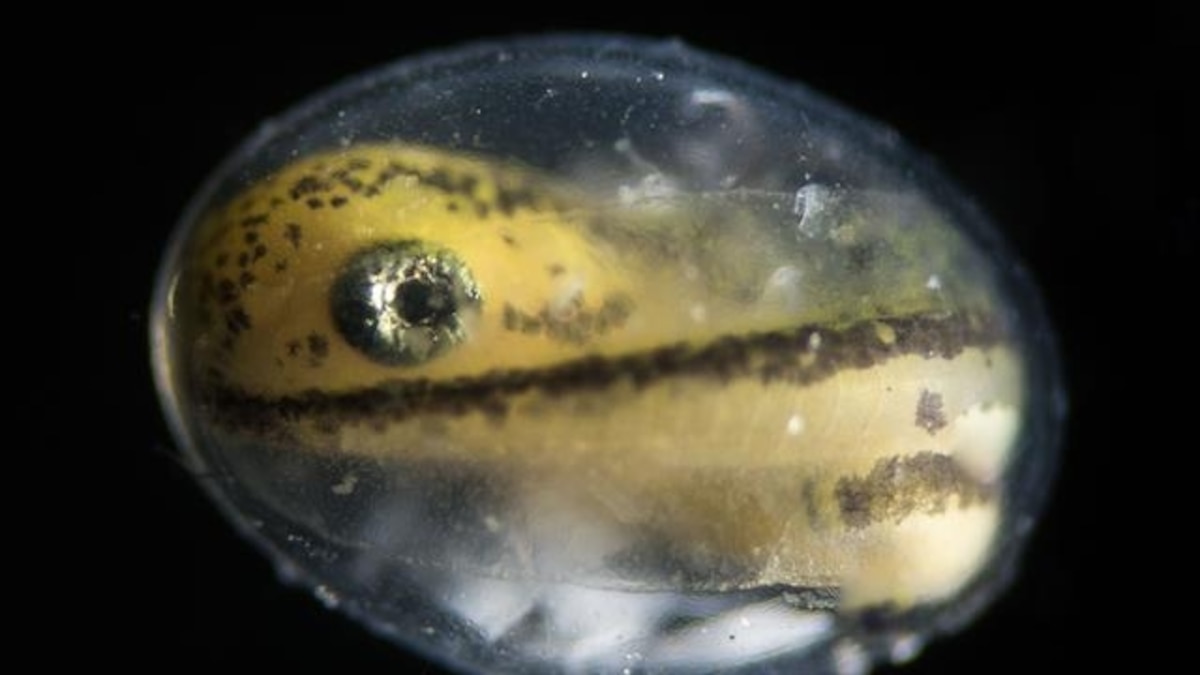
Incredible time-lapse shows a single cell transforming into a salamander
See a salamander grow from a single cell
Animals
911 points · by smusamashah · 5y ago · 292 comments
https://pmdvod.nationalgeographic.com/NG_Video/772/995/14428...
youtube-dl https://youtu.be/SEejivHRIbEI dealt with the page for as long as I could, scrolled, saw no video and came back here for someone to surely give the direct link. I think someone has trained me, but for what purpose I am not sure.
And yet there it is, and what's more the finished product comes fully loaded with all sorts of instinct about the physical world, plus an ability to learn as it goes that our AI can't hold a candle to.
And that's just the Salamander version. Feed in a different strip of ticker tape and now you're looking at your very self emerge.
It's utterly unnerving to behold.
One of the best arguments that there is no God is exactly that beauty and complexity. It's only complex in a certain type of way, an evolutionary type of way.
No animal has jet boots, or fusion power, or laser beam eyes, or the billions of really useful, but impossible/really, really hard to evolve features. There's no design. There's no plan. There's only evolution baby!
You'll have to make do with some generalizations though, trying to go into the detail of every single thing is probably beyond what can be read in a single human's life time now.
Bill Bryson's A Short History of Nearly Everything is pretty good start, or Unweaving the Rainbow by Richard Dawkins, which is a book about how science makes nature even more beautiful by explaining it, not less.
It doesn’t matter whether I’m atheist or not, but to state that you can fully explain - well - any process of the universe is simply naive. There are areas we know many things about, but biology itself has an enormous amount of accidental complexity, (which is often brought up by atheists as a criticism of design) for example many many signal path ways that do fundamentally the same thing, but differently. Compared to that, spaghetti codes have good architecture.
Whether God exists or not is imo orthogonal to the complexity of the world around us.
No, starting from beetle eggs does not count. They point is no one knows how to start from the inert chemicals that make up a beetle and cause them to assemble into a living beetle. More generally, abiogenesis has not been cracked.
We all are able to take that little step inside our consciousness, trusting our innermost ancestral intuition and logic... to be grateful and humble in front of whatever is behind this universe.
I've read some books on evolution, many about philosophy and religion, and I find it all fascinating, but I didn't completely escape that feeling that it's not enough...
But, instead of saying "these explanations aren't satisfying, there must be a god behind these misteries", my position is "these beautiful explanations aren't completely satisfying, I'm left with some uncomfortable questions, and that's just part of being a human being".
I've been a devout catholic, I've been a kinda-skeptical non-denominational christian, I've been a staunch atheist and a buddhist-leaning agnostic... and I've never felt that I could find perfect answers. Some uncomfortable questioning will always be there, and it's better to try to make your peace with it before trying to solve it.
Trying to solve it is also fine, but not the complete answer.
Everything else is babblery and charlatanery.
How does that logically follow? To me that is clearly just a projection of the human concept of a "creator", a person who makes things (like a house, a fire, or a website), onto the universe. I see no reason to project my human experiences and ideas onto something as vast as the universe. Whatever is "out there" or "beyond" is by definition something that far exceeds our comprehension, our human concepts. If you want to call that "god", so be it, but I don't see how that's anything more than just a placeholder for something we can't reach.
We can, on the other hand, gradually understand more and more of the laws and properties of the universe itself, and how those work together to create the phenomena we find in the universe. All those gaps in the subset of phenomena that we can observe, I am confident that we are at least theoretically capable of understanding.
I conclude that God is the origin of everything. this is something you can't prove or disprove with Science. Some might argue it's not worth thinking about, but it comes down to the individual whether they want to think about it or not.
But man, our universe sure is weird. On a fundamental level. I think people under-model just how strange our universe is. Even things like Pi. Why does Pi equal Pi? What an unlikely number to define something fundamental about the universe itself. Or take the logistic map [0]. I mean, what? Why is our universe this way? Or Euler's Identity (e^(pi*i) = -1). Why e? Why pi? I get that the math works, why does the universe need those values for the math to work?
Pi is just the ratio between the diameter and all the points to the same distance from another point, in base 10.
As simple as it gets. Circle = infinite points, thus Pi = infinite decimals.
There's no magic.
Well, it has to be equal to something, right?
Those can explain how life evolves once it already exists. And there's no argument about that, we know many laws governing those processes, from molecular to population-scale models.
However, nobody was able to show that life can emerge from non-living matter.
4.5B years of evolution vs silicon monkeys pretending to be gods
You may think humans are more amazing than salamanders, but no other species agrees with you.
I really wonder, too - does a dog care as much about a salamander as a human? How about a crow? Do crows think we're interesting at all? It's impossible to say.
Ultimately you're right though, we're just creatures trying to survive in various ways. Humans have very sophisticated ways of doing it, but they aren't inherently more amazing outside of the human lens.
I'd suggest as individuals of our species, we're not much more interesting than ribosomes -- one could say that ribosomes execute all the stuff in the salamander video (hey, they print the DNA into proteins).
Humans are maybe just biological machinery in the organism of culture, like ribosomes are the molecular machinery in the organism of biology. Culture does all those amazing things, and humans just skim along the unfathomably long and multi-dimensional ticker tape of language/culture :)
Just my 2c, of course, and the way I stay humble about humanity
I understand what you are feeling when you contemplate the wonder of humankind's technological achievements, which, by some measures, necessarily narrow, far surpass the capabilities of any other species. It's worth reflecting on this feeling, which comes reflexively to anyone who is presented with the intellectual challenge that you answered with your complete response above.
When Darwin first published his theory of evolution, he got a lot of pushback from people because of this exact feeling.
19th century British humans resented being "relegated" to the relations of apes. They scorned Darwin for saying it.
Why?
Which yet has to be proven they are really working in the long way, because we are still on trial. Also let's see if we can retain our humanity whilst surviving as a species.
> The very existence of a salamander... says very clearly a few points.
What does the existence of a salamander "say"?
I made a program to implement some of my theories.
You’re welcome to try it. cycell2d.com
My pet theory — morphogenic fields — is described in their on one of the pages.
(Caveat: I’m neither a biologist nor a ‘real’ programmer. But, I was able to come up with a system to ‘grow’ certain animals and found it a fun way to spend the lockdown... almost as much fun as posting ‘Covid is a hoax’ comments on HackerNews... ahhh... those were the days.)
[1] https://www.the-scientist.com/features/how-groups-of-cells-c...
Neuronal Signaling and Sodium-Potassium Pump (from PDB-101)
I'm not sure what the conclusion of biologists is today, but I have a feeling a lot of important mechanisms aren't encoded in the DNA - or, at least, not anymore. The key insight here is that cell reproduction doesn't happen out of nothing, it's always an existing mechanism working on a new mechanism.
The seminal paper of Ken Thompson, "Reflections on Trusting Trust" (1984)[0], demonstrates how you can encode a backdoor in a compiler in such a way that the compiler embeds this backdoor in every program it builds, and embeds the backdoor-embedding machinery in every new compiler binary it builds. You can use it to build a "vanilla" compiler and make it backdoor-embedding, even though the source code doesn't have backdoor-embedding instructions in it.
I suspect similar things happen in biology - there is computationally relevant information embedded in the runtime state, that's not explicitly encoded in the DNA - but it carries on, because every new living cell is built by a previous living cell.
--
[0] - https://www.cs.cmu.edu/~rdriley/487/papers/Thompson_1984_Ref...
In our more limited experience, certain levels of complexity mean unpredictable outcomes.
As for why-not-DNA, I think about it in terms of "If there were some way that was faster able to adapt organisms than DNA changes, wouldn't most organisms accumulate substantial functionality via that pathway over time?"
They definitely didn't get 100% of it right, buts its quite uncanny how the ancient texts were so accurate at predicting certain things that are only becoming evident in morphogensis research.
From something much simpler, and which has been iterating for approx 4 billion years.
Here's my best analogy: If you take one mole of "random" Rubik's Cubes (the number of molecules in a glass of water), then search for 'Solved' ones you'll find 512 are magically solved, merely by the power of large numbers. The ways molecules can 'snap together' are similarly 'finite', just like a puzzle.
Now think how many glasses of water are on earth. A replicating molecule would have existed probably on the FIRST DAY earth had cooled enough to form water.
If we knew what the shortest sequence if DNA is that can replicate, we'd be able to mathematically state the probability of it existing in any 'random' length of DNA of that length as 1/(4^N) where N is DNA length (number of AT/GC pairs).
Take it as 200 bases and you won't find another life in the observable universe. Avogadro's number is no match for exponential growth.
https://www.ncbi.nlm.nih.gov/pmc/articles/PMC3943892/
"The present study describes the directed evolution of replicating RNA enzymes that operate with an exponential growth rate of 0.14 min−1, corresponding to a doubling time of 5 min. Each parental enzyme can give rise to thousands of copies per hour, and each of these copies in turn can do the same, all the while transmitting molecular information across the generations."
But do you? If elements A and B tend to form compound A-B, and compound A-B can attach a further set of A and B, forming B-A-B-A which under certain circumstances will split into A-B and A-B, you have basic reproduction, and perhaps the occasional presence of element C will expedite the process. Game of life. In my [very] layman's view of the world, given a billion years or two, some such infinitely simple process should be enough to get the ball rolling, as long as it can somehow produce an ever so slightly errorprone copy.
To make an analogy, what you describe would be only the electronic chips or the logic gates of a computer. There are a still the CPU, RAM, and the whole software stack from the OS that runs our bodies (and mind you, there is a different one for each species) to the yet unknown abstractions from which human general intelligence emerges.
I think people underestimate how difficult it is for all the above to get started by accident.
That's well known. It is the key driver for the global contraceptives market, which generated revenue of $28,175 million in 2015 and is estimated to reach $43,812 million by 2022.
We are familiar with downs syndrome, 3 rather than the intended 2 copies of chromosome 21, only because it's comparatively viable.
Software programming or biological programming ?
These things have the same names but they're not really comparable
My understanding of Information Theory completely breaks down looking at this. It seems impossible that it works.
I have this feeling that we have not yet developed the theories that would make it possible for us to grasp how this truly works.
But it does not really explain certain phases of this process, in the beginning, where cells are dividing exponentially and suddenly a fold appears, and simultaneously many cells, many being far apart, start behaving differently from other cells just next to them.
So whatever chemistry or physics foundation helps achieve that, it has this capacity to be very selective (these cells far apart do it, but these ones next to them don't), i.e. it is not temperature, acidity/base concentration, pressure, or other basic physics, because these phenomena don't have this kind of selectivity.
But the big picture is that each cell has a decision tree, and local signal molecule concentration is the criteria on which they decide. And later each cell has the ability to express yet another signal molecule and so on. If we were to imagine a 2d plane and you could symmetrically place a secretion center of A and B signal in a left and right region respectively, than you can have a new type of cell in the middle if it changes based on “signal A and B is on”.
> Turing correctly predicted a mechanism of morphogenesis, the diffusion of two different chemical signals, one activating and one deactivating growth, to set up patterns of development https://en.wikipedia.org/wiki/Morphogenesis
> cells move to be near other cells of similar adhesive strength in order to maximize the bonding strength between cells and produce a more thermodynamically stable structure https://en.wikipedia.org/wiki/Differential_adhesion_hypothes...
I agree those can be very compact, and looks like a whole world is depicted in 4kb with music!
Demos are based on combining perfect geometrical structures in clever ways (planes, spheres, sinusoids, etc) because they all can be compactly expressed with the type of algebra/arithmetic/geometry that is exactly what our CPUs were built for.
If you watch many demos you tend to see certain symmetries, reflections, and other artifacts that make it all seem repetitive and plain (despite the number of moving objects, effects, etc.)
The process in this cell dividing feels very different to me, but it is hard to put my finger on it.
(1) In asexual reproduction, each successful offspring generates about 1 bit of useful information ("entropy")
(2) In sexual reproduction, each generation of offspring from population n can generate on the order of log(n) bits of information
Ref: Information Theory, Inference and Learning Algorithms by David J. C. MacKay
<video class="vjs-tech" id="aem-lead-video_html5_api" tabindex="-1" preload="auto" muted="muted" poster="https://pmdvod.nationalgeographic.com/NG_Video/772/995/becom..." src="http://pmdvod.nationalgeographic.com/NG_Video/772/995/BECOMI... itemprop="thumbnailUrl" content="https://pmdvod.nationalgeographic.com/NG_Video/772/995/becom... itemprop="name" content="See a salamander grow from a single cell in this incredible time-lapse"><meta itemprop="uploadDate" content="2019-02-14T22:25:17.000Z"></video>
Where can you find the link that ends in "audio_eng_3.mp4"?
It's a really complex system navigating all these different regimes of stability and instability, with variations caused by internal/external forces, yet coming out almost exactly the same every time.
That's why so many people don't accept the evolutionary theory. It's just hard to think on evolutionary timescales, there's no difference for most of us between 1 million, 10 million or 1 billion years. Nevertheless, it took billions of years for life to evolve.
To be fair it sometimes does not work and we end up with deformed babies.
This sounds to me like engineers talking about a code base :)
I loved watching for the moment the topology of the creature changed from a sphere to a torus. Not exactly sure when it happened, but there was a point where it wrapped itself in half and seemed to fuse.
Generally, in development, it's the lineage of the cells that matters the most. Skin and neuronal cells have a closer lineage than the gut cells do.
https://en.wikipedia.org/wiki/Alpine_newt#/media/File:Uhandr...
"And just as an organism in the embryonic stages seems to race through the aeons of evolutionary development, from single cell to ultimate complexity, in mere weeks or months; so the individual scientist in the course of their life repeats the history of science and loses themselves, by progressive stages, in the orchard [of science]."
Growing Neural Cellular Automata - Differentiable Model of Morphogenesis
The Fermi paradox asks, why haven't we found any alien probes? Why have we received no contact or evidence of aliens visiting Earth in the past? Why aren't there galactic-wide civilizations, or super advanced beings that have spread over the entire galaxy?
If there were such a being/civilization, perhaps their planning time horizon would be billions of years, instead of (optimistically) hundreds of years like for humans. With that magnitude of time horizon in mind, what might that civilization's colonization efforts or exploratory probes look like? What would their machines look like, if time was not a concern?
If 4 billion years is nothing to you, and assuming there really isn't a way around the speed of light, maybe sending self-assimilating, self-adapting machine "seeds" to all Earth-like planets is the most efficient way to expand or explore. Seeds that perfectly adapt to the environment they're exposed to, self-replicate, take over the planet, and then the solar system.
Sort of like the Protomolecule from The Expanse, instead of hijacking life, it hijacks raw materials, and was designed on a timescale of beings that think in terms of eons.
Like, why does it look so simple, like a ball of playdough, when it works more like a very complex machine...
My math is far too weak to even know where to start.
It may give a better sense of how much is lost when a species goes extinct.
I heard this anecdote during homily in church and honestly it perfectly describes how I think about God.
Stop using God as a placeholder and be more humble.
The correct answer is "we don't know", but for sure today God is not a valid theory. No more than Spiderman, Batman or cosmic magical people from Andromeda.
That's right. And that is the moment when science has to give place to beliefs. Everyone can have different. Some poeple none at all. For a person who wants to find a bridge between science and religion, this model may be good.
I can't wait until morality and governments will let us do the same with a human.
Could not find Reference for the electromagnetic radiation in time to do this reply sorry.
https://embryology.med.unsw.edu.au/embryology/index.php/Deve...
https://www.statpearls.com/ArticleLibrary/viewarticle/20922
https://pubmed.ncbi.nlm.nih.gov/14690282/
This man did a study showing how electromagnetc fields interfere with embryonic cell migration.
https://www.thefreelibrary.com/W.+Ross+Adey%2c+M.D.-a0163395...
https://en.wikipedia.org/wiki/Recapitulation_theory
(unfortunately, the theory wasn't very useful, and is mainly a historical curiosity today.)
"If you have a powerful enough language, you can take control of reality. This is what magical languages, like in the late Renaissance, were about. The only thing which comes close to that today is code for computers. Essentially, these are languages which, when executed, something happens. They are languages of efficacy. They carry, not meaning, but motivation to activity. This Kabbalistic question is very interesting; someone showed me, recently, a sculptural object, which, when illuminated from various angles by a source of light behind it would cast, one after another, each of the Hebrew letters on a screen. In other words, this was a higher-dimensional object which had the entire Hebrew alphabet somehow embedded in it. When I mentioned this to Ralph Abraham, he said, 'Well, all you have to do is digitize and quantify that object, and we’ll be able to compute from that three-dimensional object to a 5-, 6-, 7-, 8-, or 9-dimensional object, which would cast all letters of all alphabets into matter.' So one way of thinking of the 'transcendental object at the end of time' is as this kind of Ur-letter or Ur-word in hyperspace, from which, as it sheds the radiance of its syntactical numenosity into lower and lower dimensions, realities as literary functions of being constellate themselves."
All of this should be read with a very open mind however, nonetheless, the original video, the various "sacred" geometries (why are they even sacred to begin with?), inspire thinking that what if languages and symbols representing ideas are simply projections?
> more mechanical than magical.
This. As we learn more and more and our understanding expands, I don't see why not.
(I'm really pleased that we can have this thread on HN)
There are a few physics theories that use additional dimensions, but they are use quantum mechanics.