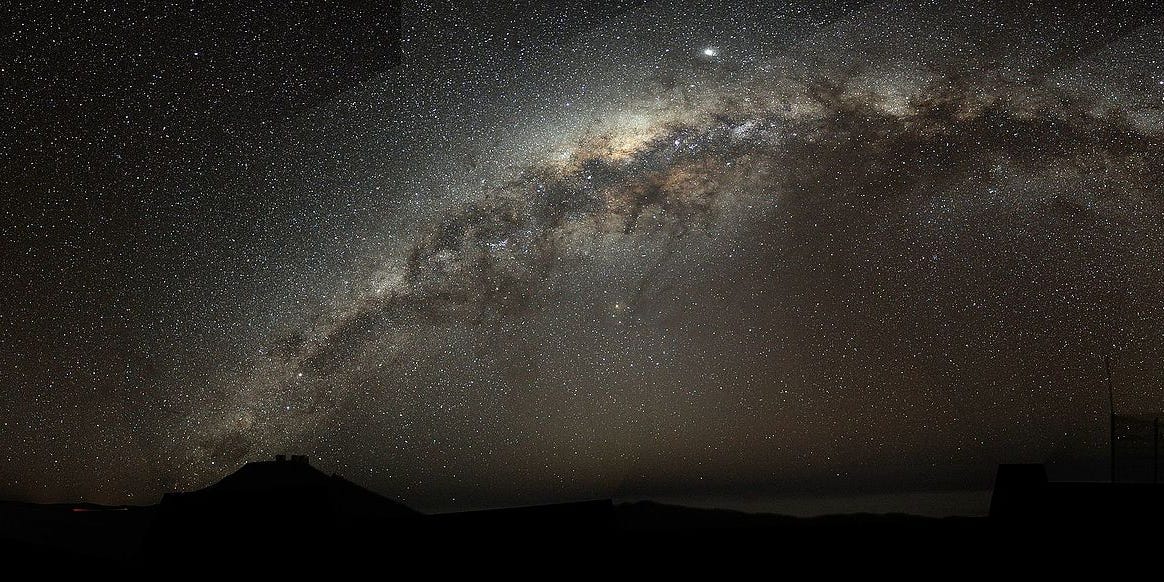
What Did We Lose When We Lost the Stars?
Starlink is a point of departure to consider the costs of the unrelenting drive toward artificial illumination, a technological development most of us now take for granted.
theconvivialsociety.substack.com
198 points · by cetera · 5y ago · 106 comments
You can see the distinctive cool white LED "O" of Apple Park from 20 miles away in a plane. Why? Just vanity? The huge amount of light bleed serves no functional purpose. Lights, lights everywhere lights. Lighting up nothing. You can buy an intensely bright fixture at Home Depot and just mount it up making any location bright as day, but 24 hours a day. LEDs may have actually made things worse because of their low cost per lumen and long operating lives that encourages more and brighter lighting.
I am out of step in wanting a world with less human noise and light. If I complain about how noisy I find the bay area and how I would love to punch the Harley rider who lives a block away in the throat the most common answer I get is 'Wow, India and China are way louder' like that should make me feel better or unjustified in my complaint. In truth all it does is make me want to avoid visiting those places.
They are awful for street lamps, porch lamps, car headlamps, flashlights, bike lights, camp lanterns, ...
People don’t seem to understand that adding massive glare in your peripheral vision and clobbering your night vision makes it harder to see everything, and makes everything less safe. (Not to mention screws up your sleep, prevents you from seeing the stars, is terribly damaging to nearby animals, ...) Street lighting (including from car headlamps) is safest and most effective when it is dim but even (human eyes are amazing at adapting to low overall light levels, given sufficient time) and not very blue, rather than bright and extremely patchy.
If people want to use LEDs, they should be dim, orange, diffuse, as low to the ground as practical, and directed primarily downward. The purported advantage LEDs have in longer lifespan and lower power use can conceivably make them better for street lamps if the lamps are made dimmer, more numerous, spaced closer together, brought lower down, and shielded better from the top and side. But if they are going to be put higher up, made intensely blue and extremely bright, then they end up not having any energy saving and making conditions worse for everyone, including drivers, pedestrians, people whose windows look out on the street, ...
The lighting vendors selling these over-blue over-bright lamps to cities and the public are doing the world a gross disservice.
[1] I'm a bit more sensitive to light than most people, I get migraines and have low grade photophobia 24/7.
People seem to abhor silence and emptiness. They hate it, or maybe they're afraid of it. They always want to fill it with something.
I love to walk around in the middle of the night because the car traffic around here virtually stops and silence and some degree of darkness returns. The busyness goes away. I'm always amazed that I rarely see anyone else out at night. Don't others crave emptiness too?
And also to disorient nocturnal migrating insects (with flow on effects down the eco system) while they signal to elites overhead how eco conscious they are by using recyclable packaging in the complimentary in-flight magazine.
Pretty much this. Humans tend to want to feel important and recognized, and what better way to feel big than to outdo the stars in the sky? When there's no more stars to outdo, all we can do is compete with each other.
People are so oblivious to light pollution. They don't realize how absurdly bright our lights are and how little they're actually needed. At minimum, they shouldn't be lighting the undersides of airplanes.
I didn't know what else I could do about this, so I inserted a light pollution level in my indie game. You have to replace these hideously bright outdoor lamps with full cutoff fixtures to gradually get the stars back. I wish there was more I could do.
The problem has to be educational. If the public valued the night sky, they would be amenable to fixing it. But how do you accomplish that if you're not any good at marketing or communicating?
I live in a purple area (one step brighter than black - none or close to none) on the pollution maps and even so, when a nearby city switched to LEDs for the "main drag" it made the city lights really apparent even further out than before, about 7 miles further out, due to the high humidity and other local effects.
However i do think that something needs to be done, i lived in a suburb of Los Angeles growing up (quite far though) and i remember being able to see the milky way during the summer when i was allowed to stay up later than usual or play outside later than usual. In my teens and early 20s though, we had to drive to angeles national forest mountain roads to be able to see the milky way.
What if another airplane has to suddenly climb at night?
But lighting would only really help VFR pilots if it was coming from above and they were looking down. Looking out and up from a small airplane cockpit to avoid traffic is really impractical. You're better off relying on ADS-B.
I can honestly say the stars were the most incredible thing imaginable. I slept in a swag, under the stars for many weeks. I’d wake up sometimes at about 2am for an hour or so as I’d go to bed so early because we had very little artificial lighting.
One particular night I remember the whole sky looked purple and white with stars, I could see so many objects moving, satellites and who knows what else, the sky looked alive.
I remember thinning how lucky I was to see it, I also remember thinking “why would anyone watch TV if they could see this instead ?”.
It really put things in perspective for me and made me realise the earth is an incredible spaceship, maybe the best one we will ever have!
If you also care about dark skies you might be interested in dark sky preserves¹ and the IDA².
(1) https://en.wikipedia.org/wiki/Dark-sky_preserve (2) https://www.darksky.org/
But light pollution, while producing waste heat, is also just unnecessary in general.
We don't need to keep office buildings lit all night, we don't need to have cities lit up all night like sports fields. Night time lighting should be on a targeted and as needed basis.
Light pollution: not deadly.
Air, water, soil pollution: all catastrophically deadly.
The effects may not be as immediately obvious or severe as the other types of pollution, but it is deadly
Time to turn off the lights https://www.nature.com/articles/457027a
Limiting the impact of light pollution on human health, environment and stellar visibility https://www.sciencedirect.com/science/article/pii/S030147971...
Light pollution as a biodiversity threat. https://www.cabdirect.org/cabdirect/abstract/20103347944
Light pollution disrupts sleep in free-living animals https://www.nature.com/articles/srep13557
LIGHT POLLUTION IN THE CONTEXT OF THREATS TO THE WILDLIFE CORRIDORS https://search.proquest.com/openview/f2decb732d52abd6837baa7...
Understanding, Assessing, and Resolving Light-Pollution Problems on Sea Turtle Nesting Beaches http://aquaticcommons.org/115/
I still think it's rather absurd to care more about light pollution than any other kind of pollution.
In contrast light pollution deprives you of a good view and messes up some nocturnal animals. Sure, it’s not great, but compared to other forms of pollution it’s almost a non issue.
"I know that most men, including those at ease with problems of the greatest complexity, can seldom accept even the simplest and most obvious truth if it be such as would oblige them to admit the falsity of conclusions which they have delighted in explaining to colleagues, which they have proudly taught to others, and which they have woven, thread by thread, into the fabric of their lives."
... or in other words: the most relevant component in the light pollution factor is the exponential factor of human reproduction.
Nevertheless, I've already noticed how much more I think about things related to what it is in the night sky. The slow movement of Orion. The so-far constant relationship between Aldebaran and the Pleiades. Learning (some) of the names of the most prominent stars. Being reminded month after month of how the lunar cycle changes the experience of the night sky, even on a day to day basis because of approx 1 hr shift in "when the moon is in the same spot".
I've spent plenty of time below dark skies, but have lived in cities more or less my entire (57 year) life. It's only been very recently that I've really started to have some sense of what is gained when one has the an experience of the night sky that is more like what our ancestors would have experienced: how it shapes one's sense of where we are in space and time, of how much vaster things are than our small lives (I say this even living in the American west, which encourages this experience all by itself), and of relationships in the sky that we can see but not really understand (without science and very complex and vast equipment).
Light pollution!
I see it from here. Look me up on a map: Waitati, Otago, Aotearoa.
The milky way is spray painted across the sky. I wonder what you mean? Is the light pollution in the cities far from you bad enough to obliterate that?
In a 200 mile radius of me there are probably not half a million people, concentrated in one direction, and a city of 120,000 fifteen miles away across a thousand foot high mountain. Seems odd to me I can see it and you cannot. Is it more visible in the Southern Hemisphere?
I go out most ever night. If it is clear I look at the stars, usually one, at random.
I can see the milky way easily and clearly. We have very little light pollution.
But it's nothing like a long-exposure photo of the milky way, as seen here:
https://www.google.com/search?q=milky+way&hl=en&gbv=2&tbm=is...
You are probably seeing a decent sky. Did you try observing after strong rain or winds? Do you have any light nearby? For perfect viewing you need clear sky after rain with no moon and far from any source of light.
I see it clearly, and I'm only 10km from Palmerston North which puts out a lot of light.
I've seen it from remote ocean, and more remote parts of NZ, and it never looks like those colorful long exposure photographs. Instead it barely has any color, but certainly has billows of tiny black clouds obscuring uncountable infinitely close stars that look like milk.
Some nights I think I can faintly see the Milky Way... but I might be fooling myself.
Seeing the Milky Way at night is incredible, but what a lot of people don't realize is that there is a whole lot more than the Milky Way up there in "plain sight" and huge, just too dim to see with the naked eye. Many people don't realize for example that the Andromeda galaxy is visually about 6 times the size of the full moon, but just too dim to see. Some of the nebulae I photograph are actually barely visible with the naked eye if you go to a truly dark enough place (e.g. Death Valley).
A big part of what I'm trying to do through photography is to inspire more people to be interested in space, STEM, and also protect the beautiful views that have been bestowed to us by the universe. It's something that I'm quite privileged to have easy access to in California but did not when I was growing up in Asia and later on the east coast of the US.
By the way, although although a lot of people have been pointing fingers at StarLink, including a huge swath of the amateur astronomy community, it's not actually a huge problem for most photography and observations. StarLink satellites are easily filtered out using even the most basic outlier rejection techniques (e.g. sigma clipping) and their tracks are presumably predictable and known in advance. They are much less of a problem in my experience than planes and assholes with car headlights who deliberately stop by your observing site for extended periods of time. I can't comment if there are any research projects affected by them but I imagine that at most they are an annoyance to data filtering and not dealbreaker.
I was thinking last week about creating a web app to teach light pollution. And a bit of brightness in astrophotography more generally.
Context is I'd like to sketch a primary-school "atoms up" learning progression, but emphasizing nuclei. Nucleosynthesis then pulls in deep time, galaxy, and stars. But many kids, and many teachers, have never seen a sky of stars. So how might stars, largely unseen, be tied to their everyday lives?
I saw this graphic[1] go by. But it's physically unrealistic - even faint stars in darkest "1" are shown brighter than the sky in polluted "9". So how might it be done better?
Perhaps as an interactive. A slider for sky illuminance. Another for exposure (pupil dilation, etc). IIRC, retina dynamic range is similar to a screen's. Conceptual buttons, like day/twilight/night, moon and phase, urban to sea, altitude, clouds, etc. These all next to a similar sky graphic, with room left over for secondary material. So one might explore the space from cloudy day, to nights with eye and instruments, to above atmosphere, Hubble, and beyond inner-system dust scattering.
With some potential for fun stories. Like once above atmosphere, being able to see a sky of stars in the middle of the day, as long as you're not looking towards the Sun, or anything sunlit. And for addressing common misconceptions. Like the moon and stars are only up at night.
[1] https://miro.medium.com/max/700/1*tMWGuSj2j3zs_oLTysYa3Q.jpe... from https://medium.com/starts-with-a-bang/your-guide-to-the-best...
This summs it up for me (being logically moved by intangibles without the wordiness):
> Meanwhile, it becomes increasingly difficult to recognize and defend human goods that cannot be objectively measured. And should some effort be made to quantify them, they are likely to be reduced, impoverished, and exploited.
> What do we lose when we lose the stars? What has it cost us to conquer the night? Perhaps only the poet can say.
If you care, get involved with the International Dark Sky Association https://www.darksky.org/
"Smothered" or "Cast away" might be better terms. Like what we're doing to beaches with plastic. We worked hard to create what blocks out the stars and covers the sands, as well as much of our other connections to once pristine nature. We know when we launch satellites, build smokestacks, drive where we could walk, and choose to fly.
We can fool ourselves that we didn't know, but as Feynman said, "The first principle is that you must not fool yourself and you are the easiest person to fool.", but also "Reality must take precedence over public relations, for nature cannot be fooled."
Starlink is a commercial operation intended to make money for its investors, none of whom asked for permission to do this, they just did it.
These fundamental things are being stolen from us by people with a stronger sense for coin than decency.
This is completely wrong, in order to launch Starlink SpaceX had to get approval from the FAA. You can't just stick whatever you want in space.
You do realise Starlink is polluting the skies outside of America?
Note: I am only a donor and not affiliated with them in any way.
http://www.davidtinapple.com/illich/1983_silence_commons.htm...
That will be when we get orbiting billboards: https://www.space.com/pepsi-drops-orbital-billboard-plans.ht...
I'd sign that.
I also like how the map makes lightwash look like a disease.
This is more correctly stated "The Starlink satellites are clearly not solely responsible for the loss of the starry sky."
But that's like saying, "It's OK to open this coal-fired power plant because there are lots of other ones already polluting the world."
Nobody consulted me (or my country, or any of the countries it's purporting to help) about Starlink. Our input is of course never needed - why would it, when America (both the government and the companies) can simply decide what's good or not good for us instead?
In fairness, this is a deep-rooted bitterness that goes far beyond this one project. The sheer fact that an American company can just up and do things that impact the entire globe on a whim (and worse, the power the American government has to approve/"regulate" such projects as though only their citizens are impacted) is unbelievably absurd to me (see also: Facebook, etc).
If that's all you think is lost, then you are apparently not a scholar of history, archaeology, philosophy, literature, or anthropology.
Moreover, just because -you- don't value something doesn't mean it has no value.
If we lose that essence of humanity where we feel wonder and awe looking up into the night sky, then we lose one of the prime movers of discovery and science. Or do you think cat videos can do the same?
Do we? Anecdotally, I grew up in the country and mostly didn't give the night sky a second thought, and yet have always been pretty obsessed with space-related fact and fiction.
I became really aware of the streetlights trying to look at the stars going down the road.
You used to be able to see so many stars from that road before street lights or houses were put in. So many stars it was hard to see the space between them.
When I got home, I ended up lying on the grass for a bit in the dark to try and look at some stars the street lights ended a couple of blocks away, so the yard's still relatively dark at night.
Then when I looked up and tried to watch the stars...all I saw were satellites zipping around everywhere.
When I was a kid, seeing a satellite was a fairly rare phenomenon almost as exciting as seeing a meteor. I honestly found the satellites to be more depressing than the light pollution. There wasn't a section of sky that didn't have a satellite in it.
I was still somewhat in that mushroom state of mind, so I got kind of unreasonably sad about it. But it really bothered me. I ended up not wanting to look at the stars and just went to bed.
But the nice thing is these satellites only have lives of a few years and can easily be deorbited.
... it only takes 1 collision to cause a chain reaction when we have 40k satellites, much less 1m.
[0] www.businessinsider.com/spacex-starlink-internet-satellites-percent-failure-rate-space-debris-risk-2020-10%
300 km 1 month
400 km 1 year
500 km 10 years
700 km 100 years
900 km 1000 years
Their satellites are 550km, 1000km, and higher.