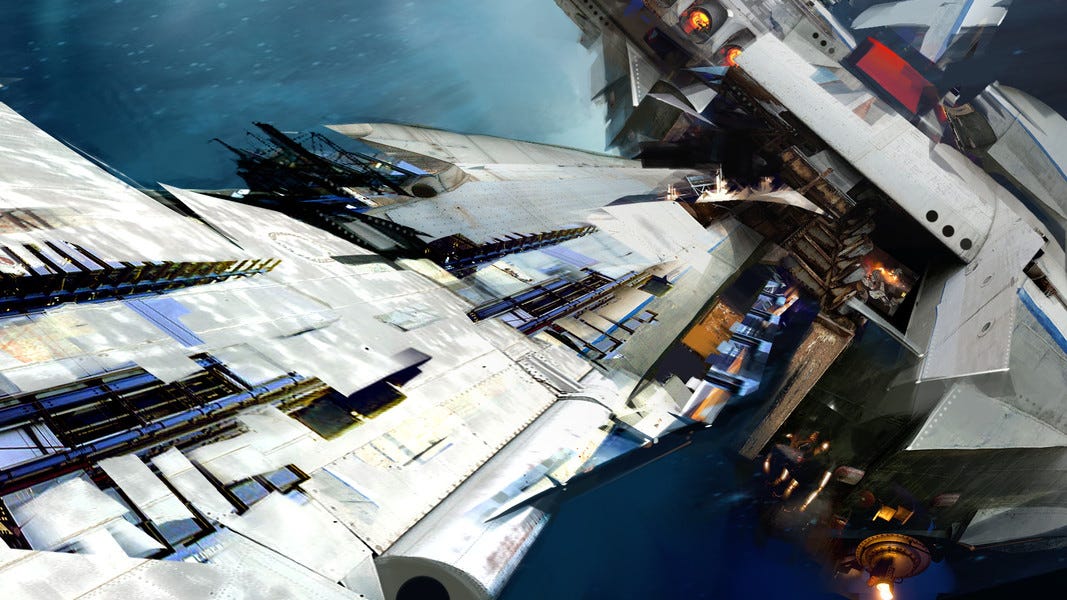
Waking the Leviathan
The story of how James S.A. Corey’s The Expanse went from game concept to blockbuster TV series
andrewliptak.substack.com
209 points · by AndrewLiptak · 5y ago · 260 comments
We didn't get the sense that it was slow and hard to follow, at all. In fact, one of my favorite things about it is the amount of world-building that you're presented with, especially in the beginning.
We marathoned the first four seasons in a few weeks, and luckily Season 5 started less than a week after we ended. It's easily one of the best shows I've seen in a long time, and one that I've been recommending to people left and right.
It's quite interesting if you look at The Expanse. Started barely top 100, then top 40, then top 20, and now this year people are ranking it #2 all time behind Breaking Bad. Seems like it took a bit for the word to get out about it, but people who take the time to watch it, seem to really enjoy it.
Abraham and Franck's prose is at best unremarkable when it's not plain bad and they have a bad habit of relying on characters acting, well, out of character and contrary to their interest when the story is stuck (which actually happens quite often and is something the show can't entierely escape sadly).
how they handled the Cas Anvar (plays Alex) issue did require a change from the books but they did it at end of season so its not disruptive and gave the character a good exit (which the character deserved, not the actor)
Feels like it's lost its narrative drive.
The Expanse was never a planet-of-the-week show. Exploring the impact of the new planets on the solar system and its people is also important.
One thing I'm a bit disappointed is the fact that they drop part of Mars storyline.
I could imagine, so, that season 6 will answer most of these questions.
S1 was completely mindblowing, film noir in space in a well fleshed out world and awesome production quality, S2 OK, S3 was a "must see" but then it went downhill.
Conversely I see hate for season 4, but I really liked it. I really love plot-lines around mysterious aliens or ancient technology. It's one of the reasons why Deep Space 9 and Babylon 5 are some of my favorite Sci-Fi series.
I still enjoy watching it and would've been happy to watch these episodes if the Expanse was like one of the half dozen star trek shows that ran 170-180 episodes each. But not in a 50 episode show like the Expanse is.
It also feels like the character building is a little too late. Exploring Amos' upbringings (maybe 10 minutes before the prison visit after which it's all wiped away) or Naomie being a parent in the second to last season, I don't know. Would've been good to integrate much of that sooner. Feels like we're kind of stuck building up characters as filler to not run out the story too fast. That's okay if it was more spread out over the seasons.
Also, read the books they are incredible!
I'll watch them eventually, but it's just not exciting enough for me to make it a priority.
Amos was one of my favorite characters but am a bit put off by how his role has, to an extent, become fan service.
I appreciate that he’s a tough guy, enjoyed that aspect of earlier seasons, and want more of it. But don’t give me, the viewer, instant gratification just because I want it if it will erode my suspension of disbelief.
Feels like the characters and narratives are trending towards more traditionally defined arcs with characters getting in fights to show the audience they’re invincible or otherwise saved by cheap deus ex machina tricks.
the 4th season and the 4th book are widely considered below average for the series.
if you liked the first 3 seasons, you'll feel right at home with s5.
The upside is that we can expect the last season to pick up again.
Amos: "I'm that guy"
... was the line of all 4 series. Haha. Loved the build up to that moment. standing ovation in the cinema audience kind of a moment
Rich, emotional, textured. More extensive world building.
And somehow made me appreciate the show more.
Somewhat tangential, it's wild to me that Devs was suggested alongside The Expanse in that Clubhouse Elon chat. I thought Devs was unwatchable. There's a point in the first episode where they're just saying fibonacci out loud to show how 'smart' they are. I looked up some of the plot after that to see what I was missing and it didn't look like it was going to get better.
As far as relating goes for most story lines you should be able to relate as much as one possibly could to a space opera.
By the way, it seems to me Expanse does not have a protagonist.
If AC Clarke and Stanley Kubrick were alive they'd be heaping praise on this show for getting so many of the technical details exactly right.
All these things happen in Mass Effect:
Sounds in space, spaceships bunched way too close together, impossibly slow projectiles for space (especially the classic "blob of light/plasma thingy" traveling at what appears to be subsonic speeds), giant 18th-century infantry-style spaceship firing lines, in general heavy reliance on "spaceships as just extensions of naval warfare" trope, all alien communication neatly glossed over with universal translation, nearly universally bipedal humanoid aliens, etc.
None of these are bad things! Mass Effect is simply much more similar in tradition to something like Star Wars or Star Trek than the Expanse.
The weightless thing is obviously understandable but it's the kind of thing where you can't unsee the things they do to convince you there is no gravity (magnets everywhere!)
- Lights inside helmets to light up a person's face is a pretty dumb thing when you think about it, but it makes complete sense in a tv series, as you definitely want to see the actor's face.
- Transparent/Glass tablets & phones is still a complete mystery to me how this could be useful in any way... other than it "looks cool".
There's also budget constraints, they can't accurately portray things every time. Although we know the producers know about the issues.
Examples: the first belter we see is more accurate to what they should look like than subsequent ones. Taller, and more frail.
Coriolis effects as Mueller was pouring his drink.
More recently, Avasarala pouring liquor while at the Moon. Even though the actors don't look like they are in the Moon (because in real life they are not), the producers will waste some CGI budget from time to time to remind us that – "hey! we know this is supposed to be the Moon. Look!"
This criticism doesn't really make sense to me. We're watching through the lens of an invisible space camera with some sort of amazing lighting rig to make things look better. Why can't that space camera also have a laser microphone and sound synthesizer which makes things make noise to provide audio cues that the audience can latch on to? Alternately: the gun and engine noise comes from the same place that the background music comes from, and nobody questions that.
The Expanse on the other hand is the best SciFi since Battlestar Galactica.
Edit - to expand on why I hate STD so much, it's the completely unlikeable characters. I just couldn't root for a single one of them.
There's also that hilarious moment in S2 where a supporting character dies and everyone goes "oh no, she was my best friend!" and gets a teary send-off, but we -- the audience -- barely knew her and she didn't really speak with anyone and there was no evidence she was actually friends with anyone before. Like bad writing 101, almost an in-joke by the writers.
You're probably right about Battlestar Galactica and The Expanse being the best hard sci-fi.
It's hard to beat the episodes/stories in the earlier Star Trek shows. The Twilight Zone was able to pull off a faithful modern reboot, why can't Star Trek?
(Someone else mentioned Planetes further down in the comments. That is also good hard sci-fi.)
It took me awhile to discover it, but what a great show. Personally, and it probably has to do with when I grew up, Star Trek TNG is my favorite sci-fi (though not necessarily 'hard' sci-fi) show.
It can be done by the right people, see Enterprise which had the trekky heart and was good on start (it did have increasing problems in later seasons).
Trek is in wrong hands now. Some commentators say the main showrunners actually hate the previous classic Star Trek, and they are trying hard to revision it.
The Expanse actually has its own world with its own problems that isn’t just a shallow mirror of the writers view of today. Also much less melodrama, although not none.
Extremely unlikable is right.
I could go on a long rant here but I'll just mention one of the ultra-ridiculous plot points of STD: The ship runs on mold. Seriously -- not dilithium crystals, but mold. They even imply that the very fabric of subspace is -- a fungus.
Stupidest show on television.
I wouldn't exactly call it hard sci-fi, but it at least makes an effort to keep some parts realistic, with the obvious exception of major plot elements like the protomolecule and all stuff derived from it. You can certainly nitpick many details about how gravity is handled, they make an effort to explain it without resorting to magic, but in the end simulating microgravity just isn't feasible on a TV budget.
I had been thinking a great deal about the joke which was left unfinished early in S5 about what a Belter, a Martian, and an Earther would drink. I initially thought that it was never going to be completed so I was kind of happy when they did and was rather let down by the joke.
That wasn't the point of it. Delgado started telling the joke before the rocks fell and finished it well afterward. You might think that his views on Belters had changed after they attacked Earth, but the punchline reinforces that he thought that all Belters were complete trash before all of that.
Showing the human element is something that they do very well, and a lot of it is a thin projection of what we, as humans, often do between different races, countries, classes, and beliefs. It's somehow easier to discuss when it's Belters, Earthers, and Martians instead of black, white, etc, even though they really represent the same thing.
He follows up with, "That used to be funnier" putting him into the 'self-aware wolves' category at least.
[0]: https://tvtropes.org/pmwiki/pmwiki.php/Main/MohsScaleOfScienceFictionHardnessExpanse is more along the lines of "geopolitics in space" with the protomolecule being a MacGuffin to drive the plot along and create space zombies and wormholes. Which isn't to be derisive, as I find it very entertaining, but I don't feel like it's delving deep into the scientific or philosophical ramifications of first contact.
I feels like the actual story is quite short but is being stretched between the first and last episode with repetitive tropes. It's too bad because it does have more potential.
Why, you may ask? The behavior of human characters in The Expanse is... terrible. They fight each other, everybody has their own agenda, they behave irrationally. Case in point: in the second book (as far as I remember) an alien ship appears in the Solar system - clearly a hostile force. Earth and Mars send soldiers on the ship and what do they do? They start fighting each other. No, I do not want to believe that humans would behave that way. If you read Clarke's books, when facing the new and possibly dangerous things humans behave logically, calmly. You do not see human vs human conflict in Rama, Childhood's End, The Fountains of Paradise, Space odyssey, Sands of Mars or almost any other of his books. It's about exploration, human unity, positivism, and there is nothing of that kind in the Expanse. I could not find a single character in the Expanse that behaves in the way Clarke's characters would. I apologize for the harsh words but I refuse to believe that Clarke would write such an abomination.
And no, it is not just the Expanse's writers, I see it everywhere nowadays, it seems that the writers nowadays need to insert human conflict so they introduce whatever irrational behavior leads to it.
</end rant>
Just like real life?
There's a difference between being irrational versus being self-centered.
> No, I do not want to believe that humans would behave that way
Humanity is currently facing a potential extinction level threat due to climate change and you have plenty of people fighting one another and making emotional - versus rational - arguments.
I'm with you.
It bothers me when people are given sci fi on the hard spectrum but then debate 'how hard it really is' for the purpose of defining then diminishing the value of the material; feels very self congratulatory.
Everyone who praises the expanse's 'hardness' are just as aware that protomolecule is space magic.
Space magic has its place but the expanse also offers a level of hardness I appreciate outside the narrative elements requiring the space magic.
I think its an important discussion in any talk of scifi to point out where the lens is callibrated with regard to hardness resolution.
Turns "expanse is hard scifi" debate on its head by simply changing that statement to "I like the level of scifi hardness in the expanse".
My nephew was reading a book and a character in it built a metal detector out of a radio in a survival scenario.
Due to my interests my nephew asked me if it was possible; if 'he could do that'.
I explained that i suppose you could construct a device to detect eddy currents out of the components of a radio, but it would be so terrible and unreliable that itd fail to detect any metal in any meaningful survival sense.
My nephew was satisfied with the answer, he honestly was uninterested in if it would 'work' but rather 'how probable' it was.
You could tell he was inspired to learn more about the topics that subjectively could allow someone know how to do that regardless of its objective viability.
So, the story could have cut ahead to after its been magically built off screen or could magically source parts from the devices without the actual necessary base components to achieve the conversion ignoring the whole radio aspect or the character could reasonably source components that "magically" works well enough to allow their knowledge to save them (the level this story choose) or the character could sit down and read through a data sheet and spend screen time soldering components to pcbs then accept they wasted all that time, and narrative space, because its an untenable goal given what they have to work with.
I think there are arguments for each of these levels depending on the narrative's slated goals, and being accessible to a broader audience is an important one of these goals.
I feel the further you move down that hard ladder the smaller the audience becomes and leaves less of the 'fi' element of sci fi for you to work with narratively.
I love ben eater's 6502 series and find it extremely entertaining, but does anyone expect that level of detail in a sci fi television show? Is that the end goal of these hardness debates?
I simply appreciate where the Expanse chooses to push that line into the esoteric, and yes even in the other direction of space magic, while still remaining accessible to a broader audience allowing people with less technical knowledge to be inspired to pursue expanding their knowledge within those fields.
So does that mean that Star Trek is "harder" now without even changing its material content simply because it inspired people to build those very devices seemingly run on 'space magic'?
The engine whooshing noises are more like what you'd hear on board, if you were on board. If they left those sounds out, the conveyed sensation of motion would lose a lot of its impact.
But consider how the characters touch helmets in order to communicate when their radios are down, or when they want to communicate privately.
Or consider Naomi's trial on board the Chetzemoka most recently. She needed to examine the ship spec plate to find out the air volume so she could calculate how many trips she could make to the unpressurized parts of the ship; she marks the number of trips on a wall, which doubles as a narrative device to demonstrate how many trips she made. Note also the way she touched her helmet to the hull in order to hear the radio broadcast while she was in the unpressurized area.
Some of my favourite parts have been the battles, the way they demonstrate the harshness of space and the way the lack of gravity confounds expectations. The way the railgun punched through multiple walls of the Donnager, into open space, and the rush to patch up the holes. Or when Prax and Amos were in the cargo bay and some tools came lose, and they flew around the bay based on the ship's manouevers - or rather, tried to stay still while the ship moved around them.
The Razorback propulsion sounds, for example, are always a rocket engine blasting by the camera.
Edit: replaced the circumlocution with the paedophile's name.
Television / Radio personality not really the same as one of the most important film directors of all time, is it?
The first belter shown has clearly different proportions compared to Earth humans. Easier to do because that one was restrained and wasn't a main character. But they are aware of that.
> imagine living your life out there.
Worse than that, imagine multiple generations out there. We don't know what's the effect of zero-g on bone growth is.
I doubt that. Citation needed.
* https://space.stackexchange.com/questions/36411/healing-of-b...
Thankfully no one to date has been injured for a 'full test' to have been done. Blood flowing backwards has been observed:
* https://www.newscientist.com/article/2223705-low-gravity-in-...
When ships travel through space, they can be seen traveling in "reverse" as they arrive, because they are burning their engines to decelerate.
Ships only have "gravity" when they are running their engines.
https://www.amazon.com/gp/bookseries/B00K7B2CRQ
There are 9 books total, not including the novellas. The last book of the series is scheduled for later this year.
It's structured as 3 trilogies. The tone and pace of the first book is maintained (for the most part) through the entire series. So, if you like the first book, you'll probably like the entire thing.
I can see that. It's a bit of a reset (without giving away the plot) but it sets up 8 extremely well, which was a great book. I'm really excited to see how they wrap up the 9th and final.
Also I think RPG DM's and gamers don't get enough credit for the incredible storytelling and world building that a lot of us take part in. A number of great fiction series have come from RPG games.
PS Season 5 is great.
I have a feeling that if the game controls were slightly more abstract, it might be better. Less "burn 100m/s retrograde" and more "intercept target", "pull alongside target", etc.
But part of it might just be that realistic spaceship combat isn't very exciting; it's not conducted at human-relevant distances and timescales, it's all over in the blink of an eye, and it's hard to judge whether your salvo of nuclear missiles will beat their swarm of laser drones.
The Expanse does a much better job of making ship-to-ship combat interesting, but I think they only manage that by ignoring some of the more pedantic hard sci-fi rules (stealth ships in S1E4 "CQB"), and they contrive battle settings (Thoth Station in S2E2 "Doors & Corners") that are more interesting than CoaDE's open space.
Still glad CoaDE was made, and it's worth a few bucks for the experience. :)
I believe this reflects the creator's conclusions regarding the nature of space combat. that is, the outcome of the battle is more or less determined by the weapons loadout and approach speed/direction. so the real "fight" is maneuvering for a favorable approach and/or forcing the enemy to waste their delta-v, which the game definitely stresses. there aren't a lot of meaningful tactical choices once you're within gun range.
could be a case of being too realistic for its own good. I do think the game would be less frustrating if it had checkpoints within missions. very annoying to have to redo some complicated orbit transfer over and over because you keep losing the final battle.
Totally agree, and this is another case where controls at a slightly higher abstraction would be nice. In the game, sometimes the enemy jukes your intercept, so you do another burn to re-acquire, and the cycle repeats.
A show like The Expanse would operate at that level of abstraction:
    Sensor Officer: "Captain, they've detected us and are taking evasive action!"
    Captain: "Navigator, match course and speed. We can't lose them."
    XO (aside): "Captain, that's a Cortéz-class recon ship; they've got more than enough thrust AND delta-v to outmaneuver us. We need to change the game."
    Navigator: "They're evading again; re-acquiring intercept."
The show has some polarizing aspect to it, about half of my friends are really into it (me included). Half my friends bounced off the first couple episodes.
You have to get through those first few episodes before it becomes more clear what the show is about. And even then, you might be misled into thinking it's about a merry band of crew floating around space on a ship; because that's not what it's about. The clue is in the name; it's about humans expanding beyond Earth, and the conflict that arises from that.
https://www.geekwire.com/2018/expanse-safe-jeff-bezos-says-a...
The show starts off quite slow, which is probably its biggest "weakness".
Then I read some wiki pages about the books and I think I see what they're doimg. This season seems to be the set up for some really big stuff.
I'm really excited for the next season. Hopefully there's only a one year wait.
The entire narrative arc of the series is the social dynamics of humans as they take their first steps beyond Earth; how the initial scarcity of land suitable for human life gives rise to animosity, how eventually the potential bounty causes a rush to exploit, and how space natives struggle for their independence.
The current season is an interesting exploration of the terrorist / freedom fighter duality. It demonstrates clearly, through narrative, how effective committing atrocities can be to forcibly unite a people, and forge a more solid sense of identity through shared suffering and a common enemy.
While I understand why many people didn't like season 4 as much, I found it interesting because it explored how people would try and export Earth-bound laws to new worlds and new contexts, and how that would conflict with the lawless nature of a frontier.
In some ways, it reminds me of The Wire. The Wire is an exploration of drug crime, how it is structured, and how politics and the media are ultimately complicit in perpetuating it - or failing to stop it. The Expanse is a study of how humanity is likely to react to opportunities beyond Earth, at various stages: when there's a single viable alternative; when there's lots of scattered people collectively forming a new nationalistic identity; and when there are new settlers to new lands in a scenario of unbounded potential, and how that remote potential may reduce the will of people to fight over scraps on overcrowded (Earth) or environmentally hostile (Mars) planets.
It's a shame it came out when it did, on the network that it did. The timeslot shenanigans and network politics were the death of that show. It would have run for years as a Netflix original.
Tell you what - If _I_ become a multi billionaire I'll pay for it out of pocket and only worry about selling it after it is all done
I'd definitely recommend giving the show another chance — the actors really grow into their roles.
https://www.kickstarter.com/projects/1780208966/the-expanse-...
I just hope they manage to cover all books
I'm all for a healthy dose of skepticism with these things, but how much more would it take to convince you?
[0] https://www.reddit.com/r/TheExpanse/comments/hi7c7q/designat...