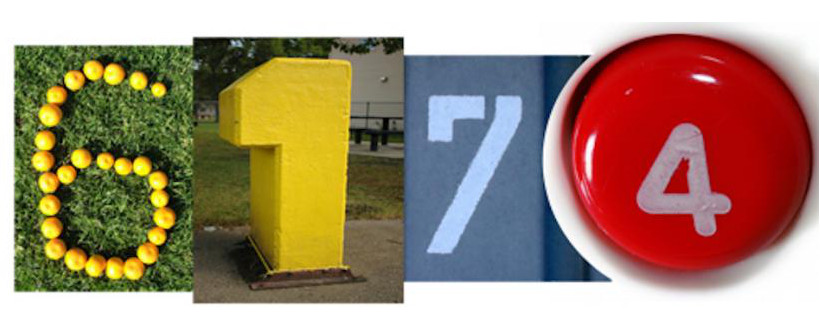
Mysterious number 6174
6174 is a very mysterious number. Yutaka Nishiyama explains why, and how beautiful mathematical oddities can inspire us to discover new mathematics.
Plus Maths
188 points · by shii · 15y ago · 64 comments
If at least you had a result like "in any base, the analogue of Kaprekar's operation in that base has a fixed point for digits of length 3 or 4 only", it would be mildly interesting. But as it is it's not math, just senseless symbol manipulation.
But yes, the fact that this is bound to a decimal system suggests that there are no deep wisdoms here.
That said, I'd agree that decimal is not a particularly interesting part of math. For reals, continued fractions are probably the most interesting representation, and have nicer mathematical properties, at that.
This is significantly stronger than just being a fixed point. As an analogy, when modeling population dynamics, one often finds both stable and non-stable equilibrium solutions. The stable ones are the only solutions that can occur in nature, and so their stability is an important thing to note. This stability often (I hesitate to say always) is the result of the solution having the same attractive nature as 6174 does.
My mastery of fixed-point mathematics is rusty, so I am unsure if that is identical to the above...
(At work, so can't say definitely yes/no without studying).
And two: http://i.imgur.com/OaynE.png
I made a quick experiment with other bases.
3-digits numbers, base 8 has fixed point 374_8=252_10. 252 `mod` 7 = 0.
base-9, base-11 and base 13 seem do not have fixed points.
base-12, 3 digits has (at least one) fixed point 5b6_12 = 858_10. 858 `mod` 11 = 0.
I think, it exploits some properties of positional notation of numbers so that fixed points all divisible by (base-1).
Kaprekar's operation always results in a multiple of 9.
Given a > b > c > d. Kaprekar's operation gives:
    1000a + 100b + 10c + d - (1000d + 100c + 10b + a)
    =999(a - d) + 90(b - c)
    =9(111(a - d) + 10(b - c))
http://mathworld.wolfram.com/KaprekarRoutine.html
http://en.wikipedia.org/wiki/6174_(number)
The Wolfram link contains a list of Kaprekar numbers and Kaprekar sequences in common bases.
Whoa, you need 50 statements in VB for that? I need 14 in Python:
    import collections

    def kaprekar(k):
        nr = 0
        while True:
            if k == 6174: return nr
            small = int("".join(sorted(list("%04d" % k))))
            large = int("".join(sorted(list("%04d" % k), reverse=True)))
            k = large - small
            nr += 1

    freqs = collections.defaultdict(int)
    for i in range(1000, 10000):
        if not i % 1111: continue # skip 1111, 2222, etc...
        freqs[kaprekar(i)] += 1

    for k,v in freqs.items():
        print k, v
  0 1
  1 356
  2 519
  3 2124
  4 1124
  5 1379
  6 1508
7 1980For smaller numbers, Wikipedia is pretty good too.
"8833 = 88^2 + 33^2"
http://primes.utm.edu/notes/proofs/infinite/euclids.html
http://mathworld.wolfram.com/EuclidsTheorems.html
We measure something by comparing its frontiers (where it begins and ends) to something else. If this something has none, this clearly cannot be done.
Of course, it's also clear that between 0 and 1 you have infinite real numbers. But is an infinite inside an infinite enough to provide a size hierarchy?
Maybe the quantum physics guys will prove that the universe is granular in every possible level and that everything is just an enormous pile of huge natural numbers. Then infinity and paradoxes will just be a fun thought experiment, and reality will still be pragmatically ungraspable, but profoundly boring.
More seriously, numbers, and number theory, can be quite interesting and often leads to computational insight in algorithm computation or numerical solving. But ultimately, unless you're a numbers geek, it [ edit: Kaprekar numbers [1] ] doesn't [ don't ] really teach anything.
[1]Sheesh, this place has lost its sense of humor.
Your algorithm is to start with a random number (the key) and and feed it to your function, producing another number. Which you feed to your function, producing a third number. And so you go, generating a stream of numbers for your cipher.
After reading how Kaprekar's operation leads to a fixed point for four digit numbers and various cycles for other numbers, you might be nudged into investigating to see if there are inputs for your function that lead to cycles and fixed points. Which would pretty-much break your cipher entirely.
Is this interesting? Yes. Is there computational insight? There is for me. Does it teach anything? I dunno, how is teaching something distinguished from providing insight?
... what? That has nothing to do with number theory.
> More seriously, numbers, and number theory, can be quite interesting and often leads to computational insight in algorithm computation or numerical solving. But ultimately, unless you're a numbers geek, it doesn't really teach anything.
There are a number [1] [2] [3] [4] of practical uses of number theory that do teach something. I've only listed the simplest uses with respect to cryptography, because those are the ones with which I am familiar, but I assure you, number theory is one of the more applied branches of mathematics.
Granted, some number theory has very few applications. But you won't ever find something practical if you're always asking "Is this practical? I better not look further if it isn't."
[1] http://en.wikipedia.org/wiki/RSA
[2] http://en.wikipedia.org/wiki/Diffie%E2%80%93Hellman_key_exch...
[3] http://en.wikipedia.org/wiki/Digital_Signature_Algorithm
[4] http://en.wikipedia.org/wiki/Elliptic_curve_cryptography
I have always found the 'meme' "Its all fun and games until someone <dubious and improbable action>" amusing. I was trying to come up with a dubious and improbable action which occurred from the mis-application of arithmetic operations on numbers.
What I have learned from this particular exchange is that people who are fans of number theory are sore about 'numerology' perhaps just like astronomers wince at people who conflate astronomy with astrology. Must be watching too much Big Bang Theory lately.
Thus, a comment which adds no value will be downvoted; a comment which is funny but has significant worth besides its humor will be upvoted.
Actually, I thought you were serious, especially given that you went on to criticize number theory as being impractical. I recommend an application of the ;) next time.