328 points · by ghuntley · 5y ago · 235 comments
I don't think I am cut out for a permanent #vanlife, but it sure sounds like a cool arrangement if you have the proclivity to handle all that it entails. My wife and I plan to do slow travel when our kids go to college. Move every year or so with a light load while learning different cultures.
Would love to hear more about the financial aspects of #vanlife... from my perspective, I reckon you save a bundle.... but I could be wrong.
For me the nag was about all the thing we wanted to do to the house but couldn’t because it was a rental.
To each their own I guess - there are fair points for both approaches. Do what makes sense financially and keeps you happy / less worried :)
If they bought it 20% down and want to cash flow for a goal of 8% cash on cash, that's another type of return on investment. If the property value tracks inflation, their return is probably closer to 20% yearly.
Also they can shelter that income through depreciation, mortgage interest, expenses, etc.
Now the little repairs that were due during these years (in 3 different downtown apartments) always went like this: I tell the landlord that something needs to be fixed, they tell me to call someone (or sometimes they send someone they know) and I pay for it, get the invoice which we then deduct from the rent next month. No extra profit made on the repairs. You can say that it is priced in the rent, but then that's the rent (which will be subject to competition). Yes, obviously they are looking to make some meaningful return on their investment. Whether that's higher than the mortgage's interest rate depends a lot on when they actually bought the property. But in an equilibrium the two should be pretty close because if they start to diverge too much people will either stop renting or they will stop buying apartments (and do the other).
So financially, unless the mortgage is much more expensive, buying is a better decision.
That's unlikely, if the rented space is part of a complex. The complex repairs are amortized across all the units. The issue is about cost per square footage. Given you don't have to pay for the same square footage (not the full lot, only the space your unit and parking occupies) it's almost always lower.
Many (most?) rentals in my area (in Scandinavia) is not for-profit and get cheap loans to build. Just like the utility company (electricity, heat, water, fiber). You can get permission to improve and if it is good for the environment you get some of the money back if you move out.
Also, they can’t both be pretax and deductible. The former, the money never shows up on taxes at all, the latter they show up as a subtraction on taxable income.
Sadly in my country, our rental laws are still firmly stuck in the "quarter-acre" dream of the 1960s, where renting was only something you did at university before shortly buying your first house with a tiny deposit and a Government backed home loan.
These days as house prices rocket, only now are changes being made to tenancy laws to give tenants some more security. Back in my renting days, I had to move 4 times in 5 years because the landlord wanted to move in, or they sold it, or the farm my cottage was on had been sold and the new owner wanted it for workers, etc.
So here, at least, owning removed a significant amount of stress for me - I know I'll still be living here in 5 years, I haven't been able to say that until now.
Do you not have any nagging thoughts about renting though? Because I went the exact opposite way. I was always super stressed when renting, because I knew that at the end of our contract the landlord could tell us to leave. Especially when we were on a monthly rolling contract, my stress about this was probably 10/10.
Now that we bought a house I sleep well - if anything goes wrong I can probably repair it myself, in case of appliances I can buy second hand ones cheap or again, try the repair myself ...and for things I can't repair myself(ie - boiler) I have insurance for. It's about 10x less stressful than renting to me.
Luckily this can't happen in most of the EU. Even if the contract say X years you can't throw people out after the contract runs out unless you are moving in yourself.
What alternative timeline is this?
However, you are talking about things that I don't really have to worry about since it is an apartment. So maybe there is a slight difference here.
The only argument that can be made is that the money you do not spend on your own house is money that could be put into a different investment like the stock market. But in NL renting a place is roughly as expensive as my monthly mortgage payments. So both situations it is money I cannot put in the stock market. Insurance and heating is being added on top of those monthly payments regardless of the option you pick.
For people like me with no desire to have kids and minimal ownership of furniture and toys, renting is nice.
I've always wanted to be a renter for life, but recently I also have been thinking about buying some land in upstate New York or in the outskirts of some European city and building a livable structure like an A frame or a geodesic dome.
I do think urban housing prices are insane. My rental units were in the suburbs, and now I have vacation rentals in Southern Utah instead. So the rent price ratios made sense. In denser cities, the landlord would have to out like 50% down just to break even on the mortgage. Yes, they may be cash flowing, but just barely, and the nuance is they put a massive down payment. It just depends on location.
For those who need a general rule of thumb comparing rent vs mortgage, there's the 5% rule: https://www.pwlcapital.com/rent-or-own-your-home-5-rule/
How does this prevent you from going on a trip? I don't understand. Mind to elaborate a bit?
Try saving to much on home maintenance and you risk damaging your property, lowering it’s value in the future. Owning a home is expensive, it’s still a sound finacial choice, depending on country and so on, but it has a running cost.
When you get your pay, put aside money first and save for dedicated budgets.
Decide what budget you think is required in each slot.
Example: I want a house saving for min $30000 for unexpected and expected maintenance.
I want a minimum of $8000 for vacations.
Etc
Then, save as much as you can into those accounts until you reach their goal and then keep saving into them, but maybe lower the amount.
In the beginning (and if your out in time, this will be while you're DINKing) it might be rough, but it will be easier as your buffers stabilize.
When fixing the house, don't steal money from your travel buffer. And absolutely never take money from house buffer for travels. :-)
I think a lot of people spend way to much on luxury, like eating out or having three movie streaming services instead of none or one. And then they realize that "oops, no money left for savings this month neither"
Survival, savings, higher standard, then luxury, not the other way around.
I lived out of a minivan and then a larger fan for 2.5 years while writing software and loved it.
It was one of the most freeing and enriching experiences of my life, and was so much better than living in a stationary building.
I traveled all around the country and was still able to remain productive. In fact, I was more productive and motivated, because my life was actually interesting and different day-to-day.
It was sometimes uncomfortable, especially in the beginning when I learned the ropes, but nothing too bad. (This is in the U.S., where it's safe to do in majority of places.)
In my gradual cutting of monthly upkeep expenditures I had to give it up in favor of more detached living, but it was great, and I would do it again if I didn't have to do paid work to accomplish it.
https://www.youtube.com/watch?v=l-DgMYB6L0c
Bathing:
- Sponge bath, external shower hookup, or an internal shower, are common. Using gym / campground / community centre facilities is also frequent, loss of these a major fallout of Covid. Taking a "navy shower" minimises water use. There are recirculating showers (with filters) used by some, and instant-on-demand hot water heaters (used by most). The video shows a bathroom built into cabinets which opens for use, shower curtail is pulled up. Fixed-wall stalls exist but really chew into space, often double as closet space.
- Cassette or composting toilets latter w/ urine diverter, are common. Again, using available facilities is often preferred.
- Winter is easy: a small heater and insulation. Condensation is a bigger worry than cold, especially against the front windshield. Summer heat is generally worse --- keeping a metal box under full sun cool is a challenge. Especially where solar exposure is needed.
i don,t think it is missing, it is one of the most frequently asked questions, and also one of the most frequently answered.
Something needs to change. Why screw oneself with a 30 year mortgage, plus property taxes, plus constant maintenance headaches? And deal with shitty HOA too, in some places. Maybe this is a good way to silently protest and force progressive housing policy changes.
They only are insane if you insist on living centrally in large cities. Which you can't do anyway if you live in a van. So it's hard to give a lot of weight to this prediction.
This is really beginning to concern me. I think we’ve created a fake plastic economy built on face plastic house prices. By stoking the bubble, the purchase and renovation of housing keeps pushing money through the economy.
By constantly remortgaging, new value is “created” which allows people to have a new kitchen, go on holiday, buy a car, extend their house. But it feels like a trick to me. I’m not an economist, but where’s the wealth creation here?
As a result of the forever rising prices, foreign investors buy properties, often leaving them empty. They see the game the government is playing and exploit it.
Feels like the U.K. government doesn’t have a Plan B. They don’t know how to create a strong economy so they turn to retail and the housing market. Surely the wheels have to fall off at some point?
This has been an issue for a long time now. There should have been a crash in 2008/2009 but instead the government in the UK decided to prop up house prices with various schemes. I'm not saying this is right or wrong, for many people, house owners and people looking to purchase, this helped people stay out of negative equity/allowed people to purchase their own home.
> By constantly remortgaging, new value is “created” which allows people to have a new kitchen, go on holiday, buy a car, extend their house. But it feels like a trick to me. I’m not an economist, but where’s the wealth creation here?
I'm not sure remortgaging is creating new value. All money is loaned into existence, remortgaging is just creating new debt secured on your home. It still has to be paid back. People could still get loans, just not perhaps at the same favorable rate.
There has been a lot of money printing over the past 10 years or so, I think rising house prices are a natural result of that. I think it's more of a case of decreasing purchasing power of the £ in your pocket, rather than homes rising in value. Have a look at this chart when house prices are compared with gold[0]. It's also a function of the availability of loans, since now you can borrow cheaply over long periods, this increases the total amount people are able to borrow, as it's much easier to service the debt.
What's more surprising to me is that we're not really seeing inflation in other areas of the economy, such as wages or consumer goods. Inflation has been surprising low since the crisis of 2008/2009.
UK retail is just wrecked. Even before the pandemic it wasn't great.
Why would you expect to only pay for the price of building it?
There is also a lot of value in land itself, the view from it, the infrastructure around that land, what other people (And businesses, and schools, airports, restaurants, etc. etc. etc.) live there in close proximity. What laws are in place on that general part of earth... There is so much more at play here than "cost of building it".
Housing has become a principle (and one of the largest) asset classes. The things that make it suitable for investing are precisely the same attributes that make it inaccessible, especially to the young, poor, old, and otherwise disadvantaged.
Flyover-state housing may be affordable by SF / New York / LA / Chicago standards. It's often not affordable to locals themselves.
And services (data, power, food, support, healthcare, education) are often far below standards typical on the coasts / near major metros.
Lack of regulation in places without rigid building code enforcement can also make it hard to find people who aren't hacks (if you can find people at all) in construction.
I think you're combining the worst of opposite ends of the spectrum here. When services are lacking, the prices are cheap too. You can live in a disconnected shack in a depressed rural area for practically nothing today too, just like (many more people did) in the past.
There's a lot less restaurants, and they are all the same, and grocers tend not to stock quite as much variety, so those are more true.
Education and healthcare are a lot more variable. I expect having to travel further tends to be the biggest difference in healthcare.
With a more remote workforce now on the long term horizon, why not just move to a cheaper city rather completely jumping off the proverbial cliff?
(This comment is coming from someone who is considering van life and I have also spent some extended periods of time working and living out of my vehicle).
Remote work might not be possible for everyone.
Personally, moving to a cheaper city would be my first choice, followed by tiny house.
All of these have pros and cons. But for many people in their 20s/30s, buying a house might never be an option at all, simply because they can't afford it.
Unless progressive policies are implemented, we can expect major housing crisis soon. People want their home's value to continuously increase, they see their home as an investment first - instead of seeing it as a place to live, first.
I dunno what the solution is, but I don't think this situation can continue.
Prior to that, I spent 2 years on a motorbike living out of hotels and rentals all over Vietnam, Cambodia and Laos.
I am lucky to have a job and a life that was already remote.
In normal life, I think that's a much _simpler_ approach than being out in the forest. We were never far from a water source or a hardware store in case of emergency, which came in handy more than once.
I hope it continues to work out for them!
If you are in East Coast U.S., I may be able to find you a shower.
It's about people in American with similar situations who decide to go off grid. And like the OP are a bit older, not necessarily the hippie type.
The movie is quite stark and realistic. A mix of documentary and drama. And it starts Frances McDormand from Three Billboards, who is excellent in it.
That said, this lifestyle has absolutely no appeal to me. What do you do when you get older? I mean much older? Is a 70 year going to be lugging propane tanks around and doing odd jobs for food? There needs to be some sort of plan, doesn't there?
My dad has been 100% sedentary since his 60s. He's now 71 with the mobility of a 90 year old. His father was a military man who kept a strict exercise routine till his 80s. He looked (and performed like) 55 at 75. Designing a lifestyle that forces you to move and lift heavy things is a really good idea.
both are good when done properly
Good question. That’s a thing. People have this grey nomad ideal and when they reach that age they sell up everything and buy a big rig, only to find that at age 70, it’s difficult to drive such a thing. Particularly if they’ve never reversed a trailer before.
This is why you can buy second hand rigs that are 12 months old that are hardly used, cheap.
The real limiting factor is when the furnishings, flooring, cabinets, appliances, all that stuff wears out. Manufactured housing in general has this 20 to 40 year depreciation, because we don't pretend as a society that they're an appreciating asset. Its ridiculous that we treat stick built houses (as opposed to the land they are built on) that way; houses have major maintenance costs over time as well. It's just easier with manufactured housing of any type to, instead of: new roof, new HVAC, a kitchen renovation, new flooring, etc etc, just.. defer maintenance on those items as practical and then replace the whole thing or do a major midlife overhaul. (The latter does require a "home base", so doing vanlife long term does require finding places to settle down occasionally - this lifestyle is much easier for people who have families and/or friends with single family detached homes in suburban or rural areas they can crash with sometimes.)
I'm not sure they did, their situation looks precarious to me.
This lifestyle is incredible and life-changing, and shouldn't be discounted by anyone who's looking for a change.
Do these citizens in these countries think these laws around divorce are fair?
While this doesn’t seem like a difference, it has major implications in pretty much all aspects of life.
Whatever opinions you have about divorce law aside, it's a simple fact that if housing was already a difficult expense, it gets much harder when one family becomes two.
Working from home is a long sought boost for everyone. Places like Sikkim, or Ladakh, unspoiled parts of Nepal and Sri Lanka are ideal for remote work.
The problem is that there is no demand.
This is a zero-sum view. I've recently observed it becoming more popular online. True to form, the simple take misses all of the nuance.
On one hand there are people decrying the horrible conditions for housekeepers sending remittance from the Gulf. On the other there are economically troublesome analyses like the above.
Politicians don't care about taxing corporations that they like. You'll see them do the whole dance against Big Oil or Walmart or whatever, but when it comes to Big Tech, boy do they love their Apple toys and Google Internet.
With wireless coms, weird real estate fluctuations.. new vehicle designs too it might become a new form of nomadism.. are we becoming snails ?
It’s ABSURD how much money you need to pay for a 2 bedroom apartment.
Anywhere 1.5 hour drive north or south of Sydney and still within 20 minute drive from the ocean is minimum $AUD800K.
If you want to buy in Sydney proper it’s $AUD1M minimum unless looking at something in need of serious renovations.
The government does nothing to stop the bubble. Rivers of dubious Chinese money flooding in and lax lending practices combined with reduction after reduction in the interest rates.
The current government in Australia is hijacking the next gen’s future with bad environmental policy, foreign dependency of the education sector and a housing bubble that never ends.
To the OP, please come and visit Hopetoun VIC, free camping at the lake, you would love it here
Perhaps I will try it again in a few years with my wife this time.
Caravans don't have any of those downsides, but I guess people make it work?
It probably has something to do with being born in Brazil/RJ, where hugging everyone is the norm.
I've read mixed reviews on whirlpool and other forums.
I understand minimum latency is 650ms. What's that like for videoconferencing?
Presumably I'd need an articulated dish so I can recalibrate every time I stop. Anyone had any experience with those? They cost about $2000. Can they be secured, or are they likely to be ripped off from time to time?
This seems very expensive. How do you set up the monthly plan more efficiently?
We use Viasat at our farm and it's acceptable but kind of slow and has a long ping. I'm really itching to get starlink which they've projected will be available at our place later this year.
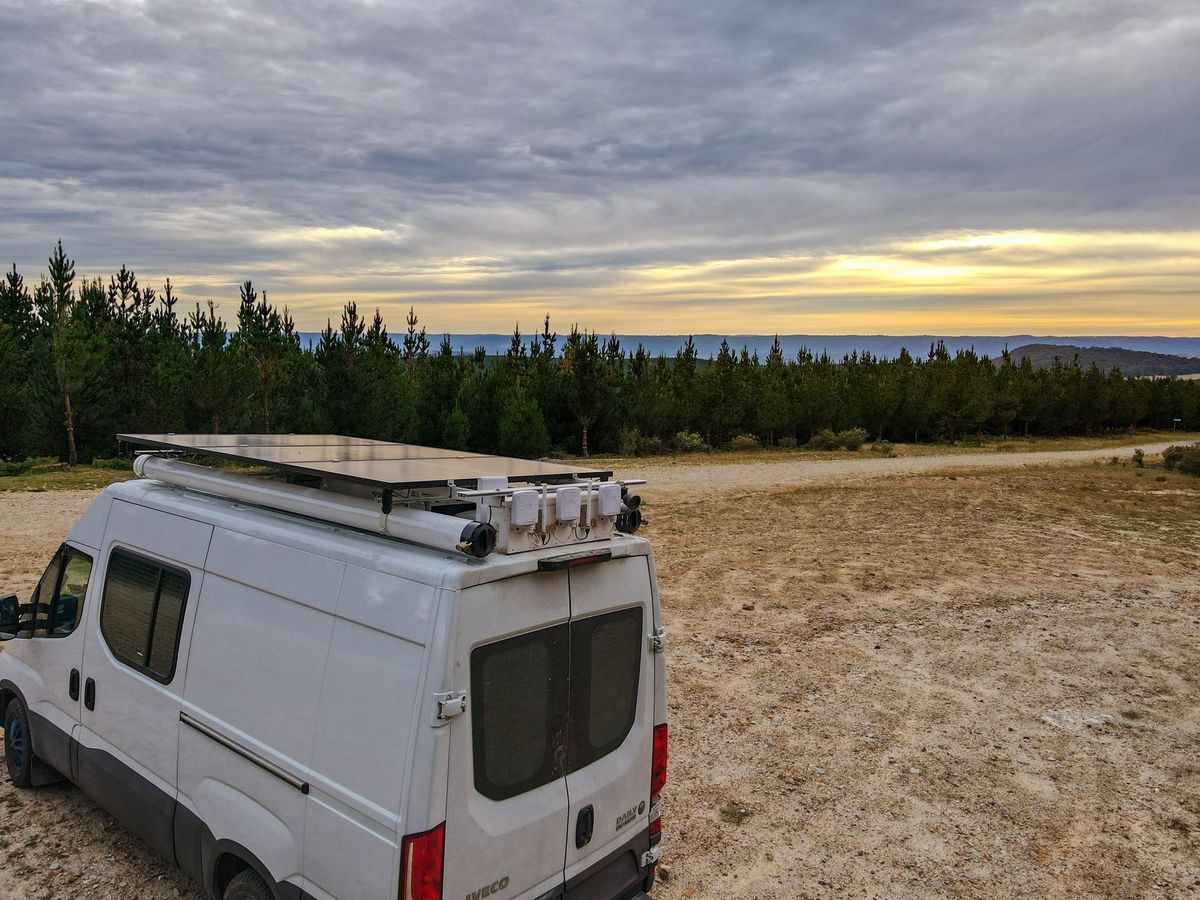
Also, any cool stories to tell about power maintenance? I see you have giant solar panels but wonder if they're enough for your daily workload - do you have enough power at night?
Sorry if you've answered these questions before, I'm new to your blog!
* the solar panels deliver average ~200W for 8hrs per day, 1.6kWh total
* OP has average 50W power draw while working, 8hrs per day, 0.4kWh total
* OP has lighting requirements of ~20W, 4hrs per day, ~0.1kWh
I guess he's probably fairly comfortably net positive for electrical power. In my experience the solar panel estimate is reasonably conservative, although I've experienced some extended periods of very bad weather where my panels produce less than 5% of their rated maximum (in the UK- not Aus!).
I'm not much of a city dweller. It's not that I hate cities, they have their charms, it's mostly just that the things I most enjoy don't exist in them. My job is reasonably flexible and living in a van allows me to be closer to the things I love to do: skiing, climbing, running/hiking (off road), especially. Typically I'll do one of those for 2-4 hours per work day, and much of the weekend. Because I guess you may wonder: I find this makes me happier and gives me more motivation in general, which, anecdotally, has a positive impact on my work.
A little more background: I work an average of 40hrs/wk; I have no children; minimal financial responsibilities; I live in the van with my partner, who works ~20hrs/wk, also remotely.
And if you're in tech, you probably know more people in tech than you know accountants/doctors/lawyers/chemical engineers/business owners.
I'm not sure how my wife and I will go long term, but living in campervan has always been a dream - so only one way to find out! :)
Can someone explain this? Is OP suggesting that the typical working life is 100 years?
Also 8 hrs is closer to half one's waking hours so that's either another math error, or a mistaken inclusion of the word "waking" (actually he used "awake"), or he works part-time.
At the moment I just sit on the bench seat with my laptop on my lap, but it’s slowly taking its toll on my posture.
Any advice?
Basically, there's where you, your butt, monitor, keyboard, mouse, peripherals (printer/scanner, camera/audio gear), power, net, hardware, and any materials (books, suplies, etc.) go. Thermal management. Security.
Laptop or desktop system?
A swivel front seat (driver, passenger, or both), may be the best chair option. It's already there, adjusts to height/tilt, and is comfortable for long periods. Alternately a fold-down / jump seat.
Alternative bed / garage configurations may free up interior space, at a convenience cost. A Murphy, folding, or convertible bed especially.
Fold-out work-surface / stowable monitor next. Support for keyboard, mouse, tablet. A swing-arm monitor doubling as a video display, cabinet or roof mounted.
Easy access to anynecessary materials. Ability to get in or out.
Other seating or lounge space (bench, bed, stool, outside chairs) can be used with laptop, tablet, or possibly a wireless keyboard & mouse with monitor swung out, as an alternate workspace for variety.
CPU, storage, and networking kit can be built-in or mounted to cabinet or rack space, but will likely require airflow / cooling. Utilising or protecting from outdoor ambient conditions may assist.
Then there's sorting out where other amenities / services / systems / storage go (food prep, cooking, cleaning, bathing, toilet, sleeping, cloths, gear, electric, fuel, fresh & waste water, etc.)
In the interim, try to put a pillow on your lap, and your laptop on the pillow. Try to tense your core a little in general, and especially if you feel discomfort in your back. You'll probably need to maintain the tension for a little while. I find this avoids or alleviates my discomfort- but is probably not a _good_ solution.
This is terrible for the thermals. You should never put a laptop on a surface that restricts airflow between the surface and the laptop.
I can imagine this going really wrong
There's plenty of ready-made options, they're just not using the "vanlife" brand on their blog posts.
[ETA: Removed content of unpopular comment]
Yes, the world is full of problems, but we don't need to stop living our best lives and writing about them just because someone, somewhere is living worse.