150 points · by pseudolus · 5y ago · 265 comments
Results are different, often opposite, in countries that have a better relationship to meat, like the big Austrian food survey study from 2014: https://www.ncbi.nlm.nih.gov/pmc/articles/PMC3917888/
> Moreover, our results showed that a vegetarian diet is associated with poorer health (higher incidences of cancer, allergies, and mental health disorders), a higher need for health care, and poorer quality of life.
Other survey data across several countries often replicate the meatless = lower mental health claims, eg: https://www.tandfonline.com/doi/full/10.1080/10408398.2020.1...
(This should come as no surprise to people who have read about B12 and mental health, which is a relationship so extraordinary that I'm surprised its not more front-and-center.)
But again, food survey data is generally bad. Some are okay, when they are very focused, like the Swedish studies on dairy product consumption. But most of them are bad, and the more general, the worse they are.
There was literally a reality TV show in England based around how terribly inaccurate food diaries are. It's on YouTube[2].
[1] https://www.ncbi.nlm.nih.gov/pmc/articles/PMC4527547/figure/...
[2] https://www.youtube.com/results?search_query=secret+eaters
Funding
This work was supported by the Wellcome Trust, Our Planet Our Health (Livestock, Environment and People - LEAP) [grant number 205212/Z/16/Z]; Cancer Research UK [grant numbers C8211/A19170 and C8211/A29017]; and the UK Medical Research Council [grant number MR/M012190/1]. AP-C is supported by a Cancer Research UK Population Research Fellowship [grant number C60192/A28516] and by the World Cancer Research Fund (WCRF UK), as part of the WCRF International grant programme [grant number 2019/1953].
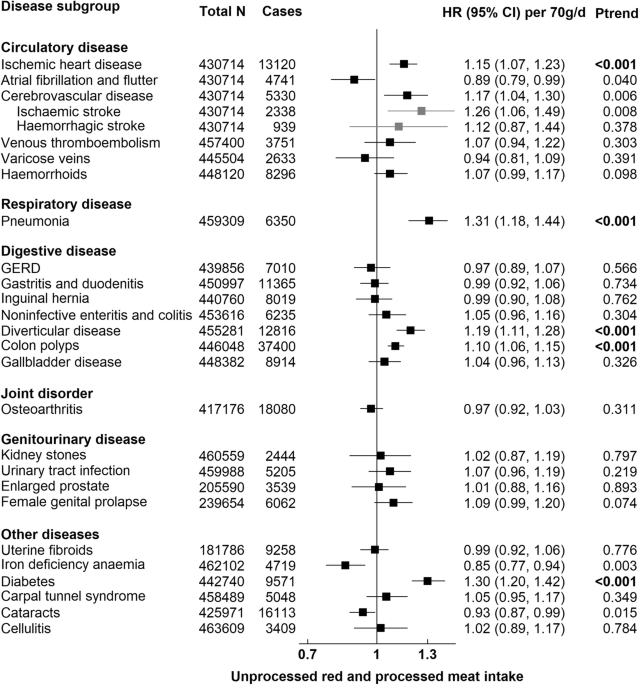
> and most of the positive associations observed for meat consumption and health risks were substantially attenuated after adjustment for body mass index (BMI)
> higher BMI accounted for a substantial proportion of these increased risks suggesting that residual confounding or mediation by adiposity might account for some of these remaining associations
The numbers in the abstract should control for BMI (but not adiposity, i.e. bodyfat percentage). They're probably also too high.
To clarify: I'm 100% in agreement with you. I think meat gets a bad rap for bad reasons (one of them being bad science). I just wanted to point out this study did some effort (even if they could have done more) and that does deserve to be said.
In this case in particular they control for BMI. If eating less meat is helpful in lowering BMI, this effect isn't captured by this result. So you have to watch out for this when taking conclusions from a study or making decisions (if you already have a low BMI then you can trust the conclusions better).
> Despite the media headlines, the results from this Austrian cross sectional survey provide no proof that vegetarians are in poorer health than meat eaters.
https://web.archive.org/web/20200427104728/https://www.nhs.u...
I have to be mindful that I make myself eat a steak once in a while. On a regular day my skin lacks a lot of colour these days. If I forget to eat the right things I start to fog up, emotions waver, mood falters, and can even get clumsy. (Couple this with some latent pancreatic problems and it's worse)
The unfortunate thing about it, is it tends to progress even if you're making an effort unless you're making enough of an effort and it can be so creeping and insidious as to leave you unaware until you've done irreparable harm to yourself, either by diet or a physical defect.
Horrible stuff, this: https://www.ncbi.nlm.nih.gov/books/NBK559316/ (read: your body will more or less start falling apart)
For one, nutritional studies tend to point to whole foods being the way to go to gain the nutrients required by your body because of the vastly complex interplay of absorption and the related catalysts. And in many cases, it's easy to overdo it on specific vitamins, especially when they're isolated and concentrated. (https://www.mayoclinic.org/healthy-lifestyle/nutrition-and-h..., https://ods.od.nih.gov/factsheets/WYNTK-Consumer/)
Secondly, I'm not sure what your first statement is intended to mean. When I eat meat, it's from usually chickens, turkeys, some fish, crustaceans, and occasionally western pig and cow (and even more occasionally, game animals).
As always, it's something each person should go over with their doctor—especially vegans or vegetarians who don't want to begin (or return to) eating meat.
It is apparent to me from living life that meat is a big part of a healthy diet. But it can be frustrating seeing studies such as this one come out and not knowing what to believe.
I recently started dating a vegetarian and am really realizing how much harder it is to eat a healthy vegetarian diet. Since no one actually wants to eat nothing but greens / veggies all day, many of her meals are carb heavy to fill up, with little protein. I'm not saying you can't be a healthy vegetarian - but it's harder. There are no good meal analogues for something like grilled chicken with a sweet potato/veggies on the side.
[1] As with all traditional practices, partial adoption may result in loss of any amount of the benefit, including amounts greater than 100%.
Or maybe there’s no reason to believe that a diet that’s healthy for Indians is necessarily healthy for Europeans or vice versa.
[1] https://www.goodreads.com/book/show/6043908-beef-and-liberty
The leader of a wolf pack gets first pickins at a kill, and it always eats the liver first.
Large carnivores elsewhere eat organs first as well.
There's a growing body of research for something that's being called the "carnivore" diet, and there's a sub-movement called "eating nose-to-tail" that seems to be, as best as I can tell, led by a physician named Dr. Paul Saladino, M.D., although the usual suspects are always on his podcast, or he's on theirs and/or associated with him: Dr. Dominic D'Agostino, Dr. Shawn Baker, M.D., etc.
Its basically exactly what you would expect... eating a lot of heart, liver, kidneys, along with skeletal muscle, etc.. I tried to do it, but I love things like french fries, roasted potatoes, roasted Brussel sprouts, etc. way too much. The biomarkers on this diet look amazing, but its always the same "problem". The people who are evangelical about eating this way are also huge into fitness, oftentimes spending an hour or more a day exercising.
I'd like to see 100 total lazy fatasses on a nose-to-tail carnivore diet and 100 total lazy fatasses on a vegetarian diet for 1 month, 3 months, 6 months, 1 year, and 2 years, and do weekly workups on them... blood pressure, fasting glucose, post-prandial glucose, and so on.
That being said, it sucks. I tried it and I couldn’t do it. Not eating any of the foods you like fucking sucks. And the adjustment period is brutal, with nausea and watery stools. Electrolytes are a constant problem. Once you get past the one month mark it’s supposed to level out, but I’ve never been tough enough to last a month.
[1] - https://shop.ancestralsupplements.com/collections/frontpage/...
Now that may be because of your top point, most of the meat consumed in the US is processed in some way. I think the biggest culprit of meat-related cancer (?) is preserved meats.
I don't know. I just wanted to admit to being a little shocked at the whole vegetarian/cancer link. You often hear the opposite of that.
I mean potato chips are vegan. French fries are vegan, etc.
The key is whole foods. Unprocessed foods.
[0] https://www.cancercouncil.com.au/blog/the-sick-quitter-effec...
Don't know if that's a representative sample of vegetarian/vegan population, but it's not unlikely the case. Hence, the link between the veg* diet and cancer is not hard to imagine.
The main issue with (a lot of) these research papers, other than having bad data to begin with, is the lack of control for other parameters: what exactly do those surveyed meat-eaters and vegetarians eat, and what their lifestyle choices are (e.g., vegetarians are generally more health-conscious, so they often exercise, don't smoke/drink as much, etc.).
In my observations (I'm in the US) this statement is true of the majority of the population, including omnivores. 2/3 of the US didn't become overweight (1/3 obese) by being mindful of their diets.
There are a lot of vegetarians in India on traditional diets that don't include highly processed foods with added sugar. I think it's safe to say that most Indians eat vegetarian food most of the time. Meat is just something most people in India can't afford everyday.
For me it was for standard 'moral' reasons and so eating junk food is still acceptable.
Eventually I picked up the health reasons angle (and discarded all the junk food) and moving to mostly a plant based diet (mostly vegan).
https://jacknorrisrd.com/austrian-vegetarian-study-making-wa...
My favorite trivia here is a study which documented that, of people who self-describe as "vegetarian", one third will admit to having eaten meat in the past one (1) week.
A week has 21 meals. If you eat 3 types of food per meal, you will make 63 food choices per week. A person can choose meat for one of those 63 choices (1.6%) and still be a vegetarian. Many folks choose meat for 30% or more of their diet.
Maybe a lot of people want to try and be a 'vegetarian' (I dunno to sound cool?), try it for 3 months and fail constantly. These aren't vegetarians, just pretentious.
I've been a 'veggie' for 25 years and I haven't eaten meat, nor anyone else who I know who are.
People have no clue about how frequently they eat meat. Since vegan and vegetarian diet are gaining traction, everyone is pretending they're being careful and eating less meat than before, yet the global meat consumption is still increasing.
> In Model 1, we estimated hazard ratios (HRs) and 95% confidence intervals (CIs) adjusted for race, Townsend deprivation index [20], education, employment, smoking, alcohol consumption, and physical activity, and in women, we additionally adjusted for menopausal status, hormone replacement therapy, oral contraceptive pill use, and parity. In Model 2, we further adjusted for total fruit and vegetable intake, cereal fibre intake score (calculated by multiplying the frequency of consumption of bread and breakfast cereal by the fibre content of these foods [21]), oily fish intake, and non-oily fish intake. For Model 3, we added adjustment for body mass index (BMI).
> Our results revealed that a vegetarian diet is related to a lower BMI and less frequent alcohol consumption
Wouldn't you say lower BMI is healthier?
Does that not seem problematic to you?
> Higher unprocessed red meat, processed meat, and poultry meat consumption was associated with higher risks of several common conditions; higher BMI accounted for a substantial proportion of these increased risks suggesting that residual confounding or mediation by adiposity might account for some of these remaining associations. Higher unprocessed red meat and poultry meat consumption was associated with lower IDA risk.
So basically 'Red meat is fine but we found a correlation between heart disease and obesity'?
What if don't drink, don't smoke, do regular exercise, not obese... and eat lots of high quality meat? I haven't seen anything that comes close to showing that this would be unhealthy.
These studies are quick to point to conclusions. Remember that time where every "scientific" study pointed at fat as the big culprit behind heart problems? When it was sugar all along?
30 years later the narrative has become: all animal products are bad for you. Stop eating eggs and meat, and eat grains, it's better for the planet too!
People are getting duped, even on HN, it's depressing.
Since you're upset about the weakness of these studies, can you point to any that rigorously show any of the claims here? In particular that free range animals are somehow healthier to eat? Grain free next. Followed by the claim that fast food meat is inherently less healthy than meat I can obtain elsewhere.
None of the claims would surprise me if true, but there's a lot of commentary in this post about how flawed these studies are while making very strong claims about what is healthy (no carbs, free range meat, etc).
Getting Hugh quality data with enough power to separate out the effect of Big Macs versus lean steaks is really really hard. I imagine they are doing the best they can with the experimental techniques available to them.
Most of the conclusions of large scale studies are not very solid and can often be dismissed with correlation is not causation. Your point is valid, but also very often popular health habits align with the view of what a healthy diet is in society. Therefore lower meat intake often is connected to more exercise, more sleep etc. Of course they often try to correct for it, but it still makes many of the conclusions debatable.
There is however one association that seems to hold up for red meat, whether that's a steak or a shitty burger, which is the connection between heme iron and certain form of cancers:
https://www.ncbi.nlm.nih.gov/pmc/articles/PMC3261306/#:~:tex....
But at the same time the effect is still very small and not well understood.
We really need to focus on how much sugar is in our foods both naturally occurring but most importantly in processed foods that are everywhere.
I have always operated under the idea that if you only use the produce, meat, and dairy, departments of a grocery store you can do a lot to improve your health. The largess of our society is that we have so many food options that are very easily consumed that many tend towards over consumption; as in no preparation required
Source?
Er no, people were told to stop eating fat but of course they didn't and average calorie intake went up in all categories. Sugar intake in the US peaked years ago but Americans are fatter than ever. Chicken and cheese consumption is through the roof.
Like the article says, being overweight is very unhealthy and almost any diet that keeps you from gaining weight is going to reduce your risks of a lot of illness.
The advantage of a plant based diet is that it's a lot kinder to the earth and to our animal cousins while also helping you avoid obesity.
To fix that, most successful diets rely on increasing the ratio of protein you eat (wether it's fish, meat or poultry). It gets you to the same satiety but eating less carbs, and you lose weight.
Now enter plant based / animal free diets, how are people gonna get to satiety without all that dense meat / fish / chicken?
If you're some amazing diet expert, I have no doubt you can figure out a way to get to satiety without relying on carbs. But most people, what are they gonna do? Just get two more slices of bread, or 50% more pasta.
If you strictly oppose a meat only diet VS a plant only diet, people will be leaner on the first one.
Also, let's take a look at the regions of the world that live longer. What do we find? Regions of the world that, in almost all cases, consume less red/white meat, sugar and fats comparatively. These populations almost universally eat more plant based food. Look at places like Japan, Singapore, Monaco. Is it just food? No. Stress, access to healthcare and other things also compound into the results. But you can almost guarantee where you find old, lucid individuals you're not finding fast food, junk food, highly processed food and stress.
Is red and white meat akin to smoking? No. But overconsumption of something that doesn't provide many essential vitamins, minerals, and fibers doesn't positively increase overall health.
As an aside, cheese consumption doesn't have to be bad since there are really delicious cheeses which have almost no fat but plenty of protein like the whole branch of "Harzer" cheeses with one example I buy and eat quite often being "Hausmacher"[0] (grinding a little bit of pepper on top of the cheese slices makes it even more delicious). Short summary of its contents by weight: 30% protein, 0.5% fat, <0.1% carbohydrates, which AFAIU is quite normal for sour milk cheeses.
Does it actually help avoid obesity? Many of the vegetarians I know are overweight or even obese.
If this is the case, you are also more likely to be financially comfortable as this is an expensive diet. It just isn't possible if you are poor enough, but plenty of vegetarian meals based on beans, rice/grain, and vegetables are.
The narrative is factory farmed meat & dairy is not good for you, not good for the people working in that industry and it's not good for our biosphere, e.g. deforestation, pollution etc.
And of course it's absolutely bad for the animals involved, but most people don't care about animal welfare or don't even think about it.
If people must eat meat for whatever reason then the healthiest option would be to hunt or raise & kill your animals or buy from people who do, but it also comes with the associated price tag.
Reminds me of https://www.bbc.com/news/science-environment-39054778
I think the documentary "the game changers" addresses precisely that.
One of the authors of a cited study did a rebuttal here - https://ketogenic.com/debunking-the-game-changers/
Welcome to my world!. ( Not just HN really, it extends to most people on this planet)
One problem is there isn't enough high quality meat available - high fat red meat in particular - however there are trends developing including ketogenic, carnivore diets, etc - as well as people buying half or full cows (much much cheaper) and then freezing it; plus then you can actually meat [freudian slip pun, I'm leaving it] the cow and see how it's cared for, etc - tying into the benefits, value of local.
I mean there is just insurmountable evidence that fat is correlated to heart disease. What is so ironic is that some journalists with no medical backgrounds write a book about "The Big Fat Lie" and now it is sugar that is the cause with not much scientific research to back it up. Sugar is bad and inflammatory for sure, but mountains and mountains of research on fat and heart disease are somehow all wrong now?
Now it appears it's not that clear. It's the excess of sugar in everything that overloads your bodies temporary stores of glycogen in the muscles and liver, which is then stored as fat, since your body can easily transform sugars into fats.
To see how that looks you can track the obesity numbers in US, the more "0%!" fat products are propped up with suger over the years, the larger the obesity crowd.
I don't think the final word is out yet, but the _cause_ of fat in your body, is not necessarily the fat that you eat.
> BMI accounted for a substantial proportion
In the "Role of BMI" they also say that BMI isn't perfect to detect adiposity, suggesting even further that being fat is what you want to avoid.
> Finally, given the observational nature of this study, it is possible that there is still unmeasured confounding, residual confounding, and reverse causality.
Studying human diets is hard.
Coincidentally, industrial food producers have discovered that it is cheaper and more profitable to sell ground up peas and plant oil as “meat”, water rinsed through oats as milk, etc.
All of the “problems” with meat are market issues. Animal welfare issues are due to industrial farming practices, which will get worse if the industry declines. Land use and environmental issues are all about the market conditions, which are literally putting sustainable meat and dairy business out of business.
The “solutions” of fake substitutes are PR driven narratives.
> The “solutions” of fake substitutes are PR driven narratives.
I think you are looking for a conspiracy where there is none. Those newer alternative meat products are not the basis of a healthy plant-based diet - they are treats that actually are marketed towards meat eaters. Ask any veg/ans you know what they eat as staples; it's not expensive Impossible or Beyond burgers, but tofu, tempeh, beans, legumes, and seitan.
I also doubt that the problems with meat can be fixed at its current scale. A trope in the vegan community is every meat eater has a neighbor raising organic grass-fed cattle on acres of land that he lovingly slaughters.
The reality is, almost all animal agriculture in the US is factory farming style CAFOs.
[0] "Using data from the 2017 USDA Census of Agriculture, which was released this month, it is estimated that 70.4 percent of cows, 98.3 percent of pigs, 99.8 percent of turkeys, 98.2 percent of chickens raised for eggs, and over 99.9 percent of chickens raised for meat are raised in factory farms"
Cattle especially are not grass fed, they are stuffed with corn, soy, and other food grown at a rapid clip with petro fertilizer. There is not enough grazing land in the country to produce meat at the scale it's consumed here.
[0] https://plantbasednews.org/culture/factory-farms-study/
You can dive into the USDA numbers yourself here.
https://www.nass.usda.gov/Publications/AgCensus/2017/Full_Re...
It is much cheaper to operate a couple of large national-scale factories to produce plant-based meat alternatives with mostly automated equipment and minimal regulatory oversight. Meat processing either needs to be regional, which is higher cost, or national, where limitations or capital costs of automation require a large pool of unskilled labor. You "fix" factory farming by enforcing labor standards at the processing layer that make concentrated, high throughput meat processing uneconomic. The result would be changes in how the industry functions and higher prices. (ie. market forces)
Those same market forces would ultimately drive more plant-based calories in diets and probably healthier eating habits. Factory farms exist because USDA policy since the 70s have been focused on slowing inflation in food prices. That policy ultimately drives alot of unsustainable practices, from factory farms for livestock, to the long-term depletion of the Ogallala Aquifer, to the transfer of topsoil from the Mississippi/Missouri/Ohio river watershed to the Gulf of Mexico. 50-100 years from now, our descendants will be returning to regional agriculture at very high cost as midwest production fails and climate change breaks the environment the supports the magnificent bounty of the California central valley and Colorado watershed.
I don't quite follow.
What happens to businesses with fixed or declining demand? Consolidation.
The bigger players start scooping up the weaker ones. Bigger players have more regulatory muscle. There are a thousand examples... aircraft is probably a decent one. You used to have Lockheed, Boeing, McDonnell, Douglas, etc... Now you have Boeing as "Team USA", who has the political and market power to do things like ship airliners that crash for avoidable reasons.
But I'm assuming he means that with a reduced demand for meat, it would mean that factory farms are going to have to find ways to reduce costs. And they're already doing their best to operate at the bare minimum. So any cost cutting measures will come at the expense of animal welfare.
I don’t really buy it.
There's a big difference between someone who eats a lot of high quality meat with no regard for pricing and someone who lives who gets meat consumption from cheap canned goods. I would guess the latter has a higher rate of obesity.
"Positive association" doesn't mean that there was an association with a "positive", as in "beneficial" result.
The study found that this positive association with health risks was "attenuated" (read: reduced across its range) after adjusting for BMI, meaning there is also a positive association with BMI that confounds the effort to draw a firm conclusion from the studied data.
This is clarified further in the rest of the paper:
Role of BMI
In the present study, most of the positive associations between meat consumption and health risks were substantially attenuated after adjusting for BMI, suggesting that BMI was a strong confounder or possible mediator for many of the meat and disease associations. BMI is an important risk factor for many of the diseases examined (e.g. diabetes [7]). BMI was highest in participants who consumed meat most frequently, and some previous studies have found that high meat consumption is associated with weight gain [56, 57], but it is unclear whether this indicates any specific impact of meat or an association in these populations of high meat intakes with high total energy intakes. The associations of meat with disease risk reported here which remain after adjustment for BMI might still be due to higher adiposity, because BMI is not a perfect measure of this characteristic; we observed similar effects when adjusting for waist circumference (results not shown), but, as with BMI, waist circumference is not a perfect measure of adiposity and there could still be residual confounding.
I guess sugar does not create CO2 while it grows so (it binds Carbon), so political idea is to create a narrative that will decrease usage of meat/dairy. But even if we all stop eating meat/dairy sheer number of people and population growth will again create CO2 emission in some other way.
> In multi-variable adjusted (including BMI)
So after correcting for BMI, meat consumption is still bad.
The summary says "higher BMI accounted for a substantial proportion of these increased risks suggesting that residual confounding or mediation by adiposity might account for some of these remaining associations"
That means that a substantial proportion of the increased risk is explained by a higher BMI. Unfortunately the summary doesn't say how much "substantial" is.
Ten percent are active smokers and the alcohol numbers look really high to someone like me who never drinks.
What I want to see are numbers where people with healthy habits who consume meat and their outcomes. This means no measurable smoking or drinking. When there are some truly adverse numbers associated with smoking and drinking it really needs to have those risk factors removed as much as possible to get good results.
Humans and their lives are just too multi-variate, even with nearly ~500k people in a study.
All you end up with are correlations – I've basically never seen a study like this that manages to demonstrate causality convincingly.
To distill two of the most valuable things I've learned:
1. The Mediterranean diet seems to be the healthiest and closest to the Western and American diets, although its actual form has some key differences from the received wisdom. In particular, its pasta is a whole-grain variety and the fish consumption is less than once per day.
2. Most people are not fat-adapted and their bodies do a poor job of metabolizing fat! Typically this requires fasting or other forms of intermittent ketosis to get the body producing fat-burning enzymes. This is likely the source of a lot of conflicting info on fat. It's perfectly excellent for you - if you are fat-adapted, you will use it for energy and won't experience 3pm brainfog. But if you're not, it will very quickly create adipose tissue (body fat!) that continuously emits cytokines (poison) that sabotage your health.
3. Stress alters our metabolism for the worse! Since so many of us are stressed we're not performing proper digestion and not getting the right benefits from what we eat! Breathing exercises, etc. can help improve this.
It's a bit like what used to be called the 'French paradox' in that American observers mistook a tradition of rich foods as the constant ingestion of such food.
I think the biggest problem is that they are not measuring low level molecular variables like metabolites, or abundances of gut bacteria. Hence, it's pretty hard to infer a causal chain. And since controlling for covariates is so hard, inferring something useful is difficult.
Especially when the purported effects are small/clinically insignificant.
He was curious as to whether these groups of people, known to live a long time and even be healthy in their old age, had anything in common.
And they did.
They all exercised a lot.
They all had very strong social and community connections.
The all ate a mostly-vegan diet, punctuated with small amounts of animal product (in quantities varying from a portion every few weeks, to a few times a week but for only a couple of months of the year - for seasonal reasons).
He attempted to also prove, that taking any one of the above three commonalities away, was enough to invalid the results.
It's an interesting book, for sure.
Unfortunately, it has the terrible, baity title of: "Healthy At 100", and an even worse sub-title I won't repeat. But other than that mis-step (possibly at the hands of a publishing company), it's a good, well-referenced read.
It will be interesting to see if WHO revise its recommendations regarding meat consumption.
(background section describes that in more detail)
https://pubmed.ncbi.nlm.nih.gov/15342453/
"Consumption of fresh red meat and processed meat seemed to be associated with an increased risk of rectal cancer. Consumption of chicken and fish did not increase risk."
(admittedly, that conclusion is a stronger statement than it should be. More precise: consumption of chicken and fish was not linked to increased risk, as they merely did not reject the null hypothesis.)
Some potential culprits are listed here: https://www.ncbi.nlm.nih.gov/pmc/articles/PMC4698595/
Loosely: curing, searing, heme iron (from blood; what gives red meat its color), fat content, and some other things that can't be summed up as nicely.
It's plausible that all of them contribute to some degree, leading to a more potent effect than any of them in isolation.
What I wonder is if adding heme iron to fake meat cf. Impossible Burger would reproduce the same effect.
I mean a person can eat a hamburger a day and still be thin, in my experience it's the fries, coke, twinkies and pop tarts and stuff that make you fat.
I think the US especially would be far better served to appeal to people to reduce portion sizes rather than insist on industrialized plant based food. Minimally processed foods in smaller portions is far more sustainable and healthier than vegan radicalism and scientifically formulated plant-based edible substances.
There are issues with our industrial food production particularly around meat. They should be addressed. I would be perfectly happy with lab grown meat if it was proven to be safe over time. I would prefer real meat without massive pollution or cruelty. But I'm not going to shift my diet to something proven to require pills to be healthy.
Just watch, the next phase will be trying to shame people for eating meat. It's only a matter of time.
My personal opinion is that we're so growth and value oriented - and that's fundamentally incompatible with a healthy diet.
Look at CostCo! They have an amazing amount of fresh, healthy meats and vegetables. But you're still walking out of that store with a twelve-pack of fish and the barrel of cheese puffs you saw on the way out. The majority of Americans simply lack the self control. The food production companies know this and take full advantage of it.
- Make food companies label non-organic food and say why they aren't organic, vs. making organic declare themselves, certify and therefore cost more. - Raise minimum grades on beef and poultry. Low grade meat is the only way to make large portions work economically. - Require food with meat ingredients to list what grade of meat is being used, hormone use, etc. - Disallow mixing of multiple animals in ground meat products... or at least cap it. Right now, fast food works because you can grind up hundreds of cattle at once.
Back when being atheist was a tough choice and being some kind of religious was the default choice I think there was more thoughtful people in the atheist camp.
Today as the tides turn one finds that the same annoying thoughtless people are atheists if that is the default.
Im the same way it doesn't surprise me at all that one find some of the healthiest people are vegerarians (or mostly meat), I think there's a huge overlap between those groups and those that generally think carefully about what they eat instead of just eating whatever processed food is cheap.
Going forward I think we'll see more unhealthy vegetarians.
The Impossible Whopper is no better or worse for you than a regular Whopper by any metric.
It is pretty easy to be a fat vegetarian today.
On days when we have time to cook, we make good, healthy meals. However, unhealthy alternatives are always present and very tempting.
The curfew has been hard for me and I have resumed my bad habits. I ate plant-based burgers, non-dairy ice cream, cookies and cakes almost every day. Most fast-food restaurants near me will ship from apps and offer meat-free alternatives for the same price.
Plant-based food is not necessarily healthier. It is simply meat-free.
Without resorting to an anecdote, my point is that it might simply be easier to accidentally eat healthier food when one has to abide by the contents of the packaging.
and most of the positive associations observed for meat consumption and health risks were substantially attenuated after adjustment for body mass index (BMI).
I didnt read all the details, but that seems like a sneaky way to invalidate the benefits of eating meat. If sounds like the benefits correlate with low BMI, so they want to dismiss them. But what if eating meat helps one to maintain a low BMI? Suddenly the picture is cloudy.
As for heart disease, there is always the iodine rabbit experiment from the 1930s.
Just wanted to throw out there how healthy my vegetarian dinner was.
higher BMI accounted for a substantial proportion of these increased risks suggesting that residual confounding or mediation by adiposity might account for some of these remaining associations.
I'm confused. What is a "substantial portion" of the increased risk?i.e. you can still be 'skinny as a rake' and be type-2 diabetic.
If you are a homeless drug addict, being a vegan or vegetarian won't help improving your overall health. Likewise, being a well-off employed young individual in a stable and happy relationship who does regular health-checkups is more than enough to counter the daily 250g rare steak...
That surprised me. The article later gives a hypothesis that plentiful iron is good for pathogens, citing a separate and interesting article:
What did they eat, meat rarely (they couldn't afford it all the time), mostly vegetables (mostly home grown), salad-stuff, beans, maybe fruit and the odd nut.
Maybe going back to this direction, is the way we should be leaning.
Said "scientific study" is funded by Wellcome. An arm of WHO, unelected crisis manufacturer supreme. On wellcome's site:
"Reducing meat intake, particularly in the USA where meat consumption is highest, should be a global priority."
Show me the incentives and I'll show you the outcome.
And cancer research. But you didn't bring that up.
edit: Also not "An arm of WHO", they partner with them cause priorities (public health) are aligned.
I couldn't find anything here about meat consumption:
You may already realize this but if you type
site:wellcome.org "Reducing meat intake, particularly in the USA where meat consumption is highest, should be a global priority."
into Google you'll find it.
A proper -mediocracy- meritocracy (i.e. it's actual skills and qualification that counts) is preferable over any kind of popularity contest. That's not to say the WHO in particular works by this standard, I just find it very irritating if people insist on every position or institution - especially very specialised ones - being subject to elections.
That just doesn't make sense and can have horrifying consequences (see [1] for an example). There are positions (in my example: medical examiners), that simply cannot be adequately filled by laypeople and amateurs. That's not how a complex society works. It's not the middle ages anymore and most professions and many official positions require training, experience, and qualifications.
That's why I don't get the obsession with everyone needing to be "elected" (and by that I assume you mean by the general public, because WHO positions in particular are in fact awarded by elections).
While I think mediocracy is more accurate, I think you meant "meritocracy".
Lower risk of IDA (Iron deficiency anaemia), but you have a higher risk with the above five
Is a filet mignon, ground beef, or chick thighs processed? Sure. But i don't think that is what we're talking about here.
It's not just chickens, I've seen ground meat, and pork tenderloins in supermarkets with the same processed treatment.
But like you said, it's the additives that we really think of as "processed". If you home make sausage with just ground meat and pork casing is that "processed" if you didnt add nitrates or edta? Technically yes, but that's where I think clear cut definitions need to be in place.
If you know how to cook, you can tell what it is, just by looking at it.
Not sure about other parts of the world, though.