54 points · by Guardianmag · 5y ago · 84 comments
Those are interesting numbers to consider when searching for extraterrestrial life in other planetary systems: 39% of planetary lifespan had advanced life, 11% of planetary lifespan had technologically advanced civilization.
If we really, really, cared, we could set up a momentum exchange between Earth and Jupiter mediated by an asteroid, moving Earth further out and Jupiter (slightly) further in, chasing the outward drift of the Sol habitable zone: https://arxiv.org/abs/astro-ph/0102126
Also, we could (in principle, not saying we will or we should) engage in selective breeding or genetic engineering of ourselves; and while mind-uploading is currently SciFi, it’s in the category of “we recon this is eventually possible” rather than “convenient plot device”.
Anatomically modern humans evolved 300k years ago and didn't change much since. Can you imagine what kind of progress we will make in the next 300k years? I can't even imagine the next 1000 years.
With regards to dolphins and crows - wow! What a find animals like that would be on another planet! Quite intelligent - but not technologically advanced. You raise an interesting question: assuming a planet has evolved life having the intelligence of a crow or dolphin, what's the probability that planet will evolve a technologically advanced life form? How likely is it earth is the only planet to have evolved such a life form?
[0]: https://en.wikipedia.org/wiki/Timeline_of_the_far_future
Why is Wikipedia not doing this?
If you're on a phone, does the non-mobile link redirect to mobile?
The formatting on the mobile site looked just fine to me on a laptop. I'm sure there's a good reason I'm missing.
IIRC, mobile Wikipedia has a bigger font, is less information dense, and the navigation doesn't work as well.
> If you're on a phone, does the non-mobile link redirect to mobile?
Pretty sure they do, but the reverse isn't true.
If I'm reading that right, that's only C3 plants. C4 plants would keep going until 800–900 million years. And who knows if something else doesn't evolve or is engineered for the different conditions.
Perhaps it's possible there is another high-metabolism cycle that doesn't involve much oxygen, but nobody really knows both if a pathway exists, and if evolution can "find" it in time. Any biochemists here who want to weigh in?
If Mars had intelligent life and now it doesn't how does that bode for Earthlings? Can life really adapt given the lack of evidence anywhere?
I wonder how will space travel to the next possible habitable planets work. Shoot in all directions and hope that life spawns on a few of those possible habitable planets that are light years away.
Venus, however, is sheathed in clouds. So we only have low resolution radar images of most of the planet, and we’ve only sent a few very short-lived landers with low resolution cameras to the surface. They could have landed in areas that were once oceans or otherwise uninhabited. And secondly, Venus has been basically completely resurfaced with lava over time. Venus may once have had large oceans before runaway greenhouse effect. (And keep in mind that the Sun has gotten significantly brighter over billions of years, besides the increased greenhouse effect on Venus.) And so we can’t even rule out a planet-spanning civilization like our own. It’d take a lot more exploration and drilling to rule that out.
First, there is the possibility of a civilization dying and evidence being erased by tectonic plate recycling. Mars is approximately 4.6 billion years old. We know it has volcanic activity, and most consider it to have inactive tectonics now. Some scientists believe it could have had significant activity in the past, based on the 3 distinct regions of Mars. Earth's tectonic plates vary in their rates of recycling: the oldest non-oceanic tectonic plate is 3.6 billion years old, and shows no sign of recycling. Oceanic plates recycle on the average of every 180 million years though.
Second, there is the possibility of technology that didn't leave a visible trace. This is not supported by any evidence and is mere conjecture. If the society tore down non-organic structures and converted to using all biodegradable/organic materials then evidence of the society would be scarce, if existent at all, especially if bodies were cremated as many do today. Chemical analysis could detect this I suspect, or more importantly prove it wrong.
Last, if for some reason civilization evolved underground and stayed underground, then there wouldn't be any visible evidence above ground. This is also pure conjecture. Micro-robots that explore Mars' caves might find something, as might ground penetrating radar.
We're not really sure what kicked off Venus' runaway greenhouse, so it's possible that would still occur, though it does seem less likely. Without the runaway greenhouse, Venus' atmosphere would likely remain primarily nitrogen. Its atmosphere would still be significantly thicker than Earth's but by a factor of 5 instead of a factor of 100. With the additional atmosphere, it might remain quite temperate even at the greater distance.
Of course had Venus and Mars developed in eachother's places, Venus would have developed as a smaller world with a thinner atmosphere (generally more mars-like) and Mars would have been larger with a thicker atmosphere (generally more venus-like), so the whole point is somewhat moot.
Red Tape as the real Great Filter...
Life evolved in the sea. At some point life evolved to leave the sea and go to land, whether the sea was no longer hospitable enough, or in search of better food. Life continued to evolve on Land, specializing into different groups and colonizing different lands.
Perhaps civilizations evolve on their planet, then at some point they leave their planet and go into space (when their planet is no longer hospitable or they need more/better food). Finally, while in space they evolve more, founding different colonies that evolve differently due to culture and environmental differences.
The most probable scenario is that life is born multiple times, in multiple places, when conditions permit it.
There's no evidence of life moving across planets of different star systems.
If that hypothesis holds, then conditional on all the steps having completed on a given planet, they will have done so roughly equally spaced in the time allotted, regardless of their relative difficulty.
So, for example, if the window on Earth is 5 billion years, and there are four hard steps to complete, then, conditional on all four steps finishing, we expect each step to have taken about 1 billion years, give or take, with about 1 billion years left to go.
(See the Technical Appendix to Robin Hanson's Great Filter essay: http://mason.gmu.edu/~rhanson/greatfilter.html#appendix, or his more detailed discussion of this particular point: http://mason.gmu.edu/~rhanson/HARDSTEP.PS)
(I'm joking; the article is interesting, and I'm not trying to frame it as trying to portray this as an urgent threat)
It's one of a whole class of problems that (1) we will have to solve or we will go extinct, but (2) are completely and utterly pointless to actually try to solve now because they are so far beyond our level.
When some far future people finally have the ability to seriously start working on one of these problems, they will have techniques and knowledge so far ahead of us that anything our best and brightest could do in a lifetime's work now on the problem will be something the future people can trivially do in a day.
The only contribution we can make now to these problems is to just continue to improve our science and engineering in general, in the hope that if we do that for enough generations then eventually our successors will have enough accumulated knowledge to actually tackle these problems.
But the code is here: https://github.com/kazumi-ozaki/lifespan/blob/master/main.f9...
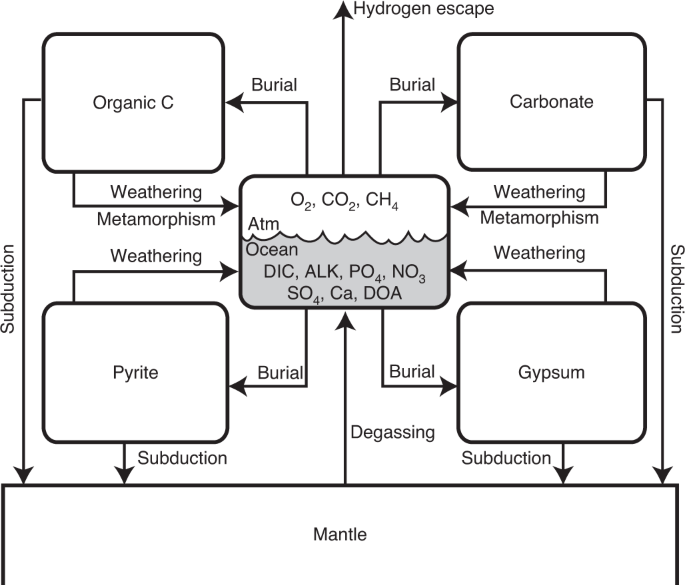
It does not give me great confidence in the modeling. Perhaps the paper goes into great detail about the formulas used in the code, and explains those variables and naming choices (those not in the Constants file with comments), or the fitting coefficients.
Of course, I really wonder how the complexity of the natural world could be captured by a few hundred variables.
1. https://www.nature.com/articles/s41561-021-00693-5#data-avai...
[1] https://www.pbs.org/video/the-end-of-the-habitable-zone-4t8g...
And it's very hard to conceptualise what a billion of years in the future actually means.
Edit: Another alternative is technology progresses but political and cultural institutions do not, so the requisite level of global cooperation never materializes.
Kind of makes it a tautology.
* Provide more information to the search for habitable planets/extra-solar life
* Better understand how the Earth's atmosphere and overall ecosystem evolves over time, which may inform our understanding of long-term risks of climate change (and perhaps contribute to our ideas of how to manage terraforming on Earth, if we need to mitigate climate change).
Get to work on those planet hunting.
So, two people ran one model described in one paper. Even if that was the whole issue, it would merit "may last only" rather than "will last only".
Additionally, the authors are making a variety of assumptions with little or no basis about the behavior and development of Earth Flora and Fauna; specifically, that it will be mostly static in most ways, with no adaptation in genetics, inter-species interaction, prevalence in different places on Earth etc.
Having said that - in 5 Billion years, Sol will become a Red Giant, so this planet is going South at some point between now and then.
Another commenter suggested moving the planet and got down voted to oblivion but it's not at all a ridiculous suggestion in these kinds of time scales. You could place giant ion thrusters on the moon and set it in an orbit where tidal effects would nudge the Earth outwards over a few million years. This can be made subtle enough as to not even be noticeable to life on Earth.
Of course a cheaper solution is to just use a solar shade that can incrementally decrease it's opacity to compensate for the brightening sun but this would not be enough when the Sun transitions into it's red giant phase
We're talking millions of years in the future and assuming "we" are still around, I doubt that a 21st century layperson would be able to deduce that they ever stemmed from the same genus, never mind species - even assuming no genetic engineering or cyborgs.
Life extension is also likely going to play a major factor in the future and it's a lot harder to dismiss the merits of long term thinking when it's a very likely possibility that you will be around to experience the consequences of your current short-sightedness.
It would be so great to learn some more details about the model, etc.