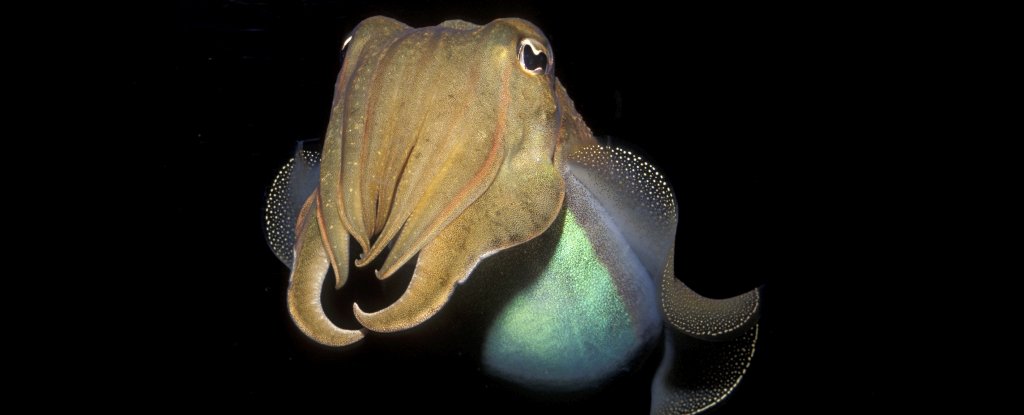
A Cephalopod Has Passed a Cognitive Test Designed For Human Children
A new test of cephalopod smarts has reinforced how important it is for us humans to not underestimate animal intelligence.
ScienceAlert
209 points · by daegloe · 5y ago · 100 comments
I think folks in modern times are less & less prone to thinking animals are ‘dumb’. But 1 or 2 generations ago this was not the case. I think humans for a long time have regarded animal intelligence in an inferior light.
Cephalopods have proven to to be incredibly intelligent, and emotional. I think you could easily argue many of them are smarter than human children, maybe even a lot of adults :)
I highly recommend an episode of ‘Nature’ I saw recently on PBS about octopi. It’s called “Octopus: Making Contact”. It’s the story of a professor who decided to install a tank and keep an octopus in his home, and the relationship he & his daughter developed with it. Absolutely stunning!
https://www.pbs.org/wnet/nature/octopus-making-contact-previ...
https://www.pbs.org/wnet/nature/baby-cephalopods-first-momen...
Great post. Respectfully, though, I disagree with the excerpt above.
I find that urbanization has led to a disconnect between people and animals. In times past, a person would have regular contact with a host of domesticated animals (cattle, horses, mules, donkeys, sheep, goat, chickens, pigs, etc.) as well as the wild animals that are a part of everyday life in rural settings (rodents, possums, armadillos, foxes, coyotes, snakes, deer, birds, etc.)
Without question, people in the past had a far greater appreciation of the ‘intelligence’ and behavior of animals than modern city-dwellers.
One need look no further than the numerous metaphors that have been passed down from these non-urban times: stubborn as a mule, wise as serpents, cunning like a fox, horse-sense, wise as an owl, etc...
In short, I’d suggest that the more modern (or, perhaps, urbanized is a better word) the LESS appreciation one finds for animal intelligence.
The degree of ‘compassion’ one has toward an animal is not directly correlated to one’s opinions as to its intelligence.
My uncle raised pigs. A frequent topic of conversation was how smart they are. Without question, they’re smarter than dogs. (I had a pet pig growing up.)
Yet, we ate then.
An even more brutal example: slavery. It was obvious and undeniable that human slaves were intelligent; yet, that didn’t mean that compassion towards them was common.
Are you sure that comes from nature observation ?
Satire used to criticize the powerful of the world picturing them as animals. So these associations might not come from where you think they do. La Fontaine's fables are a good example of that. He was not the only one to do that.
Never thought snakes were that ‘wise’ though. Don’t know about owls.
The naturalist Jean-Henri Fabre, in the 19th century, made an extensive study of solitary, spider-hunting wasps. Much of what he discovered, with regard to the surprising complexity of their hunting and nesting behavior, became well known in his day - he was one of the first writers I discovered when I started delving into the literature to feed my own burgeoning interest in the aculeates, and one of the reasons his work is so easy to come by is that it was popular, and thus well preserved.
It was very much new to me, though; to whatever extent it had entered common knowledge a century and a half ago, it has since exited again. If anything, I think that in recent generations we have become less likely to recognize complex behavior and intelligence in nonhuman animals, not more so; that may be changing, but if so, I think it must have begun quite recently.
I struggle to understand how I disregarded animal minds for decades, but I suspect it can be reduced to arrogance, convenience, and gluttony. It has been a difficult revelation in some ways. Cooking meat has almost been a part of my way of life; it’s something I took pride in and always did to the best of my ability. Now I don’t really have much interest in food at all.
I think personally owning a pet dog and realizing they aren't biological machines simply responding to stimuli has helped me with that realization.
I think the parent comment to yours is more about avoiding meat because of compassion to the intellect/consciousness. Rather than avoiding meat in order to eliminate any suffering that may occur during "production" of it.
I'm curious because I'm pretty good at convincing myself that the meat I buy comes from animals that haven't suffered. And if it can actually be guaranteed (moose killed by hunter) I'm all-in on meat. But if I somehow "woke up" and realized that I didn't want to eat other living things because of compassion (or whatever) to their minds? I'm not sure that I could go back from that.
I know what you mean, but on some level you and I are also "biological machines simply responding to stimuli". The difference is more in the complexity of said stimuli and responses in time and space :)
I don't think that cephalopods are arrogant when they eat other creatures, although I suppose they may be gluttonous. Why hold yourself to a higher standard than you hold the animals you refrain from eating?
For some, morality isn't fungible or based on the morality or others (animal or human). If someone is a thief and willing to rob you, does that mean its okay for you to steal from them? It seems reasonable to me to hold a personal code of ethics and standards that isn't dependent (or at all related) to the ethics and standards of others (if any).
Also, I'm not sure a cephalopod has evolved the physical and mental capability to vary its diet on command such that it can choose if it will feed on other animals or not.
At some level humans and cephalopods are just animals, and equivalent in that regard, but I'm not sure I accept the equivalence far beyond that or especially when it comes to morality.
This cannot be how you approach morality. Animals routinely do horrific things to each other. Would you ever ask someone that question outside of a conversation on whom we kill to eat?
Cooking is a source of pleasure and society. My cultural Christian inheritance (and yours?) is quite committed to the separateness of people and animals. Many people deny even the wholeness of the human species. Where is the mystery in your beliefs? It is only an inheritance you now reject.
You can come back to meat later, or not, in your own time. Sort of like when you go far enough left, you get your guns back. There is nothing shameful in a cat.
But that said, there's so much great vegetarian food to be eaten!
And you're right, most of the world has amazing vegetarian food. It's daunting to take on learning all of it. Indian and Thai foods especially have been incredibly appealing to me lately. So much flavour and nutrition is possible and these people seem to have figured it out a long time ago.
So I don't see the need to look down on yourself for realizing something new. It wouldn't be new if it was totally familiar. However, the knowledge itself is thousands of years old, and also evolving.
Park Ranger at Yosemite National Park (on designing secure garbage cans)
https://www.schneier.com/blog/archives/2006/08/security_is_a...
The kea sit and watch and learn over s day or 3 and then they are back in, causing chaos.
The kitchen staff were trying to solve each puzzle with time pressure, a job to do and bad weather. The kea looked to find it funny whole the poor worker was frustrated.
If our civilization lasts long enough, someday we'll all be reviled for eating animals, especially octopi and pigs.
Harry Harrison wrote a book I read many years ago called West of Eden, where the dinosaur extinction event didn't occur. An advanced species of lizard used modified lifeforms for their tech. I have it on my list to read again. It does make you think people might be more symbiotic towards the world rather than what we have now.
That may very well be a skewed understanding, but it's likely why they choose that grouping.
Well, it is objectively inferior. That doesn't mean that it's not intelligence.
On the other hand, human children are incredibly curious and experiment with everything. It may not be stupidity that keeps them from following directions.
There is much to be learned by occasionally breaking the rules.
1. Draw a triangle on your forehead
2. Make a shitty clone of yourself with a circle drawn on the clone's forehead, who comes out of the shop immediately after you walk in
Then see if your dog decides to follow the shitty clone, or whether it waits a couple minutes for the regular version of you.
Edit: also, repeat with many more dogs, many more dog owners, and many more shitty clones.
Anyway, I think a fun cartoon would be the Flintstones with ceph, for example their screen could be a smaller ceph whose chromataphores are pixels.
[edit]
Old drawing, back of a napkin (apologies to MIT AI Memo 554):
https://github.com/koalahedron/ideas-for-models/blob/main/RE...
Recurring villain, probably gets his own show.
Some primates can delay gratification, along with dogs, albeit inconsistently. Corvids, too, have passed the marshmallow test.
Having had a couple of human children, I would definitely not claim that they are anything but extremely clever, but then so are many primates, dogs, and corvids.
And I learned Hungarian (and Portuguese) as a kid.
On the whole, psychologist and dog researcher Stanley Coren estimates, the average dog's intelligence is roughly as sophisticated as a 2.5-year-old baby's.
A few weeks ago she (on her own) decided to dry her wet painting by taping it to the heat vent. We have never used tape in any way similar to that, and certainly have never used the heat vent to dry anything (it being a long-term safety hazard, and potentially bad for the ventilation system).
She routinely falls on her face because of getting herself into ridiculous precarious situations (in disturbingly similar ways).
The problem is intelligence just isn't 1D no matter how much we wish it was. Delayed gratification, problem solving and communication ability are not necessarily highly correlated enough for a single metric to make sense of the three.
The clumsiness might be a different thing. Changes in height, weight, strength and sight and probably a load of other things come into this. If you change something about an adult it takes them a while to adapt.
The example that comes to mind is a pregnant woman squeezing though some gap. To any observer the attempt was obviously not going to go smoothly.
I think dogs are still surprisingly smart.
Human children are stupid by design (well, evolution). Language, culture, and technology are overtaking genetics as the more effective information transfer mechanism. As we shed our instincts to make room for learning, human children will be born more and more stupid over time. It's a trade-off: At the same time, human adults will have greater capacity for smarts. It is the increasing stupidity at birth which enables us to learn so much into adulthood.
Animals without developed language haven't been able to afford this progress. They are smarter than human children from birth, but are unable to learn as much. So while your dog outperforms a human child at waiting outside the store, it will never have the capacity for art, mathematics, nor engineering, no matter how hard you train it. Humans on the other hand, can be trained quite a bit.
https://vaviper.blogspot.com/2019/06/from-onion-study-reveal...
This feels like an evolutionary attribution error, if that's a thing. Self control is different from a thumb; there aren't necessarily any genes that code for it.
My first guess would be that, in order for a creature to be as smart as a cuttlefish, it needs to have a mental model of spacetime and of itself. Self-control is just one of the many results of such intelligence.
It feels like we are wasting our time looking for aliens searching for them in the skies (especially the unscientific work around oumuamua).
They are living right beside us in the form of cephalopods. We haven't deployed enough science on these amazing creatures yet (without of course distributing them like putting them in cages), probably because it's not a sexy field as compared to say astronomy or other cool things...
I do know there are a couple of websites for cephalopod enthusiasts:
Textbooks:
Cephalopod Cognition by Anne-Sophie Darmaillacq (Editor), Ludovic Dickel (Editor), Jennifer Mather (Editor)
Cephalopod Behaviour 2nd Edition by Roger T. Hanlon (Author), John B. Messenger (Author)
Personal anecdotes:
The Soul of an Octopus: A Surprising Exploration into the Wonder of Consciousness Paperback by Sy Montgomery
I don't care if its my favorite treat either. I believed quite strongly that a little vs a lot doesn't matter: the best parts are in the anticipation, the initial bite, and enjoying the lingering aftertaste. Having more more bites to eat is a gimmick with nothing but downsides (however now I get how things like addiction can drastically alter that equation so the "more" is practically everything).
So show me a version of this test that doesn't have the assumption "all kids are greedy for food and the most successful ones will optimize for that" at its core.
>The other part of the experiment was to test how good the six cuttlefish were at learning. They were shown two different visual cues, a grey square and a white one. When they approached one, the other would be removed from the tank; if they made the "correct" choice, they would be rewarded with a snack.
>Once they had learnt to associate a square with a reward, the researchers switched the cues, so that the other square now became the reward cue. Interestingly, the cuttlefish that learnt to adapt to this change the quickest were also the cuttlefish that were able to wait longer for the shrimp reward.
https://rs.figshare.com/articles/dataset/Data_set_raw_traini...
Theory of Mind is much more a test of human-ness - a stage person-ness really. And yes, quite a few animals qualify.
Some birds remember thousands of locations of their stashed food. Some animals have a detailed internal map of many square miles of land on which they live. Pick just about anything a typical 3 year old can do, and we can find an animal to outperform them in that respect.
Are We Smart Enough to Know How Smart Animals Are?
https://www.amazon.com/Are-Smart-Enough-Know-Animals/dp/0393...
And I'm curious if those studies of animal intelligence, actually tried a human. Could I remember thousands of place I put stuff? I think I do. I have a whole house full of stuff, and can find most of it quickly. I remember where I kept my socks in an apartment I lived in 30 years ago.
So yeah no, animals maybe aren't ahead of us in cognitive function.
-> Intelligence is ambient.
All cells think, and all collections of cells (from biofilms and stomatolites on up) think. In computer terms all cells use compatible protocols and processors and the living world is a kind of biological internet ("Wood-Wide Web").
-> All life shares one mind.
Whatever mind is, if you believe it "runs on" the physical substrate of cellular internet, then our minds are not separate from the minds of other living things. This would explain a lot.
When I bring this up people often object that this is anthropomorphism, but don't see it that way. Since all living tissue is intelligent, I see humans as the anthropomorphism of that ambient intelligence of the biosphere.
-> The biosphere is the result of "intelligent design": it's own.
From early on, the evolution of life would have become (more deeply) self-referential through mental feedback, meaning that the advent of intelligence itself becomes a factor in the further evolution of life. Things like the great switch-over from anaerobic to aerobic metabolism and the concomitant massive increase in atmospheric oxygen may well have been deliberate choice on the part of the global mind. In any event, the reductive mechanistic view of "dumb" life is faulty. Earth is Solaris.
Now this changes nothing about evolution. It's still a chemical tautology with no purpose, and adaptive pressure doesn't stop just because cells can think. ("Science does not remove the terror of the gods.") The Earth as a single being still has to navigate the "slings and arrows of outrageous fortune". Gaia is mortal. Part of the reason living systems seem so wildly inefficient (an illusion) is that they are so inconceivably resilient. (Efficiency vs. inefficiency is meaningless in evolution: there is no purpose so there can be no measurement of efficiency.)
[1] "What Bodies Think About: Bioelectric Computation Outside the Nervous System" (youtube.com) https://news.ycombinator.com/item?id=18736698
It's a bit of natural selection. I don't know if cephalopods have a 'patience' gene. If yes, then --> natural selection. The ones who didn't have this gene got eaten many generations ago. The ones who do (and their genetically blessed offsprings), are alive to 'tell the tale'.
This is a bit biased if you ask me. They examined only the ones thay they found. The ones they found are the ones that are alive. The ones that are alive are the ones that are patient.
To disqualify my above 'theory' the scientists must capture eggs of 100 (?) eggs, raise them, treat them all the same, and then release them in a controlled 'wild' environment and see how fast they get eaten/how many survive for how long.
Then they compare results with their observations in the wild.
I am not a marine biologists, so I probably wasted 30secs of your life (apologies).