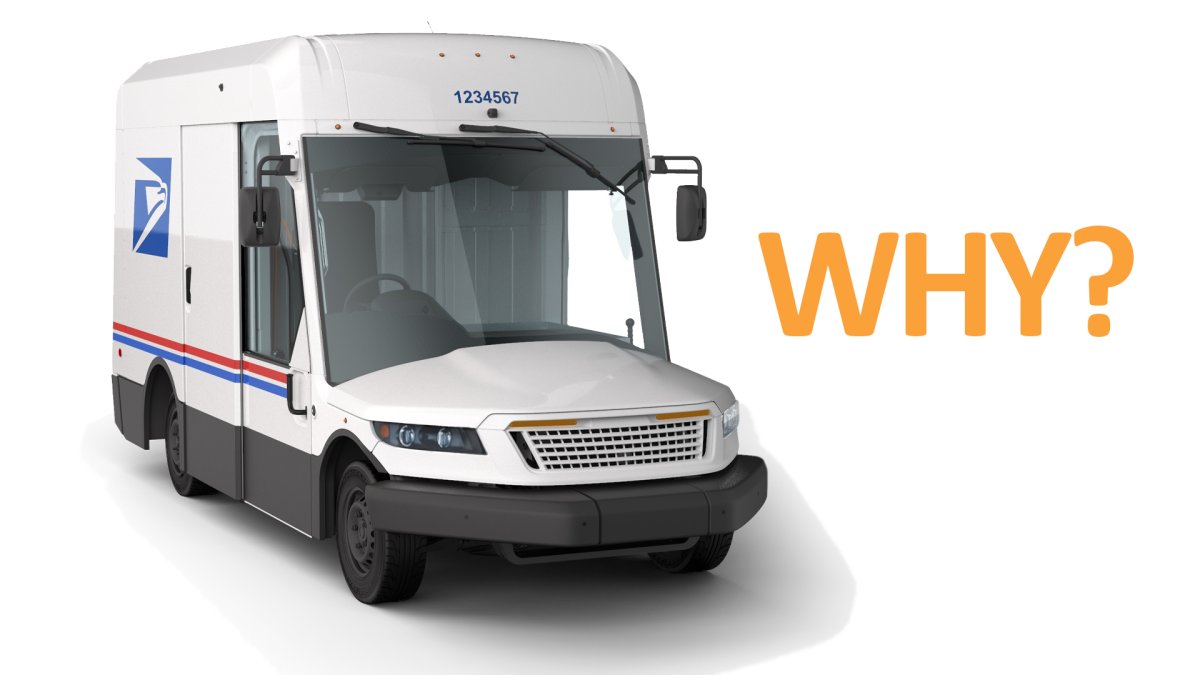
Here’s Why the New USPS Mail Trucks Look So Weird
It might look funky, but there's a good reason.
The Drive
265 points · by minding · 5y ago · 377 comments
LLVs are currently horrendously inefficient (fleet average of about 9mpg). They have a ~13 gallon tank for a range of about 120 miles. They drive about 18 miles a day on average (total fleet average, so some are idle and probably the typical route is 45 miles, but 18 miles is good for our purposes) and burn 2 gallons of gas. At $3/gallon, that's about $6 a day in fuel costs (and let's ignore brakes and oil changes). We could put a 75kWh battery in that thing, easily get 250 mile range (double the range of what the LLV is). For an efficiency of about 3.33 miles per kWh, and an average commercial electricity price of 11 cents per kWh, that's 59 cents per day in electricity cost. So every day, the electric one would save $5.40 in fuel costs (net).
Even with that generous 75kWh battery, you're talking just 6 years for it to pay for the electric battery to pay for itself in fuel costs vs the old vehicle. And these things are designed to last for multiple decades, plus this will drastically reduce oil changes and brake servicing costs. Are they really that cash strapped they'll ignore something that can save them that much? The US federal government definitely isn't strapped for cash. Does this really boil down to punitive fiscal requirements for the USPS put on by Congress and DeJoy? Because if so, that's inexcusable.
Or perhaps no one bid a competitively low price for an electric powertrain?
USPS leadership had instructions to electrify the fleet. For whatever reason, they decided they didn't want to. Maybe they didn't want to deal with a risky change, maybe they thought it would hinder meeting their other obligations. Doesn't matter. They decided they didn't want to do it.
Their next step is then to write requirements in their rfp such that they can select a contractor that cannot meet the electric mandate. This allows them to legally pass the buck for the electric thing to their contractor, who will get paid big dollars to "develop" electric vehicles that their customer doesn't want.
Congress gets to brag about their environmental contributions, USPS gets the vehicles they want, and the contractor gets a sizable sum to do nothing. Win-win-win.
I am surprised they didn't look at using LNG instead of petrol.
Also one might be able to keep costs down by optimizing for cost rather than energy density. LiFeP04 cells have been comparatively expensive, but it seems price has been dropping lately. It's also a good choice for safety and durability reasons, and because they don't use cobalt which is sort of expensive and sort of rare. Not using cobalt means avoiding a resource that would bottleneck other manufacturers of EVs.
It'd be interesting to know what the actual specs are on the EV version of the USPS vans (battery type, capacity, etc...) and see if my speculation corresponds to what they chose. I don't know if they've released that publicly yet.
A 30kWh battery could easily be 5 or 10 thousand dollars, which may well be worth it to save on gas for a long time; on the other hand, gas engines are well-understood and really cheap, because we have a huge established industry that builds engines by the millions and has been optimizing for cost for over a hundred years.
This sounds a lot like the "Captain Samuel Vimes 'Boots' theory of socioeconomic unfairness" from Terry Pratchett that generally eventually gets quoted in this sorts of discussion.
https://www.goodreads.com/quotes/72745-the-reason-that-the-r...
The post employees also often complained about the relatively high loading edge for the storage box, which makes it super hard to load and unload heavy packages.
Regardless of the problems, I think it was a really good idea and a rather cool looking vehicle. And when it comes to urban streets in Germany, the street scooter probably was the perfect vehicle when it comes to space requirements.
[1] https://en.wikipedia.org/wiki/StreetScooter [2] (German) https://www.businessinsider.de/gruenderszene/allgemein/stree... [3] (German) https://www.elektroauto-news.net/elektroautos/streetscooter-...
last year deutsche post lost two streetscooter CEOs for "diverging opinions on the future of streetscooter". deutsche post is now trying to sell their subsidiary.
https://www.post.ch/en/about-us/responsibility/our-prioritie...
Electric wins on all fronts in cost, simplicity, and city health
In this day and age, reliable ICE drivetrains are pretty much a solved issue if you're not trying to make tons of horsepower (which they're not)
Most of the maintenance with a modern ICE has nothing to do with the drivetrain. Tires, brakes, suspension components, filters, all things that EVs still have (brakes get a respite from regen, but the extra weight takes the savings back for the tires).
Oil changes with modern synthetics and low performance demands can be 15k+ apart.
Then there's the fact you can get an ICE drivetrain repaired anywhere and fuel up anywhere.
The cost of building up a repair and charging infrastructure alone would probably have killed any savings.
This is not an anti-EV post, but it is an anti-antiquated-ideas-about-ICE post.
All other common repair items would the same for an EV: suspension, various ball and CV joints, tires, AC, body damage, sensors, bushings, etc
Also, maintenance would probably be more expensive if you have to train people to work on the electric powertrain.
But presumably they could always modify the powertrain in a future iteration.
It's not that these aren't valid concerns, they have to be addressed, they're just so minute they don't change the calculation even slightly.
EVs at that speed may lose a bit more (already more efficiently generated and used) power in regen - vs. a guaranteed 100% loss on a gas vehicle.
Cost/benefit analysis comparing ICE and EV changes wildly if the effective range of the vehicle is lower and the comparable fuel efficiency is not enough to justify the additional costs of EV.
These are fleet vehicles that get deployed all across the country, and they have to be serviced, moved, etc...I doubt the choice not to go EV was an oversight, considering that fleet has been one of the beachhead markets for alternative-energy vehicles.
> While some will be EVs, some of the NGDVs will come with modern, fuel-efficient internal combustion engines. As electric vehicle infrastructure improves, these NGDVs will be able to be retrofitted with the battery-electric powertrain later on.
Whoever is making these decisions either wasn't given competitive bids or they're poorly informed about electric vehicles.
Electric vehicles are great but at scale, the issues around charging them daily are very real. It works for a single homeowner, but if a post office has 100(?) trucks, and it takes 2 hours to charge, someone needs to be there to keep track of them, unless you expect 100 charging stations.
Also, there are 30,000 post offices. I'd imagine it will be a long process, even if they just put in 110. one evse requires large amounts of continuous current, let alone with a parking lot full of vehicles.
The LLVs don't drive for an hour a day and sit in the parking lot turned off for 23 hours a day. Many routes might be 6 hours or more. You need vehicles that have AC or heat and the ability to run for an entire day. The differential cost for such a vehicle is not the cost of a battery. I'm not saying the current purchasing process is waste-free, but you need to use realistic numbers.
The longest route is about 185 miles in Phillipsburg, KS. There are averages, medians, and modes, none of which are the right numbers. The average isn't as important as probable mileage.
For example, say a bus carries a maximum of 80 people. When 10 people get on your bus, your costs aren't 12%.
https://www.vice.com/en/article/3an4k8/dont-expect-the-usps-...
If a federal government agency in the most powerful national on the planet can't take the most obvious step toward electrification in a case which is the best possible situation for an electric vehicle (very stop and go traffic, slow speeds, short routes, long total miles on odometer over life of vehicle), what hope does the rest of the world have in taking action on climate?
Greta Thunberg is right. People don't care about climate. Literally everything else is a priority.
There's no way to do a project this big without phasing it in. The USPS has many tens of thousands of buildings.
Clearly USPS is trying to look after its employees, trying to ensure they have the best vehicle, suited for their work with minimal hassle.
More weirdness please. Looks great to me.
Why have a nose at all?
Put driver's seat over the front wheels. Like the VW Vanagon (Eurovans). https://en.wikipedia.org/wiki/Volkswagen_Type_2_(T3)
These are gonna be EVs, right? Might as well do it right.
Jerry did not use his talents to the fullest extent.
I really wish there was a spin-off with only Newman & Kramer.
Kramen.
Stealing a regular person's car and crashing it isn't of much concern if you don't kill anyone.
What the hell are you going to do with a stolen mail truck? Everybody who sees it will know exactly where you got it
But there are also people out there who are influenced by wanting to look in a way they perceive as nice or cool and still have a satisfying life. I appreciate the tech culture that helped eliminate the suit but mostly because I like the way I dress and it's a form of expression for me. Plus it's nice regularly getting comments for putting in a little effort without having to resort to business casual. I know specifically my younger cousins admire that I can do a programming job and still wear (and are able to afford) clothes they'd want to wear.
Perhaps if the USPS trucks weren't the ugliest design that satisfied specs and instead seemed like some cutting edge vehicle there might be people out there who are growing up that would actually find it kind of fun or cool to drive around a USPS truck. It might be nice for it to be a job people want to do versus it being a secure job where you're the joke for driving around the ugliest vehicle on the road while dodging people's dogs.
As a simple example that well design can still be top quality, look at any of the trains on the Tokyo subway and train systems versus any train system in the US. They're far better functionally than any of the trains in New York or Chicago and look alot better inside and out as well. Maybe it looking impressive and not a tin can on wheels contributes to the increase in ridership for all groups of people, maybe that makes the job to be a conductor highly competitive to the point of it being a college degree worthy job. There are other things the train system does well but you still want to not hate riding on the vehicle.
An even simpler to understand example is the early days of android vs iPhone. Android was simply uglier but wasn't that different functionally. It was just extremely ugly to the point of people not wanting to buy it if they could afford to otherwise, so much so that Google invested a ton of money in creating Material Design
Weird can be fashionable forward thinking but it's not always and I'd argue it's not usually unless there's a forward thinking artistic vision behind the weird that sees something new. Those electronic shirts that show wifi strength from a few years ago will never be fashionable but they definitely are weird. A government spec sheet is not a forward thinking artistic vision.
[1] https://beta.sam.gov/opp/588f5ed4becd4fc4abf6df8e7a918184/vi...
Edit: This[2] seems to be a notice of the contract being awarded to Oshkosh for exactly $481,877,752.00 USD.
[2] https://beta.sam.gov/opp/1e56c386808444d886124fc1927f4eb0/vi...
Seems to work fine. Packages gets carried in bigger trucks, but still just business trucks with different branding on them. Wouldn't it have saved a lot of cost in the end?
Amazon use off-the-shelf vehicles though.
> one of the requirements was long service life
I wonder how they require that. Does the manufacturer have to warranty them all for 30 years? That's extraordinary!
https://www.aboutamazon.com/news/transportation/amazons-cust...
"Just one year after announcing the purchase of 100,000 custom electric delivery vehicles as part of The Climate Pledge, Amazon has begun testing the new vans on delivery routes."
In 1986, they road-tested the contract competitors' trucks for 24,000 miles, and the Grumman LLV (the truck that this new vehicle replaces) was the only one running at the end. Definitely not proof that they'd run for the intended 24 year lifespan, but I guess the USPS got lucky with the LLV (they even stretched it 6 years past the original retirement date!).
https://www.nytimes.com/1986/04/09/business/postal-contract-...
The article also says you can learn more at llv.com.
Bonus, I learned that Grumman LLV stands for Grumman Long Life Vehicle. Maybe everyone else already knew that, but I thought it was cool.
1 - https://www.speedsportlife.com/2010/02/22/avoidable-contact-...
Not for long, they even invested in Rivian, an EV manufacturer, who is going to build vehicles to their spec.
Same reasoning here: at such a scale, having a custom-built thing optimized for a bunch of your specific requirements, and made uniform, pays off.
Also, the USPS uses panel vans in denser areas. My neighborhood in Seattle has the mail delivered in a Sprinter/ProMaster/Transit thing, but weird trucks are ubiquitous elsewhere.
"As a Postal Service™ Rural Carrier Associate (RCA), you will have a continuous, part-time job with a reliable employer. If you are retired, self-employed, an at-home parent, an educator, night student, or are employed on an evening shift schedule, this on-call position could be the ideal job for you.RCAs are responsible for the safe and efficient delivery and collection of the U.S. Mail™, working part time when regular carriers have scheduled days off or take vacation days. RCAs also sell stamps, supplies, and money orders. RCAs perform a vital function in the Postal Service, serving thousands of families and businesses in rural and suburban areas while traveling millions of miles daily. The work can be demanding—but also rewarding."
And a note about the vehicles:
"Generally, RCAs are required to use their own vehicles for mail delivery, and they receive an equipment allowance in addition to regular pay. The vehicle needs to be insured, dependable, and in good working condition. Vehicles with bucket seats or standard transmission are not recommended. Some offices may provide a Postal Service vehicle."
Their previous standard mail trucks were a Jeep variant, too: https://en.wikipedia.org/wiki/Jeep_DJ
I'm pretty sure most of the geography in the US can be found in either Spain or Sweden as well. Except jungle I guess, but don't think you have much of that over there either. Besides the point anyway.
Yeah, the cars here do drive through a lot of different geographies as well. In the denser areas like cities, the postal workers are most often on motobikes or just walking though, depending on the density of the city.
So it might be less different than it seems at first.
In the UK, we have letterboxes in our front doors. Nobody can drive up to them (mine is up two flights of steps!). So, last-yard post delivery is done on foot, and vehicles are used to deliver the postmen (and in urban areas, postmen will travel from the delivery office by foot or bicycle). The vehicles can thus be normal vans.
In the US, they have mailboxes on posts by the kerb. Postmen can drive right up to them to deliver the post. There, it makes sense to have specialist vehicles.
I suspect Sweden and Spain are like the UK, and not the US, in this respect.
Not really. The country side in Sweden at least have mailboxes on the kerb for everyone, it's really common. And the mail workers still seem to manage dumping the mail into there without leaving the car, without having a specialty designed car for it.
https://cdn.arbetet.se/app/uploads/2016/04/09235113/01-Brevb...
Some others in the area imported RHD vehicles.
A few years ago, exiting the vehicle on the left side to come around to the curb, he was struck by a car in a hit and run (they never caught the driver). Spent 6 months in hospital learning to walk again, and while he’s since somewhat recovered, he’s going to spend the rest of his life living in significant pain.
Not having to exit into the road, when the job involves people exiting the vehicles hundreds of thousands of times per year, matters a lot for the long-term safety of the delivery force.
I don't mean that it doesn't matter at all, the procurement process needs to make sense and not be a path for graft, but there's reasonable volume there to spread fixed costs across.
There there are conversion kits for common rural postal vehicles (jeeps)
Most regular vehicles are not optimised for many/small/various packages and are not optimised for high frequency in/out and searching/unloading as mail trucks would need. You'll easily see how the package/postal delivery drivers loose time searching the packages through the back and energy bending, opening/closing doors when they use such regular trucks.
One of the great things here is how they seem to look for best posture and efficiency for the driver: it's not only about speed of delivery, but likely to also prevent accidents during the trip, injuries from the work, ...
Good video on subject: https://www.youtube.com/watch?v=RE5FGyq12ds
But I guess these don't really count as these are suncontractor vehicles...
"The requirements dictated the step-in height, the glass height (including the low side glass), the vision angles, the internal height, and the maximum roof height," wrote Kahn in a tweet. "That was all locked in."
Other constraints included the ability to reach the mailbox while in the seated position, and the requirement to see the ground around the vehicle...
Just because those things are spec'd as they are, that doesn't mean they need to be.
It certainly sounds reasonable to have an enclosed cargo area with sufficient head room for comfort, but saying they look like they do because there are requirements doesn't really explain it.
Now, I understand that it's to prevent accidents, make it more easy to put mail into mailboxes if they're situated right next to the road, etc. Yet somehow every other country makes it work without specialized vehicles.
To my knowledge, there are no right-hand-drive vehicles manufactured in the US, as RHD is limited to countries closer to extensive auto manufacturing in Europe and Asia. As a stopgap measure, the Postal Service has been making use of domestic minivans converted to RHD using a belt arrangement that does not look particularly user friendly. The driver has to lean over to see the dashboard instruments.
Unit cost would be higher but it would be laying the groundwork for the next generation of vehicle, sustaining those smaller companies and encouraging innovation. As well as avoiding too much reliance on one supplier.
**She was known as "the mail lady" because our town only had 1 mail carrier. I realize that term wouldn't fly today, but this was rural America 30 years ago and I wanted to give context. Same mail carrier for 20+ years. Worked 6 days a week. Her name was Linda - Bless her for her hard work.
...why not?
It's not "cancel culture" as the sibling comment suggests; it's rarely people being outraged about imagined attacks. It's just language evolving as society evolves. As an added bonus, sticking with non-gendered terms means you don't accidentally insult someone by assuming something based on their body type or haircut, and it leaves space for non-binary or non-conforming people to not be accidentally made to feel unwelcome.
On the USPS Creed, I was a paperboy when I was a teen and always chuckled at that. I never got Sundays off. I don't think I ever had a snow day, but there were days the US mail didn't run due to weather.
As a non-American I have always found this amusing.
Here in New Zealand Post was until a few years ago delivered by bicycle in cities (SUVs or vans in rural areas). They have since moved towards small electric vehicles called Paxster. Basically large four wheel scooters that can ride on both the road and pavement.
Australia Post used to buy ~2000 of them a year, but recently have replaced most of the motorcycles with bicycles and electric bicycles (and the volume of ordinary letters that are suitable for motorcycle/bicycle/walking delivery has also plummeted, these days an enormous (literal) volume of mail is parcels from China/Amazon, which don't fit as neatly/efficiently in a motorcycle pannier an are mostly delivered by contractors in generic white vans.
"In terms of actual numbers, a major contributor to the fall has been the Australia Post ‘postie bike’ fleet. After artificially inflating new bike sales figures for years, sales of the postie bike (formerly CT110, now NBC110) fell 43 per cent in 2017 and a further 52 per cent last year. Australia’s top-selling ‘road bike’ for years, the NBC110 only scraped into the road category’s Top Ten last year and didn’t even figure in the overall Top Ten." -- https://www.justbikes.com.au/news-and-reviews/2018-australia...
and:
"For years, the CT110 was Australia’s top-selling motorcycle, but almost the entirety of those sales went to Australia Post. With the decline in letter delivery and Australia Post’s move to electric trikes better suited to parcel delivery, CT 110 / NBC 110 sales have fallen rapidly in recent years, including a 52 per cent drop in 2018 alone. The NBC 110 didn’t even appear in the ‘Top 10’ listings provided by the FCAI, suggesting less than 500 units were sold last year. That compares to 1,447 sales just two years ago." -- https://www.justbikes.com.au/news-and-reviews/motorcycle-sal...
But no, the NZPost business model (or lack thereof) does not depend on junk mail. Mail is ridiculously expensive, ~50%+ more expensive than the USA, so addressed junk mail is relatively rare, maybe one item per month.
Here the mailbox is usually on the other side of a grass verge and footpath (sidewalk), too far to reach from the road.
Not once have I ever seen a USPS vehicle other than the Grumman LLV, which has no AC, even during the summer months and at several different residences across the state.
Hybrid cars turn the ICE engine on at intersection when AC or heat is on, to convert gas into electricity and avoid depleting the batteries completely.
The press release kind of vaguely implies a price range:
https://about.usps.com/newsroom/national-releases/2021/0223-...
> Under the contract’s initial $482 million investment, Oshkosh Defense will finalize the production design of the Next Generation Delivery Vehicle (NGDV) — a purpose-built, right-hand-drive vehicle for mail and package delivery — and will assemble 50,000 to 165,000 of them over 10 years. The vehicles will be equipped with either fuel-efficient internal combustion engines or battery electric powertrains and can be retrofitted to keep pace with advances in electric vehicle technologies. The initial investment includes plant tooling and build-out for the U.S. manufacturing facility where final vehicle assembly will occur.
> The contract is the first part of a multi-billion-dollar 10-year effort to replace the Postal Service’s delivery vehicle fleet, one of the world’s largest.
If "multi-billion-dollar" means about two billion and they make 50,000 vans, that's $40,000 per van. If they make 165,000 for 2 billion, that's about $12,100 per van. I guess that range sounds sort of reasonable.
[1] https://www.theverge.com/2021/2/25/22300281/usps-new-mail-tr...
Since average mail route is 45miles [1]. At 1000Wh/mile - that's only 45kWh of charge needed per vehicle.
[1]https://www.grit.com/community/usps-rural-delivery-factoids
You can’t tell me that exterior outlets are rare or expensive. The fuel saved in a single year would easily exceed the price of putting some exterior outlets in a parking lot.
Source: https://usa.streetsblog.org/2017/12/07/while-other-countries...
Unless you are a kid of course, then not only will the driver never see you, trucks positively decapitate you.
The previous models were injury/death traps.
Spending an extra hundred bucks per vehicle for a nice N-way adjustable seat or spending engineering hours making the seat-belts more convenient will have far greater benefits than throwing random safety technologies at it.
The previous models were designed in the 1980s. All 1980s work vehicles are/were death traps by modern clipboard warrior standards.
That speed is quite deadly with zero crumple zone.
If you're not wearing a seat belt then you're going through the windshield and it doesn't matter how the vehicle is equipped.
A crumple zone is going to still help in that case (40mph head on with another car at 40mph is significant, crumple zones in both vehicles would help both occupants).
Can't they just write "DO NOT BEND" in sharpie on the side?
Particularly since they routinely swing in and out of the roadway without looking or even using their directional signals.
It's best to treat a mail truck on a roadway as a being of pure chaos, utterly unpredictable and capricious, if not always actively malicious.
1. All electric
2. Can transport a double bass
3. But no bigger than necessary
4. Meets decent safety requirements
Oh. You edited your post to say "decent safety requirements". A '91 Metro probably doesn't fulfil that these days. But they'd probably do fine with an electric conversion.
But still, why the Impala? Why an 18mpg, FWD, 300hp transversely mounted engine design? Why kneecap yourself with a shit car? When do they use the full potential of the Impala, or the Crown Vic, or the EcoBoost Explorer? Even in the 90s and 2000s. Why not solicit contracts for custom vehicles? We could have had a 4d, 4WD Mitsubishi 3000GT Sedan Interceptor Edition. Instead there are enough Panther platforms cubed up in junkyards for every man woman and child in America.
It goes to show that the requirements for police vehicles are crafted by the police themselves. "We need a high performance, 2WD luxury car with... ahhh... three, NO four... yeah FOUR hundred horsepower!"
Basic fleet models would have gotten the base 200hp engine.
In an application with multi shift operation (like shared taxis) there is a lot to be said for an understressed v8.
Availability is likely worth more than a bit of marginal fuel cost - which likely didn’t see that many miles... lots of idling, which btw small turbo engines generally don’t like
https://en.wikipedia.org/wiki/Police_vehicles_in_New_York_Ci...
My understanding is that UPS scraps their vehicles once they've exhausted their usefulness, which is why you don't see used UPS vehicles driving around with the logo painted over. Would USPS do the same?
And don't forget the cost to have trash trucks haul the thousands of pounds of waste away, also diesel powered.
So it’s a lot of junk as you said, but it’s also a lot of money. I’d wager that less than 10% would pay that $150 annual fee for an “ads-free” model.
[1] https://about.usps.com/newsroom/national-releases/2020/1113-...
No, it's not. Ad-supported newspapers are older than postal mail being largely advertising subsidizing other mail. Older than the US Post Office (and the US, even in North America), too.
I'm glad they went with a utilitarian design, seems better to have a truck that does exactly what they want for the lowest cost than to spend money making it look "better" but also more expensive and/or less useful.
These excesses - typically designed to feed the government undergrowth - remind me of what the early Thatcherites complained about.
Guess why the new mail truck looks 'weird'? PROJECT REQUIREMENTS such as view and mailbox accessibility.
I know this place has sunk a bit over the years but clickbait?
https://i.pinimg.com/736x/5e/64/9b/5e649ba44cdc59c8c6f4a605c...
(Meaning, a car designed for public services, exposing construction and functional requirements in a sculptural expression, which is not dictated by marketing requirements.)
Here's a possible example, a Diamond Reo refuse truck, which also brings some to the sculptural aspects of brutalist design:
https://cdn.motor1.com/images/mgl/Y9p1j/s4/mitsubishi-minica...
I propose this eagle:
https://images-na.ssl-images-amazon.com/images/I/61M%2BFV3aD...
It just seemed like a missed opportunity to make lemonade from these design constraints. Though maybe it'd be a safety issue to make the mail delivery vehicle excite the kiddos as much as my little old red miata does because it resembles Lightning McQueen.
true, parcels and overstuffed mailboxes would challenge robots, but the difference in cost would be so extreme, it would still be a net win... heck, you might be able to deliver mail more frequently, then send electronic notifications to users that their mailbox is full !