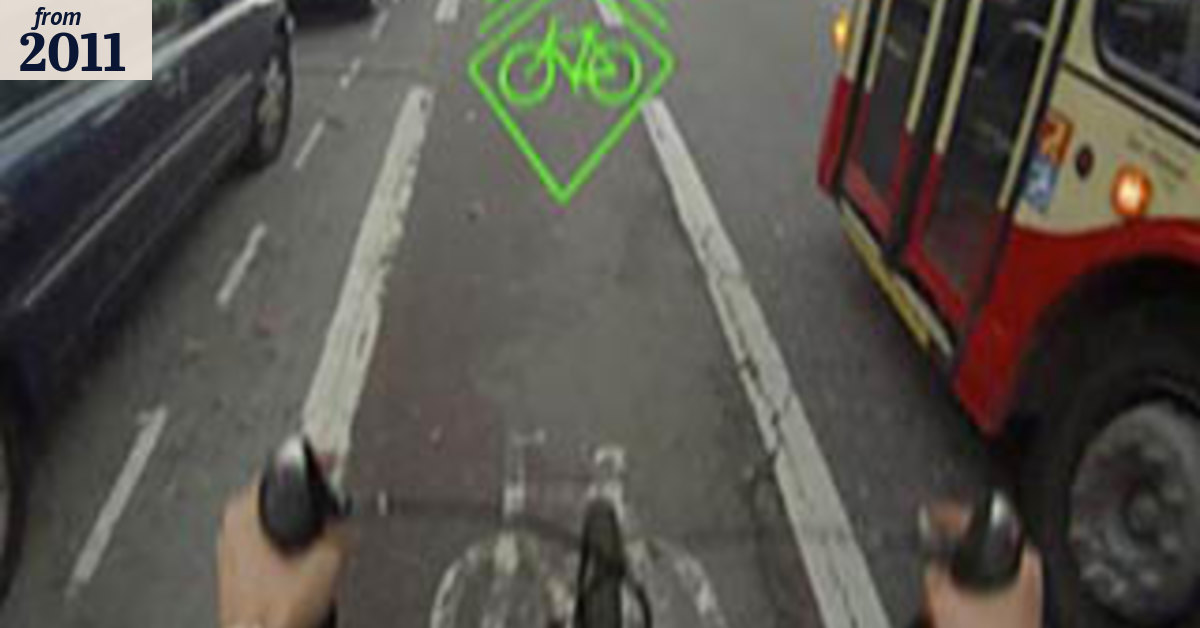
Laser-made bike lane could save lives
A safety device that projects a bright green laser image of a bike onto the road ahead – alerting motorists to its presence – could be a potential life saver.
The Sydney Morning Herald
85 points · by julian37 · 15y ago · 60 comments
Experience from Copenhagen shows that the best solution is to have the bike path on the inside of the parked cars so the parked cars function as a buffer against the moving cars.
Putting it on the inside makes it possible to make it a different level (like the footpath) so the cars cannot go into the bike lane.
37% of people in Copenhagen bike to work, so they have a significant amount of experience with bike paths: http://www.youtube.com/watch?v=UDs83Ud6Zss&t=1m24s
Compared to this, on streets I almost never have any risky situations - even on busy multilane streets. Cars see you earlier, because you ride on the same street as they do. You don't appear unexpected (for car drivers) because you overtake on the left side like everyone else. The right of way is clear, as there are no exceptions as in the case of bike paths.
In cities such as Copenhagen and Amsterdam bike paths have an advantage, because you are faster (no traffic jams) and because car drivers expect bicycles at crossings due to the high amount of bicycles. In cities such as Vienna where the amount of cyclists is relatively low most car drivers don't expect to encounter them - so even if you have the right of way on a bike path they just ignore it.
The problem it seems to me is the size of the roads. Most of the time you can not cleanly get around a biker without going into the oncoming lane. On a 50mph road with bikers going 20mph you constantly have to judge the speed of oncoming traffic to see if you can safely pass or get hard on the brakes to wait. This happens a lot and is annoying.
There is a significant effort to install so-called "continental-style" cycle lanes along some major routes. These really are lanes of a decent width in their own right, typically a couple of metres, modelled after the kinds of place you mentioned.
However, the opinion of local cyclists is fairly consistently that if you can't have proper facilities like that, you're better off with nothing at all than with a bit of paint on a normal width road that marks a "lane" barely wide enough to contain handlebars even if you're cycling in the gutter. It is now very clear that such lanes just encourage cars to pass far too close, and drivers to complain when cyclists do crazy things like riding in the main traffic lane because the gutter is full of water/broken glass/etc.
There is plenty of evidence now that having no lane at all actually results in drivers being more patient and giving more space when passing cyclists than having a lane too narrow to be sensible but marking it out clearly.
Also, although shrinking, cars are bigger in the US and drivers seem to be more distracted.
Most close calls I've had were either with seniors, cell phone talkers, distracted moms or young kids, probably roughly in that order.
The really weak laser pointers won't do any worse than make you see spots for a little while, as I can tell you from personal experience.
That said, there are lasers that you have to be very careful of. The laser-pointer level, though, is generally quite safe.
The illumination level on an overcast day is about 1000 lux, so to be visible in daylight the device will have to light up the bright bits of its image at least about that brightly.
The image in the picture looks to me like the illuminated area is at least about 0.1m^2, probably rather more. So that's a total output of at least about 100 lumens.
Light at the peak of the photopic curve (i.e., wavelength optimized to look as bright as possible per unit power) is 683 lumens per watt.
So the output from this thing is going to have to be at least about 150mW. That would be well into class 3B, meaning that you need a key switch and safety interlock on the device and protective goggles if you're anywhere where it could shine into your eye.
(Doing laser safety calculations properly is complicated. Don't take the above too seriously.)
The point of a laser is that the light is /not/ scattered over a square, its a very tight circle. If it was instead over a 3mm diameter circle, that 100 lumens would be over 20 million lux. You would, of course, not want to stare into that!
Its unclear from the picture exactly how long the "line" being drawn is (3mm diameter by even 7m long is only 0.02m^2), but a hypothetical kid staring into the beam would only get hit by part of the figure; the laser beam is moving to project the entire figure. Only the part that actually goes into the kid's eye matters, and the impact is lessened by the fact that its moving and also by the blink response.
BTW: Wikipedia tells me direct sunlight is up to 130,000 lux, so that's probably around the illuminance you need, not 1,000 lux, btw.
No sir, I don't like the idea that the inconsiderate laws-don't-apply-to-me cyclists I carefully avoid running over every day will suddenly be equipped with lasers which can shine into my eyes by accident.
This can't be true. The statistics in the US say that this is 7% of accidents:
http://www.johnforester.com/LAW/Bikeway%20Controversy.htm
The reality is that riding on the sidewalk and turning from the wrong lanes are the big cause of bicycle accidents. Being hit from behind is exceedingly rare. Being doored is probably the main worry that a cyclist riding correctly should have.
(Using the correct lane should be the secondary concern. Don't go straight through an intersection from the right side of the right turn lane. You're going to get hit by cars turning right.)
Putting it in front of the bike would seem like such a minor change, but puts it from being a gimmick to a lifesaver.
Combining both designs and tweaking the projected images and colors could be an incredible step forward for bike safety.
That's not even counting the bicyclists who blow through stop lights, stop signs, don't stop for pedestrians at crosswalks, ride on busy sidewalks.
In my honest opinion, I don't think bicycles belong on roads (at least in city areas).
The important data to me is my total driving time from A to B. So, I measured my total driving time to and from work. I also noted the number of bicycles I had to pass on that journey. If the cyclists were slowing down my total commute time, then there should be a trend in average driving times with 0, 1, or 2 cyclists encountered. No such correlation exists in my data. On average, red-lights and other traffic have more impact on my commute time than do delays caused by cyclists.
My conclusion: my emotional response to a cyclist was not proportional to any measurable delay. Now I wait calmly for a safe place to pass, secure in the knowledge that, on average, it doesn't delay me at all.
(obviously your commute time could be affected differently than mine, but I encourage you to look at the actual delay, and see if your frustration is warranted)
The closest comparison I can imagine would be if there were no sidewalks in cities and you had to deal with pedestrians on the side of every road as you were driving.
I used to do a fairly reasonable commute every day through the center of Edinburgh and the problem of car drivers overtaking and turning left was probably the single biggest danger I had.
Besides that, governments will never allow random citizens to make their own street marks. It interferes with traffic regulations and laws.
Lots of them will provide a very noticeable indicator, and that's good.
Until all the cats in the neighbourhood start chasing you....
I can see it working in more open roads where this would be easy to see up ahead, but when space gets narrow, the visibility angle becomes tough.
Valiant effort though.
This device will be particularly cool in foggy conditions or in smoke.
That's one of the reasons why I typically have a heavy u-lock and a pepper spray with me when cycling.
It's not right but it's happening all the time.