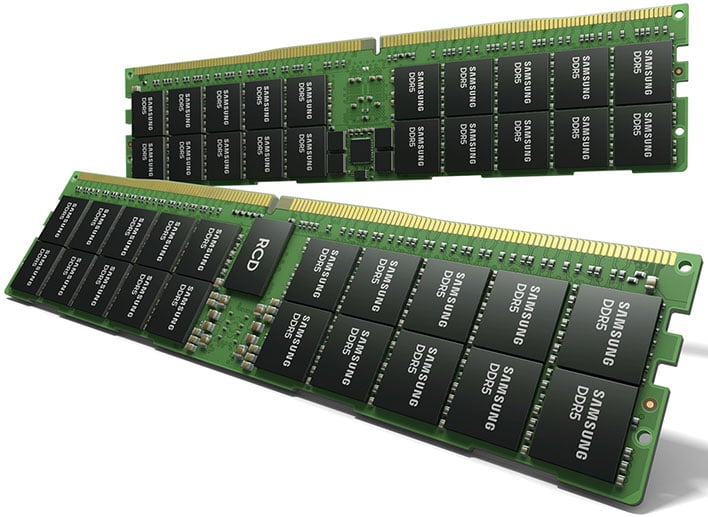
Samsung Announces 512GB DDR5 Memory That Is Twice As Fast As DDR4
Samsung is laying claim to the industry
HotHardware
76 points · by kjhughes · 5y ago · 31 comments
So, I'm wondering (and maybe something like this already exists) what if RAM could be placed at the end of a high-speed serial cable of some sort. Like Firewire, Ethernet, Fast USB, or some kind of LVDS high-speed data serial cable...
Now, this RAM (because it would allow for long cable sizes, because we'd like to connect more of it to a PC, and thus the serial cable speed would be a bit reduced due to length) would not be intended as System RAM -- but more like a faster-than-SSD hard drive -- although perhaps it could be used as System RAM, just as slightly slower System RAM...
Note To Future Self: Look into the various ways that RAM can be connected via high-speed serial links (also, in the future, such links might include optical fiber...). So, high speed serial links AND optical fiber...
Intel Optane DIMM and Intel Optane SSD. Although Micron is selling their "Optane" Fab and Intel has yet to announce if they intend to buy it.
>such links might include optical fiber
Intel has been working on this for many years, Silicon Photonics and the goal is to have Compute, Memory and Storage in different "box" or even "Racks".
>can be connected via high-speed serial links
IBM OpenCAPI and OMI. Which allows up to 5PB of memory ( No more Big Data crap ) , and if I remember correctly with additional 10ns latency.
I have several close friends working at that fab and I am astounded that Micron is both still in business and hasn't caused a chemical disaster in Lehi yet. It's a fantastically mismanaged and unsafe workplace.
https://en.wikipedia.org/wiki/Texas_Memory_Systems
Edit: and IBM’s CAPI
Assuming RAM is 2 inches away from the cpu, and assuming the CPU is operating at 3 ghz, you are looking at 3 billion round trips per second over the distance of 2 inches, or a grand total of 12 billion inches of wire being crossed per second.
Electric signals are limited by the speed of light, though. In a vacuum, light travels at 299,792,458 meters per second, or 11,802,852,677 (11 billion) inches per second.
Do you see the bottleneck?
I see the issue on latency, but suppose this system is being consumed by a large GPU or a traditional out of order CPU or DMA mechanism. If you can start reads and writes over a high throughput pipe on many chips, can't you also get higher throughput to keep multiple parallel operations busy while requests are in flight?
But, short of having a "how to subvert the speed of light" discussion, which would be exceedingly long (and probably unproductive!) -- you've given me an idea!
Yes, you are correct that the speed of electrical propagation is limited, and does limit things!
We're completely agreed there!
OK, so here's my idea!
F--- the electrical cable entirely!
So, we have Quantum computers, Quantum bits, and all sorts of research on how to compute things with them, all kinds of professors and papers and companies and venture capital all researching how to do Quantum Computation...
Well, I say F--- all of that! (In a polite, friendly, "yes your work is really genius and I acknowledge all of your brilliant contributions kind of way!").
Here's the grail!
The grail of Quantum is NOT Quantum Computation -- but rather Quantum Communication!
In other words, get rid of the damn electrical cable, and
figure out a way to do that communication with a pair of connected-at-a-distance Quantum bits; that is -- Quantum Communication!
In other words,
Quantum Communication -- should replace wires and busses of all sorts, serial, parallel, electrical, light, what-have-you.
That's the damn grail!... (pardon my language!)
Not Quantum Computing!!! (brilliant though it is, I am not trying to knock it in any way, far from, quite the opposite!)
Quantum Communication -- replacing wires and busses of all sorts, serial, parallel, electrical, light -- would be the Holy Grail -- of being able to build bigger computers (like imagine close-to-infinite RAM -- on one motherboard! Close-to-infinite RAM! Well, it would be off that motherboard... but Quantum Communication, if it were available, would, for all intensive purposes, make that RAM so connected, would have the net effect -- of physically existing on the motherboard, even though in actuality it would not be so!)
So, to answer your question...
YES, I DO SEE THE BOTTLENECK!
But... equal-and-oppositely...
Do you see my point?
https://www.anandtech.com/show/16143/insights-into-ddr5-subt...
[1] https://pcpartpicker.com/products/memory/#Z=32768002&sort=pr...
But remember to compensate latency cycle counts with the faster cycles of higher speed RAM. Often the absolute time in nanoseconds hasn't changed as much as the cycle count numbers make it seem.
twice the transfer speed, same latency (if we are lucky). For reference
https://en.wikipedia.org/wiki/CAS_latency
https://www.crucial.com/articles/about-memory/difference-bet...
Which I assume will only allow 8 DIMM per socket on a 16 Memory Channel CPU at a maximum of 4TB Memory per Socket.
- The speed of this is 7,200 Mbps (lowercase "b").
- The speed of a fast SSD is 7,000 MBps (uppercase "B").
Why am I paying for tons of ram to cache anymore? (I'm ignoring wear & tear for this question.)
Referenced SSD speed source from here: https://www.gamingpcbuilder.com/best-m-2-nvme-ssd/
--------
EDIT: found the answer here: "Samsung's latest module would deliver around 57.6 GB/s transfer speeds on a single channel"
https://www.engadget.com/samsung-unveils-a-512-gb-ddr-5-ram-...
DDR is random per byte/word.