Latest EmDrive tests at Dresden University shows "impossible Engine" does not develop any thrust
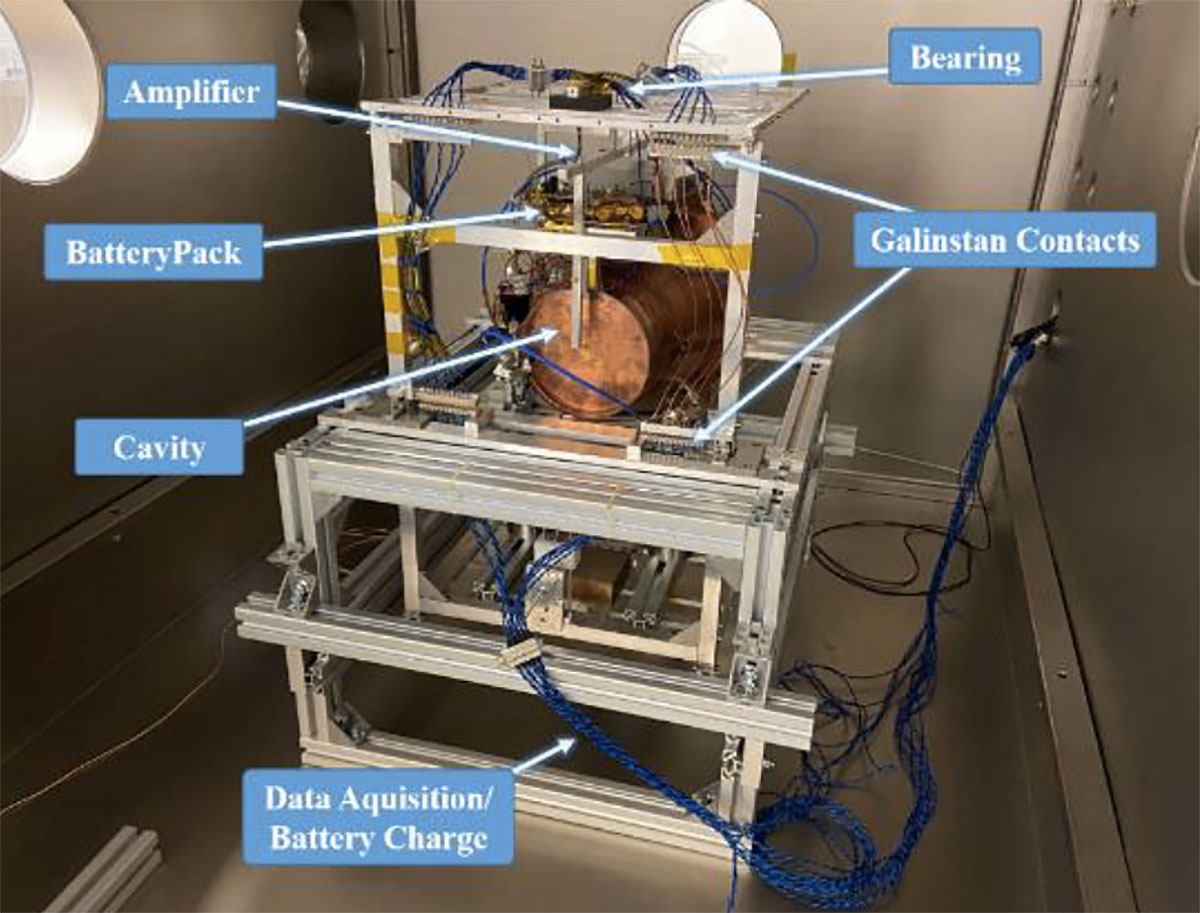
The final reports on the testings of the "impossible engine" EmDrive show that it does not produce the previously claimed thrust.
GreWi
534 points · by sohkamyung · 5y ago · 296 comments
Suppose there was a rally driver who would claim that rally cars could go much faster if they were always driven in reverse. He did some rudimentary experiments and might have found a significant improvement. The general public and other racing drivers, who in my analogy can all be wonderful people but happen to know little about the mechanics of cars, are naturally enthusiastic: a potential breakthrough in driving! But clearly we need more experiments. So other rally drivers get to work: they set up an elaborate system with ropes and pulleys so they can reverse the driver's position in the car and run a car as fast as they can, but in reverse, on a test track. What do they find? Sadly, their answer is somewhat inconclusive, probably negative, but perhaps the test track had many bends. So they would like to repeat the experiment on a track with a few more straight segments: they write grant proposals, build a track, and plan other test runs... and all the time their progress is eagerly followed by the general public.
Now suppose you are a car mechanic in all this. What are you to do? This cannot work! It flies completely in the face of the way cars are set up, not to speak of the disadvantages in air flow. So you can loudly dismiss the claim as preposterous early on, but then you will be called a pessimist and the public point out that at least the rally drivers are trying something new - what the bleep have you been doing all this time? So you just wait the whole thing out, see it come... and go.
I guess I should at least be happy that I did not buy any shares in EnDrive Inc?
If you go read what the real experts in a field have to say about the state of knowledge, they are often incredibly humble. They state that there is so much that they do not know. That are so many things that could be wrong. That there are even bigger pictures just beyond their grasp.
Now these reactionless thruster concepts don't look to be doing too well. But I for one am not particularly convinced that mach 's principle is so stupid.
We are pretty sure of what we are sure of and we are pretty sure of what we aren't sure of, impressions notwithstanding. Science is a method, not a set of facts, and it has a built in mechanism to allow greater insights to replace lesser ones. As long as we stick to science we'll one day find the limits of what is knowable.
For many of us, we just accept that science is, what it is, and its the facts we know at this time. That doesn't mean unwavering absolute faith as implied by saying it's religious, it's just we don't feel the need to have knowledge be anything else other than knowledge that we continuously build upon.
Of course in general, lots of scientists know much more than other scientists and there is always bickering, people who have their identities married to it and so much more - but often times those very same people are often religious too so i question if the religiosity argument really exists or if its merely weaponized by people who fear the comfort of others who are ok with science without faith.
I think this is a common misconception made mostly by people who distrust science as a whole, but not really broadly held. I don't know anyone who understands an area of science at any depth who holds such a view.
The really broad problem is that in science there are things we have very high confidence in, and there are things we have very little confidence in but are the best working models currently - and everything in between. However, communication about where the confidence lies is often poorly done. Many observers who mostly hear about things through the lay press have no good tools to differentiate between "some person with a Ph.D said Y once" and "the vast majority of experts in this field are confident that X".
You are quite right that real experts have a healthy feel for what they don't know - and often humility - but those are often very different things from those that worry people outside the field. All of those same experts could happily give you a list of things they and their colleagues have very good confidence in. It's almost always the right thing to do to accept these and move on.
On the flip side any scientist will tell you there is small but real value at the margins for someone plugging away at a "crazy" theory. They are almost always wrong, but occasionally it turns up something really interesting. The trick is not to involve more people or too much resources, as these are long bets that will mostly fail.
Science is never 'settled'. There is the current understanding of the art, but that current understanding is not always fulfilling. There are edges and holes in most domains in science where people are poking around wondering how it really works.
A lot of the things I implemented as an engineer (I am not a scientist, but I worked with scientists) were attempts to answer questions. Many of them having to do with "how do we measure this thing, without touching it?" Modeling information and making decisions based on observations against what you were expecting to observe.
Which is ironic as we know our models are wrong somehow as we can't mesh Quantum mechanics and general relativity. There is clearly some undiscovered idea or principal.
Science is about the process not about the body of knowledge we amassed. Science is about doing experiments to poke at the gaps of our knowledge. Not to like the Ancient Greeks debate our way to truth or worse declare something false based clearly on our flawed understanding.
Just to clarify - are you implying scientists crave certainty, or non-scientists who enjoy reading about science crave certainty?
The life scientists I know are the people in my life who are the most comfortable with uncertainty, or at least can recognize how uncertain the world can be. Perhaps they crave quantifying the uncertainty? But they certainly understand, respect, and live with uncertainty.
If you go to read what the real experts in the field have to say then you would learn that not a single one of them thought that the EM Drive had even the slightest chance of being true.
In fact all the publications and work on EM Drive strictly avoided the real experts (physicists). They were all engineering journals. A paper that claims experimental evidence that overturns all physical theories from Newton onwards that's very telling isn't it?
At a fundamental level, you must throw your results at the wall of publication and see if they stick, the only way science sticks is when it can be replicated by others. It remain on the wall!
When people’s refutation of things like the em-drive is simply “this can’t work” my response is “prove it” not because I believe, but because “can’t work” just isn’t science, science is done by proving that something “does not work”. That means for something like the em-Drive you prove it doesn’t do what it claims, you prove it by replication and better measurement... and you learn how to build things better, learn how to measure better and that’s the value of these efforts! Or you prove it by detailed non destructive analysis of the experiment apparatus and prove your work by detailed physical simulation, publishing your code to prove you didn’t make any mistakes yourself! You cannot just give the answer you must show your work if you expect to go around calling what you do “science”. Providing such proof is not a waste, or bad science, it is the very essence of science itself.
Sure, we do know!
And we know how to recognise when someone masters current literature (a.k.a. factual knowledge) and proposes a breaktrough in a yet uncovered field, and when someone is speaking out of his ... nothing!
If you prefer a non-car analogy: we all do know that a hundred consecutive heads is possible, still you are not going to bet your week pay on it, even if you were promised 2^100 weeks of pay in return.
The expected reward is just one-week's pay --- you have to offer better than that with all the uncertainty ;)
What if the reward is potentially infinite amount of money? If the investigation proved our current understanding of physics wrong, that could lead to historic breakthroughs in natural science.
Better yet, we don't know what the odd is. It might only need 32 consecutive heads.
They also know they have experimented extensively over the region this effect claims to exist, and have found nothing of the kind for well over a century, and that if the EmDrive did what some claimed, it would violate literally thousands to millions of experiments already conducted.
Claiming physicists don't know everything about possible physics does not imply they don't know a tremendous amount about the places they have extensive experimental and theoretical agreement. Those places are not likely to ever change.
Technically, yes. but not in the sense that the word "wrong" is generally used. Existing measurements confirm that the current theories are mostly correct to high degree of accuracy, and over a lot of measurements, in a wide range of circumstances.
Current understanding may be proven _incomplete_, but it won't be superseded by something completely different that contradicts those measurements. That would be a non-starter, but it's what people think of when they hear "x is wrong".
e.g. Newtonian mechanics is "wrong" or "incomplete", but it gives very good answers for everyday circumstances. Just not for very small or very fast.
The best essay on this subject is "The Relativity of Wrong", Asimov, 1989
https://chem.tufts.edu/answersinscience/relativityofwrong.ht...
People are generally aware that if someone is presenting a perpetuum mobile they are wrong. Free energy doesn't exist. The fact that you can't have free momentum is just as strong (and has been known longer), yet less widely intuited.
Let me give you an analogy though:
Let's say someone proposes a water base perpetuum mobile like this:
https://en.wikipedia.org/wiki/Perpetual_motion#/media/File:W...
It only works if you place the machine under a massive waterfall though. Now this would be very difficult to refute experimentally, because you have to account for all possible interactions in the waterfall.
That's what the EM Drive is. A perpetuual motion machine built in such a way that there's a lot of energy going around and it's hard to eliminate all spurious interactions.
Or take computers for that matter. People designed and built them from scratch. Someone had to design and lay out the transistors on the CPU, and presumably they know everything about how to do that. And yet we are currently trying to figure whether there's an ordering to switching the transistors on and off that would imbue the CPU with human-level intelligence. There are plenty of people who know computers inside and out, yet there are still questions that need answers. We have a whole discipline called Computer Science that performs experiments on computers for the purpose of answering these questions.
that's just plain wrong, friend.
It took a team of physicists four years to disprove this result. Did they do it just to prove a point, or because they didn't understand the car analogy? No, professional scientists are rarely that callous with their time.
There was a slim possibility that our understanding of physics was wrong, and now we know for sure that this was not an instance of that.
But everything that's really interesting happens at the edges. No groundbreaking scientific result, ever, has happened by rejecting out of hand unlikely observations that violate established theory.
You're absolutely correct that building better testing to disprove it completely is a good thing to do, just to remove the extreme unlikelihood that one of the most fundamental laws in thermodynamics are incorrect, but extreme skepticism is definitely warranted when the claim is so huge, and people are able to find realistic flaws (sufficiently realistic as to be proven to be correct) that would explain it entirely.
My point was that OP appears to would have rejected this hypothesis out of hand, and that this approach that would be wrong if everyone that matters did it. Obviously there were people who mattered who did not, as the experiment demonstrates.
A posteriori it's difficult to put numbers on it, but I'd say this experiment was worth doing even if your heuristics put it at a 0.1% chance of succeeding. Obviously that's not the case for Mad Morty's 1000th garage-built perpetual motion machine, but multiple physicists obviously evaluated this hypothesis as less shitty than that.
All in all we would probably agree if we could just zero in on our key points, so I probably shouldn't have spent four paragraphs on this.
I'm pretty certain that the practicality of a nuclear chain reaction wasn't widely accepted in December of 1942, even though fission was first demonstrated by Meitner and Hahn three years before.
https://www.atomicarchive.com/history/manhattan-project/p1s2...
If it wasn't considered theoretically possible, what do you make of Einstein's famous letter?
I've finished https://www.goodreads.com/book/show/170428.Now_It_Can_Be_Tol... last week, and from what I understand, a lot of people didn't think that bomb is a possibility (for example, the Germans weren't really sure), and even when the Manhattan project was running several years, the scientists still weren't sure that the bomb will work as expected. There was a lot of variables in play, and for example, materials for the bombs weren't available for testing in large enough qualities.
One of the concerns, from what I understand as a layman, was that a critical amount of material will blow itself up too early, so that most of the material won't be part of the explosion. This was solved, I think, by some kind of neutron reflectors, or something*.
There are few chapters about how part of the Manhattan project was capturing scientists from France, Italy and Germany. When they captured them, their housing was bugged and there are transcripts from that time in the book. When the bombs were dropped, they generally couldn't believe that it really worked.* One of the transcripts shows, that the Germans didn't think of this, and when they thought about the bomb, the thought about basically overloaded nuclear reactor, which would be big, heavy and impractical for use as a bomb.
Why not celebrate it?
Experimenters: that sounds amazing! So we tried. We can report that all test subjects reported a massive headache. Unfortunately none seemed to get significantly smarter.
You: a negative result, well done! Time to celebrate!
And now I hope you will accept my apologies for exaggerating to the point of being rude, all in reply to your entirely reasonable question.
I guess my point is this. There has to be a cutoff where a claim is too obviously incorrect and testing is simply not useful any more. But the natural cutoff point depends enormously on perspective. Are you a car mechanic, a rally driver, or a complete layman? And as the latter, who do you trust?
My original comment was written to highlight the frustrating perspective of the car mechanic. But an interested layperson (or a non-expert handing out grant money) might have the more difficult time.
  > I guess my point is this. There has to be a cutoff
  > where a claim is too obviously incorrect and testing
  > is simply not useful any more.
professional drivers (truckers) want to cut out all the emissions control systems because "older trucks get better mileage!" On the face of the issue this seeems to be true, but even after cutting everything out and switching back to low-grade diesel all you've done is create a smoke and soot belching mess from the 1960's. Why is this?
Two reasons: older trucks got great mileage because there was less traffic congestion and fewer weigh station stops, and the national maximum speed limit law in 1973 made sure trucks drove a speed that got great mileage.
Not so long ago, the experts knew and said it was impossible to land and reuse a rocket.
Can an outsider with no knowledge of the field make a chance discovery? It's theoretically possible, and we might want to support undirected experimentation for the one in a billion chance that something might work. But we should take those probabilities into account when allocating our collective resources.
If I want to investigate einstein rosen bridges, whats the probability I am wasting my time?
Who said it was impossible to combine them? And "impractically expensive and counterproductive" doesn't count.
Correction: We had rockets that could land on the moon. There was no orbital-class rocket that could launch from Earth and land back at launch site (or further downrange). The difference in gravity + lack of atmosphere is a big factor.
It is like saying that the Apollo ascent module could get to orbit and therefore we can clearly make practical SSTO vehicles.
> We had rockets that were reused with the shuttle.
If you consider throwing away the massive external tank and external SRBs (without which it couldn't fly) and completely re-building the three engines after every flight.
"Our concept for reusability is inside that mathematics and realizes that maybe reusability does not start with entire stages,"
It's not that they thought it was impossible to do at all, but they thought the weight requirement of fuel, landing legs, heat protection, etc would be so high that it would eat up too much of your payload capacity.
As long as there's enough resources to go around to pay 8 figure meme-value dollar amounts for digital assets without intrinsic value, I think there's no harm in spending a fraction of that on possibly fruitless research.
* Imagine telling a mechanic that mounting a ski box on your car with the fat/blunt end pointed forward seems to improve fuel economy vs being mounted the other way.
* The mechanic believes it’s absurd to claim you can improve fuel economy from a change that increases wind drag, so therefore your experiment is wrong since it seems to contradict established theory — case closed.
* Imagine that you more carefully measure, and find that it still seems to work surprisingly well (though also mysteriously reducing braking and cornering performance)!
* The mechanic still denies the result (which is unfair), and questions your test methodology and demands replications of the experiment (which is fair).
* Imagine someone else tries to replicate the experiment with a differently shaped ski box (i.e. not an airfoil, or with the airfoil shape vertically inverted), and fails to reproduce your results.
* The mechanic community concludes that the original result was obviously just experimental error, since the latter failure to replicate aligns with current theoretical consensus of what should happen.
In a similar way, early pioneers experimenting with winged aircraft design were laughed/scoffed at endlessly by established scientists/engineers of the era, ridiculed and crackpots wasting valuable time and resources.
The aerodynamics of the airfoil (which also explains the above ski box phenomenon) is an extremely non-obvious emergent effect, and even to this day is not as fully understood as most people probably assume.
One peculiar aspect of this drive system is that it allows your car to go as fast in reverse as it does forward! Of course the Dutch could not let this go without setting up a race around that theme, which was wildly popular in the past.
Since dafjes have an 'unfair advantage' you also got a secondary class, with other car brands, this is a video of that race.
Here are the DAFs:
https://www.youtube.com/watch?v=zoh8i0jfpTo
That video really hurts to look at by the way, the casual destruction of such a large number of what would be very special classics today is grating, especially that pretty 55 coupe is one that I'd love to keep around.
=> so it may be faster indeed... :-)
https://tubedubber.com/?q=a59KyXhk74w:MK6TXMsvgQg:0:100:174:...
It's best to have a smooth, progressive tail to minimise flow separation at the rear of the car (think of an airfoil shape - quite blunt at the front, thin at the back).
Hatchbacks often have very flat rear ends compared to the front which usually has a more progressive slope. A famous example is the Austin Allegro, but it's actually quite common.
also for all the knowledgeable people hurt by naive enthusiasm.. I guess a healthy dose of cynicism is to find a way to benefit from this and then reuse them for your better thought out projects
Meanwhile you can be targetted by financial actors that play your positions on the stock market, at times even disregarding the atual company behind it. Further you have to mind monetary policy. If faith in the stock suffers compared to other stock but the overall market just goes up and up, your shorts have a problem again.
Personally, I have no informed opinion on EmDrive, but I have been very pesimistic about companies in the past and I am about some right now. Still, I do not think that shorts are anything appropirate for me. I'd much rather buy competitior's stock than burn myself with shorts or waste hundreds of hours getting into the financial market that I could also use to create value in my actual job/profession
Short the individual researchers? Research projects? Short private funding?
Scams like EmDrive (but there are countless others – "save the planet with X") may be amusing, as long as it's on someone else's dime. Live and let live.
But the minute they manage to convince enough people, whether by virtue or shady marketing, it becomes a political problem. And then it's your problem too, through taxation and "too big to fail", no matter your position. Shorting on the stock market gets you only so far, and only for entities that actually exist on the stock market.
When the facts change, opinions can change.
The objection to the EmDrive is that is that it makes no sense, which is much less likely to change.
Not sure a mechanic is better than anyone with understanding of car dynamics, but the "air flow" argument is the key to this.
Who are the experts on emDrive tech, and what principle does the emDrive violate? If you can't say, then you are indeed a pessimist.
I would point out that cars have gears, but then someone would say that in the US they do not, and I would have to explain that that is not the case, actually, and it would all get very tiring very quickly.
> Who are the experts on emDrive tech, and what principle does the emDrive violate?
A physicist would point out that momentum is conserved, so nothing can start moving without something else moving in the opposite direction, but then someone would point out that cars seem to be able to do just that, and then I would point out this big round thing underneath a car, and it would all get very tiring very quickly.
How does that relate to airflow?
It is purported to generate thrust by reflecting microwaves internally in the device, in violation of the law of conservation of momentum and other laws of physics.
https://en.wikipedia.org/wiki/EmDrive
Extraordinary evidence is required for extraordinary claims. Any hint of evidence at all is required for idiot claims before waisting people's time.
This is the physics equivalent of someone writing a brute-force recursive SAT solver and wondering why it takes so long. Perhaps we don't measure time correctly? What if mirrors are an illusion? We mustn't stop advancing the field!
In my opinion, the tests that have happened with the EmDrive are exactly what _should_ happen to make sure that our knowledge is strong and that we do keep advancing the field.
(Actually, fun side note, in a gravitational field, space isn't symmetric under translation. IIRC, this was the original problem that caused Noether to prove her famous theorem. She found that while there was still a conserved quantity of a sort due to "translations" in space and time, it wasn't just the energy-momentum tensor, but also depended on the gravitational field. In any case, the EM drive is supposed to work in flat space, so that shouldn't become an issue.)
https://news.ycombinator.com/item?id=12962579
But then, nobody had Tajmar's perseverance; kudos to his team!
This post shows how hard it was for scientists to prove it's bollocks. And the above comment shows how the general population doesn't want their hopes dashed.
It is what is mentioned in this fragment of the article:
"When power flows into the EmDrive, the engine warms up. This also causes the fastening elements on the scale to warp, causing the scale to move to a new zero point"
Basically, thermal expansion of the thruster and the measurement device causes the rest position of the thrust balance to drift with time, which is hard to differentiate from the actual thrust generated. This is most critical when the thrust-to-weight ratio is low, as is the case here.
https://en.wikipedia.org/wiki/Photon_rocket
[edit] You can find a less scientific / more illustrative introduction to the concept here [2].
[1] http://groups.csail.mit.edu/mac/users/wisdom/swimming.pdf
[2] http://www.brophy.net/Downloads/AIL%20Class%20on%20Reality%2...
I'm not an expert, but isn't that definitionally everywhere? Or is it that it works better when your vicinity is more curved? The paper is a bit beyond my ability to get anything from, and the summary on Wikipedia isn't much better, and also doesn't seem to match what you're implying it is.
> “Swimming in spacetime” is a geometrical motive principle that exploits the curved spacetime metric of the gravitational field to permit an extended body undergoing specific deformations in shape, to change position. In weak gravitational fields, like that of Earth, the change in position per deformation cycle would be far too small to detect, but the concept remains of interest as the only unambiguous example of reactionless motion in mainstream physics.
Modern physicists unequivocally say "a photon has zero mass, but has non-zero momentum and energy".
I'm always tailoring it to the audience because sometimes physics metaphors need to be unpacked when communicating. I have run into people who think that the "hole" that can move around in a lattice is an actual particle, not a quasiparticle, like it was a swimmy little positron just sitting in there, simply because the metaphoric shorthand had overtaken reality.
If I were talking physics grad to physics grad, I wouldn't do that. Anyone else? Yeah, brushing the complexities under the rug with shorthand leads to, well ... the idea that you can get thrust without kicking something in the other direction.
For instance, if a quantity of photons is put into reflective mirror box, when you put it into the scale, the measured weight will increase by E/c^2 (both before and after the photons are absorbed).
The gamma factors hidden by the relativistic mass definition of course still occur, but they get folded into the 4-vector quantities instead, which happens naturally if you use proper time for your derivatives.
This way, we avoid having to introduce things like transverse and longitudinal mass, which was the explanation within the variable-mass picture as to why the spatial part of 4-acceleration generally isn't parallel to 3-acceleration.
edit: s/velocity/acceleration/ where appropriate
But the question still remains: is there a practical non-Newtonian way? We already know of rather impractical ones, such has deforming spacetime.
On the flip side, the exhaust velocity also determines the ratio of (kinetic) energy to impulse, so energy beam propulsion needs over 10 000 times more stored energy.
Energy beam propulsion is only viable if you have compact high-capacity energy storage available (antimatter?).
Being able to use energy directly instead of propulsion mass would make a lot of travels more sustainable and with potentially lighter vehicles.
You could imagine some kind of dish that catches the energy, but that's the extent of my knowledge -- I don't know how you'd convert it back to propulsion.
And to those that says that the outcome was given, and that they wasted their time, I'd say that we do have to sometimes try for the really long shots. In addition, it is important to show that we don't sweep any controversial results under the carpet just because they don't align with current "dogma".
All scientific results are positive, but I have the feeling people end up skewing their research just to show what they want to see. Yesterday I read a study [1] by the most renown Brazilian university claiming that the control of Covid on Brazilian football is bad because 11% of the players got it while in Germany only 0.5% were sick. Then I looked the data up and the Bundesliga has the exact same 11% [2], but the researchers chose a very specific time frame in which they didn't have many cases, just to "prove" their point.
This was easy to verify, but I wonder how many long term researches find gibberish results and no one will ever know.
[1] https://globoesporte.globo.com/sp/futebol/campeonato-paulist...
[2] https://www.sport1.de/fussball/bundesliga/2021/02/bundesliga...
Klystrons and TWTAs are not exactly known for being low wattage pieces of equipment, in terms of their TDP (thermal dissipated power). Ask anyone that's ever worked on a 1000W+ uplink power amplifier for two way geostationary satellite stuff... It's a lot of heat to get rid of.
So these guys are trying to duplicate results of like 1 millinewton per kilowatt, meaning you'll need a microwave source of at least 3-4kW, of course it's going to throw off a lot of heat.
I do wonder if any of the scientists trying to duplicate this effect have thought to bring in some commercial industry manufacturers of big C, X, Ku band TWTAs and get their advice on building a test rig.
Or to try modern small but high power GaaN SSPAa vs TWTAs...
https://www.cpii.com/docs/datasheets/17/t22ci_mkt326.pdf
https://www.cpii.com/products.cfm/153
Even very low powered terrestrial microwave radios are a lot of waste heat compared to what they output in rf. The radio head on a ptp microwave dish setup that is a 35W load on -48vdc might be outputting around +18 into the waveguide, equivalent to around 200 milliwatts. The rest is all radiated into the atmosphere and what it's mounted on. This why you'll see ridges of heatsink fins on the body of a full outdoor modern 18 or 23GHz radio. This is considered to be totally normal (a 35W 1024qam dual linear polarity radio with a capacity close to gigabit Ethernet line rate is sure a big improvement over a full 42RU rack size Harris Megastar 64QAM radio consuming 1800W from 25 years ago)
That would mean one could put it on a spinning arm with a generator in the center and make overunity power.
If you ran it at 1 m/s, it would only produce 1 milliwatt (1 mN * 1 m/s). Underunity. If you ran it at a million metres per second, it would produce its own power, 1 kilowatt. And if you ran it at 2 million metres per second, it would produce twice the energy that it consumed.
2 million metres per second is 2000 km/s and less than 1% of light speed. Relativity can be ignored. Would it be possible to build such a system? In vacuum with UHMWPE wire, one could build a spinning system 2000 kilometers in diameter that would spin 3 times per second. The centripetal acceleration would be 200,000 gees. Wikipedia tells me this is in current ultracentrifuge acceleration range. https://en.wikipedia.org/wiki/Ultracentrifuge
"We were able to greatly improve our measurement technology as a result"
> Tajmar, M., and Assis, A.K.T., "Particles with Negative Mass: Production, Properties and Applications for Nuclear Fusion and Self-Acceleration", Journal of Advanced Physics 4, 77-82 (2015)
> Tajmar, M., and Bertolami, O., "Hypothetical Gravity Control and Possible Influence on Space Propulsion", Journal of Propulsion and Power 21(4), 692-696 (2005)
> Lörincz, I. and Tajmar, M., "Null-Results of a Superconducting Gravity-Impulse-Generator", 52nd AIAA Joint Propulsion Conference, AIAA-2016-4988, Salt Lake City, July 25-27 (2016)
I think his job ranks among the coolest positions in physics that I've come across: He does fundamental physics (something almost every physics undergrad dreams of doing), both theory and experiment and both quantum mechanics and General Relativity, and he literally does rocket science. Unreal. I didn't think such a position could exist.
[0]: https://tu-dresden.de/ing/maschinenwesen/ilr/rfs/forschung/f...
Can you provide more details or, possibly, sources? Was it just because he dared considering (and testing) "crazy claims" like the EmDrive in the first place?
Physicist here: that's not how physics works, at all. We don't even pretend to have a "true" (complete?) model of reality at all. There are many gaps in our knowledge. Unfortunately they are either so small, so large, or so high energy that we can't easily expand across those limits to our knowledge using data gathered from labs here on Earth. But every now and then you get a really simple test that demonstrates a gap in our knowledge that reveals new physics, and that's how we make advances.
If the Em drive were real, it would be just like the photoelectric effect or quantum-slit interference patterns: things which defy classical explanations but which are evidently quite real. And I assure you, those were NOT disappointments. Far from it--every physicist dreams of discovering such an experiment, and it would certainly win the Nobel prize.
Isaac Asimov
That would have been exciting, actually. More stuff to learn, more natural laws to discover, more possibilities!
But it is! Before special relativity, conservation of mass was thought to be a law of physics; SR refined this law to conservation of mass-energy.
If the EmDrive worked, it would mean that several foundational things are just wrong. Not incomplete, just completely wrong.
In the vast majority of scenarios, you can keep your conservation of mass separate from your conservation of energy. You only have to pay attention in very specific cases: fusion, fission, and relative velocities that are quite intense.
This refinement, which we see again and again in physics, is "oh, sure, if you do THIS, here's a correction you can apply ... should start showing up three or four sigfigs in."
We ARE making up physical laws as we go along. We see something unexpected, we try to find why it could be, we invent new possible laws of nature and we check if those laws are sticking to wall with experiments. What sticks to wall, is then called "law of nature", but it might nit be exact or true. We only know it fits what we've seen up to now.
Special relativity says that the temporal order in which events happen can () depend on the frame of reference of the viewer, and thus, such events do not have any objective order in which they occur.
(
) that is, if their relative "time-position" is spacelike, or in other words, if light is "too slow" to travel from one event occurring to the other event occuring.To add on top of this, it says that if faster-than-light particles exist, a chain of FoRs can be constructed such that an event happens before itself.
If that isn't shaking basic principles, I don't know what is.
Um .. what's your alternative description on how scientific knowledge comes about?
Had this worked, it probably wouldn't have overturned conservation of momentum either. It might have redefined momentum again, though.
The EmDrive was always a long shot, but it wasn't the only reactionless drive under investigation. Unlike the EmDrive, which never had a plausible physical mechanism for how it could work, the Woodward Effect [0] does have such a mechanism and has yet to be experimentally disproven. It exists in this weird place where it seems to be a straightforward theoretical prediction from general relativity; where, almost by exploiting a loophole in physics, the maths says you can get thrust without propellant, and much more of it than possible with a photon rocket for the same power. This, apparently, doesn't violate conservation of momentum, either, because the momentum would be carried by gravity waves, essentially "pushing" against distant masses throughout the universe. Whether this is actually predicted by general relativity or is a misapplication of the theory, is very subtle and not something I'm capable of evaluating.
This is being evaluated by NASA [1] -- not that that says very much, NASA will evaluate some pretty crazy things, see exhibit A: EmDrive -- but they've yet to achieve a negative result. Not that that says very much either -- EmDrive didn't have a negative result until it did. Still, while the chances of the Woodward effect working are small, I would still rate it as much, much higher than the EmDrive ever seemed to be. It's something to keep an eye on, anyway. There's also this interview with James Woodward [2] that might be of interest.
[0]: https://en.wikipedia.org/wiki/Woodward_effect
[1]: https://www.nasa.gov/directorates/spacetech/niac/2018_Phase_...
[2]: https://medium.com/predict/james-woodward-on-machs-principle...
> But Tom, is this stuff ……real?
> I….don’t…. know. And I say that after being involved in chasing it down for 10+ years. At this point, I see arguements on both sides.
> Fundamentally, the mathematics are extremely compelling. I have yet to come across anyone credible in General Relativity who can say why the derivation is incorrect. About as damning as I’ve heard is something along the lines of, “Wait,…This can’t be right….But I don’t know why it’s not right”. The math is straightforward.
> The effect (or something like it) has been demonstrated in a wide variety of different types of devices and experimental setups. Something has been observed if it’s merely capacitors being shuttled back and forth, but also with later generation devices composed of all PZT discs.
> […]
> As time progressed and the experimental apparatus more refined, the “effect” seemed to get smaller, and that’s a REAL bad sign. It was already well below what the theory predicted. That sets off alarm bells. After all this time, if something isn’t in hand to float around a table top, its should still at least be producing unequivocal results.
[0]: https://www.otherhand.org/home-page/physics/graduate-studies...
> In a third paper, the Dresden physicists then describe their research on the “Mach-Effect Thruster”:
> “Here we have proven that the Mach-Effect-Thruster (an idea by J. Woodward) is unfortunately a vibration artifact and also not a real thrust.”
I guess context really does drive perception.
Look at the dates: the conference papers were published march 17-19. The interview was march 21.
Ion drives are the future, but hopefully gravitational drives. Otherwise we will not get far
Not a failure. It's just science. Cool stuff either way.
It would have been so cool for something like that to have worked. We don't get many discoveries like that.
That, my friend is the very definition of Snake Oil.
> We don't get many discoveries like that
On the contrary, we get far more than our fair share of charlatans claiming physically impossible results. See also: Theranos, Energous, Fontus and a million other scam companies.
A) you're not trying to sell anything to anyone
B) you fully open source the design, specifications, schematics and your notes, and invite any interested third party to try to duplicate or debunk the effect.
C) you intentionally refrain from making hyperbolic claims about how revolutionary your thing is, before it's been duplicated. Maybe some clueless third parties engaged in hyperbole but not the original creators of the concept.
Science is working as intended.
If the EmDrive team was trying to sell NFTs and sucker people into investing in their radical invention it would be snake oil. But instead they approached this very responsibly, saying "we don't understand why this works. help us figure it out."
That's science done right, and a lot of new science has moved forward by questioning and changing the known rules. Whether or not it happens here.
I'm an investor in a competitor: Reach Labs which has systems in production powering swarms of low power devices wirelessly. I've seen the technology work in person.
Is it? How does a bicycle work?
https://www.nature.com/news/the-bicycle-problem-that-nearly-...
"Give us enough billions, we'll have one working in 2050. Or 2060, or someday. It won't produce any power, oh no, of course not. But give us ten times more money after 2050 (or 2060) and by 2100, or 2140, or anyway someday maybe, we will have a prototype power station for you.
"Sure, it will cost a hundred times as much for each kW-hr as whatever you will be using by then—and the plant will destroy itself after only two years—but it will be fusion power. And that will be so cool!"
Tokamak fusion is mainly a jobs program for hot-neutron physicists, to maintain a population ready to draw on for weapons work, but is also a massive boondoggle providing a steady flow of corruption money to well-connected pockets. (Hot-neutron physicists are not getting the $billions.) Every cent spent on Tokamak fusion is stolen from actually practical work.
So don't talk to me about snake-oil until after you kill Tokamak.
https://www.altpropulsion.com/events/apec-4-3-the-emdrive-qu...
I really want something like this to work, and it may, one day.
Just not yet, I guess.
Here's a detailed analysis by Greg Egan showing why the EmDrive would not be theoretically expected to generate any thrust: https://www.gregegan.net/SCIENCE/Cavity/Cavity.html
Proponents tried to hand-wave these arguments away and claim that the EmDrive's empirical results were explained by new, unknown physics.
I had hope for the promise of the drive, but such as it is.science proceeded and now we know more.
A while ago they conducted this experiment in Earth's orbit and found that the drive basically pushes itself away from Earth's electromagnetic field. Sadly it's useless in deep space.
While it's good to have multiple labs trying to reproduce results, that needs to apply in both directions to ensure that no unintended bias caused issues.
I sometimes enjoy to tin-foil that things like the emdrive and all those whacky navy patents are actually superpowers intentionally wasting the time of rivals. One space faring nation recently spent a lot research effort getting an emdrive into space to test it.
I think it's total bs. That doesn't mean the proof it is bs doesn't deserve to be repeated.