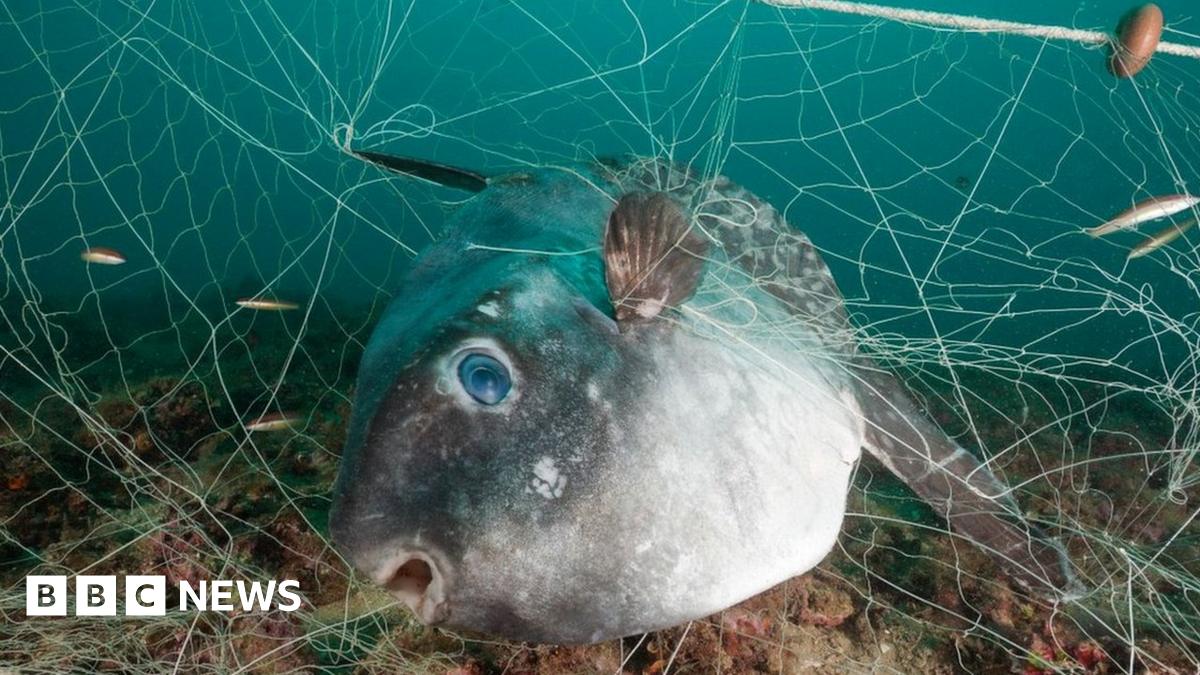
Is Netflix's Seaspiracy film right about fishing damaging oceans?
Are the activities of the fishing industry destroying the world's oceans as a new film suggests?
BBC News
95 points · by bananapear · 5y ago · 133 comments
"oversimplifies a complex issue", so why don't try to explain it to us? Instead of criticizing and discrediting real issues that we're going to face in a few years.
Ah, they're quoting multiple times professor X and study Y without links or reference...
I'm not a Netflix fan/users, but I saw those documentaries and I really appreciate the effort they're doing to open the eyes of a lot of people.
Maybe they do and nobody is listening?
The crux with complicate topics is that oversimplification can lead to wrong conclusions. So experts are always eager to avoid the point that leads to the wrong direction and are careful with their explanations.
The question is whether cowspiracy and seaspiracy turned in the wrong direction or whether the critics are just to cautious.
Exactly why we need something like seaspiracy.
Overfishing, coral reef deaths, and all the others problems are real and if not for George Monbiot, David Attenborough and similar figures, they would all remain hidden to the large public.
The reason why experts don't "try to explain it to us" probably is exactly because they think it's complex and nuanced. They probably don't even think there is an "issue" that need to be explained to begin with.
Think it this way: you're in a field, and you know its pros and cons. You are not going to randomly speak anything about it because that's just.. like everything else in the world. Now, suddenly someone, likely an "outsider", wrote an article to describe the field/area in a certain one-sided way (good or bad). Of course you now suddenly have a strong opinion on it.
Note: above is about the common question I saw "why these experts only appear to refute others but never explain the thing themselves", not about Seaspiracy in particular.
The much more likely explanation here is that experts have a vested interest in looking smarter than some guy with a camera so they furrow their brows and talk about the complexities of the issue.
As an analogy, BitCoin is complex. Between its usage of a blockchain and energy usage and murky origin story with who knows who owning a large chunk from the get go. Yet you could probably explain the power consumption problem to someone pretty easily.
The TV producer would take 90% fact, 5% oversimplification, and even 5% misleading info all day every day.
The experts probably won't accept that. This is not to say they are unable to simplify things (which as you said, is a very crucial skill on its own) if asked, they just won't go ahead and actively publish anything that way.
I personally side with TV producers here as soon as they have good intention. But can see why other people think otherwise.
I am a very rational, science oriented person (actively promoting science, atheist, PhD in physics, actively hating homeopathy pseudo-science, you name it). I wanted to understand:
- why there is a problem with climete chnage
- how we know there is one
- my winter was cold, where is the warming (exaggerating that of course)
- etc.
I am not an expert, nor want to become one. I just want someone to tell me: this is the evidence, these are the consequences as seen historically, we are "here" in the timeline.
The only thing I hear is "you dumb believers!" and "you dumb non-believers" (or a disgusted stare).
The only pertinent information that does not come with 200 pages of explanations are, as usual, in xkcd: https://xkcd.com/1379/ and https://xkcd.com/1732/. And also https://thefederalist.com/2016/09/30/xkcd-succumbs-to-climat... and https://wattsupwiththat.com/2016/09/20/josh-takes-on-xkcds-c... - as a counterpoint.
The basics of climate change can be taught standing on one foot. Carbon dioxide absorbs IR radiation, while oxygen and nitrogen are transparent to it. There was an equilibrium between visible light hitting the earth, being absorbed, and being reemitted as IR. We've doubled the amount of CO2, so you would expect twice as much of that heat to be retained. Compare it to the surface of the moon, which is at the same distance from the sun as us, but is on average well below freezing. CO2 isn't the only factor, but we've changed the equilibrium by doubling it.
That's it. It's very, very simple. The reason it produces only yelling is because it's been said so many trillions of times that if you haven't seen it, it's because you're not looking. There's no sane counter-argument: more CO2 produces more heat. It couldn't not do so.
The economics of why that's a problem is more complicated, but we've spent so much effort fighting anti-science attempts to deny really basic, obvious, trivial chemistry that we don't get to the even slightly non-trivial parts. The slightly non-trivial parts are "Yes, if you raise the temperature 4 degrees F it's going to make a lot of marginally livable places unlivable, and many millions of people will die. Also, some of that carbon dioxide becomes carbonic acid when absorbed by the oceans, which isn't good for sea life. Also, you know that weather is a chaotic system, and changing the energy balance of it causes changes to what meta-stable parts do exist, requiring substantial changes to the lifestyles of people there."
Again, this has all been said thousands of times. If it helps to have somebody explain it to you, great. But you also know that I'm about to be overrun with Gish Gallopers trotting out repeated-refuted objections, and to a casual observer it's going to look like I can't keep up and therefore must be wrong. And the only way to decide for yourself is the one thing you don't want to do: as you say, you're not an expert and don't want to become one.
So I'm really not sure what to do, and I'm pretty sure I've just wasted my virtual breath. I really think that my second paragraph should have put an end to this, and you can imagine my frustration that it doesn't.
- We were alerted to a potential climate change issue by the melting of glaciers and sea ice amongst other things.
- If this continues such that large quantities of ice melts then this will cause large problems as low-lying cities (such as New Orleans) and even whole countries (such the Netherlands and Bangladesh) would be flooded.
- It is also predicted that such changes will disrupt global weather patterns and produce more extreme weather. I'm not 100% on the science behind this, but I think it has something to do with weather gradients.
- Thus scientists began to look for an explanation (such that they could predict if such warming would indeed continue). An increase in carbon dioxide and other "greenhouse gases" in the atmosphere were determined to be a likely cause as they are known to have an insulating effect (can be demonstrated in simple small scale experiments), and we have also been able to measure increasing levels in the atmosphere. And this was backed up by modelling (presumably of known solar influx with different concentrations of CO2 in the atmosphere).
- There is also a secondary effect: Ice being whiteish reflects a lot of the Sun's energy back away from the earth back out into space. But water and soil tend to absorb a lot more of that energy. Thus there is concern that a small global temperature rise which causes the amount of sea ice / glaciers lost to pass a threshold point could cause a runaway effect where global temperatures continue to rise despite no more CO2 being released.
- Hence the focus on reducing CO2 emissions, and doing so ASAP.
- Re: "my winter was cold, where is the warming (exaggerating that of course)"
Pretty much everywhere except the North American continent. See https://www.forbes.com/sites/startswithabang/2019/01/30/this...
The explanation for the change in temperature that has by far the best evidence is the increase in greenhouse gas concentration in the atmosphere. We can derive this from physics principles and test it by examining CO2 concentration and temperature over long periods of time. CO2 concentration increases are coming from human emissions. This can be proven by examining isotope ratios in the CO2 in the atmosphere. Once we have this connection established, we can estimate future CO2 emissions and run models to predict future temperatures.
Rising temperatures are bad for a number of reasons
1. Certain staple crops are fragile and rising temperatures may turn highly populated regions into places where it is difficult to grow enough food to feed the population.
2. Sea ice melt increases water levels, threatening coastal cities and reducing global albedo.
3. Certain macro weather patterns like the gulf stream are found to be unstable in models if we increase the temperature. This has big problems for places like Europe, which are made warmer than their latitude would suggest by these macro weather patterns. A similar situation occurs in California where the RRR breakup allows for wet winters and if it fails to break up (more common in higher temperatures) then we get bad droughts in CA. This effect also contributes to the polar vortex that causes major cold snaps over the central US.
Changes in these macro patterns are what enable the sort of "my winter was cold, where is the warming" effects.
Human beings could adjust where we live and grow crops to account for rising temperatures. But this is massively expensive and disruptive and does not work well in a world where state borders are fixed on a map. This "solution" is not especially viable.
4. There are some hypotheses that increasing temperatures can cause an unstoppable positive feedback loop, as lower albedo means we absorb more sunlight and releasing gasses trapped in ice means that greenhouse gas concentration will increase even if human emissions drop to zero once we are past some tipping point. These are not proven hypotheses, but they are worth considering.
is better than 200 pages
I think this article is very fair. It does a good job linking to sources where available, and calling out where estimates lack hard sources. They've brought in a variety of experts, and they do mention the claims which might seem unbelievable but are accurate. I've never had much problem with the Reality Check series.
Note that this is the BBC's turn of phrase, not a quote from one of the interviewed experts.
As to the studies mentioned in the BBC article, most of those are the ones cited in Seaspiracy itself. The BBC seems to have asked the authors of the studies to comment on how their findings were represented by Seaspiracy.
In the case of Cowspiracy (the prequel, so to speak) there have been careful analyses of the claims in that documentary. From wikipedia:
>> Doug Boucher, reviewing the film for the Union of Concerned Scientists, disputed the film's assertion that 51% of global greenhouse gases are caused by animal agriculture. Boucher describes the 51% figure as being sourced from a 2009 Worldwatch Institute report by Robert Goodland and Jeff Anhang,[18] not from a peer-reviewed scientific paper. Boucher asserted methodological flaws in Goodland and Anhang's logic, and said that the scientific community formed a consensus that global warming is primarily caused by humanity's burning of fossil fuels.[1] Boucher stated that the scientific consensus is that livestock contribute 15% of global greenhouse gas emissions - far lower than the 51% stated by the film.[1] Boucher's review concludes: "Movies like Cowspiracy aren’t believable, not only because of how they twist the science, but also because of what they ask us to believe: that the fossil fuel industry—the ExxonMobils of the world—aren’t the main cause of global warming... and that thousands of scientists have covered up the truth about the most important environmental issue of our time."[1]
>> (...)
>> A 2018 peer-reviewed meta-analysis estimates that the food supply chain is responsible for 26% of annual anthropogenic GHG emissions. Within the food supply chain, animal products (including fish farms) account for 56-58% of GHGs,[3] implying that animal products account for roughly 15% of total anthropogenic GHG emissions.[23][24] In a 2019 erratum to the meta-analysis, the avoided annual greenhouse gas emissions arising from a "no animal products" scenario are estimated at 28% of the total, which includes 8.1 Gt CO2 of removal by trees regrowing on land no longer required for livestock.[25]
>> A 2019 Forbes article quotes Steven Chu, the Nobel Prize winner and former U.S. Secretary of Energy, stating: “Let me say it again: agriculture and land-use generates more greenhouse gas emissions than power generation." The article references the 2009 Worldwatch Institute article that estimates livestock are responsible for at least 51% of human-induced greenhouse gas emissions.[26]
https://en.wikipedia.org/wiki/Cowspiracy
No doubt, a similar careful analysis of Seaspiracy will follow at some point. The BBC is probably not that interested in a careful analysis anyway.
The same pattern can be seen with regards to pandemic warnings before this one.
There's a very strong tendency to do business-as-usual and it's my non-optimistic belief that we will experience empty oceans and complete ecosystem collapse in our lifetime.
These events are white swans (just like the pandemic) and it's quite clear that our tendency for response towards white swans is inaction with "educated" dismissal.
Ok, they mention empty oceans by 2048, yes the study is applying a linear estimate (as oceans empty there might be some regulation to slow down the curve and the linear estimate is incorrect) but they are just discrediting the study without confirming the trend. What should I believe, that oceans are emptying or flourishing? Should I expect empty oceans in my lifetime or should I leave this worry to other generations? Also, I'd say that linear estimate is a wrong one because depletion can happen exponentially and regulation is just a small damp to an exponential collapse.
This made me feel very uneasy.
I believe this is the most important topic of our lifetime, as much as climate change is a major issue, retaining and preserving biodiversity and its 4 billion years of knowledge is surely just as important.
These are more "Black Elephants" imho:
A Black Elephant, notes Vinay Gupta, ‘is an event which is extremely likely and widely predicted by experts, but people attempt to pass it off as a Black Swan when it finally happens. Usually the experts who had predicted the event – from the economic crisis to pandemic flu—go from being marginalized to being lionized when the problem finally rears its head’ (Gupta, 2009).
I agree we’re likely to see empty oceans before then — climate change will cause famine in a lot of places, increasing the demand for food (and particularly meat, given how resource-intensive it is).
Sure, there are things like lab-grown meat but those aren’t going to be realistic on any scale outside of wealthy western nations. The other ~6 billion people in the world are gonna be totally screwed and that’s going to have consequences to our ecosystems. It’s a nasty feedback loop.
Basically unless the a dude has a fishing rod and is catching his own dinner it's unsustainable.
Those boys over at impossbile burger better be whipping up some fish substitutes because I think the future of the fishing industry will look like what the British fishing industry is going through with Brexit right now -- a sudden collapse.
It's not though -- thats the myth to be debunked. Also the parasites were disgusting -- farmed fish are slowly being eaten alive -- for every four salmon produced only 1 makes to the chopping board for human consumption. The others succumb to the parasites and are simply discarded creating their own pollution problems.
I didn't know this before the documentary. He covers advanced countries like Norway and Japan as well. So this isn't like some developing country who can't even get onboard with human rights or international law.
There are also serious welfare issues with fish farming - for example, horrible mechanical and chemical treatments of salmon to remove lice, high use of antibiotics, terrible life expectancy of feeder-fish (which are introduced to eat lice off of salmon), poor environmental conditions for the fish (largely because so many fish are packed into such a small area), high rates of disease (again largely because of high stocking density).
For example, aquaculture can be moved offshore to large farm, mobile farm vessels, so the pollution is spread about instead of being concentrated at a small section of coastline. These vessels are new though, and an accident or freak weather even could result in millions of farmed fish being released to the wild - farmed fish are not the same, genetically, as wild fish, so the effects on wild stocks from that many escapes could be significant.
Another new solution is closed-containment aquaculture, where the fish are placed inside a sealed sphere in the ocean. This approach allows all waste to be collected at the bottom of the vessel, and then turned into fertiliser. There are welfare concerns around increased stocking densities, and shutting hundreds of thousands of fish off from the outside world.
Another solution that is (inexplicably, IMO) seeing huge investment are land-based, RAS (Recirculating aquaculture system) farms. These too can collect all fish waste, and it's touted as a way to prevent disease. There are concerns here too though - using arable land for fish farming doesn't seem like a very good idea, RAS farmers use horribly high stocking densities (they must, to be profitable), and there have been several incidents where disease has been inadvertently introduced from the outside (in such close quarters, the effects are of course disastrous).
OK, so that still all sounds pretty gloomy - realistically the only way for things to get much better is through regulation. But better welfare increases farming costs, and like anything, there is always going to be a race to the bottom (e.g. if Norway increases costs too much for farmers, more move to Chile etc).
Moving farming to vegetarian species like tilapia would solve this but it's going to take a monumental effort to change the attitudes of generations.
E.g. for salmon
> On a dry-dry basis, 2–4 kg of wild-caught fish are needed to produce 1 kg of salmon. The ratio may be reduced if non-fish sources are added. Wild salmon require about 10 kg of forage fish to produce 1 kg of salmon, as part of the normal trophic level energy transfer. The difference between the two numbers is related to farmed salmon feed containing other ingredients beyond fish meal and because farmed fish do not expend energy hunting.
I guess this pretty much answers the question whether seaspiracy film is correct or not. People are trying to justify as if industry care about sustainable catching methods? Really? And there is common practise "The Solution to Pollution is Dilution" and there is no easy way to find how much industry is damaging ocean I bet its more than what Netflix Seaspiracy shows.
Imho Industry is more about earning $ rather than sustainable thing and most of the time the sustainable things are marketing PR strategy.
Remember Sugar Industry? Tobacco Industry? Looks like similar strategy this time too.
In the mean while: just eat plants directly.
What plants should I eat that are eaten by sheep and goats?
[1] https://www.thegrocer.co.uk/finance/media-bites-4-dec-amazon...
This is mostly true. You could maybe have a "mostly rice + meat once a month diet" that has less impact than a vegan diet rich in Impossible/Beyond meat and avocados. But apart from comparisons of "outliers" this statement true.
> But in the meanwhile these new vegan/vegetarian companies are a huge cause of the deforestation of the Amazon [1]
Might be so, but nothing close to what is needed for real beef. They say some forest is cut for soy, so soy is bad, and vegans (plant eaters) eat soy, so vegans are bad. Well, beef was a cow, and cows eat by far most of the soy on this planet. So "fake meat" is not compared to the alternative "meat" (they just point out something unsustainable about fake meat in isolation). Just an example: to produce one beef meat burger patty enough water is used that one could shower for 3 months 24/7. When it comes to "impact" (as you call it) it does not get much worse than red meat.
A big fallacy in your argument is that all vegans would eat massive amounts of "new vegan/vegetarian company" products: they dont. We (yes im vegan) eat a lot of lentils, soy (tofu/tempeh), sweat potatoes, veggies, etc. As a group we are MUCH less impact for for the environment, simply because it is so inefficient to feed plants to animals only to have a less shelf stable product (meat), and lots of waste (bones, feathers, some organs, consciousness of sentient beings, etc).
Please be vegan while we bring this wasteful industry to its knees. It's time.
On top of that the huge amount of water required for this whole operation.
It's much more efficient to use the land to grow crops / plants which we can eat.
---
https://www.ox.ac.uk/news/2018-06-01-new-estimates-environme...
https://www.un.org/sustainabledevelopment/blog/2019/05/natur...
is it for beef cattle? palm oil? vegetables? lumber?
An even greater conspiracy at work here is one the filmmakers are complicit in: teaching Americans to express their moral outlook through consumer choices. You would have thought they would have learned by now that swearing off fish (or meat, or processed foods) was a meaningless gesture that lets people sleep at night without having to reckon with the fact that even in a "democracy" the average person has zero power to make their voice heard on these issues.
However, I think it's really difficult for them to send a message of what we should do for political change. What would they say? It's not like voting has ever caused the kind of substantial, rapid change that is now necessary. Pointing the finger at political parties would have probably hurt their ability to publish the film to get the message out. And they can't go and suggest sabotage of the fishing industry or rioting/revolution, even if those would be the most effective.
Why present serious evidence when you can simply harass your local chippy about what kind of forks they sell?
Some of the reviews are pretty mixed, saying that the film's message is confused by conspiratorial threads and off-putting journalistic style.
Or, if you're already aware of the problems with industrial fishing, is it a pass/not much of an eye opener and not mandatory watching?
Watching episodes of David Attenborough's Blue Planet might have done more for me already to appreciate the value of sea life than what I imagine is lots of footage of industrial fish markets, processing facilities, etc. But maybe knowing the ugly side is important.
For example, I had no idea that the "Dolphin Safe" label was just marketing and didn't actually represent any sort of guarantee.
When you think about it, it all makes logical sense. These fishing trawlers are dragging huge nets across the ocean to catch giant schools of fish. Who else eats that fish? Dolphins and sharks. So of course they are going to get caught in the nets along with all the other fish. This had never really occurred to me before.
It was also incredibly eye opening to find out what really happens at most fish farms. They have all these fish contained in a relatively small area and they are feeding them all the other waste fish byproducts that come from normal fishing. The farmed fish just sit there in their own filth. It's hard to believe that's a healthy or sustainable way.
I also learned that a lot of the health benefits of fish such as omega 3 oils actually originate from the algae that fish eat. This means that you can just avoid eating fish entirely and just source omega 3 oils from algae. No reason to even eat the fish.
It was also very eye opening to discover just how much more toxic the ocean is becoming over time as humans keep using it as our dumping ground.
Ultimately, there only seems to be one solution: Stop eating fish.
But that begs the question... if the ocean runs out of fish, then we have to stop eating fish, right? So if we just all stop eating fish now, how is that any better than running out of fish later? The net effect is the same!
The most "conspiratorial threads" consisted of sustainable seafood labels being mostly a sham and funded by the fishing industry, which is not exactly surprising. The film also documented rampant criminal behavior and some oppressive police action, but I wouldn't call any of that "conspiratorial" rather than depressingly common.
Some of the nets will have disintegrated but surely some must have large pieces of them intact?
All the photos of the patch I've seen tend to be individual plastic items - bottles, cups etc. – so wondering if anyone's seen different
EDIT: Found this https://mymodernmet.com/ocean-voyages-institute-great-pacifi... the majority of 103 tons dredged up were fishing nets etc.
The reason they eat is is because the microscopic particles floats in the water column like "snow", just like all of the other tiny things that fish eat while they swim around.
That's literally nothing. How much garbage do you think a small city collects from residents daily? Google shows variety here, but that garbage trucks can handle between 10 to 20 tonnes per load.
Again, not saying it's good. There's clearly a lot more down there. But I dislike stats/info in articles which seems like a lot (eg tonnes, They dredged up tonnes!! Over a large, massive section of sea, over more than a month.). Worse, they talk as if they actually did something:
we are continuing to help restore the health of our ocean, which influences our own health and the health of the planet.
No, they're doing nothing. It's like I walked to a garbage dump, picked up a can, then took it home and recycled it.
"I created a cleaner world!", uh, yeah, sure.. good job? It's just a meaningless tiny bit of nothing.
I think it's likely that nets are easy to catch. Floaty, big surface area, lots of anchor points.
The issues are real and I appreciate raising awareness but wow. Not good work.
Tabrizi's approach is to tackle a bunch of different subjects with the same attention span of a child on Xmas morning. Each new subject is treated as 'the' most important one, but he drops it unceremoniously after ten minutes.
Then there's the cherry picking of interviewees and their arguments, which is a disservice to the cause – and completely unethical. Even environmentalists interviewed as 'the good guys' complained about this[0].
If Tabrizi is genuinely a fan of the likes of Cousteau and Attenborough, he should watch and listen a lot more before making another documentary.
[0] https://twitter.com/christinachicks/status/13753901779133726...
Quality - I would say it was pretty illuminating on a lot of issues that almost nobody here will get to see first hand.
[1]: https://ourworldindata.org/environmental-impacts-of-food
Suffering is not relative.
“It just isn't possible to mass produce meat without torturing animals. In fact, raising animals specifically for consumption, i.e., “humane slaughter” is an oxymoron.” —https://www.cynicusrex.com/file/cynic.html
There’s always a “can be” for everything. The question is whether you’re willing to take personal responsibility in doing something while you can or not.
I don't. I'm indifferent to any sort of value judgment in the matter. I simply acknowledge and accept that my biology requires the consumption of nutrients. Circle of life, and all that.
Organisms are the only sufficient source of nutrients I have access to. Unless you're here to enlighten me about how to cook rocks, I don't know what you're on about.
Or just have less kids, which they are pretty much doing right now without any effort and pretense of morality.
What about the folks that are poor? Those are the biggest group, and it's a little tone-deaf to call them privileged just because they were born in a place that contains folks that got rich.
I bet we don't understand even one fifth of every interactions going on between animals and plants, deep ocean currents, high altitude winds, &c. everything is interconnected, we might be the smartest apes on earth but we're faaaaar away from being able to use our tech to counter balance the damage we already dealt.
All we're able to detect are visible symptoms far too late to even act on them, we might be missing deep changes and we won't know before it's too late
This book kinda touches the subject: https://www.brainpickings.org/2016/09/26/the-hidden-life-of-...
I'm less concerned on whether their "storytelling" is being fair or an oversimplification, and more concerned on whether it leads to constructive atitudes by those influenced by them.
Given the lengths they seem to go at shocking people I see little depth in their work at actually wanting the enact constructive change on behaviours.
What would be the proper way to enact constructive change on behaviors?
Obviously it's not impossible, but I imagine it'd take some serious bespoke engineering and investment.
These people are developing tech for it: https://theoceancleanup.com/
We just need someone willing to pay for it.
Maybe we should not allow companies to sell another fishing net unless customer brings the damage one back for exchange?
Maybe soft drinks should be sold this way as well? If you are packaging something, you can't sell a packaged good unless you take in used package back.
You could start it gradually. To be allowed to sell 100 bottles of Coca Cola, you need to take in at least 10 used plastic bottles of the same volume.
There is something like that for car batteries. If I want to buy a car battery I have to bring back my old one. If I don't I have to pay very large fee that I can recover only after I bring back old battery.
I'd be all for a system with deposits like you describe. Most coke bottle here in Scandinavia at least do have a deposit fee, but it's not significant enough for anyone except children and the homeless to care.
That seems intuitive to me.
We should be farming fish on land in controlled environments, and again, not feeding them caught wildlife.
The film was pretty sympathetic to those communities. In particular, coastal Africans, who depended on local fish for food, and now are in trouble because industrial fishing operations are vacuuming up those fish.
The main point of disagreement in the article is the study about 2048. It's good news that the future might not be quite so imminently grim, but the film doesn't lean on the study all that much. For the other claims mentioned in the article, it says the film was pretty accurate.
So contrary to Betteridge's law, it appears the answer to the question is "mostly yes."
I wonder what are _those_ made of? Its not like they comes out of thin air. I guess its _waaaay_ more efficient?