240 points · by pmarin · 5y ago · 163 comments
I was in highschool living in a trailer park with my mother. My ma ended up getting a pay out from the government for a work related injury. She bought me a PC and we set it up in the caravan and I was able to run Morrowind. It was a great escape from the conditions at the time and I kept learning programming when I wasn't hunting Daedra's.
Morrowind really shines when you're able to work past all that immerse yourself in the world anyway. Without spoiling too much, you're released from prison without much skill or equipment into a fractured society, full of political and racial tension. It's up to you to explore and navigate your way through things and the world is rich enough to (usually) support your investigation. The story leans into typical tropes about the "chosen one" and power creep in a way that makes it compatible with using a little meta-gaming knowledge and min-maxing while roleplaying. After a little artifact hunting and enchanting you're soon able to breathe underwater, levitate at will, instantly kill everything in a 50 foot radius, or jump vast distances across the continent and land gracefully. All of which would feel pretty cheesy if it weren't set on an island ruled by three individuals who have amassed enough arcane power to be called gods.
Speaking for myself personally, Morrowind is one of those games played as much in the theater of one's mind as it is on the computer screen. As others mentioned, mods help a lot to make the game more visually immersive and iron out some of its rough edges. But ultimately what appealed to me about Morrowind is weaving my own story into the setting, climbing that power curve from nearly powerless to god-like.
You have to wait a while for the vendors' inventory and gold reserves to reset - luckily one thing you can use all that gold for is paying trainers to improve your skills, after which you'll be able to level up if you sleep (handily resetting the vendors). With the right trainers, it's possible to always improve enough major and minor skills together before sleeping, that you power level, gaining the maximum stats per level.
The first real city you get to, Balmora, has trainers that cover every single skill I cared about (maybe all of them?) and enough vendors to supply you with plenty of gold to pay the trainers. I made a "circuit" of the city, where I would run around farming vendors and paying trainers, then sleeping to level up. After doing this for a couple hours, I'd already leveled up more than the game expected me to do at all - enemies didn't seem to scale all the way up there that well, and because I'd consistently powerleveled, my stats were super high too. I still completed the game, but it wasn't all that challenging, felt more like a sandbox to play god in.
The magic of Morrowind is in the discovery of the world. Modern RPGs like Skyrim might give you an arrow to follow that points directly to where you need to go for a current quest. Leading the player to ignore most things outside of that objective arrow. Morrowind instead says "Go Northeast of the village to find this cave". By doing this, the player organically stumbles onto things and events that build out the world.
A good example of this is the early mission to travel from the starting village (Seyda Need) and head to Balmora. One option you have is to walk there, which takes a bit of time and offers multiple encounters along the way. One that quite literally falls into your lap. When it happens, the game doesn't explain anything. You have to piece it together. That discovery is part of the intrigue.
Even if you're not interested in the characters or culture, the game offers a lot. You could alternatively delve into the empty steam-driven ruins to find who built them and why they are empty. Perhaps instead you see an unknown cluster of plants to pick and practice your alchemy. Maybe you stumble onto a wrecked ship full of pillows and want to track down the owner listed on the shipment invoice.
If you feel like you're walking from point A to B to C, you may be following too close to that arrow. Trying to find what you're pointed to without seeing what else is happening around you. Stop and look around every once in a while. There's probably something or someone nearby. Anything that catches your interest should be investigated. What may seem like minor events often become the most memorable moments.
Oblivion felt like a slog because of the auto-scaling, but I finished it.
Skyrim felt exactly like Oblivion but with more rails and even fewer voice actors, even though there might have actually been more voice actors. I have only made it a few hours each time I try to get into it. The voice acting alone ruins the immersion. Everyone looks and sounds the same!
When you do stumble onto something, it gets all the more interesting -- of all the nothingness, why is this here?
It's a drawn out form of gratification, compared to the every-other-step-you-run-into-a-procedurally-generated-cave type of instant gratification I felt with e.g. Skyrim.
Morrowind is more aimed at exploration than later games, and some amount of nothingness in the world is required for this.
----
Of course, nothingness is relative. In absolute terms, I'm sure Morrowind has less nothingness tran later games, but the limited graphics and draw distance and smaller populations makes it feel more empty.
This is true, but with the default draw distance it's very hard to apply in the base game. Mods that improve draw distance are critical to enjoying Morrowind, in my opinion.
The fun of an Elder Scroll's game, for me, is the sense of aimlessness in a world that doesn't feel structured like a quest-checklist, but like a world. Something I can poke and prod and truly make my own goals and activities in. You could almost call it "meta-fun". The individual actions aren't fun - some in Morrowind are almost painful - but the big picture is enthralling for someone like me.
But not everybody's like that; and not everybody likes them
RPGs like the Baldurs Gate sequel are very structured
First, mod it. It looks old; make it prettier. The walking doesn't feel as bad when the scenery is nicer.
Second, either consider a travel mod, OR start focusing on what fast travel the game presents you. There are boats and stilt striders, and then the mages guild can teleport you between different mages guilds. The Intervention spells take you back to the nearest Tribunal temple/Imperial cult shrine.
Taken together, this means a spell gets you 'out' of whatever wilderness bit you're in, to a civilized place, and then you have methods (albeit ones you have to learn) to travel between civilized places. Once I learned these well enough, it was actually pretty easy to get around. Not Oblivion/Skyrim level easy, with fast travel, but not painfully so, and having to actually walk through the wilderness each time, following roads, etc, meant I felt a greater feeling of exploration than I did in those other games.
But, if that feels too daunting, no shame in modding it.
You missed the two: - One of the official plugin that adds teleportation between any Dwemer ruin and the Caldera mages guild. - The Mark and Recall spells.
You needed to find the right questions to ask or the right level of friendliness or intimidation to for example unlock the secret of a murder. The characters would also give you long explanations of how to find places. Finding places became something you could become good at. Sometimes the directions were wrong which might leave you stuck on a mission for some time.
The later game in the series have traded in some of this but the limited options necessitated by VO just mean they cannot be as robust. The newer games have a very paint by numbers sameness to every mission. Obviously this is to streamline the games for a wider audience.
Though they are still incredible achievements.
Oblivion's level scaling made nothing you found or did worth it at all.
Morrowind was very large and pretty and fairly amazing for its time, but its world is empty and pointless.
I dunno, somewhere along the way, developers seem to forget, sure we could add every single random real world item to every random house and sure it's realistic, but it's not fun.
Finding piles of dishes and foodstuffs, exploring random building after random building to find.essentially nothing that adds to the game, go through lousy generic quests that add essentially nothing to the game and basically...
I dunno, last time I played oblivion I played as a naked punching cat, because why not nothing you do matters anyway. And sure enough, the gameplay experience was about the same as when I actually tried playing the game properly.
My point is: it’s okay to grow out of things and move on.
I like the feeling of being in a world that feels real independently of you, with its normal citizens doing normal things, its work and errands going on, its cities and spaces, many of them irrelevant in the grand scheme of things, but where you may get lost doing some quest or other if you so desire.
For me, it's much better for immersion than most modern games which focus on tight storytelling: you're special, have to follow your destiny, everything in the world is placed there to drive the plot, help you in your quest or entertain you. There are no dishes and food in residences (or maybe, no residences at all) because who cares, that has no bearing in the quest of the great hero. When I play games like that (i.e., most), they feel artificial and limited to me so I don't enjoy them as much.
In fact, for me the best TES game is not even Morrowind, it's Daggerfall (if anyone wants to try it, there's a very good modern remake: Daggerfall Unity) because it's closest to the ideal of the realistic huge world that doesn't especially care about you. I think you wouldn't like it at all because it has the things you don't like about Morrowind, but taken to the extreme :)
Mind you, I totally get why some people prefer the tight storytelling where the experience of following the main quest has been distilled and optimized, and has more detail and uniqueness due to not relying so much on procedural generation and repeated models. It's very personal. So let's hope for plenty of RPGs for every taste in the future.
PS: the kind of games I'm praising often have the massive imbalances you point out, like being able to win with an absurd character (I guess because it's very hard to balance things when you're free to do a wide range of actions in the world, rather than following some predetermined quest lines). Daggerfall also has plenty of that kind of issues, including choices at character creation that feel like exploits and make the game much easier. But for the kind of person who likes this kind of games, this doesn't matter that much. I roleplay my characters. I wouldn't create an OP absurd character because it isn't fun... I just think what kind of character I want to be in the world, and create it.
Specifically soul gems and high-value amulets/rings. How to win at Morrowind? Enchantments. Get the Fortify Skill spell from Mournhold and imbue an expensive ring with xxx pts of Fortify Enchant for 1 second. Cast the effect and instantly open your inventory.
Now you can practically become Exodia. Open lock 100pts? Fire, frost, and shock damage 100pts at the same time? Paralyse for 30 seconds? My favorite is resist magicka 100pts for 1 second, enough to slip on the boots of blinding speed without being blinded.
Buying these enchantments from a mage would cost you hundreds of thousands. You only need to kill 1-2 dark brotherhood dudes and sell their gear to pay for your initial boost and have enough GP left for fast travel forever. Spellmaking and enchantments are in a different league from Oblivion and Skyrim.
A lot of people mention RNG and such but you just need to train some stats. Don't forget to Admire the trainer to 90-100pts to get huge discounts. You can get easy money from soul trapping monsters in stolen gems and selling them, selling nice NPC gear, or raiding Vivec vaults. You only need ~10k to max out a skill with a trainer. Your greatest difficulties in Morrowind will be where to sell this 500K's worth of NPC gear you got from killing a few dudes at a plantation.
Morrowind had a world that was so expansive at the time it was awe inspiring. I think that was the main thing that made it so wild. It lacked a lot of quality of life features that make it hard to play today, and I remember routinely taking a break then forgetting which five month long plot I had been playing before going on vacation for a week. Just not the kind of game you can pick up in a weekend.
Skyrim is especially bad imo because it all takes place in the same biome with no sense of “wtf is going on here?”
My advice to people here: Get OpenMW and start playing Morrowind with a notepad open that you can alt-tab into for notes. I never beat the game until last year.
If the pace is too slow, fine, just open up the console and find the command to double or triple your walking speed. It’s a game best enjoyed slow otherwise, as you unfold the mysteries of the world. I think it definitely holds up to 2021.
And you can also memorize the fast travel options which unlike other games aren't just clicking on a map but using restricted teleportation spells, items or talking to NPCs and employing their services. They form a sort of transportation network.
It's also totally unbalanced, if you want to lookup a guide you can figure out how to become the flash in a short time and leap over mountains.
The game gives you a lot of freedom.
That said it’s one of my favorite games for what it was when I had time for that.
[1] https://en.uesp.net/wiki/Morrowind:Pemenie_and_the_Boots_of_...
[2] https://en.uesp.net/wiki/Morrowind:Cuirass_of_the_Savior%27s...
I found I could save, jump, look around, die, load, jump again, use the gained knowledge to end in the water or against a tall building or on someone's head or whatever, and live.
“Welcome to Balmora, Mr. Anderson...”
the other comments have a lot of good points, but one thing i see left out -- the biggest difference between skyrim and morrowind is their growth curves. Skyrim is logarithmic while morrowind is sigmoid -- very flat and punishing in the early game. but once you hit that first inflection point it gets a lot more fun. you enter a feedback loop of getting missions -> winning combat -> getting paid -> getting stronger -> repeat
but you definitely have to have a mindset for taking it slow and appreciate exploring a hand crafted world piece by piece.
Morrowind's 'fast travel' system feels like a drawback since it makes you skip the content/world. I generally start using stuff like silt striders after taking the walking road a couple times perhaps
To pick it up now, the early levels are such a slog: constant stamina drain, slow leveling, etc that unless you really want to dig in, you'll never get to the "good part".
This included, FYI, under development new game elements which were mostly written and launched using a mix of things called RPROGs, OPROGs, CPROGs and Descs (among other things) all of which were written in a custom domain language input into the MUD itself - devs like myself worked only on underlying mechanics and had no need to wander into the specifics of all those triggers.
This probably opened up a number of security holes but, given that the game only ever checked the first six characters of a password (and checked them one by one against a plaintext copy - that was patched) there were lower fruit available to criticize.
If you want to check it out an older copy is available open-sourced[1] - it's a DIKU variant MUD.
1. Open a pipe
2. fork()
3. parent exec()'s the new binary with an argument saying "reload yourself from pipe at FD #n"
4. child writes the entire game state including open connections down the pipe, and closes
It's done this way so the PID of the process doesn't change.
https://www.usenix.org/legacy/events/hotos03/tech/full_paper...
In fact, your example of main menu vs single player vs multiplayer is still the example provided as the use case for similar APIs on more recent consoles.
Another surprise was the utter lack of a date-and-time clock chip. Without a network (and I'm guessing, without actually connecting to XBox Live), the 360 had no idea what time it was. That saved a bunch of money on hardware, and removed headaches involving coin cells (such as shipping policies).
The only downside is that it seems to cause a certain amount of pain with applications sometimes not working when there's a contest over sending Dolby to a receiver.
On the time thing: turns out that PlayStation 3 and 4 will stop letting you run games if you replace the battery and it can't re-sync time with the PSN.
It wasn't something I expected, and there were good reasons for the behavior other than "let's hassle developers with more annoying cert requirements".
This is true of iOS apps too. Apple highly discourages apps closing themselves (maybe even outright forbids it, it's been a while)
So maybe exiting was allowed early on and discontinued later.
There was a TCR that required the game to be able to run for an extended period, don't remember how long. But to prepare for it, I'd set it up to run in a loop overnight on the dev kit, and if it was locked up in the morning when I came in, I knew I still had work to do.
AFAIK the Wii used the same audio chip and I think the Wii U might have as well?
(have you tried turning it off and back on again?)
I highly recommend running it on PC with OpenMW, especially with the Tamriel Rebuilt mod installed.
https://quade.co/2018/xbox-128mb-ram-upgrade/
Regular Xbox games don't benefit of course, but it becomes possible to play arcade games based on the Sega Chihiro platform (an Xbox derivative with 128mb RAM)
64MB was small compared to contemporary PCs, but it was a powerhouse among the major console competitors.
Xbox - 64mb
Xbox 360 - 512mb
Xbox One - 8 GB (later 12 GB)
Xbox Series X - 16 GB
This last one also surprises me, was expecting at least 32GB
> This last one also surprises me, was expecting at least 32GB
Well the GPU is comparable to 8GB models, so I can see why 16GB would work fine. You don't need that much space for game state.
Though looking into the Series X more, they sure set up the ram weirdly. There are 4 1GB memory chips and 6 2GB chips. This gives it 10GB of very fast memory, and 6GB of somewhat fast memory. The operating system reserves 2.5GB of the somewhat fast memory, and games get 13.5GB
The 'natural' setup would be 20GB, and they didn't even go that high, so they must be plenty confident that 32GB is well beyond what they need.
Like, it's 16gb, but it's 16gb that only has to cover the next few seconds of gameplay, not the next 30 seconds.
I don’t recall which one, but this was used by an FPS to switch between single-player vs. multi-player exes that were developed by two completely different studios.
It is indeed a story of creativity in design.
This is because the original specification would have had a memory card slot in the controller but it was too expensive. They also had considered using floppies for storage, but they were too unreliable (and my experiences with 1.44MB 3.5s definitely agrees that consumer-grade cheap disks sucked hard)
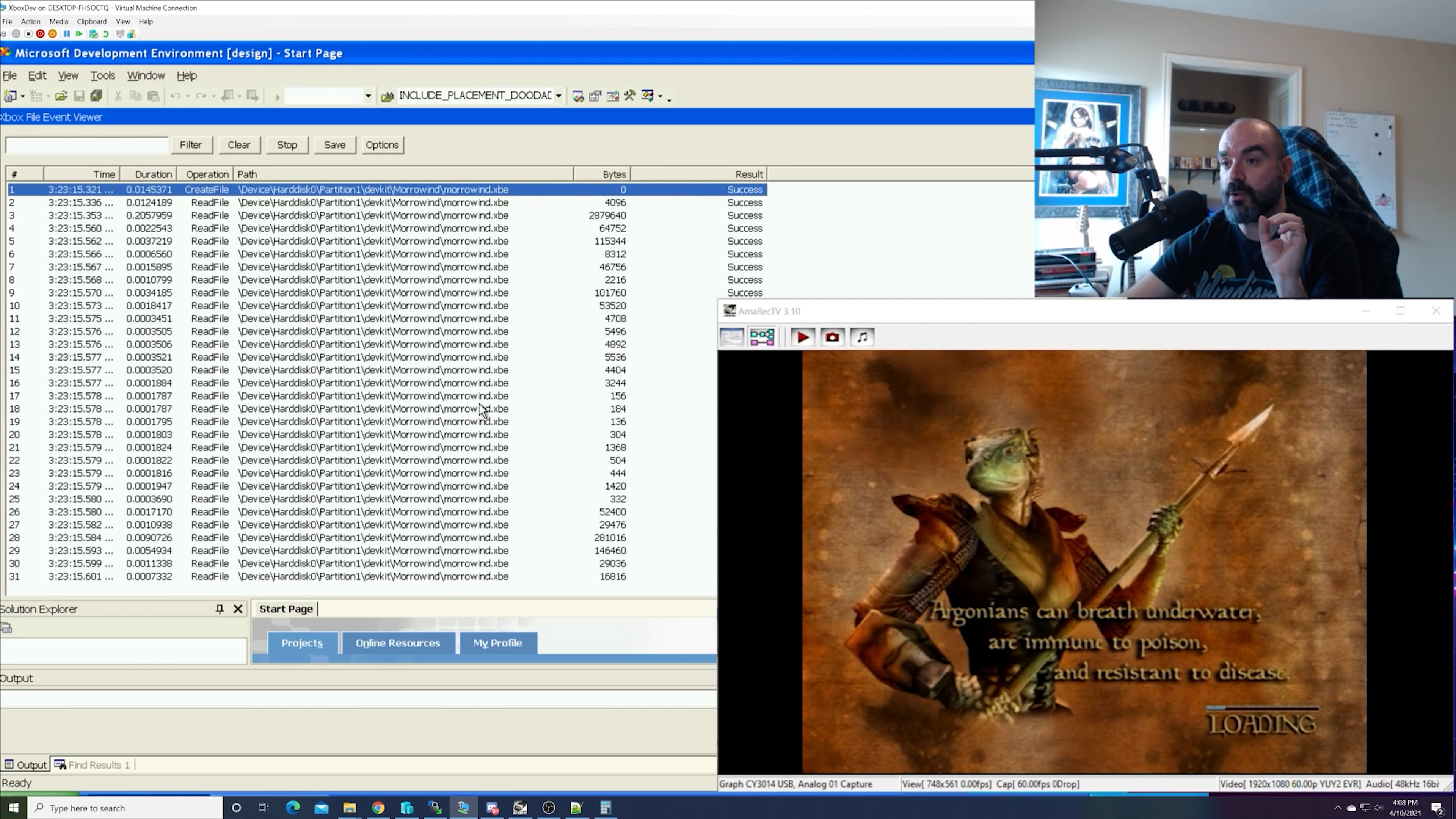
On system initialization, kernel routines are copied into RAM by the bootloader[1]. Executables run in ring 0, and have a jump table to call kernel routines in their own address space (IIRC) [2].
As such, loading any executable counts as a soft reboot.
Also, there is a functioning open source emulator, Xqemu [3] (and its sibling/fork focused on speed and compatibility more than accuracy, xemu [4])
I recommend reading "17 mistakes Microsoft made in the Xbox security system", which is very informative [5].
[1]: https://xboxdevwiki.net/Boot_Process
[2]: https://xboxdevwiki.net/Kernel
[3]: https://xqemu.com/
[4]: https://xemu.app/
[5]: https://xboxdevwiki.net/17_Mistakes_Microsoft_Made_in_the_Xb...
What happens is you would are allocating large memory chunks at level loading time, and potentially a number of smaller allocations during the a user playing that need to be persistent (for example, player save data). You would inevitably end up with a small block of memory allocated in the middle of a large free chunk, and would unable to allocate a large chunk that spanned the small allocated chunk. This was manageable up to point, you would try and pre allocate as much of the persistent memory as possible so that it would end up at similar addresses and contiguous, but it was difficult to guarantee.
Theoretically, of course, you can develop without allocating persistent memory in game, but it becomes difficult to maintain, and limits you in other areas. If you used any 3rd party libraries that allocated memory, or certain template functions or standard library functions that allocated memory, you had to work around that. If your game wasn’t linear and players can move around dynamically, this becomes exponentially difficult.
On consoles, we also had to pass “soak” tests, where the game has to run in a demo mode for 24-48 hours or longer, continuously without crashing or errors.
Inevitably the only solution was to force all your memory to get remapped, but the only way to do that was to reallocate everything in a relatively predictable order, and the only way to do that was to save your state, force a reboot, and reload. Hence the “hack”, except that this was so common, facilities existed that helped you do it. Normally, there was a chunk of memory that persisted between soft reboots, so you could store your state here. You could also pass flags to the rebooted executable, to tell it where or how to load.
Too bad later Genesis models lacked a RESET button...
So, 'arena'/'region-based' memory management, of a sort. Figures. Wonder if any other games used the same trick.
[0] https://docs.gitlab.com/ee/administration/operations/unicorn...