611 points · by joshuacc · 15y ago · 237 comments
Get a supremely optimal outcome and get the case dismissed right out the gate because it is legally defective even assuming all the facts alleged are true? Sticker price: $10K and up (more likely $25K to $50K to make it definitive after several opportunities to amend are given to the adversary).
Go through discovery to find out what witnesses will say on deposition, dig through all key documents, and then move for and get a summary judgment before trial by which a case is tossed on grounds that the law allows only one result based on material facts that are undisputed bearing on the legal point? Sticker price: $100K and up, with a year or more of grief thrown in as a bonus.
Go through trial and get vindicated by a judge or jury based on a complete presentation of evidence? Sticker price: $250K and up, after a year or two (or more) of wrangling.
And don't forget the appeals.
Most cases never get to trial and cost is a major factor prompting litigants to settle even though they are not particularly happy with an outcome. Charles Dickens, though he exaggerated for dramatic effect, got the spirit of this right in Bleak House (http://en.wikipedia.org/wiki/Jarndyce_and_Jarndyce), and little has changed since.
This, by the way, doesn't mean that you can't defend against cease-and-desist demands. Costs cut both ways. But it is sad how many times parties who are right nonetheless must fold because the costs of engaging (monetary and otherwise) are just not worth it.
Only sue if you have nothing to lose, or your opponents are ridiculously rich. (preferably: both).
Not quite your point, I know, but it seems to apply here.
Edit: changed my wording to be more accurate.
I'm not in any way experienced in law, but it seems like that would help reduce the number of fishing expeditions and barratry.
Jay Meisel : you suck. For doing this.
(...too bad HN pages rank low on Google).
But that tends to discourage people without substantial wealth from pursuing cases.
The law is not perfect and never will be.
Really? It seems that if you don't have much money, you don't have anything to lose. You know, like the average American buying a house during the bubble; if values go up, they make money. If values go down? bankruptcy.
The only consolation is things would be even more expensive if it was a "Gangs of New York"-style world today.
There's an interesting "law and economics" justification, which is that the party who in the best position to have prevented the problem should be responsible for the damages caused. The damages become an incentive.
I particularly liked this quote: "[I]t's reasonable to expect to find a large number of retained legal representatives under a legal system in which people feel that their property rights are constantly threatened by rent-seeking litigiousness or in which rampant rent-seeking opportunity gives them an incentive to behave litigiously themselves. The rarity of retained champions in medieval England therefore suggests that rent seeking under trial by battle wasn't rampant."
In December 2002, a 60-year-old mechanic named Leon Humphreys was fined £25 for failing to notify the Driver and Vehicle Licensing Agency that he had removed his Suzuki motorcycle from road usage. He refused to pay and claimed that he had the right, under medieval law, to choose a trial by combat with a "champion" nominated by the DVLA. This claim was denied by a court of magistrates in Bury St Edmunds, and he was further fined.
http://en.wikipedia.org/wiki/Trial_by_combat#Modern_era
also
The United States inherited its common law traditions from the English system after it declared its independence in 1776, with precedents before that date entrenched in the American jurisprudence, as the Rule in Shelley's Case in property law has. The British, however, did not abolish wager by battle until 1819 after Ashford v Thornton, as noted above, and since independence no court in the United States has addressed the issue of whether this remains a valid alternative to a civil action under the law.
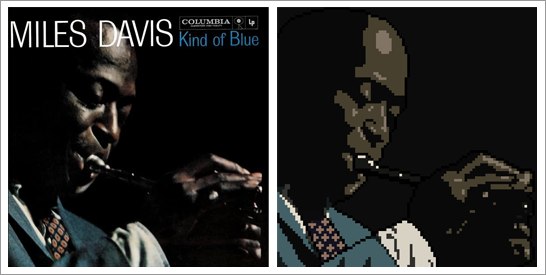
And it's worth noting that trying to license the image
would have been moot. When asked how much he would've
charged for a license, Maisel told his lawyer that he
would never have granted a license for the pixel art. "He
is a purist when it comes to his photography," his lawyer
wrote. "With this in mind, I am certain you can understand
that he felt violated to find his image of Miles Davis,
one of his most well-known and highly-regarded images, had
been pixellated , without his permission, and used in a
number of forms including on several websites accessible
around the world."
The pixelated version was incredibly appropriate for a chiptune tribute and anyone that claims to care about art should applaud such a use of an imitation, mockup or inspired work. I don't like artists who think their work is so special that any change ruins it. 99.999% of people don't care about his original 'masterpiece' in any way, but a few more may care now that there was a different rendition of it. Artists should recognize there is a bit of luck involved in them and their art becoming famous. For every well known great artist, there are ten who were better, but simply didn't become known.Personally, I find the overly-developed sense of self-entitlement to be way more unlikable than an artist's overly inflated ego.
It is an annoyingly 21st-Century notion that one's original work must be free-for-all and a commodity.
I believe today's works are more complacent about this. The artists understand that their work is supposed to pay them one time, that is, they receive their payment as agreed before starting it. If their work suddenly goes far beyond its initial goal, they will get bonuses of fame but rarely direct payments of their work showing up everywhere. Not-artist people usually don't even care.
Le droit d'auteur, vraiment c'est pas possible. Un auteur n'a aucun droit. Je n'ai aucun droit. Je n'ai que des devoirs. Jean-Luc Godard.
(Copyright, really, that isn't possible. An author has no rights. I have no rights. I have only duties).
Le livre, comme livre, appartient à l'auteur, mais comme pensée, il appartient - le mot n'est pas trop vaste - au genre humain. Toutes les intelligences y ont droit. Si l'un des deux droits, le droit de l'écrivain et le droit de l'esprit humain, devait être sacrifié, ce serait, certes, le droit de l'écrivain, car l'intérêt public est notre préoccupation unique, et tous, je le déclare, doivent passer avant nous. Victor Hugo.
(The book as such, belongs to its author, but as a thought belongs - the word isn't too vast - to mankind. All intelligences have a right to it. If one of two rights, the writer's right and the human mind's right, should be sacrificed, it would surely be the writer's right, because public interest is our unique preoccupation, and all, I declare it, must pass before us).
Why? You seem to think you have scored a point by using "should" and uppercasing THEIR.
I disagree that how THEIR work is used "should" be the artist's choice. The artist's choice is in whether to release the work, and then whether to use applicable copyright laws to control distribution of derivative works for the duration of copyright.
The question, really, is "Is this pixel-art thing even the same picture, legally speaking?" And the answer is: "We'll never know, because a legal decision is too expensive for one of the parties to obtain."
The real story here isn't 'unreasonable artist sued me' but 'lawsuits used as scare tactic'.
The real, real story here is, as the author asks, where do you draw the line? Personally I don't think the author had much of a leg to stand on given that the image was being used to sell an album and was easily recognizable as a simulacrum of the original work.
So... down with fair use?
Everything created is copying something else in same way or another. An artist that expects complete control over their work is more than just delusional in their expectations, but also ignoring how their creation is riffing on previous works by other people.
For the original photograph? Yes, of course.
For a derivative work, which the pixel-art reproduction clearly is in my mind? Of course not.
But this looks to me like a very low-resolution duplicate. Only on inspection do I see elements that say "pixel", and these aren't particularly important or interesting. All the examples cited by the OP are considerably more different from the original than the image in question.
To get more clearly into the category of "fair use", I would think the art would need more significant differentiation. To an unexpert eye, these might be things like: - Variation of the palette into something typical of an NES game - Revisit the perspective to make it more two-dimensional, as an older video game would (the image clearly depicts Davis at an angle in a way we wouldn't have expected in an 80s game console) - More exaggerated usage of "pixelized" elements - Introduction of elements / themes /motifs from other pixel art pieces - Turn the image upside down, put curious, "where the hell am I?" look on Davis' face - Pixelized chipmunk - Pixelized Thelonious Monk
If the idea here wasn't to invest a lot of time into the image itself, and have some that plays the marketing role of 1950s cover art, then do something evocative but more clearly distinct.
Finding the line between "derivative" and "creative" is not a computable problem. But it gets a lot easier with the quality of the art. But it seems to me the photographer has a point. Especially when I consider that the image real does look like a low-res JPEG -- if he tolerates that, the next question will be the difference between this and an actual low-res JPEG.
Now, could he have been nicer about it? I would certainly think it better to start with "hey knock it off". But maybe I don't everything that went before the settlement.
I see this as being not that different.
Which really brings up the key to this, which is what is considered "derivative". Everyone has a different concept of it, I'm sure, and it's not cut and dried.
To me, simply taking a picture someone else took, and digitizing or pixellating it, is not something that I would consider "derivative". I liken it to sampling music to be used in a "derivative" work. In the vast majority of those cases, the samples have to pass through the proper licensing and be released for use before they are resold.
And while the guy might not have created the content of the picture, he spent the time and effort to actually go and take the picture. Doesn't matter if he spent a month setting up the content and lighting to get the perfect shot, or sat on his cel-phone camera and it took a great picture as a result of blind luck, it's his picture.
If he wants to sell that picture for profit, and has cleared the rights of the content of it, that is his prerogative.
I think that the pixellated image would require something similar to a mechanical license that you find in the music industry, where someone creates the song, but then gives the rights for another band to record and sell their version of it.
The only thing the artist may be protected from is duplication for the mere purpose of profit, not further cultural benefit.
Thus everyone is free to make derivative works, so long as they're not so closely associated with the original that its considered mere duplication.
Duplication, if not for profit, can be allowed for individual consumers but not businesses.
---
I think writing off this admittedly socialistic view on artistic work as "self entitlement" is short sighted.
If an artist makes a work of art and nobody ever pays any attention to it, is the work still valuable?
To a certain extent, the attention that people give to a work of art gives it value (in my opinion). People's attention is a limited resource, one that certain artists fail to duly acknowledge when they attempt tyrannical control over their works. Artists: if you want absolute control over your works, keep them to yourselves and never show them to anyone else, ever (please!). Otherwise acknowledge your debt to the (mostly-free) cultural environment(s) you drew inspiration from and to the public mindspace your works occupy. At least pay back our attention with your gratitude, instead of IP-thuggery.
Why? Seriously, I'm genuinely interested in why you believe this statement should be true. If this were actually the case, there would be no such thing as a fair use defense.
The more derivative a work is, the less it belongs to the original artist. In this case, the work was derivative enough for there to be a legitimate legal case either way. It's easily understood as an honest mistake, though it clearly was a mistake not to check the art ahead of time. It's understandable for the artist to be upset. But it's conflict that reasonable, respectful human beings should be able to resolve without a full-blown lawsuit.
The vengeful attempt to inflict punitive damage on the guy who, at worst, made an honest mistake? That's worse, in my book.
Do you think Toyota should only permit particular uses of their vehicles? That Dell should only permit particular uses of their computers?
It should be the artist's choice on how their work is released, but beyond that, they can do nothing.
Once an artist has released their work, the details of how it is consumed, how it is interpreted, and how it is used will always be well beyond their control.
Much like a startup must pivot, so too must an artist live in the world within which they create their work.
It's unfortunate the author didn't think the cover art would be a problem. It's a pretty iconic image, and the very fact that he really wanted to copy it because it would fit so well should have set off some alarms. It's like a brand name, it could be seen to increase the value of the product. (I don't even know if he sold Kind of Bloop or reaped any kind of financial reward, but sometimes even that's not important. If he didn't, then man does that penalty suck.)
Did you not read the post? He explains this in the very first paragraph:
"Remember Kind of Bloop, the chiptune tribute to Miles Davis' Kind of Blue that I produced? I went out of my way to make sure the entire project was above board, licensing all the cover songs from Miles Davis's publisher and giving the total profits from the Kickstarter fundraiser to the five musicians that participated."
Copyright in the US exists to promote the progress of science and the useful arts (US Constitution), not to protect the "purity" of an artist's work.
Parody is one well-recognized, legally protected form of fair use - and no doubt it would cause this photographer to feel "violated".
Making a copy of someone's work is always tricky. The point at which it becomes your own work and not just a rip-off is very subjective. She made a painting that she wont sell because it was derived from a couple in a portion of a larger picture in an ad. I maintain that she is silly because she copied only the pose and even the original photographer wouldnt recognize that it is a derivative work.
Asking permission is always appropriate and sometimes you get turned down. As an artist she asks for model's release for anything that might result in a recognizable portrait.
I am not arguing a general case; I'm arguing specifically that Maisel should not have complained, let alone started a lawsuit, about this specific use of one of his works, in part because he is in the position to do so. He can let a thousand derivative suns, making a few handfuls of people happy each time, bloom without any negative effects for him.
But really, if this guy had used a picture by your girlfriend as the cover art, she would have been pissed? Why? Because a couple of dozen people now have a CD with some version of her art on the cover? Because some guy on the internet has that version on his website? I don't understand that at all. Even unknown artists are supremely unlikely to suffer any negative consequences as a result of this tiny project using one of their images. It isn't like this is a serious commercial effort: it was born out of love, not out of a quest for cash.
And the 8-bit derivative is but a thin layer on top of enormous work. Think of someone who add 10 lines of code on top of your 10,000 lines of code and publish it without asking for permission.
The artist definitely have the right to be pissed at least.
And then what would happen if the photographer sued EMI and Coldplay, and won a $32K settlement? I'm guessing the Internet would either be satisfied or angry that $32K is too little for such deep pockets.
I understand and agree that Jay was too vicious in this, but how is he in the wrong again?
The case is especially interesting because no large faceless corporation was involved, it was one (very wealthy) artist going after other (not very wealthy) artists.
Is there a point at which those values of money make it acceptable to take some one else's work, alter it, and re-sell it? If Maisel had settled for $10,000 would we be having this issue? What about $1000? Nothing at all?
Litigation is unfairly tilted towards those with money. Fortunately for Jay he has some. He obviously felt that Kind of Bloop's cover unfairly used his art, so he sued. I am assuming that the settlement will cover _his_ legal costs. My wild-ass guess is that $32.5K would be about right to cover filing, and negotiating a settlement with a good NY attorney.
So, if an artist feels that their work was ripped off (whether or not that is ACTUALLY the case), and they have the means to do so, do they not have the right seek litigation against the offender?
Regardless of the merit (I believe it's fair use), Maisel was not harmed by this remixed album. Purely sending a cease and desist would have done the trick, there's no reason to try and squeeze cash out of it. That's why I think he comes out looking like a dick.
The derivative examples he provides below are copies of truly iconic images, while Miles Davis cover is a pretty mediocre photo by a commercial photographer.
To your second point; the original photograph on the Miles Davis cover has absolutely become an iconic piece of American culture - I take it you're not a jazz enthusiast?
Given the circumstances, an album with a very limited audience, available primarily for electronic download (there was only a physical version with this cover for Kickstarter backers), I think the commercial and legal aspects should be considered moot.
Let a thousand of these tiny suns bloom. The world would be better, not worse and that is the only criterion that needs to count. All analogies are off, because we don't need to be arguing the general case. They all fail to consider that this is a work by an accomplished artist whose reputation or commercial interest are in no way threatened by this use of his work. That is the specific case under consideration and that is why he is utterly wrong.
And that's just one tiny element.
Copyright law is supposed to encourage artists to create new work. However, it's been perverted to let artists (but mostly large corporations) milk money from a single cow in perpetuity.
"Copyright law is supposed to encourage artists to create new work"
By discouraging other people from reproducing their work without permission and/or compensation, yes.
Someone got jumped on for reproducing a work at a lower quality. Whether it was a photoshop filter and/or hand placement of a few pixels doesn't matter; it was recognizably reproducing the work. This wasn't some new piece of art that got them sued, this was a particular reproduction of a 50-year-old photograph.
There's a significant difference between something like this and, well, covering a song as a chiptune. If you cover a song and try to sell that, you have to make arrangements to compensate the songwriter or rights owner. This is just appropriating an original work and hoping nobody notices.
The purpose of Copyright law is to "promote the Progress of Science and useful Arts", not make creators feel like they are entitled to total control over their work.
The question is whether the progress of the Arts, as a whole, is promoted by preventing people from creating derivative works. You act like copyright is all promotion, but there is of course an opposite effect, too, by preventing people from creating derivative works. Why do you think the copyright clause explicitly specifies that copyrights are "for a limited time"?
It's not "reproducing a work at a lower quality." That would imply that the artist was trying to copy the original but could only get those dang pixels because all he had was a 1980s era computer and couldn't do any better. That's clearly not the case.
It's a different work of art inspired by the original, meant to evoke it but clearly apart in purpose, aim, and audience.
It's like saying that "Pride, Prejudice, and Zombies" was a poor attempt at copying "Pride and Prejudice."
I always though Jay was a good guy for letting artists use that space (even if it was a silent agreement), but maybe that's not the case...
Not that it directly involves this case of fair use, but that building is worth millions of dollars, so Jay was doing this for the sake of "artistic purity" or whatever you want to call it, not because he's a starving photographer...
An article about his building a few years back: http://nymag.com/realestate/vu/2008/09/50481/
Gruber made, I think, a somewhat asinine point about this being an example of how spectacularly well-off Maisel is and how much of a dick that makes him for enforcing his IP rights. But Maisel bought the place for a pittance in the '70s and doesn't collect rents on it. I'm sure he's much better off than Baio, but he's not a mogul.
2008 - 42 = 1966.
$102K in 1966 is $711K in 2011 inflation-adjusted dollars.
I could see it being a mix of both.
I don't think it makes him less of a good guy.
I appreciate what the author was trying to accomplish, and my geek side totally understands the transformative nature, my photographer side thinks it is too close, especially for a commercial work.
I don't think this was a case of "Internet entitlement", but rather a case of two cultures clashing, which is unfortunate, because the cover fit the album so well.
Could this be a new variation of the Streisand Effect? Lawyering up on some inconsequential copyright violation and getting your poor behavior broadcast across the entire internet? Should it be the Maisel Effect or does Sony already have trademark?
The truth is that his version just wasn't that different than the original iconic image. He used the image in exactly the same context, derived value from the similarity (that was the whole point), and derived revenue from the sales. So how is this okay?
I wondered the same thing. For example, what if I took his 8-bit music and painstakingly recreated by hand a 4 bit version by exactly copying the notes from his version. And what if that started appearing all over the internet and swamped the references to his own work? I think he'd be pissed off.
I feel bad for him because he did go out of his way to do the right thing on all other counts and this was an oversight - receiving a $32k punishment for a simple mistake is a tough break. However from his description he knew up front he was trading on a very fluid definition of fair use and he had to know it was a risk.
I want to forcefeed this article to all of them.
Are there any landmark cases that have set good precedence for fair use online beyond allowing for parodies of works?
One point: I think a mechanically produced low-resolution version of the image would not be "transformational". The image here does look mostly like that - an exception is the tie, which is rendered as if flat, to preserve the pattern. I think if all or most or enough of it was like that - a sort of cubist version - it would be transformational.
It really sucks to pay tens of thousands of dollars. And the experience itself sucks even more. The guy should have just got an injunction, not damages etc. Though I guess, many had been sold already - it was too late to prevent the problem. The only justification I can think of for the artist is to cover his own legal costs. I wonder if he would have just asked Maisel to stop, with no lawyers involved, if he'd known in time? OTOH, Maisel firmly believes he was in the right - so I also wonder if he would have stopped? Maybe lawyers - and their costs - had to be involved
Look what happens if you reduce the original picture to four pixels algorithmically: http://i.imgur.com/q2z3w.png
Point being, the final four-squares image in the pixel series bears no relationship at all to the original photograph beyond a color scheme which is only reminiscent of (not identical to) the original. And the color scheme wasn't the original photographer's invention, anyway.
If there's any "inherent beauty" or "balance" in that last picture, with just four squares of color, it was put there by the artist who made the series of pixel versions.
"I went out of my way to make sure the entire project was above board, licensing all the cover songs from Miles Davis's publisher..."
All well and good; or mostly well and good, as he didn't seek to license the cover shot. Therefore, the "entire project" wasn't "above board" and the statement above is disingenuous. So why didn't he try to license the cover shot? Apparently, he thought that wasn't necessary. Leading to this conclusion:
"If you're borrowing inspiration from any copyrighted material, even if it seems clear to you that your use is transformational, you're in danger. If your use is commercial and/or potentially objectionable, seek permission."
As a visual artist, I don't like getting ripped off. It's happened any number of times, on a small scale. So I can sympathize with Maisel, even if he comes across as a hardass. I can also sympathize with Baio, but not as much, because he explains pretty clearly how he did it to himself.
I should also note that the US Congress ratified the Berne Copyright Convention, which includes protection of the "moral right of the artist." This includes explicit protection against someone else modifying one's work.
One person's "transformation" is another's "mutilation."
Pet peeve of mine: I hate it when people cut quotes down in a way that changes the sense of the original, then start arguing based on the faked up quote they just provided. The full quote, why you even provided it yourself, was:
"I went out of my way to make sure the entire project was above board"
The point is that he was trying, and trying very hard. His failure to license the cover was the entire point of the article. He is saying that the reason for it was simple, honest oversight, and we can believe that his motives were pure by virtue of how much money he put down for the other portions of the album. How can you accuse him of being disingenuous when its his own article you're citing back at him as the evidence? It's pretty ineffective disingenuousness!
I don't see how the quote here has been misappropriated at all.
Further, the subtext of your comment seems false. "The point is that he was trying, and trying very hard". Well, no. That's not the point. The legal system often does give credit for trying, in the sense that a good faith effort may ward off treble damages. But compliance with the law is often not a best-effort thing, and you do not in the real world always get points for effort.
Therefore, the "entire project" wasn't "above board" and the statement above is disingenuous.
He's explicitly (and literally) stating that Baio was not being sincere. When this clearly isn't the case. I think we both understand the difference between disingenuous and an oversight.
And in particular he wasn't being disingenous with the statement he made. As jerf points out the statement is used as the pretext for the mistake he made. How in the world could that be disingenuous -- unless you think he didn't actually try and is lying about the whole thing?
Photographs & Music are two very different mediums.
A music composition is made to be played. And part of that is that multiple people will probably be playing it. The fact that the instrument choice used on the album was unique did not make it any different from any other cover album. And thus permission was sought.
A photograph on the other hand is made to be viewed & that's not how it was being used in this case. It was being used as the inspiration for a new derivative work of art which played off the concept of the music.
I can totally see why Baio was not worried about licensing the original. I can also totally see how this was a mistake in practice.
This concept of the "moral right of the artist" is the kind of incredibly vague legalese that's at the heart of the problem here, really. Nobody's arguing that artists shouldn't get compensated for their work (and it's disingenuous for you to assume that). The real problem is that the laws pertaining to this are so vague that they basically enable the person with the most expensive lawyers to bully anybody and win.
If you're in favor of an intellectual-property plutocracy, then congratulations, because that seems to be what we've got.
The secondary problem is both legal and cultural: remixing a work is not yet perceived by many people to be "work". But it is, without question. Doesn't the remix artist deserve to be compensated for their work?
Someday you'll find yourself in a similar situation, if not through malice then by accident, and you'll desperately wish that rules were clearer.
No, it's not "incredibly vague." Rather, it's pretty clear:
What constitutes infringement of moral rights?
VARA grants two rights to authors of visual works: the right of attribution, and the right of integrity. The right of attribution allows an author to prevent misattribution of a work, and to require that the authorship of the work not be disclosed (i.e. remain anonymous). The right of integrity bars intentional distortion, mutilation, or other modification of a work if that distortion is likely to harm the author's reputation, and prevents the destruction of any work of recognized stature. Therefore, if I paint moustaches on a painting by a famous painter such as Roy Lichtenstein or Frank Stella, I will have violated the artist's moral rights under VARA. If I paint moustaches on an Andy Warhol painting on the other hand, I will not have violated Warhol's VARA rights, because VARA protection ends with the death of the author.
Source: http://cyber.law.harvard.edu/property/library/moralprimer.ht...
You may say that "pixelizing" the photo caused no harm; the photographer obviously had a different opinion; to wit, that his "right of integrity" was harmed. While reasonable people can have varying opinions on the level of harm, if any, this principle, as described above, is not vague.
"Under VARA, moral rights automatically vest in the author of a "work of visual art." For the purposes of VARA, visual art includes paintings, drawings, prints, sculptures, and photographs, existing in a single copy or a limited edition of 200 signed and numbered copies or fewer. In order to be protected, a photograph must have been taken for exhibition purposes only."
In addition, the Fair Use doctrine in the US makes things not as clear-cut as you make them out to be. Even if the creator doesn't like it, it's sometimes the case that she doesn't get to prevent her work from appearing in certain kinds of criticism, even if it involves distortion or modification of the work.
Because he believed (and still believes) that it was fair use: "My lawyers and I firmly believe that the pixel art is 'fair use' and Maisel and his counsel firmly disagree."
He was making a derivative (but original in its own way) work based on Miles Davis' work. So he sought permission from the right entities to do so.
He was also making a derivative (but original in its own way) work based on Meisel's photograph. So he didn't seek permission from the right entities to do so.
This reeks of tunnel-vision. As a musician Baio had the appreciation and understanding of the field to know that he's producing a derivative work. As a non-photographer he didn't seem to think the same principle applied to another field of art.
Two sides disagree - the tiebreaker should be the fact that one side created the original work on which the clearly recognizably derived work was based. That side gets more weight.
No, the whole point of fair use is that certain uses are protected EVEN IF the artist doesn't like it.
Right… it's subjective, hence his warning that you should seek permission even if you think it's obvious.
Regardless of who's side you fall on in this disagreement, I think everyone can agree that the subjective nature of it and the ambiguity of the law has a chilling effect. There is a risk to use any copyrighted work in any capacity. Defending yourself can bankrupt most artists.
The examples he gave of what he thought was equivalent were not close to equivalent of what he did (his friend did). The Pulitzer example was obviously its own piece of art inspired by the original. His was a flat copy that was transformed to 8 bits.
So you can have multiple rights here. Clearing the rights to the score is easy - if the composer is ASCAP/BMI/PRS/GEMA (etc) then there's a standard license they've agreed to, so you pay your royalties and you're away. Mechanicals and lyrics can be a bit more complex when you start creating transformative works (ie sampling, rewriting words, etc.)
The losers, of course, would be copyright lawyers and the artistes that want complete control over their work even after it's published.
Why did he think one type of art has more rights than another type of art?
Coming from knowing Kind of Blue very well, it's fascinating to hear what other people take from Miles' songs, and I've caught things from Kind of Bloop that I had never noticed in the original. Highly recommended.
It's sad that since the potential losses of going to court are so high, most people have no option other than to settle.
If you're reading this Andy: just make sure that you don't use the same image in your documentary! :-)
1.) Protecting the rights of artists - those who dedicate their resources to CREATE
2.) And along the same lines, offering the freedom of expression to newcomers; re-creating art through new mediums.
The guy folded, yes, but not because he thought he would lose, but because even fighting and winning would be too expensive.
Looks to be to be clearly a derivative work and clearly a copyright violation based on it not meeting any fair use requirements.
The purpose of the new work is commercial (point against fair use) but it's also a transformative commentary on the old work, bringing new aesthetics to it (point for it). (In fact, one of Maisel's complaints seems to be that it has been transformed [1]). The amount of the old work used is the entire work (point against it). The impact on the market for the old work is minimal -- it's not an adequate substitute (point for fair use).
The final factor, the character of the old work is a factor that is very hard to predict how a court will analyze. One common distinction is "fact or fiction". A photograph of person is closer to the factual category than fiction, though the category division doesn't make much sense to apply here. It is well known and iconic, so this use doesn't "preempt" the first public presentation, which some courts have considered as relevant. Overall, I'd say this factor argues in favor of fair use, though not necessarily strongly.
It clearly meets some fair use factors, contra your claim. Enough? Well, as I said, that's not going to be determined outside a courtroom.
[1]: Maisel told his lawyer that he would never have granted a license for the pixel art. "He is a purist when it comes to his photography," his lawyer wrote. "With this in mind, I am certain you can understand that he felt violated to find his image of Miles Davis, one of his most well-known and highly-regarded images, had been pixellated, without his permission, and used in a number of forms including on several websites accessible around the world."
I don't see Andy's side at all.
The artwork is a copy, used for commercial purposes and without permission.
Copyright restricts copying. This isn't fair use. It isn't a parody or an even an homage – which can blur the line.
Not the same thing at all. Look closer, like at the tie. They didn't just reduce the color palette and resolution. He describes the process of creating it:
> I tried to draw it myself, but if you've ever attempted pixel art, you know how demanding it is. After several failed attempts, I asked a talented friend to do it.
I'd imagine it's not an entirely even split either...
There's a flow of money around every Tech Crunch article that is posted here, yet I don't see the same comments.
I don't think my day is complete without seeing links from him, but I mean, this same thing happened with Danger Mouse, and that was really testing fair use, and I don't think was even trying to, but this was another copyright issue promoted by his site.
So, I mean, I'm not commenting on the substance of the specific settlement, I'm talking about the whole issue the post is describing as to what went on. He promoted a derived work, often does, it was challenged, but didn't fight it but settled, and yes that's an issue that should concern us all because that's the current fight over copyright.
Part of that fight includes was the value of the creative work directly the result of the success of the original material, without any value added or interpretation of new art, and I would say sure. I agree with the fight, and I agree that works like this should be cool to do.
But you put your shoes on of the rights holder of the original, and I think it is very clear that a guy makes money, with essentially low-res photo of my client's property.
Now, that's completely ignorant of the 8-bit technology social history hat tip, I know, but I guess I don't know how clearer to put it that I'm not coming out of left field with trying to provide some kind of subtle issue around the subject that I don't read very much about... has challenging fair use for community ideals become just another method of capitalization? Is that why the lawyers thought that their claims would be honored in court? Because that's the only thing I could barely think could be an issue for anyone.
Anyway... was hoping to see at least some kind of critical analysis. Perhaps it is forth coming by someone who can articulate maybe what I'm after better. Andy rocks, tho, for sure.
In the first case, he created something interesting, and his arguments for the symbolism of his piece and the entire project were compelling. Yet this is reasonably likely to not be considered fair use. In the second case, he blatantly displays the creative work and offers commentary on the issue, and profiting here is perfectly fine. This seems somewhat backward to me, so I think th0ma5's comment is interesting.