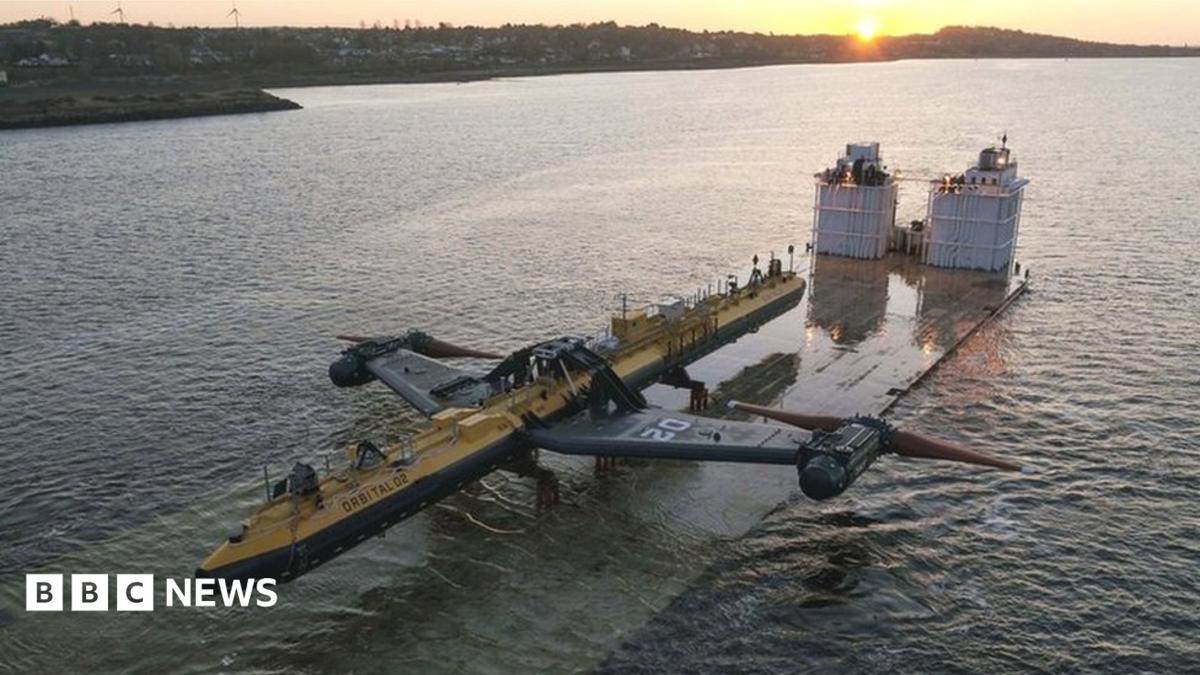
'World's most powerful' tidal turbine sets sail from Dundee
The 680-tonne turbine, which can supply power for 2,000 homes, will be towed from Dundee to Orkney.
BBC News
148 points · by Kaibeezy · 5y ago · 119 comments
Wave and tidal energy schemes have failed to deliver useful and reliable energy after over 50 years of investigation and research funding. Putting moving parts in salt water off the UK coast is always a tough prospect.
By contrast, UK offshore wind power is delivering energy cheaper than ever and has emerged as a clear winner.
Given the above, I'm honestly puzzled why offshore tidal energy projects are continuing to attract major funding.
Incidentally, the argument that the tide is more reliable as it always flows twice a day is a rather moot point, as like wind, the tide doesn't always flow when you want it to.
Highly annoying to see ideas that were - solidly - discredited decades ago come back in a slightly different guise for a re-run.
Based on past performance I predict that this setup will right up until the first major breakage, after which it will be uneconomical to even salvage it.
The temptation of the tides is easy to understand: the power is immense, it is essentially the power inherent in the gravitational attraction of the moon orbiting the earth conveniently transferred onto a moving fluid. So on paper it is trivial. But that's where it stops being simple. The forces being immense is also a force that tries to destroy your gear. Corrosive salt water is the nastiest working fluid you could pick outside of acids. The wind & the waves combined can really stretch the limits of engineering (I've seen a minor bit of water hammer effortlessly flip an 8 cubig meter concrete cube right across a dam, like a 2x2 lego brick only slightly larger and heavier).
The 'head' compared to most hydro installations is limited (though in some locations it can be of usable height), the flows are hard to trap without interfering with the rest of the environment and so on.
As a 'mere matter of engineering' it is probably one of the hardest jobs you could tackle including going to space, the ocean is an extremely dynamic environment and near the ocean shore that is even more true.
And finally, to be economical such an installation has to work for a very long time after initial deployment because it is very hard to work on once deployed.
Any pointers to the ideas that have been discredited? This is a technology I dearly want to work, and I had bought into the narrative that it doesn't "because we haven't invested enough" (compared to offshore oil and gas production).
You can broadly group all tidal devices into several simple groupings and for each of those there were a number of initial prototypes and all of those did not make it past the POC or initial deployment. Anything the future is likely to come up with will be variations on those themes. That won't stop people from trying and it won't stop future subsidy grabs because this all falls under the 'wouldn't it be nice if it worked' heading. Yes, it would be very nice. But no, it doesn't work and if you're not going to come up with something radically new you are better off reading the literature on what exactly made it not work the first time.
Those who don't know history...
Here is a very nice example:
https://teamwork.nl/category/teamwork-technology/
I'm sure they pocketed a ton of subsidy by now.
In the same vane (pun intended): rooftop windmills, vertical axis turbines, kites, sound to energy conversion and on and on.
Combine something that pumps, two check valves, some hose and creative plumbing (alternatively, replace creative plumbing with a lever and hydraulic cylinder) and you've got a really low pressure pump. From there it's just physics.
Doing this kind of thing at scale just doesn't work. Between expensive engineers, permitting, code, surveys, OSHA, etc. etc. etc. there's no scale at which you can do this where you more than break even generating eletricity. Electricity travels great so you're competing with all sorts of other sources. It just doesn't work.
But if all you want is to pump enough water into a tank so you can hose bird crap off your dock and you want to avoid digging a 300ft trench for a water line at the same time it works great.
If you need real power somewhere remote go solar/wind. If you need better uptime than that then add lead acid to the mix. But once you start breaking into mid-range power needs (think gravel pit mine running crushers or something) it's hard to beat diesel.
Is this a globally significant wasted funding? If not, it sounds like a reasonable idea to try something new from time to time. Worst case, some project trial fails and we learn a new failure mode / limitation. Best case, we get a new reliable power source.
Oh certainly!
But funding is always finite. Unless some radical new wave/tidal technique comes to light (and it hasn't, yet!), then the project funding would surely be better directed to other renewable energy sources.
The cynic in me says wave/tidal projects based on existing technologies (shown to perform or scale poorly) are simply to grab funding for green energy projects. The Swansea Tidal Lagoon fiasco is a classic example.
I am no longer confident in this seeming obvious statement, our ability to pump money into unproductive assets appears to be infinite, looking at the surging realestate prices, shares and crypto
Producing energy on a completely predicable schedule, while being less useful than at will, is much easier to deal with than producing energy on a modestly predictable but highly variable basis.
But on the general point about funding for tidal energy I agree with you. To make it work we'd need to make bold and highly disruptive changes to the environment, for example the tidal barrier across the Bristol Channel.
I agree in theory, but in practice tidal doesn't scale like wind does (both in terns of the size of turbines and where they can be located around the coast).
The predictable but small amount of energy it can produce is of limited use.
* Hollow out an area of the beach that's underwater at high tide
* Install a big tank that lifts up some number of meters.
* Lift the tank at low tide
* Let water fill the tank at high tide
* Drop your tank of heavy water like a gravity battery to generate power, at whatever rate you choose
* Release water so its easy to lift again
You open gates; let high tide naturally fill a reservoir; close the gates; let the water back out through a turbine.
They have been built but the largest are only producing ~250 MW (ETA: thats 250 PEAK, actual generation is more like 50MW) which is nothing compared to what it takes to get that, like if you're already building a seawall it only might be worth installing turbines.
It is not very likely that there are tech improvements that would make things like this more viable. Salt water is super hard on equipment and that will always be true. Any improvements in durability would likely also apply to wind components. Gravity is only powerful at large scales, so just using tidal forces means you have to harness a lot of water, which means use land use and environmental disruption. Water batteries are economical only in places with extremely specific geography.
(Sending the water through bi-directional turbines, to get power from the inflow and outflow)
And while Rance could take advantage of an estuary with a dam just 750m wide, Sihwa uses a 12.7km long seawall.
Sihwa's seawall was actually built for flood mitigation before SK realised it could work for power generations, building a 10km seawall solely for power generation sounds insane.
Hydroelectric dams essentially build a tank, but they only build one wall of the tank. Hydroelectric turbines are about 90% efficient, so you're essentially looking to extract the same amount of energy from the weight of the sea water... with the complicating factor of needing to peak smooth due to tides.
How? Don't you have to pump it out since it's below sea level?
To me, this seems more like a pioneer project and one where we will learn lessons from.
This isn't a problem with a magic answer or a problem that will benefit substantially from incremental improvements to materials and designs.
factually lacking and basically an insulting word IMO
It is possible (although complex and expensive) to construct a tidal scheme that can generate power consistently 24x7.
Conceptually, you can imagine two pools - one of which is filled on each high tide, and the other of which is emptied every low tide. There is always a water height difference between these two, so you can generate energy anytime with a generator between them.
It turns out such a scheme is less profitable than just generating lots of energy when the tide is flowing fast.
For contrast, some of the fastest deployments of autonomous vehicles, solar energy and novel digital communications come at Australian remote mine sites.
I badly wanted to read takedowns of your summary, but I'm forced to say absent well constructed arguments of viability i think you're carrying the room. Obviously the backers, grant or seed capital aided believe in what they're doing and we're a long way down the road from Salter's ducks. But on balance I think this is a niche product.
Some places like the bay of fundy, if you took local ecology out of the picture, look like 80% of the construction cost of a tidal race is done for you by nature. It doesn't mean they would work, it only means the initial capital investment might be better. I think the same is true of the Scots waterways used for these tests, but the volume of power remains below wind and you would be right to say it questions why the investment given the balance of returns.
The same is true of Carbon Capture and Storage: huge but elusive upside for the coal power sector, exploiting something known to work, from gas and oil well injection. It's had billions pumped in (hah) worldwide and doesn't seem to work in practice. Fugitive gas is a problem and the chemistry is complex and consumes energy ferociously to do the conversions. Had the same funds been spent on battery tech, improvements in transmission and other change to power, we'd be significantly better off (in australia)
(Not an engineer, not in the power sector)
I’m guessing salt corrodes metals and barnacles grow on them which make the moving parts seize up.
What are some of the less obvious issues that they face?
1. Short installation window: they can only install this machine when the tides are changing (i.e. not much flow), so they only have a couple of hours to collect the moorings and it hook it up to the grid
2. Fatigue: loads of areas, not just the turbine blades... variable loading on the mooring lines, vortex induced vibration of the power offtake cable, wave induced motion on the offtake cable
On the two you mentioned:
Marine growth (barnacles etc.) is generally manageable with anti fouling paints, or PTFE (teflon) coatings, wipers and bearings around the things that you don't want to seize up. The animals will have a hard time getting a footing in this high flow environment anyway, it'll be pretty well self cleaning.
Saltwater / corrosion is also manageable with coating systems, cathodic protection and large corrosion allowances.
While these two do cause issues, they're kinda "solved", you can generally apply the same straightforward techniques and they don't take up as much engineering effort as solving the installation, system design and fatigue.
Tidal energy does seem like in principle it should work without many moving parts at all save the turbines, which don't have to be metal. Is it the turbines themselves which are very difficult to maintain in salt water?
This one is a floating design, which isn't ideal for maintenance, but I imagine at a large enough scale a dam between two bits of land with turbines in it would work - something we already do with hydro power and fresh water, and a concrete dam with access tunnels would solve a lot of problems with access and maintenance.
The real key is they are far more difficult to maintain than wind turbines. Also, dams are ecological nightmares and disrupting huge swaths of coastline is not ideal. Dams also made use of very specific geological conditions where a maximum amount of water power could be achieved with the least amount of money, time, materials, etc. Coastlines don’t have steep cannon walls to build up hundreds of meters of water to push through turbines at high pressure. Coastal tides are moving water meters high, not hundreds of meters. It isn’t that it can’t be done, it is just that it can’t be done more economically than other technologies.
Having a diversity of energy sources seems sensible...
Wind turbines scale much more easily than wave/tidal, both the size of the turbines themselves (much larger than a wave/tidal system could ever be) and where they can be located around the UK coast.
A diversity of renewable energy sources is sensible (nuclear, wind, biofuel etc), but wave and tidal are difficult to scale and have failed to deliver.
Consider the flagship 'LIMPET' project: https://en.wikipedia.org/wiki/Islay_LIMPET
(I have seen some in lakes/reservoirs. Surprisingly, less than 20% cost premium)
> why offshore tidal energy projects are continuing to attract major funding
Yeah. Agreed. Solar/wind/batteries/EVs will dominate.
Everything else will get "scraps" from a $trillion/year energy industry ;)
I don't think land is more than 10% of the cost of solar in most places anyway - rooftop solar can cost $5000, and I'd expect rural areas to cost less than $500 for a paddock with the area of a house.
Increased power density is indeed one allure of wave energy vs wind. In the same way that wind is concentrated solar energy, studying the mechanisms and origins of waves show they are essentially a form of concentrated wind energy. So if the difficult design challenges are solved, there is potential for greater energy per unit of structural material which some believe could be associated with competitive cost of energy.
Other allures of wave energy include that it is fairly consistent, with some seasonal variations, and its decoupled from solar or wind which decreases the chance that all renewables resources aren't producing at the same time. Of course this is talking about wave energy where oscillations occur with a period of approximately 4-18 seconds rather than tidal with several periods per day, and for these periods of time flow is essentially unidirectional. Tidal energy, like the link in this thread, often uses underwater turbine but wave energy devices rarely use this design.
But the power generated by a turbine is proportional to the cube of the air/fluid velocity..... and the wind normally moves much faster than tidal flow.
So what? You can store tidal water and let the store always flow.
Low tide only occurs twice a day.
Why? The ice forms on the shore and encases pieces of rock. Huge chunks of ice drift into the Bay carrying the stone nuggets. The chunks erode and shed buoyant ice until the density is > 1, then they sink and the strong current leads them into the blades.
Neither is it cost-effective for engineering companies to develop technology for our geography, the conditions are too unique and the inventions don't scale.
Pity.
One of the challenges about building an energy system with lots of variable inputs is that you can't just look at the lowest levelised cost and build only that, otherwise you'd just build wind and be done with it. Adding sources that are not correlated with wind makes the overall grid management problem easier, even if those sources are more expensive the system cost may decrease.
Obviously tide, while very predictable, is not dispatchable so not quite as valuable for grid management, but still shouldn't be written off just because it costs a lot per MWh.
One thing that does make it hard is that peak water flow only happens in the middle of a six hour tidal cycle. For every location you have a predictable 6 hourly cyclical power curve. There's about 75 minutes between the high tide times in the North of Scotland and Southern England so on a GB grid basis, you can spread the curve out somewhat but still have that cyclical element.
Merging the output from eg West Wales and East Anglia would give you a pretty constant supply.
> how power is transmitted back to shore,
Article says there is a static sea-bed cable that that is connected via a "dynamic" cable to the turbine.
> how it's anchored in place. > whether it's bi-directional
Very high level overview of the platform here: https://orbitalmarine.com/o2/
It shows an forward and aft mooring points, so my assumption would be is that at anchors are put in the ocean bed and that the whole structure is held in place by cables.
It also shows a "Two-bladed pitching hub allows bidirectional operation", so I take that to mean the blades are rotated in the hub depending on which way the tide is flowing.
Bi-drectional? Looks like those adjusting flaps are to make it bi-directional yes, but maybe the angled legs mean it has a preferred flow direction (I'm guessing).
How power is transmitted back to shore? The video seems to show, in red, some good old "big fat cable" technology. It's described only as powering the Orkney Islands. I wonder if surplus energy there can be fed back to the mainland grid.
How it's anchored in place? Two massive mooring cables front and back. The main central cylinder floats, with the legs and rotors dipping down into the water (Maybe obvious, but not to me at first)
I can't possibly express my existential torment that I feel when I read statements like this in an article.
Just state the damn power in SI units.
A close second is measuring the size of something in terms of "football fields" or "Rhode Island" (wtf??). I am pretty sure this is tied into the general innumeracy of the population.
This is from the BBC, not a scientific journal. While your average reader may know that their microwave is 800W, telling them "This turbine will generate <x> kW" doesn't mean anything. They _do_ have a home. If they don't _need_ to know/use Watts on a day to day basis, then the number is just going to be forgotten. However, they _might_ remember "a tidal turbine that can power thousands of homes".
It would be lovely if everyone was scientifically literate, but people have other shit going on in their lives. On a pragmatic level, I'd rather society remember the abstract idea of 'how many homes' than _forget_ the precise '<x> megawatts'.
Largest turbine and it’s only going to power 2000 homes?
That’s apparently about 9% of the power for the island, not counting industry (eg, Scotch), which sounds more impressive, but not that impressive.
As the tide tries to lift the object the force could be converted for various purposes.
This can be used basically anywhere where there are significant tides and where bottom can be reached easily.
It is the same as other gravity storage methods except uses buoyancy.
A simple calculation shows you need an enormous volume float to generate a useful amount of power. A tidal range of a few meters isn't that much potential energy applied to a float of limited volume: by contrast, there is much greater mass of water in the sea to generate energy from.
An object displacing 250kt of water (ie. size of Ever Given) has a potential of about 0.7MWh per 1m. Most coastal regions see tides above 2m and a lot much higher than that.
I say 1MWh extracted daily from from a dumb metal object the size of Ever Given (and potentially much more if you are in are with exceptional tides)?
I guess it would depend on how efficiently it can be built and the cost of additional infrastructure (though it would be less if you build it in form of a farm).
Remember, it can be used as energy storage, so if you have a large farm you can program it to automatically pull some of the containers deeper to provide power when at low tide.
Also efficiency of this can increase with the size of the tank as the amount of materials scales less than linearly.
I used Ever Given as an example, but this has been built to be seaworthy and pass Suez Canal. If you don't need to make it seaworthy and don't need to make it to pass through anything and can make it any shape you want you could probably design much larger structure.
Consider a single offshore turbine in the Galloper wind farm is rated at 6 MW and this doesn't look so impressive.
> a dumb metal object
That's the thing. It isn't a dumb metal object. It requires generating gear, maintenance and protection from weather. Also consider the Ever Given is 1/4 mile long. These are big volumes you are talking about.
No matter how you look at it, wind is a tough candidate to beat when it comes to offshore power.
[0] https://www.gov.scot/policies/renewable-and-low-carbon-energ...
[1] https://www.bbc.co.uk/news/uk-scotland-north-east-orkney-she...
Rough seas damaging your tidal energy kit are the one thing you don't want.
I have mentioned above that offshore wind has emerged the clear winner with respect to offshore renewable energy. Putting moving parts in salt water is always a tough prospect, and wave/tidal simply cannot scale to the extent wind can.
I hate to say it, but I suggest many of the experimental wave/tidal schemes under trial are simply for green bragging rights and/or to grab funding for green energy projects...... Funding put forward by well meaning bodies that that would be better directed to other renewable energy sources.
EDIT: This is Hacker News, not Reddit. If you disagree with the above please explain why in comments rather than down voting.
"Downvoting for disagreement has always been ok"
Getting usable power out of tidal energy is stupendously hard and won't scale.
And yes, we're on HN. And yes, having built a windmill (not a toy, one that can power a house) and having worked with innovative solar plants (specifically: concentrators) and finally, having consulted on tidal energy projects I actually think I know what I'm talking about. Tidal energy = uBeam = Theranos.
On satellite maps that’s going to look like someone ditched an A-10 at sea.