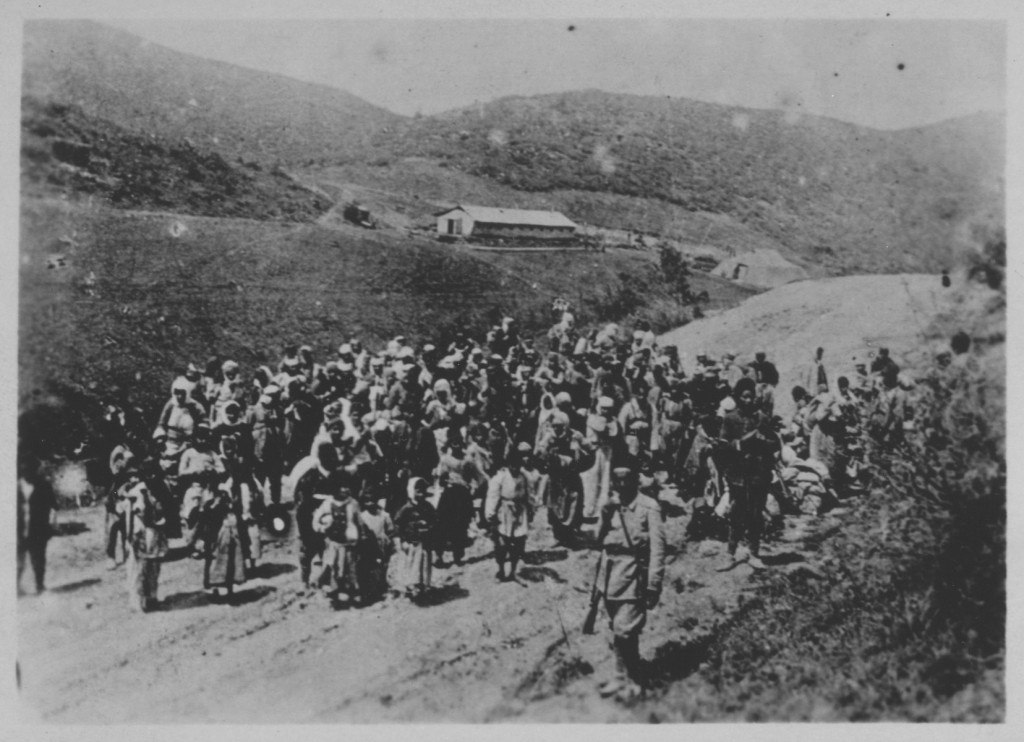
The Armenian Genocide (1915-16): In Depth | Holocaust Encyclopedia
Learn more about the Armenian Genocide, which was the physical annihilation of ethnic Armenian Christians living in the Ottoman Empire between 1915-1916.
Holocaust Encyclopedia
277 points · by tomohawk · 5y ago · 125 comments
The stories are painful, and the legacy of that pain affects my family even today. My grandparents saw their family members and community murdered and had to rebuild their lives abroad. My grandmother, toward the end of her life, would weep, recounting the violence she endured, reliving the experience in her decline. These scars can persist across generations.
There are two excellent books I can recommend: 1. Black Dog of Fate, by Peter Balakian 2. They Can Live in the Desert, but Nowhere Else, by Ronald Grigor Suny
The first is more of a first person narrative describing the lingering effects of the genocide across generations in the Balakian family, very poetic. It’s a great read, full of life, and poignant in its portrayal of inter-generational pain.
The second is a straight history by a historian, tracing the events, causes, people, etc. It’s a dense, but good read.
"Death to the Armenian dogs",
said B. Leylani, who was, back then, the vice president of the Turkish National Association of Sweden. The spectators (Turkish extremists?) were cheering. Later he had to resign (there are also, of course, kind and reasonable people in that organization, who don't want any more genocides, and I presume they didn't like what he said).
Apparently when the genocidal state, the Ottoman Empire, doesn't get defeated in a war (like happened to the nazis), and doesn't get removed / put in prison, then the genocidal ideas can a bit live on and be somewhat strong, 100 years later.
I'm not saying that people in Turkey would be like that. Angry extremists are always few, in comparison to the many more people who are silent, right. I have friends who are Turkish (they don't like Erdagon b.t.w.).
In the Swedish news: https://www.svt.se/nyheter/inrikes/starka-reaktioner-efter-t...
A video recording: https://www.facebook.com/The-state-of-Turkey-uncensored-1502...
"Annihilate" is another word he was using.
But they are often supported by large portions of the general population, such as widespread support of the Nazi regime among ordinary Germans, widespread support of the Soviet totalitarian regime by their citizens (millions of which were murdered by the same regime), widespread support of Mao's Cultural Revolution, of Pol Pot, of countless civil wars (and just plain wars) all over the globe and throughout time.
Humans have not proven to be a very peaceful species, and it doesn't take much for them to lunge for each other's throats.
The largest fascist/ultra far right organization in Germany (by far) are the Turkish Grey Wolves, while ethnic Turks make up about 4% of the population. There are approximately the same amount of ethnic Russians living in Germany, but Russian far right groups aren't known to be relevant in Germany.
I grew up with quite a few Turks in Germany, and all but one were extremely nationalistic and supremacist. It appears that Turkish culture and their historical narratives are different from others. You don't e.g. hear about the Japanese today talking about Koreans as vermin, but it's common to hear those tones from Turkey.
On the other hand, finding any neutral resource about the First World War in Turkey is hard to come by. The best resource I’ve found so far is written by a German General called Otto Liman von Sanders, he wrote a book called “Five Years in Turkey” [0] talking about 1913 - 1918. It at least has some parts on the events which will end up in the Armenian Genocide and the hate against Greece and Greeks.
Sorry to digress but it’s important to mention that, the hate against Greeks will take an ugly turn in 1955 [1]
[0] https://www.amazon.com/Five-Years-Turkey-Liman-Sanders/dp/18...
[1] https://en.wikipedia.org/wiki/Istanbul_pogrom
It seems the downvote army has arrived. Take note my troll friends: You can’t hide the truth, it will come out. Do not take part in enabling people who cause human suffering.
In particular I would recommend "I was sent to Athens" (link: https://openlibrary.org/books/OL6734490M/I_was_sent_to_Athen...) and the section on the 1922 Izmir Fire.
This subject was always used against Turkey in political confrontations for years. Turkey has been better and stronger ally to USA. This recognition is nothing but a political warning against Erdoğan and his latest actions against USA and also this will make Armenian residents in USA happy.
IMHO nothing will change for us (Turkish and Armenian folks living in Turkey), don’t know about Armenians living in Armenia.
So why are you happy?
Because I don’t care if I come from country X, atrocities all around the world have been committed, and still being committed. People have to be responsible for this suffering, we shouldn’t be able to shout “Fake News!” to everything and get away with it.
Nobody living today are responsible or should be responsible for it.
Almost no one is aware there has been constant armed conflict between the Greeks and Turks in Cypress for over 100 years on ethnic grounds. This includes genocide, terrorism, massacres, kidnappings, executions, and mass graves
Nobody brings this up, because it was Christians killing Muslims.
Still the Armenians remained and thrived in Western Türkiye. My neighborhood in Besiktas is 1/3 Armenian and 1/3 Kurd to this day.
Still, I would point out that, just as in the Bosnian war, the scale of atrocities was a lot worse on the side that is more remembered. Over a million Armenians and other minorities were systematically raped, murdered, and purged at the behest of Ottoman authorities. It's unclear to me why Turkey does not want to acknowledge this. You can still appreciate your country while recognizing that people in the past did some pretty bad things. The world is a complicated place.
How had the professor been educated, and what was their perspective? Were they Turkish?
(A bare sequence of questions can seem confrontational, so let me be clear that I don't mean that—I'm just curious about what the teaching looks like from the "different understanding" point of view.)
But it's particularly surprising with Turkey, because, unlike Japan or the US, the Republic of Turkey replaced the Ottoman Empire by a violent revolution. They have more of an excuse than most countries to claim they are not the direct political descendants of the genocidaires.
So it seems reasonable to infer that Turkey's rationale for denying the Armenian genocide is not to save face, but rather is rooted in resentment for what Turks see as a long campaign by France and England to weaken them and constrain their influence in the Mediterranean. Turks point to the discrepancies in how we see Christian genocides of Muslims in the Balkans and the Caucasus vs the reverse in Anatolia. For example, nobody mentions the Circassian genocide 40 years earlier, even though it occurred on a similar scale. The original version of the Treaty of Sèvres, which cut Anatolia into pieces, is a particularly sore point.
I'm looking for a copy of a book about it
Road of Suffering of the Carpathian-Germans 1944-1946
Here's a hint of it from Wikipedia: https://en.wikipedia.org/wiki/Expulsion_of_Germans_from_Czec...
https://en.wikipedia.org/wiki/Three_Pashas
https://en.wikisource.org/wiki/Circular_on_April_24_1915
None of them survived to see the end of the Turkish Revolution. Ataturk was a mere lieutenant colonel at the outbreak of WWI and did not reach the Caucasus theatre until January 1916, eight months after the outbreak of genocide -- he went on to win a few crucial battles and was then shipped to the Levant.
However, Turkey did go on to deny their crimes and venerate Talaat Pasha, who played some role in the development of modern Turkish institutions. Kieser, who is likely the source of your claims, does not implicate Ataturk directly, but does emphasize the influence of Talaat on modern Turkey:
https://books.google.com/books?hl=en&lr=&id=uGW1DwAAQBAJ&oi=...
but see also the counterpoint:
https://www.tandfonline.com/doi/full/10.1080/14623528.2019.1...
The genocide wasn't just limited to the World War though. A lot of significant damage happened between 1919-1923, when the Turkish were fighting for independence. And by 1918, Ataturk was already a general in the Ottoman Army.
As far as Turkey is concerned, this is fake news. And big tech has agreed to defer to Turkey.
[1]: https://www.engadget.com/facebook-turkey-emails-200407588.ht...
Genocide can be talked about on Facebook, you can even organise it.
https://www.bbc.com/news/world-asia-46105934
https://www.nytimes.com/2018/10/15/technology/myanmar-facebo...
And if the Turkish government tried organizing another genocide, I'm sure Facebook would platform it, and censor any opposition to it.
Why wouldn't they? They've already committed to deplatforming critics of the Erdoğan. Do you think that Facebook would take a principled stand and suddenly choose not to take orders from the Turkish government, and risk losing that market? I don't see that happening.
It’s pretty far removed from me, and I’d probably not live here if my ancestors hadn’t fled the Turks back in the day, but it’s also very sad to see that it’s used as a political token over and over again. Obama promised that he’d be the first sitting president to acknowledge it, but then didn’t. I don’t know if Trump promised to acknowledge it but he didn’t and his admin even rejected a specific opportunity to do so.
Now Biden is dangling it, either as a way to buy points with Armenian Americans (heh not likely, he’s got CA and doesn’t need to further lock in the Glendale vote) or more likely to push Erdogan to do what he wants. My guess is he doesn’t acknowledge it.
It’s really a bummer overall — it’s not like anyone in Turkey today had any part in it unless they are like 120 years old but Erdogan is in many ways basically a dictator that just hasn’t worn out his welcome with the rest of the world, I think largely because of geography and his not so thinly veiled threats re: immigration.
If they deplatform critics of Erdoğan, why would they also not be willing to deplatform anything else that Erdoğan does not like, like discussion of the Armenian Genocide?
And maybe this is why we should consider the consequences of encouraging deplatforming of people we don't like.
My other comment pointing out collusion of Facebook and the Turkish government is heavily downvoted, and I am not sure why. If I am mistaken, please someone let me know.
[1]: https://www.propublica.org/article/sheryl-sandberg-and-top-f...
But it's as easy to point to the dire consequences of persisting in amplifying the voices of people spewing hateful rhetoric as it is to point to the people silenced to protect the interests of the powerful. I think treating this as a one-sided problem with an obvious answer does it an injustice.
Fellow Turkish trolls are doing extra duty on this thread :-)
The same thought crossed my mind, which is why is this acknowledgment such an important issue and why now? I agree with you and doubt it is to earn points with a super small (albeit wealthy) constituency. I have never even heard people care about this outside of politicians and the news.
Just seems like a very strange hill to die on.
It appears that Biden has acknowledged it since my original post, too.
The Turkish government doesn't acknowledge the Armenian Genocide. And because it's punishable to do so there might be no "Turkish" sources at all. I use quotes because obviously there are Turkish people who don't deny it happened and some of them might have written about it.
https://foreignpolicy.com/2021/04/24/armenia-azerbaijan-war-...
https://en.wikipedia.org/wiki/Spanish_use_of_chemical_weapon...
https://www.aljazeera.com/news/2021/4/23/biden-tells-erdogan...
> I wonder when the US will fully recognize the North American Native Genocide and build a monument in DC - hopefully in proportion to the monument in NYC.
I wouldn’t be surprised if that happened fairly soon. The current Governor of California recognized it explicitly as genocide in 2019, as did the current Secretary of the Interior, while she was in Congress (and before she was appointed the first Native American to serve in a Presidential cabinet.)
That acknowledgement is no longer a universal taboo in the American political establishment, especially for the party currently in power.
See also Armenian Genocide denial [2]
[1] https://www.aljazeera.com/news/2019/10/30/shameful-turkey-re...
It has been only a century since to reconstruct events thoroughly from first sources.
Similarly, it's beyond obscene to demand a revision of holokost when there are still living, breathing survivors who toiled in death camps.
I don’t think so. There are likely still findings to be made. Robert Fisk would occasionally write on this exact topic.
In his book The Great War for Civilisation he describes finding human remains from a massacre of Armenians in Syria. The event was described to him by an elderly survivor and Fisk later sought out the location.
The below link is an example and there are numerous articles.
https://www.independent.co.uk/voices/commentators/fisk/rober...
Not in present day Turkey, which is probably why you missed it.
Anyone who denies one genocide loses any credibility and right to ask others to acknowledge their 'favorite' genocide they like to mention when it suits their interests.
Most of the time the defense will be based upon a false understanding of what really constitutes "genocide". "B-But the population numbers are increasing" - Which might or might not be true, but that's besides the point:
"Generally speaking, genocide does not necessarily mean the immediate destruction of a nation, except when accomplished by mass killings of all members of a nation. It is intended rather to signify a coordinated plan of different actions aiming at the destruction of essential foundations of the life of national groups, with the aim of annihilating the groups themselves. The objectives of such a plan would be the disintegration of the political and social institutions, of culture, language, national feelings, religion, and the economic existence of national groups, and the destruction of the personal security, liberty, health, dignity, and even the lives of the individuals belonging to such groups." - Lemkin
The parallels with the past, centuries before the Genocide, and the present, are clear. This is a battle that will continue.
I support the US's long overdue stance on the matter. It is important to remember what it symbolizes. I wished we lived in a kinder, gentler world. But we have atrocities occurring all over the globe, even in 2021. The US should standup for marginalized people, wherever they are.
Which Islam? Sunni? Shia?
That seems like an oversimplification.
Then, the US is a country where only a few decades ago eugenics was legal and interracial marriage was illegal. And not so long ago 50% of the country was willing to vote for an openly racist guy.