ProjectionLab - Modern Financial & Retirement Planning Tools
Simulate your financial future. Modern financial, retirement, and estate planning tools to plan for early retirement, financial independence, and more.
ProjectionLab
479 points · by scubakid · 5y ago · 255 comments
Would love it if any of you want to try it out. It does not involve linking any accounts and almost all the functionality is free. And if anyone wants to become a beta tester for the few premium features, you can use coupon code BETA-6001 for 60% off :)
IMO the biggest problem with existing calculators, and yours, is that you have to make some pretty strong assumptions about the future. How will rental & housing prices grow? What returns will I get on my investments? Depending on the numbers you put in you will get very different results, and most people are not good at predicting these!
I think the real value here will be to find a way to reduce the number of knobs that users have to specify in some way, with either expert estimates for these variables, or joint distributions of these variables so that users can explore scenarios like "stock market crash" without having to figure out how that could impact every variable.
Edit: Tried again, but with PayPal, and it worked.
Anyways very interesting graphs and stuff, I'd be interested if once you have the monte carlo simulations up if there was like a demo mode to just show what it did for a test person to show the value of what it could do for me.
There are too many tools I never try because I get hit by the "Create account" dialogue.
The bad: I was immediately turned off that I was presented with an up-sell to premium on the very first on-boarding step and it was for a color theme... Not only that, but I couldn't find any information on what the pricing was until significantly further into using the tool, another major turn off.
The ugly: Not being transparent about premium up front feels deceptive and makes me very weary of giving you any of my data.
Everytime I see a tool that shouldn't need to be hosted remotely as a service and could reasonably be deployed to the client where they have more control over their data (not as a service), it's a non-starter for me. I get it, that's the industry model now and it's how you can get comped for your time investment, gain passive income, control IP, etc.
Unfortunately, those cost models will get no comp from me in any way. Having more data rights and ownership for a week or so free trial version where you can later shift to a pay model in which your data is still owned entirely by you during the entire course of the application usage would make more sense for people like me who still want privacy. I'm probably not the target market for something like this though and the number of people like me seem to be on the decline, so there's that.
Yes, that was a joke.
In reality, uFincs is more of a stop-gap between what you seek (native app where you own the data) and what the status quo is (web-based app where your data ownage is dubious). Yes, uFincs is a web app, but we take the extra step to do client-side encryption so that the only financial data being stored in our database is a jumble of base64; I don't want to touch your actual financial data with a 10-foot pole.
Of course, like some other people in this thread have mentioned, having a completely client-side app is also pretty important. Well, we have exactly that: https://ufincs.com/noaccount. You can use uFincs right away, without any account, and the app works completely client-side, completely offline. You can even export your data and then re-import it later if you so prefer!
Of course, the tech that enables this 'no account' option is also what makes the logged-in app work offline-first, so I think it's pretty cool :)
And if anyone asks "Well, why a web app at all then?", it's because I wanted a web app. Yes, I do enjoy accessing my finances on all my devices, thank you very much. But we do have plans to build out standalone desktop/mobile apps in the future.
I get the incentive, but considering how financial planning can be most vital to folks with spotty income, I'd strongly encourage you to bring the price of the monthly plan down. Or perhaps a bare-bones "free" tier folks can use between paid months?
But yeah, there's definitely some pricing psychology at play there. Thanks for taking the time to leave some feedback!
But yeah, in terms of more standalone distribution and sandboxing, that's where the future desktop/mobile apps would be more appropriate. Of course, they'd be Electron-esque, but that would at least fulfill my end-goals of being privacy-first, offline-first, and providing 'long-term' software.
Having an "encrypted" copy of the data, with a key controlled by you (unless there's some browser API for encrypting using the user's key?) is a lot shorter than a "ten foot pole"
As for storage, all data is kept in-browser in local storage (specifically, IndexedDB), until it gets saved to our database. And before it leaves the browser to be saved in our database, it gets encrypted using the user's key.
Finally, if you only ever use the 'no account' option (https://ufincs.com/noaccount), then all your data is only ever stored in-browser; it never gets saved to our database because you don't even have an account to save it to! Feel free to monitor the network requests to prove it for yourself (or even turn off your network connection).
Hopefully that makes things more clear.
In particular (but again, no promises), I want to start by open-sourcing the custom Redux middleware that we use to handle data encryption. I feel like that's one of the most important parts to open-source (ya know, since it's the foundation of uFincs' security), but it's a matter of getting everything in order.
Just curious, what's your tech stack, how long have you been working on it, and how many users do you have?
The simple tech stack breakdown is that the client-side is React + Redux + TypeScript + Sass. Of note, I use redux-saga, which has been an absolute boon for some of the more complex flows.
Design system is completely custom.
Backend API is Node + Feathers. Database is Postgres.
Marketing site is served separately from the app and is React + NextJS + Tailwind CSS.
I intend to write up a more complete breakdown of the tech stack sometime in the future.
In terms of how long it's taken to get this far, longer than I'd like to admit... there was a version '0.1' that was built as a capstone project over the course of 2019, then the redesigned version (uFincs as it exists now) that's been ongoing since the start of 2020.
And the user situation can look... misleading. I only 'officially' launched last week, so for the longest time the only user has been le-moi (and some friends that did testing), but I actually did just acquire my first paying customer yesterday!
Very few people I know understand and appreciate double entry bookkeeping for finances. I learned about it recently from beancount [1] and it was a revelation. I don't go overboard with detailed transactions and keep it high level with around 5 accounts salary/mortgage/cc/investments etc.
I now personally keep my raw data (monthly income/expense/balances) in a spreadsheet. I have 1 html file with js embedded that does my homegrown calculations (works great on a phone). Spreadsheet is updated monthly. I add data from my monthly bank statements (same day I pay my credit card bills so I don't forget). Run the calculations whenever I need to (so far has been very rare).
My takeaway: discipline around personal finances is more important than what tool, services or process I use.
Looking at my income/expense/balances and mapping to what happened last month, looking at trends is valuable. For me that comes from piggybacking on the critical routine/ritual of paying my bills.
1: https://beancount.github.io/docs/the_double_entry_counting_m...
Now I use hledger, which has been fantastic. I back up the file to a shared drive that's sync'ed to my phone, so every time I get a message from the bank or pay with cash, I can immediately note it down (this would have been much less workable before I found the "cone" app) and track my spending across dozens of accounts.
There are some improvements that could be made as to the visualization of data, which I might write a quick webapp for, but in terms of simplicity, robustness, and ease of use, plaintext is definitely the way to go.
> If the Company is involved in an asset sale, Your Personal Data may be transferred.
The Personal Data is the asset. This is like saying: If we want to sell your financial data, we will do so.
> We may share Your personal information in the following situations:
> With business partners: We may share Your information with Our business partners to offer You certain products, services or promotions.
Rather than ameliorate concerns about privacy, this intensifies them. This is the approach I would expect from a megacorporation hellbent on mining my private data to death while pointing to the by-sheer-coincidence-hidden option to opt out of telemetry. And the choice to pay for the ability to not be data-mined to death.
These are the design choices I expect from a product team that regards privacy as something to be defeated and evaded. It's the sort of thing I would expect from Facebook.
Perhaps a privacy-centered approach might be worth considering? What might the user experience look like if behavior was not tracked until the user explicitly consented to just specifically that? What if the ability to upload your data was a premium option, with the local-only privacy-preserving experience the default? What data do you need to let people do incredibly personal calculations, as opposed to what data do you want?
It sounds like you've put genuine thought into this, and your privacy policy is very readable, but it suffers from the generic "WTFPL" clauses.
For example, you clearly specify who the third-parties are and what data is shared, which again is commendable. But it's combined with "we may use your data for [any] other purposes", "we may sell and may have sold [extremely personal PII]", and so on.
Are you doing this? Doesn't seem like it. Could you? Apparently, and that's part of the concern.
Do you keep database backups?
You might want to reconsider the name -- it looks way too similar to Google's Project Fi. Or at least the logo, which looks like cell phone reception bars, which even further reminds me of Project Fi.
But yes, this should really be an client-side / offline app.
Maybe another analogy would be like if you had to give your full banking information to every restaurant your family dines at?
Cough syrup not being evil -used as intended to alleviate symptoms but not cure OR chugged like a panacea ambrosia delivered by the gods- is such a weird analogy to write as the burden of use falls on the individual rather than the collector.
How dare people prescribed highly addictive advertised as nonaddictive cocaine start taking it spoonful up the butthole~
imo this is the single correct perspective to have about data
- Offer a service.
- Claim that your service exists to make the world better in some vague way.
- Train yourself to sound like a compassionate, altruistic person that cares about others.
- Sell user data. Hide the information about what data is being sold and who is buying it and why as much as possible.
- Become wealthy selling data from users who trusted you.
- Buy bona-fide companies and put them to the service of your evil cause.
- Normalize evil behavior. Force other companies to become evil in order to compete.
- Turn the Internet into a privacy nightmare.
- Turn the field of computer science into satanism.
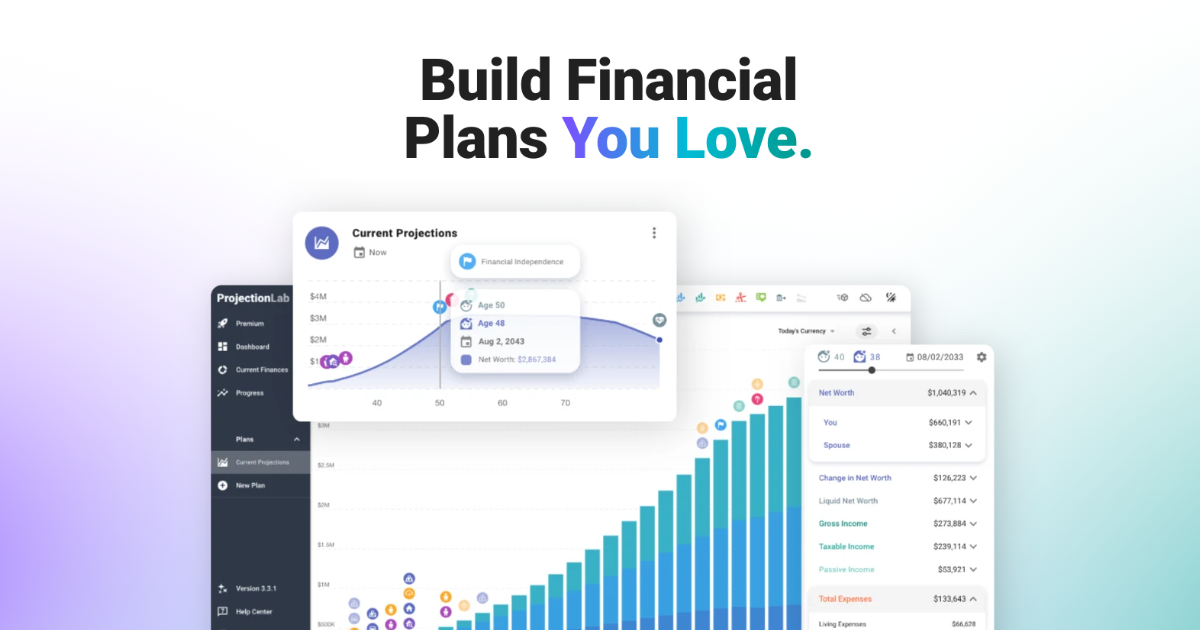
It seems like the "Stacked Financial Breakdown" chart actually _adds_ your level of debt on as just another stacked layer, as if it were an asset.
I don't think that makes much sense - with this representation, if next year I take on $1M of debt to buy $1M in assets, then my financial breakdown curve jumps by $2M.
Ideally you'd subtract off debt so that you could easily read off net worth from the chart, but that's not easily compatible with a stacked-chart representation (I don't know how you'd visually represent "negative stacks").
I'd suggest instead you just take debt off that chart, which would make you at least able to read off "total assets under management" from it.
My main product design point here is that in a stacked chart like this, you want the summed line to have _some_ meaning - since the summed level is the most prominent feature of this type of graphic.
Here, as you're summing assets together with debt, it makes the sum meaningless - which is a flag that this visualisation isn't suited to the data you're putting into it. I think the simplest fix to this (without coming up with some new more complex visualisation) is just to lop off the debt. In your current product model, that might mean just making it unticked by default.
Assuming you were evolving this product longer term, I'd reckon it'll be important at some stage to visualise both positive and negative quantities. Maybe something like a two-side stacked chart? https://www.anychart.com/products/anychart/gallery/Column_Ch...
Lastly I like how it eases the user in: it asks basics, then funnels to specifics. That makes it less intimidating.
Sorry to be "that guy" but I've been using my Excel for ~30 years and it has been solid so I doubt I would use this, but I think it might be a great starting point for youngin's who haven't thought about this yet.
https://news.ycombinator.com/newsguidelines.html
https://news.ycombinator.com/newsfaq.html
The HN community considers it spamming and guards its integrity rather zealously.
My suggestion: have the users start with the big hitters (house, income, savings) and then add more and more. Users could see the model change as they go and the onboarding process itself would become informative as they see the effect of their various assets, 401Ks, asset sales plans, etc.
You also really need monte carlo simulation to elevate this far above 'pretty version of my excel spreadsheet' into 'powerful financial planning tool' category.
Lastly, there is one always overlooked part of retirement planning which is that spending plans should not be set-in-stone. For example, if you plug "spend X per year" into a monte-cargo retirement calculator to get a 95% chance of not running out of money you will need to have a lot. But, if you are willing to adopt a spending policy of 'spend X per year unless there is a stock market crash, in which case spend .75X for three years' you will need a lot less. If you are willing to modulate your spending in response to events you can be comfortable with a lot less.
You're spot-on about the need for Monte Carlo simulations. A robust Monte Carlo mode with a variety of variables you can control is the next development priority.
And great point on flexible expense plans. I'll consider how to build some (hopefully) intuitive UI widgets to allow for that in the Monte Carlo mode.
* Not being able to save progress after you enter all of it is devious, but really turned me off. I don't just dislike it. It might be the one thing to permanently turn me off from the tool. I just spent 20 minutes adding all my info, and now you want to hold me hostage, unless I get a subscription? How dare you. (hyperbole, but I'm feeling sassy)
* Why should I care about the theme so soon ?
* No, I am not paying for a financial management tool until I have at least tried it out for 3 months.
* If everything else is absolutes, I would keep 401k as absolute too. (Also just call it 401k)
* On the same note, is my employer matching 50% of my contributions or 50% of my income ?
* It makes no sense to make the landing page the 'what is projectfi' blog page instead of the 'Official plan' page
* It makes no sense to open 'where you are today' instead of 'official plan' when I click on my account
* I won't pay $30/year even if I liked it. The tool is a one-and-done sort of thing, and I would be more down for an upfront price. I might pay $30 to buy it up front if I get to use it 1 year for free and see if I like it. I would accept a shorter timeline for other apps, but sadly my financial information just doesn't change fast enough and I would need 1 year before I recognize if I find it useful enough.
* If I am using it long term, I don't want to rely on someone's server staying up. Can you offer this as a client-side app ?
* Feature request - Export to Excel
________
OP, I hope you don't take this harshly.
I genuinely like the tool ,and the only reason I agreed to write such a huge review of it is because I'd like to see it get good. Best of luck, you might just get me as a customer if it was a purely offline app with excel exports with a one-time fee.
What’s the point of a “free” financial planning tool that needs 20 min of input that you can’t save? Too much friction! At least give me a fully featured trial, or can track 1 goal, etc
Mortgage details are likely to be the dominant term for homeowners, so seems like this one would be important to fix. Plus mortgage interest compounding calculations are pretty opaque to most people, so it would help with explaining different structures (e.g. ARM vs. fixed vs interest-only, what portion of your payment is going to principal vs. interest over time, etc.).
I had wealth management review recently and they used a 3rd party piece of software that was doing something similar, their entire pitch revolved around this app.
What you really need to have is a demo setup so I can just play with the output without having to input any data.
Also concerned about sharing this much personal detail with a start-up so I would not use it unfortunately as it is (at least with real data)
(Also Delete is disabled on that debt, so I cannot go back and change that.)
EDIT: OK I started over and see that it specifies that Debt is "not associated with a specific asset."
Later Debt seems to become "Expenses" which is a little confusing. Not big complaints, just trying to make sense of it.
Similar confusion with the plan, where it asked for a payment amount for the mortgage, but then wanted it again as a payoff plan? This was even though I unchecked Pay Off As Soon As Possible? What's going on here? It's confusing.
Also it seems like excess salary is going into cash savings, not taxable investments OR tax-advantages accounts. That is severely limiting growth in the projections. <-- No I was partially wrong, it's just that it has my mortgage payment in twice as I mentioned previously due to the confusing wizard. So my expenses were way higher and the investment amount was reduced. But even removing that my "Cash" at the end of the period of income is massive; it should be putting "cash" into investments.
I'm not saying this isn't a better solution than Excel. You work with what's available at the time. But there is nothing at all about the size of the data or complexity of the calculations that requires it to be centrally hosted. This is financial data and you're not a bank with reporting and privacy requirements being audited by state charter associations and federal law enforcement. No reason for people to trust you with this data. Make this an executable someone can put on their own machine. Don't require a network connection. Don't send telemetry.
Like Frost1x, though, maybe I'm just a minority and you don't need my business. Ultimately, do what the market will tolerate, I guess.
The web site looks great, and I sincerely appreciate the courage and vulnerability it takes to throw one's project to the "Show HN wolves," but I have to agree that this needs to be a native application (that I can demonstrably run with the network plug disconnected) for me to touch it with real financial information. It also needs to be "better than old-school desktop Quicken" for its use case, in order to un-sticky me from that application and migrate my 20+ years of data from it.
The problem is that everyone making something like this wants to have at least seven zeros in their bank account when they cash out after 5-10 years - selling licenses to a desktop app doesn't get you that.
He's not asking for your SSN or your address. If you want to use a burner email and a VPN or enter fake data to try it out, you can. This hardline approach of "every service should be an open source desktop app that I can run with zero telemetry from my cabin in the woods with no internet" so often found on HN is clearly not the opinion of the majority of internet users.
They're asking for even worse - all your historical financial data. Why would you want to give some random guy on the internet that?
I just played around with the site myself and I didn't see anywhere that it imports data, plus the tagline on the homepage says "never ask to link your financial accounts"?
Isn't this essentially the same risk profile as like FIREcalc [1], or the NYT Rent or Buy calculator [2], or some portfolio analysis tool [3], are you saying that those shouldn't be online calculators either?
[2] https://www.nytimes.com/interactive/2014/upshot/buy-rent-cal...
I was pretty impressed with the depth of detail as well, and one thing this seems to have better tooling for than my manual sheet is for tax treatment and long term tracking there
Two bugs/issues I found:
1. I couldn't tell if inflation was applied in future years at all. Despite selecting an increase in income and inflation matched expenses, neither seemed to be reflected when I selected the future year.
2. Setting 401K by percentage caused lots of issues as it allowed me to go over the IRS limit. I just wanted to set it by amount and be done with it! Would be good to have options to allocate savings like that as well as by percentage.
Honestly, this is really intriguing for me as I've covered a lot of these cases and as a developer I've thought about the UI/UX for this but basically have always thought that the edge cases were so vast that it would be hard to get users while also making sa reasonable UX. Truly, using this changed my mind and this seems like something that could be possible. I'm not sure what your team size is and I have limited time, but I'd be interested in talking and seeing if there's any way to contribute / help here! Feel free to contact me @gmail or via my bio's website contact form if you're at all interested in that!
For #1 is it possible that you haven't yet factored in that values in the simulation are adjusted to be in today's dollars? i.e. expenses that match inflation exactly would show as the same value each year.
For #2, I'd be happy to help troubleshoot if you want to send a message to projectifi.io@gmail.com. There is existing logic that should be capping your 401k contributions at the IRS limit. But if you have a scenario where this isn't behaving correctly, I'll gladly look into it.
Thanks for the comments! And currently "team size" is one haha. At the moment I don't have plans to bring on additional staff and deal with the business complications that adds, but I really appreciate the thoughtful commentary and if you'd like to have any more discussion feel free to email any time.
Beyond that feedback, I think this looks really interesting and would love to see where it goes.
https://www.nytimes.com/2020/08/25/realestate/blacks-minorit...
https://www.cnbc.com/2020/08/19/lenders-deny-mortgages-for-b...
https://www.shrm.org/resourcesandtools/hr-topics/compensatio...
Contrary to many other commenters here, I don't mind that this is a hosted service. In fact, I _don't_ want to download an application for this. If users are concerned they can just use a burner email address.
Edit: somehow ctrl+f privacy gave me 0 hits (maybe I started typing before the page loaded fully? Not sure, but I did look), just noticed when actually starting to read the comments that something similar is also the top comment, sorry for being (at least partially) redundant.
For "Financial Goals", allow me to opt set a fixed number, not just a percentage of income (i.e, if I want to max out my 401k).
When inputting investments, instead of having a field for the sum of the different categories, have line items, so I can add my copy/paste my 401k, IRA, etc into the website without having to add them up myself.
Great work!
I realize that part of the problem is that it's hard for my brain to extrapolate a few months of observations into a decades-long trendline, but I really would love to see a product that helps my brain bridge the gap between my own perception and the big money chart.
My first 5 years of full time employment with a salary, I was making enough to live comfortably and contribute to a 401K, and finances and investing aren't inherently interesting to me, so I didn't really think too much about the money accumulating in my savings account. The money definitely lost value over those 5 years because of inflation. I finally figured out how to put money into ETFs, and 5 years later that same amount of money has at least doubled in value. A lot of that probably has to do with the economy being crazy, but I suspect I missed out on a lot of compound growth not investing those savings initially. That is to say, my savings over time didn't look like a "PERT" plot until I took concrete steps (and the associated risks) to invest in the market.
Not to say that sitting on money or being slow to invest in higher growth accounts is good or bad. There's risk and everyone has their own personal risk tolerance, and diversification is important. If all you have is $5000, dumping it all into the stock market would seem pretty risky and perhaps foolish. That $5000 sitting in a checking or savings account is losing value over time rather than growing, though.
I suppose that could be another example of it being easier to live frugally when you have money, i.e. buying a $100 pair vs. $20 pair of work boots. On the other hand, many folk with very little savings still seem to find a way to buy luxuries like iphones and vacations. In addition to luck, personal discipline and sacrifice must factor in to some degree when it comes to achieving a financial goal.
That's probably why people serious about their money consult a professional, who has hopefully historical data at hand and in his head, who produces a forecast, each year, that is very tailored to the person, the person's personality, habits, job industry and many other important factors that a financial planer coded with if and else, avg and linear projection etc can't match. Maybe machine learning can get decent results of training properly on very good data sets.
And about most planners showing we will be millionaire in a few years, I'm tempted to say it's for the exact same reason demo data and screenshots for a CRM or analytics system always tend to display over optimist income/sales.
I like the idea of plans but they feel a bit bulky to use and you can't compare them. If you could directly compare plans against each other I think I would find it more useful. Also making them faster to create could be nice. I can change all the defaults in the actual view so why force me to go through the pages?
I do like the stacked breakdown of each plan and the behind the scenes calculation of taxes, investing and inflation.
[0]: https://gist.github.com/Rafael09ED/61568afa8a2308b53917915ee...
One thing I _always_ look for in a SAAS is a "pricing" page, because prices are all over the map on these sorts of things and I want to know if I think the price is reasonable before I jump in.
I guess partly this is just because I'm still 30+ years from retirement, but does anyone have any advice on how to account for the incredibly wide range of possible outcomes based entirely on factors that are impossible to accurately predict?
The thing to remember is that if you are somehow wealthy beyond need, you can just retire. You don't have to keep working if you're financially stable earlier than expected.
My point was that user to whom I replied seems to be using it in a generally negative way.
> looks interesting but I think it is still a little bespoke
As if "bespoke" is the opposite of "interesting" or othwerwise a counterpoint to a good review. As I understand the word "bespoke", it carries no negative nor positive charge - just means "made individually to order", which seems irrelevant to this app.
Few pieces of feedback:
1. It would be helpful to be able to visualize how property tax is effecting the reduction in other assets.
2. It would be nice to be able to use arrows to move the retirement age up and down and watch the scenario change. Currently having to click on the box, edit the age, and then click out is cumbersome.
3. It would be nice to be able to easily click on and off the income/expenses/other/goals in the bottom so that there would be a quick way to see how each of them (or combinations of them together) effects the scenario.
It sounds like you found one method that creates some measure of happiness for you, right now. Will anything in your future change the variables so that you have to adapt? What will your options be then?
Now, your premise here is "so much focused" or to reword, "intently focused" on growing wealth for the purposes of financial independence. If you start with that premise, there might a a corresponding decrease or minimization of competing focuses, including "what makes you happy in the present."
If you shift the premise a bit to more of a Pareto Principle approach of "do at least the 20% you need to plan for your future, and get 80% of the benefit", you might see things a little differently. Extremes don't make for good arguments, but they can be illustrative. If you feel like you have to spend "everything" you have, and invest "nothing" then any break in your income stream will instantly crush everything that you currently use to make you happy. If, on the other hand, you find that you can be really quite happy while spending 75% and investing the other 25%, you might find that over time, you've been happy all along, and you've gained a resilience to changing life circumstances as well, and increased your options for what you are required to do, and what you can choose to do.
As for just "investing" or "not investing", the common wisdom is that simple savings will tend to lose value when adjusted for inflation. You do not need to become "busy with cryptos" to invest, though. You can simply think long-term, buy broad total market index funds, and stop thinking about those investments almost instantly. It does not take focus. You don't have to go all the way down the rabbit hole to intently focus on what you might consider absolutely optimizing your investments. It's quite unlikely to pay off, so take a simpler path.
"It's Not What You Make that Matters; It's What You Save." - Somebody
However we live in a world where you need to invest at least a little bit. If you can spend 15 minutes at the start of each new job setting up your 401k to 15-20% of your salary, in a target-date fund, you will never have to think about investing ever again.
I'd love to see a little more flexibility in putting some kinds of numbers in, especially as someone not great with understanding financial data. For instance, I'm currently plugging numbers in about my mortgage. I know how much I currently pay per year in homeowner's insurance, but ProjectFi is asking me for the annual rate. I divided what I'm paying per year by the current estimated market value and got 0.3%... but I'm sure that's not accurate.
two features i'd like to see off the top of my head
* i know privacy is important for a lot of folks -- but it would be cool if graphs / plans were shareable. I'm interested what the rest of you are up to :)
* action items for how to steer your current plan to a "better" plan. The app is currently like a hand-held map that shows me the lay of the land, but I want google maps which recommends ideal routes.
Heck, I'd pay for a secure little RPi in a box running this software.
I can't give my financial passwords to anyone else at all - most of my accounts specifically disclaim any responsibility for losses if I give my passwords out.
One feature request: spouses / joint incomes. Obviously my financial picture looks very different if I include my partner's income and assets than if I just include my own, but my partner is a different age than me, so if I just add it up and act like I'm one person who makes our combined household income, it's not going to be quite accurate.
I second multiple currencies, I'm in NZ and would love the tax and stuff to work itself automatically but appreciate the enourmous overheads for doing that.
Found a bug: changing the "Maximum Value" field for a house affects all other houses.
nice job overall...
Also maybe add a url-save feature like firecalc to the free version?
*edit: I found it, you have to add monthly savings or investments into your Financial Goals
Currently the gold standard for this kind of FI simulation is OnTrajectory. There’s a learning curve but it’s so much more comprehensive than any spreadsheet you could build. I consult it every time I make a big decision.
Get in touch with your email and I can provide a referral link.
When talking to friends, I realised that even smart and relatively wealthy people have zero planning skills and freak out about the idea of "planning your life in the next decades".
I suspect your market is going to be small.
When I set it to 0, I'm paying the mortgage way faster than should be possible, when I set it to anything meaningful, I'm bankrupt in one year!
Edit: Hm, seems like sometimes it's a pair of handcuffs, and other times it's a more innocuous iron weight.
I hear Excel, but one needs also to know how an what to compute. Any books/guides in that sense?
>"Note: currently, ProjectiFi taxes inheritance as ordinary income for simplicity and to maintain a conservative estimation strategy. More nuanced options that more closely mirror current inheritance tax liability scenarios are coming soon."
This is an absolutely ridiculous assumption. Federal inheritance/estate taxes in the US don't start until $11 million. If you can't figure that out your app is not ready to publish.
Most developers want to build features that service the majority, then add more functionality later.