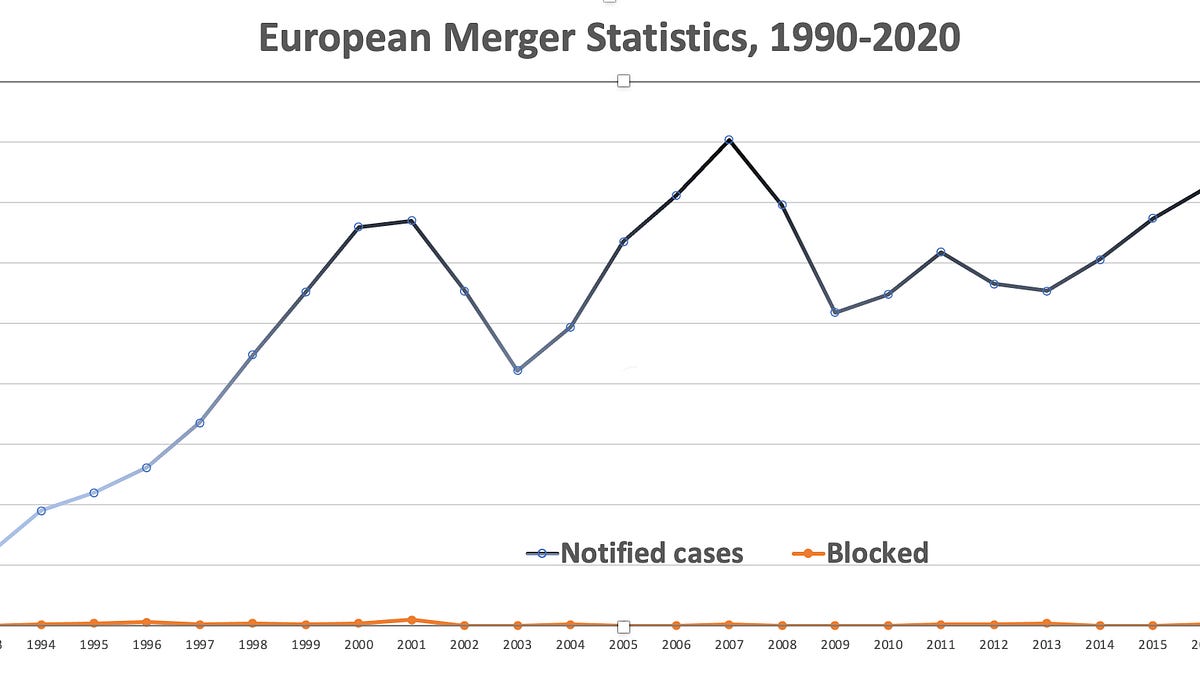
The European System of Monopoly
. . . and how to fix it
thecounterbalance.substack.com
24 points · by null_object · 5y ago · 14 comments
The legalism are pretty awful. You're hung by nation state courts, and pan European law, and jurisdiction in the contract outside Europe, and WTO. It's hardly light touch.
I had the privilege of visiting the OECD once, and sat in on a meeting as an observer. It's sausage factory stuff. Remember "europe" as we see it was borne from the ashes of a war, over markets and growth and was borne to try and unify coal and steel. What followed is a function of time and circumstances. It's quite organic, unplanned in some ways: i think we see that in stuff like the European parliament divergences on privacy, and ipr against the secretariats view.
This is basically untrue. Economies of scale are a major thing when you compare very small entities to medium sized entities.
Suppose you have a five person company and a fixed expense of a hundred thousand dollars, e.g. for regulatory compliance. That expense is $20,000 per employee. Quite inefficient. A 50 person company with the same fixed expense is paying only $2000 per employee. Significant reduction. But by 5000 employees it's only $20 and the benefit of going from 5000 to 50,000 is insignificant.
In many cases the benefit phases out entirely. If you have to build a factory which a small company only utilizes to 20% capacity, a medium company that can use it to 100% capacity is five times more efficient. But a large company can't use it to >100% capacity, they have to build multiple factories and stay at the same level of efficiency as the medium sized company.
Moreover, monopolies get full of inefficiencies because they lack competitive pressure to eliminate waste. Having two dozen companies in an industry is often more efficient than having a thousand, but having two dozen companies is also generally more efficient than having only one.
The reason so many industries end up "between two and ten" is that that's the point when antitrust authorities start to reject additional mergers, not because there is any inherent advantage in having so few competitors. If anything that's few enough to start having trouble because they start colluding or using conscious parallelism to bring about de facto price fixing etc.
Two separate companies are not allowed to coordinate the prices of their products. We derogate this behavior as "price fixing".
If the same company sells two different products, it is of course allowed to coordinate their prices.
We have many rules such as this, where mergers give companies capabilities that we have artificially suppressed in their smaller, less monolithic competitors.
Monopoly utility companies generally have price regulations because otherwise the monopolist would charge the monopoly price. The monopoly price is inefficient because it results in significantly less production (because of the high price deterring consumption) than would take place in a competitive market.
Allowing collusion across an industry is nothing more than bringing about an informal monopoly rather than a formal one.
I don’t know, what would the price of food be if unicorns were real? Who cares; this is not a realistic scenario. Defection is handsomely rewarded in almost any realistic market, outside of a few narrow cases that have extra physical constraints (e.g. power and water delivery).
But also, what you're describing is already what happens in more consolidated markets that can coordinate without formal contracts enforced by the government, because defection isn't profitable if you expect the incumbent competitors to respond in kind.