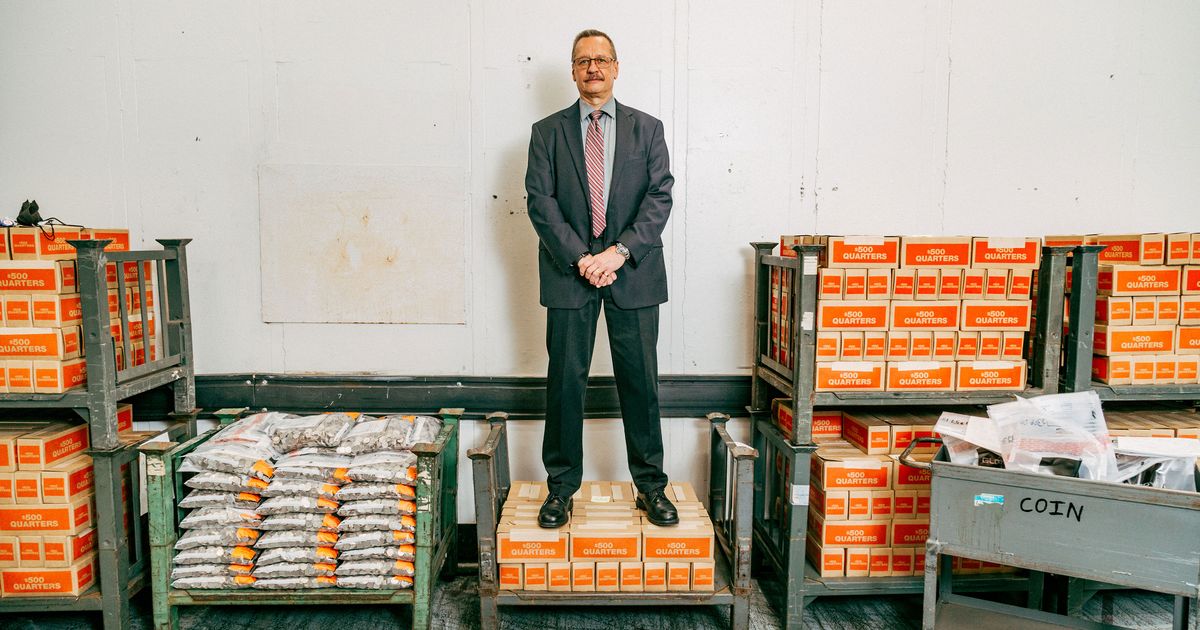
The Man in the MTA’s Money Room
Armored cars, pocketless uniforms, coin-sucking vacuums: Al Putre, who counts $1.5 billion a year, lets us inside.
Curbed
105 points · by js2 · 5y ago · 49 comments
Al Putre is a guy with a friendly smile, a classic New York accent, and is not afraid to show you he's always carrying a revolver.
Oh, and a hatred of the dollar bill.
edit: formatting
The Canadian in me was very disappointed.
And as a Canadian, I thought you'd be used to dollar coins ;) . The USA is pretty much the only developed country that uses bills for amounts that small-- which is a thorn in the side of the cash operation of places like NYC Transit.
This seems great from a sentimental standpoint but perhaps it's part of the problem with the MTA in general. You don't want the same people with the same ideas for decades. That's how you end up with government agencies running IBM mainframes in 2021, which this guy seems to say as a point of pride rather than shame.
Edit: Not that running an IBM mainframe itself is necessarily shameful (although the default certainly leans that direction). But as others pointed out this guy purchased expensive-to-maintain systems at the tail end of their life with seemingly little or no regard to how it affected the users as opposed to just how easy it was for the operating agency. Not exactly something to celebrate.
Is there some other option for people who have only cash?
Besides, I thought it was established a few months into the pandemic that fomites[1] are not a likely route of transmission for coronavirus.
[1] An object like a doorknob that may be contaminated with infectious agents (such as bacteria or viruses) and serve in their transmission.
You are correct that fomite transmission appears to be fairly rare, it's hard to be sure exactly how rare, but New Zealand, which has few enough COVID-19 cases to actually care about the finer details (they're headline news!), has two cases which they originally suspected were fomite transmission but now think were as likely droplet suspension in the air. A person who boarded an elevator that had been used by an infected person got the virus, but perhaps there were droplets left in the air of the elevator cabin for a few minutes, and a person who used the same trash can as an infected person also contracted the virus, again perhaps instead of fomite transmission via the trash can the shared area where it was located somehow still had the suspended droplets.
The virus has been shown to last for three days on bank notes (see below), though how easy it is to catch from the notes isn’t mentioned. If my job involved touching bank notes from NY public transport last year, I’d sure as hell have been nervous, as small chances presumably add up. Those machines appear to move fast too, so maybe airborne spread could be possible?
> [Al Putre] firmly defends the MetroCard system and its awkward swipe, on the grounds that it was far easier to maintain and thus cheaper than its alternatives: ”We got a lot out of that — the technology is 25 years old, and we’re still running it on an IBM mainframe.”
Why is swiping considered awkward? I lived in NYC for several years and never had much of problem with it. Every now and then you have to re-swipe, but not often enough for it to be a major inconvenience.
It's also one of those UI things that may not be perfect, but because people adapt to it, it doesn't need reworking. Like QWERTY, or Amazon.com. In fact a rework may even be counterproductive, and certainly expensive.
This is of course cut to only show failures. But, e.g., in Boston, the MBTA uses RFID cards. One big benefit is that I don't have to take the card out of my wallet: I only need to pull the wallet out of my pocket, and tap the entire thing against the sensor — it can read the card through the wallet.
I'd wager it's easier than that swipe. Probably lasts longer, as there isn't any physical contact.
(Now, the MBTA also still has a paper-card variant, and that isn't RFID: you have to feed the card through the machine. Tourists might encounter that, but the locals use RFID cards.)
Similarly, Caltrain in the Bay Area uses similar cards. (Not quite as nice, though, to reload…)
It's not like MTA decided to go with swipe at the same time that everyone else decided to go with contact list. MTA started using swipe cards in 1993 - contact-less cards didn't start reaching widespread use until the 2000s. The costs of switching systems twice in like 10-15 years would have been probably not the best.
In a lot of ways, MTA sticking with swipe (till now) is a lot like the story of NYC in the 20th century. Through NYC scale, it runs into a lot of situations first, and goes with some solution that ends up being totally what no one else decides on using when they reach NYC scale (either due to lessons learned from NYC, or just improvements in technology or knowledge).
- Your phone (or watch) can act as an RFID transit card, even when it’s out of battery. (Using apple’s transit card program)
- Any terminal can accept mobile wallets
Maybe as a permanent resident, the difference isn’t quite as big compared to typical RFID cards — just one less thing to carry. But when someone visits, it’s so convenient to not have to acquire a transit card and load it up, or buy tickets, or download an app, or acquire cash or coins. Most other cities (in the US), it’s a whole ordeal to figure out exactly how to pay for the transit system, where to buy the cards, it’s different everywhere, etc. But in Portland, all you need to know is that the terminals accept Apple Pay in any bus or train, and you’re good to go. It’s fantastic! I wish other cities would adopt these sorts of terminals. It makes public transit much more appealing especially as a visitor.
I also much prefer the sliding gates rather than the turn-style, but that's a different consideration.
Also with regards to cost, I bet they would make a significant amount of the investment back with increased fare-paying if they did the sliding door style gate (that much harder to jump over) and the contactless entry (that much easier to pay for it).
It's not going to improve payment, people who don't want to pay won't pay. The ROI on completely redoing turnstiles also probably wouldn't be great for the same reason. People hold the emergency door after all, and I don't see how a sliding gate can't just be kept open by shuffling in after someone else (the gate won't close with an obstruction right?)
The upgrade to the NYC system is mainly so that it can introduce distance based pricing but nobody is willing to say this bit out loud.
Furthermore, I would argue that the cards are shaped incorrectly--the cut edge of the card is on the trailing edge of the swipe, which seems unintuitively for something meant to be pushed forwards.
RFID solutions are just vastly superior. Go to Tokyo and ride around the trains there. You can hover your card over the reader, tap your phone, your watch, whatever, and it reads it reliably 99.9% of the time (another made up fact but yeah, it's reliable).
WMATA in DC would introduce a smartcard in 1999, so New York mostly bought a technology at the tail end of its life and had to pay the increasing costs of maintaining it.