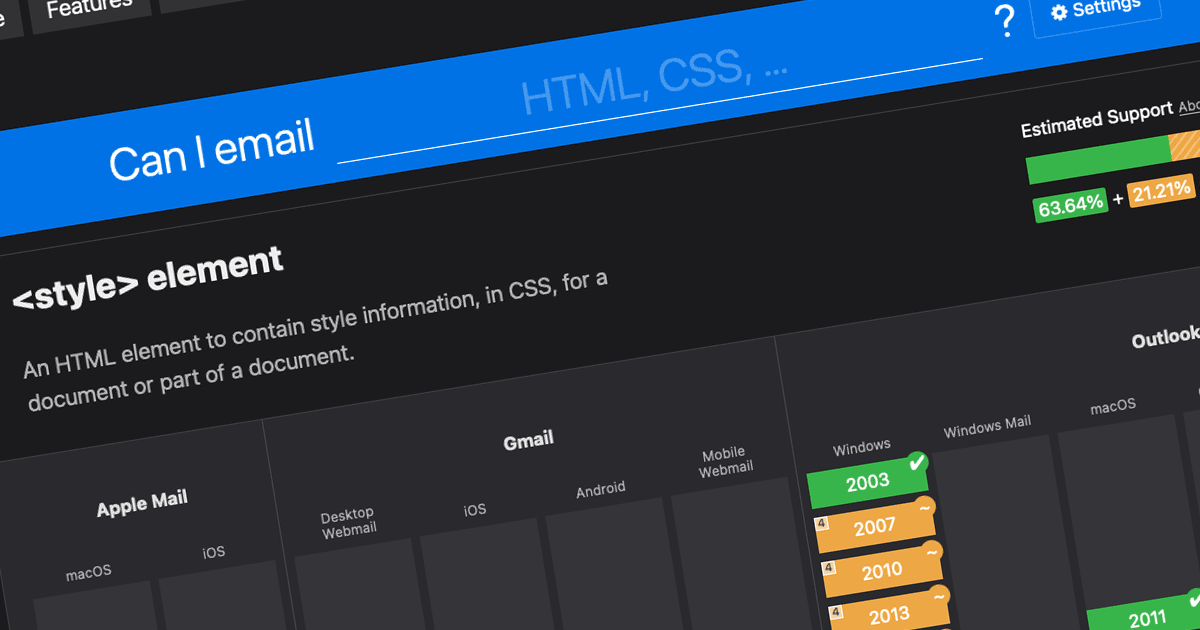
Can I email…
Support tables for HTML and CSS in emails
caniemail.com
682 points · by ggregoire · 5y ago · 273 comments
This is actually a great tool to find vulnerabilities in various webmail clients such as ProtonMail and Hey, just compare the HTML or CSS features they do not yet filter compared to Gmail, then do a search for "[feature] + exploit" to see how a feature could be abused, and then submit a bounty report.
For example, there are alot of good reasons that you may not want your webmail rendering SVG images (mXSS, appcache poisoning) or allowing CSS variables or imports.
And I'm pretty sure the list supported by Gmail could also be narrowed down further. There are some fantastic bounties lurking in here, just waiting to be discovered.
And sites with strong CSPs are often especially vulnerable to scriptless attacks, perhaps because they feel more protected. For example, in 2019, there was a bug bounty disclosure to Fastmail about a way to intercept and proxy all email attachment downloads, completely client-side, and yet without involving any JavaScript, simply using HTML5 AppCache. This also affected a whole lot of other providers, but the Fastmail team patched this within 24 hours, a pretty amazing response, and the quickest by far.
Here's a fantastic paper from Mario Heiderich (of Cure53) from 2012 on various kinds of scriptless attacks: https://citeseerx.ist.psu.edu/viewdoc/download?doi=10.1.1.46...
Those nth-child* selectors Gmail strips out are a real security nightmare.
No thanks. I still recoil at the sight of a read-receipt and the only reason most companies include any of this dreck in an email in 2021 is to either track me or market to me.
make email text again.
That ship sailed the instant it got named "email" instead of something like "etelegram".
With mail, I can send anything that my printer can print, which is everything my word processor can handle (fonts, text decoration, foreground and background colors, inline images, graphs, tables, and more) and attach anything that fits in the envelope (a CD-ROM of arbitrary data in any format).
It was inevitable that email would end up being able to handle the electronic equivalent of all those things.
The problem with email is not that it now handles more than just plain text. The problem is that there was no early agreement on how to handle those things, so different implementors came up with different ways to do it, which eventually converged on using HTML. Not because HTML was necessarily the best way to do it, but because it was something they all already implemented for other things or was already available on the systems their mail clients ran on.
But modern HTML engines are designed for the web, so there still really needs to be some sort of agreement on a subset of HTML that handles the things necessary to make email like mail, without including things that make sense for the web but not for mail.
What would you think only makes sense for the web and not for mail?
Good email clients already provide a very simple solution: a user option to disable loading remote content, with a per-message option to load it.
Your suggestion would mean that my mail client has to download a ridiculously larger volume of data than it does now.
Sure, I'd love to only send txt mails but that sadly does not align with the expectations/desires of the companies I've worked with.
WYSIWYG editors and rendering engines aren't things I know about so I wonder if there have been difficult engineering issues at that time or if they just went at it from a business standpoint of "people see mail like letters so they are documents for which we have word so let's use that".
//Edit: Looks like they were mainly interested in providing a great WYSIWYG experience using tools users are already familiar with: https://web.archive.org/web/20110311083708/http:/blogs.offic... great quote: "There is no widely-recognized consensus in the industry about what subset of HTML is appropriate for use in e-mail for interoperability. The “Email Standards Project” does not represent a sanctioned standard or an industry consensus in this area. Should such a consensus arise, we will of course work with other e-mail vendors to provide rich support in our products." - I guess their argument could be that there still is no "HTML standard for email" so they don't have to support anything they don't want to?
And from that perspective, it's better to break the mail as it's coming in (so the sender gets blamed) rather than at the moment the user clicks reply.
You can load plain HTML as a .eml template into it and send it off... but not on Windows, you're stuck with some weird undocumented binary format there.
Send me plain text email.
Add attachments that I can scan for issues before I open them.
If you send me links, I will be very wary of visiting them outside a sandboxed tab. I will not 'click through' from the email client.
I got a link to re-up a certain type of account from my bank. It was very odd, I was quite confused.
I customized them, extracted them into modules and created a design system which I then translated to an email CMS.
Coverage is pretty good although Outlook still glitches in some circumstances.
https://tedgoas.github.io/Cerberus/
FWIW caniemail is unreliable and does not have full coverage.
Also with this level of complexity I’d rather start with a few tested patterns than navigate the insane labyrinth of email client inconsistencies.
I made what they wanted with MJML. Looked good in a browser, gmail and phone.
Outlook had a few issues, can't remember which right now.
But replying from Outlook simply broke the styling completely. Gaps between each section, complete mess. Not the impression you want to give the customers when their order goes wrong. B2B means Outlook is what out customers use.
I've found that replying via Outlook is the ultimate integrity test of an eamil.
Now I'm making them by hand and it is a madening cargo cult bonanza. Takes a lot of time.
I guess MJML is fine for marketing.
This is an Outlook problem, not an MJML or even an HTML problem.
If you inspect the HTML for the email sent vs what Outlook sends on a reply you’ll see it has changed the code.
Here’s an excellent highlight of this bug https://www.hteumeuleu.com/2016/super-mail-forward-an-email-...
This is a problem area where a good abstraction framework is highly useful in my opinion.
That said I don’t specialise in email, it’s something I do “when I need to”. So if I was spending more time doing this sort thing, I might be more inclined to move down an abstraction level back to HTML/CSS and improve my knowledge of various client support.
To just get the job done though, MJML is highly recommended.
I see also a lot of mentions on this thread about replying to emails breaking the layout. Part of me thinks we’re fighting a losing battle here anyway so there is a limit to how much time it’s worth spending to make sure even replies are formatted nicely across all clients. But the other thing to consider is whether the email template is just trying to do too much.
I try and keep my email templates very sparse, clean and simple and I generally haven’t had too many issues with reply/forward formatting (that I’m aware of).
I’m not interested in learning MJML. I’m interested in learning what subset of HTML and CSS email clients render and rasterize to.
That’s it.
I’m sick of stupid developers shilling their software product that I’m suppose to build other products with.
They do it with these cutesy photoshop/illustrator logos and dribbble crafted color schemes and drop in things like made with love in (city) in their README.mds on GitHub.
I want tools, not someone’s amateur marketing campaign.
Doesn't sound like you want a framework. Sounds like you want a book.
It’s also easy to teach to designers.
You can use Table and all its related fields, span, h_, and p. Anything else is risky.
For CSS you can set the font color and size. Setting a font itself is risky. Avoid using anything else including margins and padding as these largely don't work properly. multi layered tables are your margin and padding system. You also can only use inline styles. No classes, style tags or linked styles.
Thats about it for email. Have fun.
I suppose "Your mail program is broken and can't read our message. Please go to this URL" is worse, though.
Settings → Preferences → Show advanced preferences → Reading → View HTML, select Always display messages in plain text.
Settings → Preferences → Show advanced preferences → Compose & Reply → Compose format, select Plain text, plus untick When replying, use the same format as the original message.
I don’t think this is such a rare feature, though it’s generally not made obvious at least.
What I mean is I wish companies would send their transactional emails and newsletters in plaintext. Images and the like could be sent as attachments, as opposed to creepy weblinks that track your opens and IP and everything.
I would pay each company $0.10 if they offered me the option of receiving all their emails in plaintext like this.
And you'd also need to be able to somehow force them to <<only>> monetize you through direct payment, because what most companies do is, take your money <<and>> also sell your data, on top of that.
(Preferences -> Mail -> Composition -> Default method to compose messages: "Plain Text")
Can I Email: ‘Can I Use’ for email - https://news.ycombinator.com/item?id=20948826 - Sept 2019 (196 comments)
There are plenty of use cases for <li>/<h1>/<em> in emails, and with some nice default user styles they can give everyone a pleasant experience.
Sadly, CSS is often applied and the HTML people write is often broken.
I caved in and replaced mutt with Thunderbird personally. Not only for properly displaying HTML, but it was a big reason. Thunderbird sucks massively for composing plain text emails though, and no simple way to integrate an external editor...
Have you considered emacs with notmuch and the Gnus renderer? It displays most HTML emails well, and when it doesn’t then a browser is just a quick ‘. b’ away. And of course there’s no need to integrate an external editor, because it’s integrated within the editor!
As a plus, it is simply amazing how quickly one can search local email.
Please don't say "there shouldn't be formatted text in email." That's not a reasonable position.
RFC 1896 specifies text/enriched: https://datatracker.ietf.org/doc/html/rfc1896
And of course nowadays there is Markdown, which basically codifies a lot of earlier plain-text formatting conventions.
> Please don't say "there shouldn't be formatted text in email." That's not a reasonable position.
I don’t know about that, really. We got by fine with plain text messages for decades, and the formatting conventions were good enough to convey meaning and nuance.
Once email was in wide use by the general public, easy formatting was inevitable. HTML was everywhere, and so was the path of least resistance.
I thought it awful at the time, but "at the time" was literally more than two decades ago. HTML email is fine. MOST mail I get, professionally, has some formatting in it now. MOST mail I send probably does, too, to increase what a mentor of mine used to call "scan value."
Could I put all that in a Word doc and email THAT instead? Sure. But that would be a huge pain in the ass.
But don't put every keypress from my searches into my browser history.
Am I wrong with this assumption?
I also think, though, that any open source client likely does a good job regardless of feature density, since its likely going to use well vetted code in core components.
Saying that, for example, Microsoft's or Apple's code isnt well vetted is unfair, but the amount of eyes that have seen the Microsoft html renderer vs the, say, WebKit one, is likely smaller and less diverse.
This is specifically focused at HTML specs/features, and a fork of https://github.com/Fyrd/caniuse
Targeting HTML rendering engines which are email clients.
Fortunately (at least for some of the newer features to be included) Links to MDN are available, and caniuse both link to we spec). CSS min for example is working draft. https://www.w3.org/TR/css-values-4/#math-function
With 90% desktop/mobile browser general usage support, 50% email usage support.
The feature definitions seem to be maintained manually, at https://github.com/hteumeuleu/caniemail/tree/master/_feature...; assuming it follows the caniuse.com community model, information about supported browsers is similarly crowdsourced.
(And what about Linux?)
From my experience, all versions (Windows, macOS, Linux) have the same features.
These days, I disable Javascript on any site which has the audacity to put a popup in the middle of the page as I am reading it. Any site with is not readable without Javascript is one I leave and don’t go back to.
The kinds of sleazy outfits which do not honor unsubscribes are the kinds of places email providers are really good about black listing.
I think you need some example search b/c I was not sure how to use the tool at first.
We use MJML to ensure compatibility in all mail clients, which works fine. Although MJML is much less flexible than pure HTML.
That being said, I can see the usefulness of this tool for developers, I just wish people would rely more on plain text.
When they see a plain text email from a site they would be more likely to think they are being scammed than to be impressed at its simplicity and ability to display in the terminal.
When every website is hacking around broken table layouts to get them to render in outlook (essentially Word), something is wrong and should be fixed.
This is not an endorsement of the practice, just an observation.
Among this sea of garbage, there are rare islands of useful updates - like genuine newsletters I subscribed to, or email from my doctor about test results, or reminder from my bank that they are going to deduct that car payment, whether I like it or not, so there better be money there, etc. And of course Amazon shipping notifications! If all those need any HTML, then only the most rudimentary one.
Of course, if you asked a user whether they'd want to get ugly marketing spam or beautiful one, I guess they'd choose the beautiful one. But that's not the right thing to ask.
"Nicely designed" emails are things like flight confirmations, invoices, shipping notices, and that kind of transactional email. The common thread is that some entity with Real Money To Spend on a graphic designer is sending a (usually form) email to lots of people. Most spam outfits do not have those kinds of resources, especially since they need to change up their emails constantly to avoid spam filters.
The closest I would say that the "pretty" stuff gets to spam is newsletters and particularly political fundraising emails; I'm on a lot of political party lists after spending copious college free time working on campaigns.
Indeed. The number of HTML elements in an email scales pretty linearly with the probability of it being spam.
Plain text is almost 100% certain not spam.
Do they? Do they really like it? Did anyone actually asked? And no, A/B testing your design's capability to trick the user into paying you money isn't measuring whether they like it or not.
I have an alternative proposal: average user just accepts what they're given, because they have no other choice. Nobody listens to their opinion (again, tracking and telemetry is not the same as listening to people). Abusive designs and patterns are adopted industry-wide very quickly, so there's rarely an opportunity for the user to vote with their wallet - after all, they can't choose something that's not available in the first place. On top of that, the average user lacks the mental models and language to conceptualize what is wrong and how much better technology could be if it was slightly less abusive. All they can do is accept that computers are annoying, and casually complain about this to friends and family.
There's a reason the most popular media is video and images and the main social media platforms are practically platforms for sharing video and images.
The average person all over all the world is almost functionally illiterate (literacy level of a middle schooler or maybe high schooler, at best). They really, really don't want text. They'll only read as much as they have to, and they will definitely choose images over text if they can.
At the end of the day if you see another blob of text, you either skim through it looking for what matters or you just delete/archive it.
They could even hate it, but it just stands out for better and worst.
Oh yeah, they do like it and want it. That is why they use it. And yes, I talked with a guy who was literally like "I like the emails colorful and such, but we found through testing developers respond better to plain, so I send plain to them".
Sometimes we are the odd ones and that is ok.
Taste is generated. Cool trendy startups make "nicely designed" emails, users come to expect that. If scam emails looked "nicely designed" and Google sent emails in plaintext, the "nicely designed" emails would be considered untrustworthy. As a counterpoint, an "average user" wants software to work, and forcing every email client to parse HTML (which is far outside the scope of what an email client should do, especially with html as complex as it is today) often breaks things in unexpected ways.
In my opinion, html and plaintext are both inappropriate for email. HTML is far too complex, and plaintext is a bit too simple. I think a markdown-like syntax would be the best balance, but I'm pretty sure that ship has sailed.
As far as I know, only old (possibly pre-Tiger) Mail.app in Mac OS X used to produce it.
I've corresponded with others, also German, and they had the same preferences, even if not as explicitly stated as the examples in my other comment there.
This is no different from snail mail, where important communication is usually on standard white paper while ads are high quality prints on nice goossy paper.
And obviously, "average users" notice the pattern. Just like my father who almost trashed an important tax-related mail just because it looked too nice, he thought it was an ad.
So the "average user" prefer to see nice ads, I can get that. But what the average user really prefers no ads at all.
Or worse yet, when the plaintext alternative version is broken/incomplete.
I regularly receive mail where the plaintext alternative version has templating variable names instead of actual values, where the html version has the values.
Also, systems that send mail where the plaintext alternative version is only something along the lines of “Your email client does not support HTML. Please read this newsletter at” and then a link. But of course, my client can read html too, I just have it set to view the plaintext version by default.
One of these days I will probably just set it to always prefer the html version instead. I use mutt, with elinks taking care of html to plain text conversion. I’ve been running my mail server for years.
But anyways it might soon be time for me to switch to hosted mail. I have a provider in mind.
(If your client interprets them, then you're not actually asking for plain text anymore.)
https://web.archive.org/web/20160417105503/http://www.gnksa....
Remote images are a crime, break the ability to search ofline or keep a record of ones conversation but they have one key advantage for brands which is to spy on you.
The only non-web client I've used much in recent years is aerc, which is basically covered under "mutt" in this case.
- Plain Text Mode
and
- uBlock Origin Extension is available (that can block also embedded JS)
People underestimate the attack vector of emails. I'm glad those scammers haven't figured out (at least until now) how XSS could work in Gecko with XUL. Heap spraying could easily be a thing, given that MS Outlook also still uses their outdated rendering engine.
Unfortunately, desktop Outlook is miserable with HTML support [1]. In particular, code blocks and quotes become an unreadable mess. The only way that I've found to include readable code blocks is to copy from VS Code, which somehow has the magic HTML combination that Outlook understands.
Say you’re a webshop and a customer has signed up for you “newsletter” then you kinda need HTML emails to show your advertised product directly in an email client.
Email serves every type of business, yes more could be just text - but some will never be served by that format.
For the sake of presenting marketing (Logos). Disgusting. Wear a mask, write text.
You could specify "Content-type: text/markdown" if you want Markdown (although I don't know which email clients will understand that), although I think that plain text is OK.
I also dislike email newsletters or email discussion lists; either way, I would prefer NNTP.
Edit: i realize this comes off as snarky, sorry. It's meant as a joke. It's reasonable to say that its likely not popular enough.