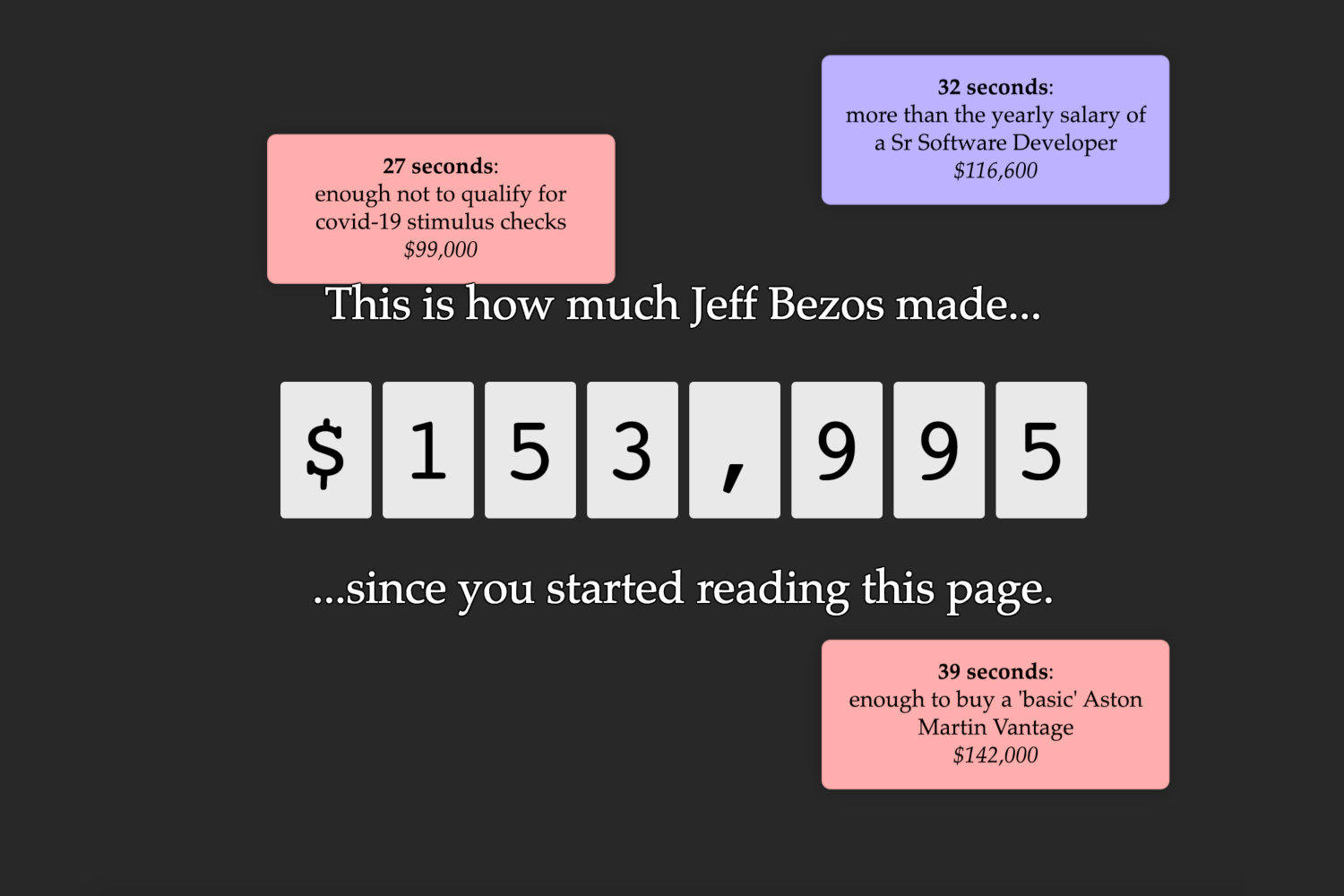
Bezos Earnings Calculator
See how much Jeff Bezos gained since you loaded the page.
bezoscalculator.com
30 points · by LouisLazaris · 5y ago · 27 comments
There is nothing immoral about this.
Where super wealth becomes a problem is when that wealth is used to influence policy. Effectively, the super-wealthy can choose to behave as unelected politicians. This is a problem.
Soros and the Open Society Foundations is an example of where this is manifest. He contributed $32 billion to fund the organization. His Open Society Foundation employs 1,150 professionals who promote his political agenda[1]. Whether you agree with his political agenda or not, Soros and I are both American citizens. We both have one vote. My influence in US politics should equal his. It does not. The only Americans who should have more political influence than I are those who have been elected or appointed to government positions.
Carlos Slim has owned 9-17% of the New York Times. Lauren Powell Jobs foundation owns the majority of The Atlantic. Bezos himself purchased the Washington Post. Perhaps these simply seemed like good investments, and I am certain that wealthy persons have owned media for centuries. But the unprecedented wealth of this century increases the potential influence the super wealthy can wield. This is a concern.
[0] https://www.cnbc.com/2018/11/07/billionaires-are-buying-medi...
[1] https://www.opensocietyfoundations.org/grants/past?page=2
In any case, money has always been able to buy political power. That's a big reason why wealth inequality leads to political instability.
The term "make money" is overloaded, and refers to several entirely distinct activities that share only the units in which they are denominated.
This is independent of how you feel about Bezos, or billionaires in general.
Most of this is just what's called "paper gains", which are not actually cash in the bank. So the little cards popping up behind mentioning how this is equivalent to someone's income are somewhat nonsensical. It's not even the same sort of income.
Really, all stuff like this makes me ask is "what point are you trying to make?". Yes, there's people out there who've earned more money, and obviously people with more money tend to accumulate more money, more rapidly than those without.
Is the implicit suggestion that we should appropriate his property and hand it over to the state to spend on whatever the state spends money on? Or that we should hand it over to "the people" (whatever that means)?
To me the only question here is this: Did Jeff Bezos get his holdings legitimately, or illegitimately? If the former, then this isn't anyone's concern how much he makes per unit time. If the latter, then a discussion can be had about righting the illegitimate appropriation.
If I own a house, it's not liquid wealth either. Should I not have to pay property taxes on it?
I don't think you should. You should be charged for your utilities, and the cost of the roads around you should you have access to them, but paying taxes on property which was already taxed in a fair transaction between private persons is nonsensical. Should you pay a "computer tax" yearly for the value of a computer you own?
If you own a landlocked property, which many people do, what exactly do you pay taxes for?
Realized capital gains are, in point of fact, cash income.
They aren’t, for most people (though this is less true weighted by dollars of realized gains) part of a stream of regularly recurring income the way salary from a fixed-schedule, fixed-pay job is. And there are fairness implications to not accommodating that in a progressive income tax system. But a lower set of brackets for fains from assets held 366 (or 367) days isn’t a really good way of handling the real differences.
Allowing distributing recognition of income over time (both advance and deferred) is sensible to handle both long-term capital gains and chunky income from other sources (e.g., the typical pattern of royalties vs. work for writing books) fairly, and adjusting the basis value of capital items on which gains are calculated for inflation is sensible as well.
There’s no good reason for a lower general tax rate for long term capital gains instead of those measures; compared to fair treatment, it (among capital gains payers, not even considering the relations to other income) benefits those with large capital holdings and recurring gains, and adversely impacts those whose gains come from occasional sale of really-long-held assets, so that to tune it to a level that feels “fair” for middle-class capital gains it has to be excessively generous to hypercapitalists.
Unrealized gains aren’t cash income, sure, they are just reasonably anticipated future cash income (which is a kind of thing we sometimes require anticipatory payment against expected tax liability on in other contexts.)
That's not what TFA is tracking.
> That's not what TFA is tracking
Congratulations on reading the first sentence of the post. Perhaps at some point later there was discussion of how unrealized gains relate back to the cash income that is realized gains and how that is relevant to taxation, for which discussion of realized gains was preparatory, rather than the first sentence being the whole of the response.
Just go look at the source: https://github.com/alvaromontoro/bezos-calculator/blob/main/...
Plus, the timescale of changes wouldn't work with this format and the author's intended message. You'd have things fairly constant for a few hours in a row, then +40 million one day and -60 million the next.
If one owns as much money as 100 people, he can out bid the resource request of those 100 people. So when the critical resource is scarce, he controls those 100 people. The actual amount of money as in numbers is meaningless, subject to inflation and scarcity of the resource in question. Only the relative ratio is meaningful. If he has more money than 1 million people, he is more powerful than 1 million people. Of course the power only applies in the domain where free market is in dominance, and in America,and globally, that domain is quite large.
Yes, one can choose to refuse to yield to the power, it doesn't mean the power is not there. The powerful people can choose to not exercise their power, it doesn't mean the power is not there.