481 points · by 0xedb · 5y ago · 722 comments
If you care deeply about something, you will find other people on Twitter. If you work in public, people will find you. Someone right now I met from Maine is currently drawing up the plans to teach me to timber frame a structure I just got approved. About 20 people I met from twitter have been over my house (for dinner, etc) at different times. Far more people read my work because of Twitter.
If you don't use it as a political mouthpiece it's incredible and there's nothing like it. And that's really up to the user.
The whole blue check Stanford Prison Experiment of giving verified people/accounts additional privileges and boosted rankings also doesn’t help matters. What was supposed to be a security feature became a status symbol.
I used to have the same opinion as the parent poster. I'd tell people that Twitter is actually really great if you curate your feed. Unfortunately, I can't tell people that anymore, because it's not possible to do.
I also don’t seem to get weird tweets anymore and I just remembered that I added some weird strings to my mute list at the suggestion of someone else on Twitter. I Googled a few and apparently this is a thing? There’s an article in Vice about it, for what that is worth:
https://www.vice.com/en/article/7kz9ez/go-into-2020-by-takin...
On mobile, I think it stopped reverting to non-chronological for me many months ago. My suggested follows are typically friends/kids of friends. Like GP of this thread, my experience with Twitter is positive but I only follow about 100 people. Main criticism is that with a curated list, it can be a bit of a wasteland sometimes - either rarely new tweets to see, or you post something to generate discussion and get nothing.
I see people complain about this a lot, but I've not experienced this. Is it a mobile thing? On my computer I got put into the algorithmic feed once, when they launched it I guess, then I changed it to "latest" and it's still like that today.
Straight out of FB's playbook, I see.
On the other hand, there are topic centric social networks like Reddit where it's a lot easier to find and follow just the news about a specific niche (like finance).
I'm not totally against the people centric model. I think it can work well in social networks like Facebook and Instagram that are more friends and family focused, but I don't really get that vibe from Twitter.
That's solved by being stingy with your follows and not being afraid to unfollow people. From my experience I have zero issues keeping my stream focused on finance (though i do follow one or two comedy accounts that post every once in a while)
I feel Instagram is 100% influencer focused -- i.e. sponsorship focused -- with just enough "friends and family" to not make it feel like an advertisement show.
You know how music on a commercial radio station is there to fill gaps between ads? That is Instagram and Facebook! Same concept but "done with computers". :)
Not judging, just expressing my disappointment about the lack of honest separation between ads and private life.
Isn't RSS more suitable for this? Subscribing to feeds from finance news sites?
Youtube is far easier to make intellectual, there are tons of great educational channels & podcasts to watch and listen to.
My hobby channels have completely dominated every other form of content in my life at this point.
1. Few people outside the politics sphere use Twitter in Australia. It's all politicians, public relations specialists, and journos. I could create an account and try and interact, but I'm unlikely be interacting with people who have any influence in my hemisphere of the world.
2. I once made an account anyway, out of curiosity, and was immediately defamed by someone I hadn't even met. To the point of having to delete the service, scorched earth.
3. Eventually I had to create an account to use the Twitter API as part of a big data assignment. However, every time I tried to verify my account, no email or text message would make its way to me. I contacted support for months, with no replies. Ended up having to use the tutor's Twitter account (which I'm sure would have breached ToS).
It's been over a year, and I still haven't received a reply from Twitter. Maybe they just don't want me to have an account?
Why would I get involved after all this? Seems like more trouble than its worth, to be honest.
Follow positive, talented and creative folk, they will provide value back.
Then again i keep a very tight leash on who i follow, and keep the number of follows very low, so i know exactly what sort of content will show up. Is that not how most people use twitter?
There are two main twitter feeds:
- Home: the algo one that twitter wants you to use. Mostly those you follow but not 100%; this will sometimes show very popular tweets or maybe something your followees liked (but didn't RT).
- Latest: which is just the (imo, good) original "everything from those you follow, reverse chronologically".
Twitter has always had a List function that makes it a lot easier to only follow tweets from a set list (or many lists) of people. Yeah, you'll still see retweets if they do happen to retweet something you're not in the mood to see. But you're more likely to be able to pick and choose people who won't do that. By self-curating, I rarely see toxic tweets unless I start drilling down into very political threads.
You can go even further in your curation through the use of lists.
I feel like the people who complain about how awful Twitter is are telling me about the company they choose to keep. I know that's not the reality of the situation, but Twitter really can be what you make of it. Just because you're friends with someone doesn't mean you have to follow them on Twitter.
It would be one thing if the negative stuff from Twitter was just internet drama and stayed on Twitter. Then anyone could "opt out". But it doesn't stay there. You can't opt out of things that spill into your life, your downtown, your company, your country.
This is at least the argument that you will hear. On the one hand completely shutting out political content does seem like a let them eat cake attitude. But of course it isn’t binary. The problem is that the political content is everywhere now and it’s toxic. I don’t want to ignore the problems of the world and I also cannot allow the endless yelling to drag me into depression.
You cannot use this customized experience as the sole argument to imply that experiences of other people on that website are somehow abnormal. When customized feeds and algorithms are in play, there is no such thing as "normal" experience to begin with.
Another layer to this issue is the fact that Twitter (unlike some message board from early 00s) is big enough to influence society at large, so while you might decide to ignore a particular drama, the drama might not ignore you. Because of that a lot of conventional wisdom about "The Internet" doesn't really apply.
Twitter is not real life. It's a deranged, toxic simulacrum of an alternative universe built by a god who hates us.
I’ve also had really negative experiences with Twitter.
My conclusion is that Twitter is frequently derided but really it does nothing more than act as a megaphone for human nature. If you don’t like Twitter, you’re probably just following the wrong humans.
This matches my experience too. I’ve connected with a lot of interesting people in a reasonably niche field (audio software dev) who I would otherwise never have had the opportunity to. I’ve subsequently had the pleasure of meeting a few of these people in real life at conferences etc.
However anything political quickly turns into a dumpster fire. I can kind of see why people get sucked in to arguing on there, but it’s better to just ignore that side of Twitter IMO. I’ve definitely unfollowed people who have too high a ratio of political type content vs. what I’m actually following them for!
twitter is also a cesspool that is destroying the world.
both can be true
I deleted FB 3 years ago and miss nothing about it
Twitter on the other hand, when used properly is indispensable
Politics is a proven source of infinite "engagement" which is how this disgusting company (and similar competitors) make their money on, which is why it's so hard to "opt out" of it - opting out of politics (and other potentially inflammatory topics) would decrease your "engagement" which while good for your time and sanity is absolutely against the company's business model.
https://twitter.com/settings/your_twitter_data/twitter_inter...
That worked better for me. Got more time to spend on HN and personal projects.
My best experience was using RSS to follow specific profiles. Still not worth it.
I think this would be considered extremely out of the norm. Your experiences with Twitter are definitely not typical.
Things are very different now that it’s so dominated by politically-charged rhetoric and piling on, and I can understand that new social connections would more likely get drowned out these days.
We can call it luck, fate, law of attraction or whatever. But these things do happen. Maybe not that common.
HN is social media too! I've heard the arguments why it's not but they aren't compelling to me; it is one. The main difference between here and twitter is the tone.
On here there is a cultural expectation that you will perform dispassionate erudition but if you read beyond that at all very few comments are any more intellectually stimulating than an average tweet. Less, honestly, at least people on twitter still seem to value joy and humor and whimsy.
Furthermore the "algorithm" is well-understood and is driven by users as opposed to a black-box algorithm designed to optimize "engagement".
Finally human moderation here is competent and keeps things in check, as opposed to treating it like a cost center and outsourcing it to underpaid people working in terrible conditions who most likely don't speak our language natively and might misunderstand the context or meaning of things (which becomes a problem when you're supposed to draw the line between what's offensive/snarky and not).
You can pretty much be as cruel as you want on HN as long as you don't swear or call people names too much.
You can find joy on here sure but it's despite the culture here not because of it.
It's no surprise within the echo chamber things seem harmonious, but there's something really funny about seeing people from here thumb their noses down at Twitter.
If you follow the right people in tech on Twitter, their replies are pretty similar to HN, and it's a lot of the same people.
Crapping on Twitter while acting like HN is above it all is kind of like saying your favorite coffee shop is so much better than the entire City of New York.
you can be deeply offensive on hn if who you are offending is people outside of what hn considers to be its own audience. hn posters will defend the harm their software does to society all over town. people on this site care only about decorum; the syntax of kindness without the semantics.
I've struggled a bit with this decisions since I've made a fair number of real friends through twitter (people I keep up with in real life after) and come across a lot of interesting books, papers etc.
But I've come to realize that despite its benefits, twitter is ultimately toxic to your mind. I've seen far too many people I care about slowly dissolve into a fever of dopamine fixes as they slowly contort their personality into a stream of memes and rants looking to gain followers.
I always tried to fight the urge to post stupid shit just to grow followers, but anything genuinely nuanced or thoughtful you post will have virtually zero engagement. This is fine in isolation, but it leads all conversations to eventually degrade in to a miasma of garbage thinking that is just a mix of groupthink, rage and memes.
The final straw for me was finding myself angry about the vague opinions of people I don't really care about at all. This same type of thinking is what got me to drop facebook entirely years ago.
I laughed when I read this because I've replaced browsing Twitter while eating breakfast with reading my local newspaper. Today I was so upset by what I read in the paper, the feeling stuck with me all morning. In my head I composed several "letters to the editor" and only now am I finally moving on. I won't write those letters, but I probably would have engaged with that content on Twitter. I don't know what this means, but being outraged at the news is not exclusive to new media.
Perhaps with social media it applies as much to younger people as well.
edit: HN also fits the bill here.
To be fair, I'm not a fan of Twitter, so I'm pretty biased in this discussion.
Now you see the same toxic behavior as on other social networks... the small community feel has been lost.
Probably some relation to Dunbar's number. https://en.wikipedia.org/wiki/Dunbar's_number
Could you gradually turn people into broccoli enthusiasts if they got 5x the engagement whenever they tweeted about broccoli? I bet so.
Works much better now.
Twitter recently introduced topics, so that you can follow one topic that aggregates lots of tweets from various people. This is not what I want: I’d like to follow @JohnSmith, but only for the JS content.
As someone who tweets, I’d like some sort of kafka-ish topic queues: I would post tweets about JS in the JS queue, and tweets about Italian food in that other queue, so that people could follow the queues they want. In the end I don’t tweet on either topic because I’m afraid I’ll deceive people who followed me for the other content.
It seems the the rise of influencer culture led to everyone else feeling like they had to only be in a specific niche, and only speak about it or they weren’t going to serve their “fanbase”.
And you know they’re probably right that they wouldn’t serve that fanbase, but good grief has it made the net a generally much more boring place with space only for near-deified experts & influencers and perpetual newbs, leaving little room for anyone in the middle to have nuanced and varied conversations.
no one is complaining that a given person talks about multiple things.
people sometimes complain that there is only one topic on Twitter: the main stream, and therefore only one way to consume the things those individuals say. it's all or none, and that's what people are not happy about.
there's an argument to be made that "this is how Twitter is" which is valid, I think.
there's also an argument to be made that "my interests are specific, and everything else wastes my time" and I think there is just as much merit in that point of view.
It's fine (and necessary) for everyone to be multifaceted. But it's not wrong to not care about some facets of a person you follow, in the context of social media.
Even two different people following the same person would care about different facets of that person, and not care about others.
The point is it's easier to manage the stream of information available to you if you can filter signal from noise in a way that you want.
Does that create a filter bubble? Maybe. Would it be better for everyone to read everything from everyone to get a broader perspective? Maybe. Or, maybe that would be worse, since there would be so much noise to sift through that the signal would be impossible to find.
That said, I think the biggest issue is neither of the above, but rather that it's really hard to design interfaces that allow people to sort the signal from the noise. To weight/filter information. I just haven't seen it.
Back to OP and @JohnSmith: if OP worked in an office with @JohnSmith, OP could tune out @JohnSmith's pineapple-pizza rants … or walk away. This would be easy and natural. OP would that they were analyzing this and adjusting appropriately to maximize JS discussion while avoiding pineapple.
We naturally weigh, throttle, and filter the input of others. This allows us to take the good with the bad.
This is the nuance that Twitter—and most social media—lacks: how do I stay up on what matters most without being overwhelmed by what doesn't without separating content from context?
I follow a few hundred people who only post about specific topics they are experts in and it’s still almost too much.
The last thing I want to read is all of their half-baked political opinions thrown in with hemorrhoid complaints.
The truth is idgaf about the individual persona on Twitter. Being multifaceted is for friends and other real human relationships.
I don't care about @JohnSmith's political stance or what pizza he likes.
Twitter is really great for almost any niche interest.
It is an absolute toxic wasteland dumpster-fire for anything related to politics (yes, even your politics) so sensible people would best avoid those political posts/discussions at all costs.
I want to follow @john-smith for his nuanced, thoughtful views on solid state batteries and EVs, and I'm extremely annoyed when he's retweeting moronic, tribalist politics into my feed.
All of these companies build user experiences entirely dedicated to profit, not giving the user the best experience.
If Twitter could give me interesting topical content I’d be much more engaged on the platform.
> Twitter recently introduced topics, so that you can follow one topic that aggregates lots of tweets from various people. This is not what I want: I’d like to follow @JohnSmith, but only for the JS content.
Very much this. As it is, if you've been followed mostly for JS, starting to tweet about Italian food feels like standing up at a JS meetup and telling people about Italian. I'd tweet more, on a greater diversity of interests, if that didn't mean hosing people. I'd also like to have tagging of "value vs smalltalk", to distinguish a JS thing worth standing up and bending 50 people's ears on, vs only worth an aside in an after-meetup bar-table JS discussion among local friends.
How might the market be altered to avoid network effects plus we've-thankfully-found-a-viable-niche conservatism from stagnating societal infrastructure progress?
Meanwhile, somewhat on-topic, I'm still annoyed that Facebook's mighty algo is showing me posts in languages that I don't speak / interact with.
[1] https://en.wikipedia.org/wiki/Pownce#Comparisons_with_simila...
1. What topics someone is interested in is something they probably know more about than the poster does.
2. Because Circles were used for access control, someone I had not placed in the "parenting" Circle would not be allowed to read the post.
The closest thing I've seen to this is bloggers having tags, and making RSS feeds available both for everything and for individual tags.
Initially I was very confused as to why you would want kafkaesque features added.
You're following the person, not the vision you have of the person. If you're interested in just posts about a topic then Twitter isn't the platform for you.
In this case it certainly could, and is almost already implemented (in the form of both the "hashtags" and "topics").
It's just a bummer that Twitter Blue is not removing ads.
I assume they're not going ad-free because they don't want to cannibalise their ad-business. As in: You can't say your ads are so great and helpful and also offer a way to turn them off. That might decrease the value of their ads?
But it's also the reason I'm a bit on the fence here. I want to be part of the message that says: "Yes, I'm willing to pay for you Twitter!" but without removing ads (and frankly with a pretty bad value prop here) it's not an easy sell.
That's probably how they can hit the $3 price-point though, I'm sure targeted Twitter ads these days bring in a lot more than $3/user/mo.
$3.72 billion (2020 revenue) / 12 = $310 million average monthly revenue
$310 million / 353.1 million (monthly active users) = $0.88 per user per month
Narrowing down to the monetizable daily active users, the users probably make up the vast majority of monetization:
$310 million / 152 million = $2.03 per user per month
Given that those users who are likely to pay for this service are probably even more skewed than that, yeah $3/month seems low. You're also somewhat selecting for users who have disposable income, which can't be great for ad value.
Many years ago I worked for a company that had tens of millions of US subscribers, my job involved modeling their behavior in order to allocate resources at least a week in advance. The law of large numbers is pretty amazing to see play out in front of you like that, where you can clearly see the bright lines between your market segments - fundamentally different kinds of people. I have a feeling that there is only one kind of person who would pay for twitter, which will very likely end up as a flag in a marketing dataset that certain companies would find well worth whatever twitter charges them (or their data-broker). Not unlike Volkswagen, on the eve of a big sales push for beetles, wanting a list of everyone who regularly buys peanut butter and cat litter.
edit: here's an ARPU estimate for Twitter in 2016, it was around $2/quarter: https://www.statista.com/statistics/430874/twitter-annualize...
At this price point I wouldn't be surprised if they would lose money by offering no ads as part of the package.
https://investor.fb.com/investor-events/event-details/2021/F...
this is their q1 earnings presentation https://s21.q4cdn.com/399680738/files/doc_financials/2021/FB...
US/CA arpu is $48.03 for just q1 (just 3 month not for the year). Global arpu is $9.27.
there's no way $3/mo makes any sense.
Well, it has a tier called (No Ads)*
However, the * is there because it still has ads on some shows.
I imagine the majority of people willing to pay for such an option are power users, the same group that likely generates the bulk of advertising revenues and lives in countries with high CPC.
Surely they'll reduce ads for the public when paid users en masse have access to this.
Edit: also quick undo. So they are monetizing the lack of basic features and their restrictions on clients. I don't really like the idea.
At the moment I‘am quiet happy using Tweetbot but most 3rd party clients are hampered due to API restrictions on Twitters side.
Tweetbot has had mute longer than Twitter has, and some, um, acquaintances I follow I've had muted for years. And I mute keywords if something is getting way too much play, like the electric F-150.
Will I pay Twitter $3/month? Sure, since I'd like to pay for what I use, just like I subscribe to the latest Tweetbot client. Will I use the Twitter client to get the benefits of Twitter Blue? Probably not.
even on official clients, it's always chronological and no ads -- but it's not perfect.
I can't think of a reason why any one is going to pay for this ? If they at least marked users as "Blue" like verified perhaps the social status would drive sales, right now there doesn't seem to be any incentive all.
Twitter threads must die, they are an oxymoron and a fugly hack. Just bloody give people a "gist.twitter.io" for long form, or something like that, for goodness' sake.
1. Discoverability and engagement.
2. A tweet thread tends to be more conversational than a blog post and therefore can be more off the cuff (and therefore easier).
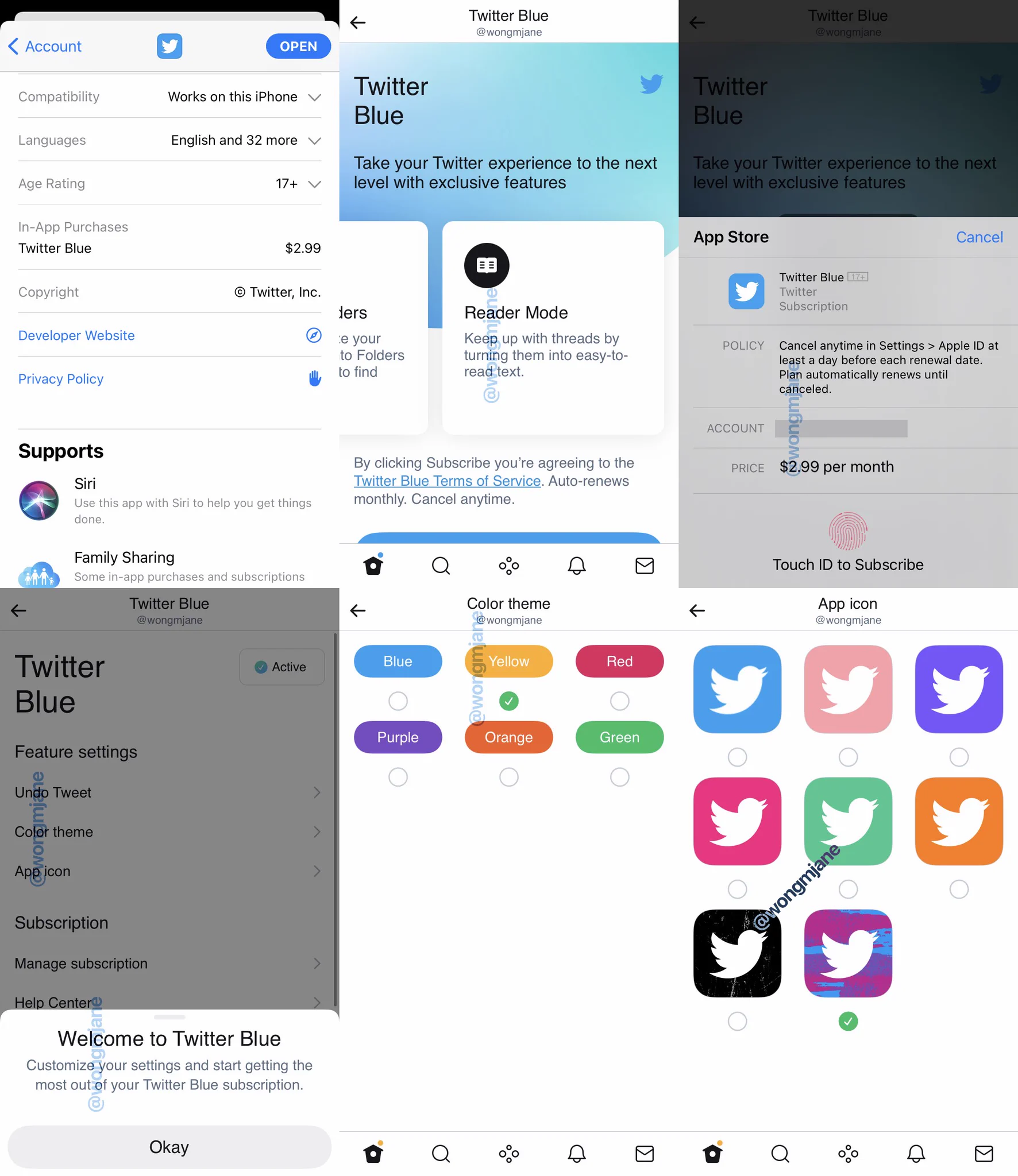
Twitter in 2021: For just $2.99/mo, you can view the tweets in your algorithmic timeline in this new exclusive colour theme!
It's like a subtle admission that these platforms are on their way out and they're throwing their own Barnum & Bailey circus just to keep anyone around.
That, along with the fact that Twitter now censors its search results, are the main reasons I stopped donating content to the platform and deleted my account after 12 years.
But you're right in that the changing-back behaviour was there some months ago. I don't know if they gave up this user-hostile behaviour or if they segment the user base in several groups and I'm lucky.
On the late little-lamented Google+, a set of features converged to give this option:
- It was possible to define what profiles could comment on one's own posts, or whose notifications would be visible. I simply piled all my contacts into two lists ("Circles") called "notifications" and "comments". If someone abused that privilege, they were removed.
- The default Home stream could include "featured" or "recommended" content. Individual lists could not. Obvious hack: don't look at the Home stream, and instead have a primary list. On desktop, I further hacked the CSS to remove any references to streams I wasn't interested in following, e.g., the short-lived "Games" category, and "What's Hot" (an absolute cesspit of anodyne irrelevance).
- On successor platforms, I typically set up about three lists in order of priority, often literally "A", "B", and "C". The highest-quality (and lowest-volume) posters go in A, spillover to B, and especially annoying / high-volume to C. If a profile's contributions are not useful, they're unfollowed.
- Block early and often. Where merely unfollowing isn't enough. https://toot.cat/@dredmorbius/104371585950783019
- Mastodon has the additional feature of being able to block an entire instance. For large instances (tens to hundreds of thousands of accounts) this may be overkill. For smaller ones with hostile cultures, it's quite handy.
I'll note: HN has none of these features, but it has excellent moderation, and the option of collapsing annoying threads. If I find myself conversing with someone to whom my meagre skills in communication seem utterly inadequate, I collapse the thread and move on. HN preserves those collapsed states (at times this is an antifeature, here, it's useful).
This isn't quite as powerful as the block-user feature, but in the context of HN's other controls, it's generally sufficient.
If you don't mute conversations as soon as they become boring, your notifications get filled with junk.
They should be selling features to writers, not readers.
Writers/Broadcasters of content would pay a lot more than $2.99 a month for extra features to curate their feeds and followers, publish content automatically, weed out spam and trolls, schedule posts etc.
https://twitter.com/pasql/status/1366795510355537924
https://pasquale.cool/internet-mob
I'm not on twitter, and poking my head into at least this corner seems pretty damn unhealthy.
In sequence a women accused this guy (falsely) of harassing her from some other random account (it's not clear why). Then another person said they overheard a conversation ages ago and stopped being friends with the guy - which turned out to not be true either. And it continued from there. Is there no consequence on twitter for this type of stuff?
Wonder if there is space for a twitter clone. Basically interesting ideas, sharing information. You'd be stuck with bad information, the response (instead of calling someone an idiot) would be to describe a different theory. No personal attacks of any kind.
HN seems to avoid a lot of this type of mob behavior around personal stuff and it's easier for non-involved people to engage then.
They have no technical moat, and their business decisions may have been a net negative to users. 95% of their value lies in network effects, and people are fickle. I expect twitter will go the way of Yahoo over the next decade.
And basically every major competitor has ceded that ground to them. Google had a whole pilot project around real-time search. It only worked because they ingested the Twitter firehose, and when that deal ended, so did Google Real-time Search. Facebook tried to take this on with “going live” video; where is that now? Most platforms like Instagram, YouTube, TikTok, Snapchat, etc. did not even try.
Ideally there would be social consequences for stuff like this, but there's absolutely no risk in trying to drum up lynch mobs against people online, but there is potential career benefit to be gained.
Mastodon have been a pleasant alternative to Twitter for me, but the experience is highly dependent on the instance (server) you choose to join. But the fact that virtually every server is community owned, contains no ads or algorithmic feed is making a huge difference.
Couldn't twitter just have a flag for personnel attacks. Or is it considered good that these attacks happen there - plenty I'm sure are potentially supported by a bit more than the one linked from HN. But either way hard to engage with from the outside.
This does feel somehow absurd, given how ineffective one would expect Twitter ads to be, but might be illustrative of the problems with paying to remove ads.
No they are not, they are anti vendor lock-in.
Their system is smart at appealing to very specific personalities that just can't help being toxic. These people produce tons of controversial content and generate a lot of traffic.
However, the system also operates at a collective level by forming closed groups of users, that fall somewhere between gossipy cliques and low key cults. This is by far the scariest side of Twitter.
Ah and the ability to create an account anonymously without a phone, and maybe to pay with crypto. I understand why they don't want that, but if you post controversial stuff (IMO harmless progressive stuff, nothing agressive or hate-y, but enough to tick some people off who want to play culture wars) then you invite crazy people who try to dox or threaten you, and all kinds of legal threats. This is in West Europe, I can't imagine how it might be in acutally repressive states.
Unless you just post for fun about cats or food, social media turns out to be ungrateful work...
* No ads
* No suggested topics
* No suggested tweets, no people I might be interested in, no tweets someone I follow liked - just show me the people I follow and things they explicitly retweet
* The timeline preserves order
* Threads are grouped together and the entire thread is shown
My client does exactly this (no ads, feed in order) and I can’t believe I have this for free already while others can’t even pay for it.
Even has some awesome features on top of that like muting (people or hashtags). They’re only limited by Twitter’s throttled API at this point. However, literally the day that Twitter opened up viewing tweet likes via the API, Tweetbot had updated their app to support it.
They switched to a subscription model with Tweetbot 6. And while I’m generally not a fan of subscriptions, I figured $6 per YEAR for an app that I use every day and have for nearly a decade is totally worth it to support the devs.
https://github.com/insin/tweak-new-twitter#tweak-new-twitter
No, Firefox isn't the same thing as Twitter. But if large numbers of people show willingness to pay $2.99/mo to change the app's theme, surely there's enough privacy-conscious people that would pay similarly for a browser that was commercially incentivised to protect privacy rather than monetise it.
I would happily pay a couple bucks per month for a Firefox Pro that’s exactly the same as normal Firefox.
Provided, of course that it’s easy to start and end the subscription, and I don’t have to create a new account. Fortunately Apple provides all of this with the App Store.
A) I don't want to create yet another account and give my CC number to yet another entity who can lose it
B) I guess I don't fully trust them to use the $$ for anything that I care about. Tying the revenue more directly to Firefox IMO would send a stronger signal that this is what matters.
As far as I know it's impossible to donate towards the browser's development.
If anything, I would want it as a social signal rather than the features.
If it's exposed over the API and someone's logging into my product with that flag set, you could reasonably assume it's not a bot, or at the very least that whoever's botting has paid $3 of their own money.
Or at least a medal emoji. Are blue checkmarks so popular that everyone is excited to have two, why is social signal so important for you?
There is pretty much no limit to what could be sold as a cosmetic...add "flair" to the twitter bird (googly eyes, hats, etc) ($5.99 - $25.99)...make circle logo on your profile an octagon ($1.99), a triangle ($1.25)...with a blue border for an extra $.99....etc
I bet they'd make gobs more than a $2.99/mo.
I use a third party client with no ads and no content except tweets from people I follow because I can’t stand the official apps, but I have since learned that this possibility was limited to new users.
If Twitter cut my ability to use Tweetbot and then charged $3 for it, I’d subscribe immediately. So I suspect this is a service more people would pay for.
When they see users they don't see people in need as a service or product.
All they see is a Knob.
-> "Twist the user like this" Are we making more or less money?
-> If yes, turn further to that direction, else turn to the opposite direction.
Modern social media companies are no longer about offering effective social networking & communication services. Its all about the money now.
By "Knob" I meant the kind of that you turn on a radio when tuning toa frequency.
And I don’t hold out much hope that this will do anything to stop Twitter from boosting crazy garbage in order to maximize “engagement” and sell ads.
I’m excited because I think this will make it easier for competitors to come along and offer a better, more user-focused experience. You can do a lot with $3/user.
Full disclosure: I’m building a privacy focused social network that will be a paid subscription service. https://github.com/KombuchaPrivacy/circles-ios
I will not talk about the ethics and privacy issues of Twitter but about user experience and quality of content on feed.
The quality of content on your feed is as good as the people you choose to follow. Choose selectively, block and mute liberally. Keep doing this, and your feed will be fantastic.
I use Twitter only for work. I set my Trending country to some country I have never heard the name of outside of trivia books containing nation capitals.
And my Twitter experience is fantastic. Have meaningful discussions, learn new things, gain new perspectives.
I keep away from politics and such.
Twitter is incentivized to introduce engagement-generating garbage into your feed whether you want it or not. You'll be fighting a never-ending battle.
Speaking of awful: Something Awful is an example of a paid social club that flourished. It can work. Twitter is a bit large and comes with certain connotations of low-brow behavior (ie the very essence of only using 160 characters to convey a thought), so I'm not confident it will succeed. It'll be interesting to watch what comes out of the paywall though.
It existed into the "modern" era of rage engagement, influencers, clickbait etc, but I would consider its "flourishing" to have ended well before that.
My feed is highly curated. 1) I mute all political words. Nothing good comes from these discussions. I also mute things that just don't contribute to my peace of mind (a recent addition being "basecamp")
2) I block users who put out garbage content or try to stir things up
3) I use lists that I view on TweetDeck, so I can have lists based on my different interests (i.e. investing, entrepreneurs, interesting people, philosophy, etc)
Using this it becomes a dream feed. I get stimulating content, great discussions, and interesting ideas. On top of that I've actually made some solid friends from the network over the years, some in-person ones as well.
I'm not completely unopposed to Twitter having a subscription offering, but this isn't what I'd want from it at all.
(Number 1 would be unrestricted third party client before. The Twitter product team is awful and the UI basically unusable.)
Twitter: Hey, check out Twitter Blue! Just $2.99 for reader view, colorful themes, and some other stuff you didn't ask for!
I really expected Mastodon to get more adopted among the regular folks because these features that everybody wants are just the standard for Fediverse instances.
No social content up-front on the page. Instead I have to watch a video if I want to know what I'm getting in to. (Yes I know Twitter just greets you with "sign up/log in" on their homepage these days, but everyone knows what they are so it's fine).
"Get started", not "sign up". Looks like I'm in for a process.
Four boxes telling me what it means to choose a community. Nothing immediately actionable. List of community categories on the left. Nothing against furries, but apparently this is the kind of place where they rate a top-level category, out of only ten categories... so. Hm. Ok.
One of the infoboxes: "You can move your account to a different community later without losing your followers." Ok, but what if I get banninated for some reason? Do I lose my stuff then? Can I still move it? How much control can an op take over my data if I upset them? Or if they just stop paying their server bill without notice? Yes sure, it may be "the same thing that happens if Twitter suddenly stops paying their server bill" but in any given year that's way less likely than that one of these listed community servers will do the same. Guess answering all that requires outside research.
I'll try the "general" category.
It's not clear, even in "general", whether some of these are topic-specific spaces. I think not? But it's really hard to tell and I'm just guessing. Some are "request invite" and it's cool that's supported.
Clicking on a few "join" buttons, all the pages I'm greeted with are practically identical aside from the color theme. That's good. Not sure I love the way "log in" and "sign up" are both given equal visual and page-position weight, considering I showed up via a "join" button, but whatever, that's a bit nitpicky.
There's a "see what's happening" link on the sign-up/in pages. Back on the joinmastodon.org instance list, they have "browse directory"(??? Directory of what? ???) links on each instance's little card, which seems to take you to some kind of user list.
Following the "see what's happening" link on a likely-looking instance. This instance, which noted on the sign-up page that it's "mostly English-language", presents me with about 50% posts in non-English languages (several different ones), and the English-language posts are context-free replies, it looks like, so they convey no useful meaning to me. It's like getting a random sampling of individual SMS messages belonging to 100 different people. The handful that aren't meaningless are kind of off-putting. I still don't know what's up with this whole thing, really, aside from I guess it's Twitterish? Kind of? Judging from the @ portions of the usernames, I think these posts are from a bunch of different servers, so I'm really not sure what the point is of treating the instances as separate and the choice as meaningful. Is it like email, so it doesn't matter where you're hosted as long as you have some host? They act like that's not the case and it really matters which host you choose, for reasons that mostly have nothing to do with longevity, stability, or likelihood of continued service, but I can't tell, from what I'm seeing, why. That's how I'd choose an email provider. I'm not getting how this is different, if this is what the "feed" looks like.
> I really expected Mastodon to get more adopted among the regular folks
Between the above and that if I didn't frequent nerd-spaces I'd never have heard of it in the first place, I think I can see why.
I really like the idea of federated services like that, but they need to have two separate, clearly explained ways to participate; 1) What to do as a normal user and 2) what to do as an enthusiast running a server.
I also think those federated platforms will have scaling issues. What happens if I end up with some type of feed that includes content spanning 20 different servers of varying (hosting) quality?
So, your current text design isn't easy to read?
https://www.inc.com/bill-murphy-jr/why-does-air-travel-suck-...
This attempt to serve curated feeds to people is too late. I've already put in the hard work of organizing my feeds to my liking, and this has the bonus of me not having to give Twitter money.
(I will happily be their 'product' in return for me having insight into my interests and being abreast of world affairs, and local news too).
Based on their recent acquisitions of
- Revue (email newsletter service similar to Substack)
- Scroll (subscription that shares revenue with news sites, and removes ads on said sites)
I highly doubt Twitter Blue will solely get you different app/icon colors, they're likely to roll those services into Blue.
This is somewhat similar to the Amazon Prime approach, where you pay for a premium version of a site/service, and get access to a portfolio of services like Prime Video, Music, 2 day shipping, etc.
Their aim seems to be "Twitter Blue is to consumption of online news as Amazon Prime is to shopping/media".
The way I see it, a subscription model = moving away from a system that incentivizes a platform to maximize engagement/ad views, and instead incentivizes the platform to provide a positive experience, so users stay subscribed.
I haven't tweeted a single thing from my vintage account, and have no (zero) followers. It is basically a read-only account. Not only that, but I try not to follow any more than 100 accounts, which is still a lot! If curated properly, you can stumble upon interesting and thought-provoking interactions, interspersed with churlish and toxic behaviour -- some of which is fairly easy to identify, albeit hard to ignore. In general, it is theatre mixed with rapid insult delivery mechanism, which I find amusing, and prefer not to read into too much, and/or have any desire to interact with.
I assume the next step is to make sure that as soon as you stop paying them the $3/month, all of your undone tweets are republished.
With Twitter, I get the sense he lost control of the company a long time ago because of a combo of monetization and culture.
So basically he helped build the greatest communication platform in the world and instead we get what Twitter is today.
This kind of weak Twitter Blue announcement, to me at least, just shows at what a lost the platform is for making money in a way that isn't engagement driven (aka, rewarding flaming-type behavior).
- No ads
- No pushy prompts for topics, follows, "tweets I might like" or anything else unsolicited
- No tweets in my feed from people I don't follow
and I'll happily pay monthly. Doesn't look like they do any of this yet, but I'll keep an eye out.
The trick is to regularly ban certain keywords associated with posts not relevant to you and to regularly block or mute users.
You can also use Lists to get rid of recommended tweets and create specific feeds for whatever use case you want. If you pin them, you can swipe left or right on your timeline to have a feed just for content related to the list.
But so far this hasn't materialized and I feel better just not going to Twitter at all, even if that means missing out on some interesting content.
Also note, HN folks are nothing like common users, and using their experience as indicator for public reception is a really bad model to say the least.
How can you ever have a healthier discussion when you can only ever reply directly to a tweet?
Twitter is the most valuable social network that I participate on.
Friends, ideas, connections all come from finding people talking about things that are interesting to you.
I don't care about any of these new features. Can just I pay $X.99 a month to not see ads on Twitter?
That'll be $2.99 well-refused.
I wonder if they are doing this to increase the value of their ads shown to people willing to pay: if someone is willing to pay $3 for minor aesthetic improvements they are much more valuable advertising targets than the general population.
I remember back a little over a decade ago they were becoming quite common.
One I liked a lot was KDE's.
The principle issue I had with them was that they scale poorly. A few dozen principle feeds: OK. Hundreds or thousands, not so much.
You effectively see the same problem with Reddit forums, as a parallel. A smallish community of a few thousand subscribers, following the 90/10/1 rule meaning maybe 10 members submit 50% of the posts, another 100 contribute the other half is OK. A sub with 100k -- millions of members, both the submissions and comments are simply a firehose, and the temporal weighting (even with vote-based ranking) means arcane subjects slip off the page rapidly.
Algorithmic ranking => algorithmic gaming.
Temporal ranking => temporal gaming.
That is, the feed is dominated by the most-frequently-posting users.
Fixing this in a fair fashion for a large number of users with a high variability of interests is ... difficult.
In any large-audience medium, the default "show/no-show" decision for a piece of content approaches "no-show". Attention is finite.
(I'm not saying algorithmic social media is better. I'm saying the problem is hard.)
Twitter needs to move from an ad model to a subscription model, with subscription fees for accounts of a certain size. The platform would still be free for the majority of users, but accounts over 200K followers (or even 50K followers) should pay for the audience that Twitter provides them with. This would lead to better financial results because recurring revenue is reliable, profitable, and earns a higher multiple than transaction revenue.
5 Feb 2021
If you're really cheap you can signup through their indian link for a couple of dollars a month.
Its a shame that the economics are so stacked against premium retail software instead of just slinging ads.
Does Twitter circumvent taxes from ad revenue ?
I know that there's also good posts and good people on Twitter, but in my opinion it has been a net negative for society for quite a while now.
What I would enjoy would be a button to hide all the accounts that post more often than once per day. Because chances are the people who talk too much have no time to think about what they're saying.
I remember one person posting hand drawn graphs without a scale claiming global warming is just a cyclical process. Does it makes sense to report someone for bad science? They probably believe what they posted to be true, and others who read that unrefuted reply may begin to think the same. So I tried to teach critical thinking to random people on Twitter, but as you imagine this was a fools errand.
I gave up and blew up all of my "social" media because they didn't serve any purpose.
Maybe an invite-only platform could have higher signal with:
- multiple "vouches" of others to get an invitation
- frequency/reputation micropayment cost to post
- reputation/karma that isn't apparent or chased, and granted some with the invite
- elimination of pile-on
- multifaceted voting based on specific aspects of relevance, agreement, and insight
- humor voted/tagged and filtered by readers to avoid using dv for that
- dv has moderator-visible reasoning to double-check and prevent spurious dv
- prevention of dv retribution
- reduced anonymity (first name and picture) for higher-quality interactions
- mediation and de-escalation facilities such as pre-comment emotional content scanning (AI-based sarcasm detection would rock), posting delay of 2 hours, and side chats
- login required to view content, no search engine spidering
- operate as a sustainable nonprofit to avoid pressures of corporate profiteering
- servers and legally based in a country the US and EU cannot control
The only thing that matters is the size of community. Beyond a certain scale, it always breaks down. Ultimately, the problem is the people.
Personal details don't deter it, as shown by the various platforms that were inhabited by the alt-right. There's a cultural lack of responsibility for the truth.
Twitter is pretty close to that, except it’s default opt-in rather than default opt-out. Meaning everyone can see your content by default, rather than you having to explicitly allow rando’s to see your content and reply to you.
But if you follow people who make high-quality posts, and unfollow, mute, and/or block people who produce all noise and no signal, you’ll have a pretty good professional and personal networking experience.
Most other social media have ways of curating your feed, but you have to proactively do it, can’t just rely on the social media platform to do it for you.
The more I think about those problems the more I'm convinced up- and downvotes are a mistake in general. They can only cause damage and are completely useless as they're not even used for the same thing by different people. For example when someone gets 5 downvotes it's probably for at least 2 different reasons, none of which are communicated to the poster. When I get a random downvote I'd really like to know if it was warranted, but there's no way to find out.
If any kind of rating system had to exist I'd vote for something like tags; with users being able to tag any content with any 1-2 words, and frequent ones are visible without some extra clicks. For one this would give more nuanced information, and at the same time it would make tons of content much easier to find or filter.
Many social media platforms have tried this and failed Even at the lowest level of having to get an invite from someone you know - its never worked:
- Clubhouse - Google+ - ELLO - Mastodon
The paradox here is you need people to generate sustainable communities. When you don't have enough people, users will stop using the platform. Another classic case of this is all the "decentralized" social platforms like Diaspora and others. Great idea, great implementation, but without enough people, its doomed to fail.
Why do you think this is a good thing?
> - servers and legally based in a country the US and EU cannot control
I see two ways that could go: either somewhere that China and/or Russia have control over, or in an unstable third-world dictatorship. Do you have any specific countries where none of the above would apply, or do you prefer one of the latter two to the US and EU?
I'm thinking of some kind of ML scheme where the site analyzes your comment and sees if it is similar enough to existing comments.
Or perhaps also analyzes your comments to see if they are similar to older comments you have made already.
The root cause is that platforms like Twitter rely on engagement (and maybe more importantly, growth of said engagement) for their lifeblood.
When that's the case, the incentive will always be to increase engagement at all costs and nothing drives engagement like flamewars and other lowest common denominator garbage.
Additionally, as long as the social currency is "how much other members of the userbase like your posts" you'll wind up with either a single hivemind or multiple warring factions IMO (e.g. conservatives vs. liberals on FB)
HN manages to keep its discourse level fairly high because of this, I believe. HN does not need to grow nor generate revenue directly. A Twitter-alike, curated as strictly as HN, might work. It might even be able to turn a profit, if the goal was sustainable profit and not some impossible dream of unbounded growth concocted by investors wanting the next trillion-dollar hit.
Everyone everywhere on the internet thinks that the "other side" lacks critical thinking skills. I'm not surprised your effort failed, I'm sure if you offered to teach me critical thinking skills I'd wonder who the heck you thought you were.
Frankly your confidence in your own impeccable critical thinking skills cast doubts. The smartest people are those who know they can be deceived. If you don't have the humility to check your own reasoning then you are probably wrong about something.
I also said it was a fools errand - something that had little chance of succeeding against the waves of misinformation on Twitter. And finally, you’re right that knowing you can be wrong and challenging your own beliefs is fundamental to critical thinking.
It's not even about critical thinking skills. The 'other side' is often starting with a completely different set of facts. The only difference being which ones were highlighted and which were omitted.
This doesn't even touch on straight up falsities yet.
Until the sides can agree on some base first principles, it's going to be a hard problem to solve.
This point cannot be emphasized enough. I have encountered people on the opposing side of an issue who have stronger critical thinking skills than people who I agree with (and probably even myself). The differences come about due to a differences in the foundations of our knowledge or on pivotal points where neither side can claim to have an definitive answer.
The whole thing is philosophically weird, but practically speaking, one can somewhat know that people saying aliens built the pyramids are the ones lacking critical thinking. For example, I don’t think people promoting the cancel culture lack critical thinking, even though I’d bet on it being a long-term disaster. But most anti-vaccers are pretty obviously lacking some critical thinking skills.
It’s generally the ability to tell your political interests apart from your epistemic knowledge. In simpler terms, the ability to engage less in wishful thinking. While perfection is impossible, I do think it’s possible to improve in this ability. Proving it to others is another challenge; You probably need to predict counterintuitive results consistently for people to somewhat trust in you.
Critical thinking is a skill that is almost useless to most people and can lead to being a net negative. It's the skill of critique. One can be amazing at critical thinking and be absurdly terrible at constructive thinking. Politics in general needs far less critique and far more construction. It's really bad to get people very aware of just how badly they're exploited but then to give them no potential solutions to solve it. That's basically what wokism has done recently. Every solution proposed by them is so unpalatable to the rest of the nation that there is no place for constructing new policies.
The left has this problem especially bad since the radical left makes being really good at critique a whole component of their intellectual tradition:
Only because we're effectively alone in the responsibility.
Hint: lack of research isn't limited to Twitter, folks. It's in your pub, your break room, etc
All of this makes educating people in venues like Twitter (and some of these exist outside of the online world) a very difficult prospect.
Instead of lionizing celebrities, money, infamy, or hyper individualism, maybe it would be worth respecting wisdom, mastery, expertise, monetary-agonistic accomplishment, and insightfulness.
The book The Mirror Effect by Dr. Drew comes to mind.
It's better to follow creative people. They tend to have much more interesting things to say. Follow people like John Carmack, Simone Giertz, or The Onion instead.
I very much find the Twitter experience is what you make of it. I did it wrong the first time I tried twitter, and I hated and abandoned it, too.
Second time around, I started with a handful of tech people that post interesting content or work in projects I'm involved or interested in, and organically grew from there. I also follow a couple people that post local (to my small city) traffic/news/etc. And within the last year, I follow some people that post COVID stuff about my region, who produce charts and stuff that are 10x more useful than the official government sources (eg: updated and realistic R calculations, include charts with hospitalizations/deaths, etc).
What is absolutely not useful is anything political (the replies to COVID stuff tend to get political, so I also ignore that), or pretty much anything in "trending".
Also don't be afraid to mute or unfollow people, and click "Not interested in this -> show fewer retweets/likes from this person" -- all things that have made it tolerable and even useful. If disinformation/lies or other similar nonsense starts getting in my feed, I do what I need to get rid of it. This has meant sometimes unfollowing someone I otherwise like (eg, they're replying that disinformation and causing fights) but honestly, it's just not worth it to me.
By curating my feed, I'm in general happy with it.
It would be lovely to have a platform/forum where the whole concept was just that the moderation would ban people not only for spreading misinformation or making ad-hominem attacks, but also for applying unsound logic / not citing sources when asked / etc. All the same stuff that'd get a journal paper rejected during peer-review.
(With public records of moderator decisions, and the ability to appeal a decision; but where the "appeals process" just translates to your post going through a Slashdot-like "bunch of regular users given temporary moderation duties approve/deny your post" — which, given the type of user who'd want to be on a platform like this, likely wouldn't be any more friendly to your post than the mods would be.)
It'd sure be a niche platform, but that'd match well with how much work the moderation staff would have to do to keep up with discussion on it. I'd pay to be there!
(Yes, this is what scientific journals were originally supposed to be: heavily-moderated public forums for conversation between scientists. They don't serve this function well any more, as they've been parasitized by the function of serving the needs of academic clout-seekers.)
I work in biotech, and lets pretend I'm an expert on a topic- say immunology. When I get home from work, what would motivate me to sift through countless posts about misinformation and flag them? No amount of money is going to persuade me - but that's just me ofcource.
Discussed at the time: https://news.ycombinator.com/item?id=22101244
Someone must have dug and learned something, for everyone else to blindly follow.
It is so hard to imagine how they just cannot seem to understand why you are right, despite all your trying to teach them.
But then you imagine that they must be thinking the same thing.
I cannot imagine what must’ve gone wrong in their lives that so many lies could be built on one another.
I'm not so sure about that. There are some people who take seriously the fact that they could be wrong. They approach discussion with an open mind, listen to the other, look at evidence with a critical eye, and respond fairly.
Others come to a "discussion" from a totally different headspace. They are bitter, angry, and, to be frank, not very smart. It's not discussion they are after, because they aren't open to the possibility they may be wrong.
My theory is that this is the "rabble" that used to be led by the church, and then by mass media, and now by internet media. The internet is fractured into close-minded echo-chambers, and for many alive today, the classic error-modes of public online communication are new and exciting. The right is enamored with the brutal effectiveness of trolling. The left seems to prefer doxxing and blacklists. And internet companies care about metrics that don't capture any of the externalities of their platforms.
Hopefully they'll all grow out of it.
As for elected officials, I wish they'd just disable replies altogether for them. Nothing good comes from it.
"Never read the comments" is common advice for a reason, and it has nothing to do specifically with Twitter.
Twitter is such a trash, I mean on the IRC at least you can split in groups, kick out and prevent unsignaled readership. On twitter millions can read a random shit without segregation it's awful.
I had to get away from it when the US required foreigners to disclose their twitter accounts upon entry, with all my ISIS "friends"...
If your service's business strategy is "1) acquire hundreds of millions of users and charge them all $0.00 per year for many years, 2) acquire lots of expensive infrastructure and employees to support the service, 3) ???, 4) profit", it's not going to be easy.
I don't think just selling ads is sufficient; especially if it's not a service you can operate at a relatively low cost with a skeleton crew. I think it's probably either that or start charging for something. (Unless your goal isn't to ever make a profit, I suppose.)
Discord seemed to make it work (I think?) by combining an initial semi-skeleton crew approach with a freemium charging approach. They tried a few other things, but I think those efforts flopped.
I don't know if it's primarily the format, or the different type of user compared to FB, but FB is the winner hands down.
I only go to the public one a few times a day now, compared to being wired to it as a beginner :D
The irony is, translating to IRL, I apparently discovered I have this semi-employed, "macho" no-shirt neighbor who accused me of being racist for asking if they had an entrance keyfob to prevent tailgating into an access-controlled apartment building. Then they talked about all the (nonexistent) "cameras" around, began recording me (for what, I don't know), using racist slurs, and tried to start a physical fight (they're half my weight, like a yappy chihuahua). I'm wondering if they're schizophrenic and narcissistic, in addition to appearing like a victim-mentality crybully crybaby. My point is perhaps people are taking their online behaviors into the real world.
PS: You should've heard what Latinx gangbangers called me when I was a kid. I never got beaten-up because I was bigger than all of them, but I learned the finer points of swearing in Spanish. :) I understand the tall blade of grass gets clipped so I don't take any of it personally.
Damned if you do, damned if you don't.
It's supposed to be an all-encompassing term for "Laino" and "Latina," but only serves to divide people further. Like almost every other ethnic rebranding of the last ten years.
This is self inflicted. My Twitter feed feels like a really big friend group talking/joking about anime, tech, finance, etc. You are quite literally the company you keep on Twitter.
> Because chances are the people who talk too much have no time to think about what they're saying.
You won't get far taking the website this serious.
(I should add that I'm black and so are most of the people I follow so it's possible I'm basing this off a group of people that already have some larger sense of community off the bat)
Compare this to politics where the end is never in sight and the goal posts are eternally moving.
Not totally accurate. I have a highly curated twitter made up of finance and tech yet the suggested trends are HORRIBLE. Wonderful topics such as "Nazis", "RacistSoAndSo", "JimCrow", "UncleTom" etc etc etc.
Its a black hole, pile on of hate. I call it the trending two minutes of hate; and its built in with no way of turning it off.
If I had to guess I’d say it goes off what your following is interacting with/talking about at the moment. I notice they get more negative when my timeline is talking about something more controversial.
What is Twitter but a reflection of our own society? These people really exist and they really have these views. I don't like the idea of banning someone for simply holding a view, or forcing someone to align with an ideology of choice. "Platform X is awful" is actually "People are awful".
>What I would enjoy would be a button to hide all the accounts that post more often than once per day. Because chances are the people who talk too much have no time to think about what they're saying.
Why not just avoid Twitter ? In any transactional setting you need to give something to get something. Twitter as a commercial entity needs users frequenting their platform and as therefore most comments on any social media platform are low going to be low quality (including HN).
The medium is the message. I firmly believe that the thoughtfulness and value that goes into a communication is directly proportional to its length and indirectly proportional to its age (likely due to survivorship bias). Twitter, occupying the extreme short end of both spectrums, seems to amplify the worst facets of human nature.
Books, especially old books that have remained in print (survivorship bias), seem to have somehow tapped into the better parts of human nature because they represent and stimulate discussion of ideas that have remained relevant across vast shifts in time and space, technology and culture.
The problem we have is that it's difficult to get people to read and especially engage with these old books. Schools have tried this for years with little success. Many (North American) students will gladly tell you how little love they have for Shakespeare, Steinbeck, Hemingway, The Great Gatsby, 1984, etc. Thoughtfulness and the slow burn of classic literature just don't have the same gratification feedback loop that people get from Twitter, I suppose.
Twitter isn't just a reflection, though, it's a feedback loop. It takes a stream of ideas (usually ill-considered) from a ridiculous number of people and sends them directly to the people that it expects will be most emotionally affected by them. Those people then absorb those ideas and either react with anger or support, feeding the system with new material to repeat the cycle.
If Twitter simply reflected society, it would have done no harm. But instead it's amplified the most animalistic part of our collective nature.
A society in which the village idiot gets a megaphone and can cheat his/her way into amplifying that megaphone with no recourse? Or a terrorist disguised as a village idiot can do the same? Then sure yes Twitter is a great personification of our current society(ies).
That is not accurate. The reality is the opposite of what you said. The megaphone is actually due to people voluntarily gathering around the person to listen to what they say. People only interact with content/people they agree with and this is causing social media bubbles.
If we all agreed that twitter was trash and we all just stop going, then it's over - that village idiot has no power.
I've stopped. Presumably you stopped too. If you are still going, maybe you're the idiot?
This is a little shallow of a view, as in it is much more complicated than that. At its simplest, sure you can say Twitter is merely an outlet with no interference on the platform itself. But if you actually use it for any period of time or just follow the various ridiculous outrages it produces, you will quickly see that, just as we shape Twitter with our tweets, it itself shapes us and how we articulate ourselves, the level of discourse we expect. To be specific, Twitter favors short, “smoking gun” style arguments, that can be compressed into 240 characters or divided up into those segments for a thread. This necessarily “compresses” discourse into a series of dramatic accusations as evidence. It is not enough to say that someone made a offensive statement years ago. Instead, it becomes that that person themselves is bad or x-ist. This I think is the net negative to society and I doubt we would arrive at quite this point with Twitter’s “help.”
Twitter is already profitable today, even without this subscription service.
There is a good reason they hid the tweet count, because most of the biggest names on twitter actually have Tweet counts that if you divide them by hours since their join date it would be as high as 0.8 to 1.2 tweets an hour every hour 24 hours a day for 11 years+
Once you learn this it puts those users in a very different perspective and they no longer seem like people you should be listening to.
One recent example, there was a news report that famous short seller Michael Burry had taken a $500 million dollar bet against Tesla. This number came from a basic misreading of Burry’s disclosure, but the news media ran with it and an article with this number showed up on the HN front page. If you followed the right people on Twitter you knew the number was wrong within minutes, while the news media has still not issued a correction. This situation happens all the time.
https://www.fool.com/investing/2021/05/17/genius-behind-the-...
This is why Twitter should be an open protocol, and people should be able to write their own UserAgents. Users should be in control of the filtering, not the app or the company.
ActivityPub is an open protocol for this kind of thing.
I use twitter as an external brain not that dissimilar to a a Xanadu inspired Memex intermixed with a Zettelkasten.
Too drastic IMO. Some of the best posts I've read on Twitter come in threads, a chain of consecutive tweets by the same author. I would propose instead an option to filter profanity, most of the low value, or plain harmful, tweets use offensive words.
Maybe a warning that your tweet will get a drastically reduced audience for using X or Y words, so the poster can rephrase it before submitting?
Heh funny I had the exact inverse assumption: that maybe they realized single-minded attempts to monetize only engagement exacerbates toxic human behaviour.
I'm thinking the truth is probably somewhere between both.
> What I would enjoy would be a button to hide all the accounts that post more often than once per day.
+1 on this thinking! But more vibing with the idea of imposed scarcity, rather that the hyper-customized view of the world.
Related: I personally feel that more elements of consensus reality should play a role in our digital spaces, not each getting our own view just because we can have it. Just because we can fine-tune our reality to our preferences, that doesn't mean that's good for a system for its actors to do so highly. Imho there's a reason human minds generally all evolved to be mostly on the same page in terms of perceived reality (except for a few subtle knobs on some generally minor axes). And the neurotypes that break theses consensus reality rules are generally perceived as maladapted and tend to be ostracized (e.g. schizophrenia, barring value judgements about their treatment in society). I do believe there's an evolutionary lens to place over that vague shared sensibility (ie. what underlying feature of network dynamics did evolution "learn" and tune into?) and imho this all informs how we might build tech :)
The experiment of directly paid social media is worth trying out, in my opinion. I know paying a few bucks a month won't necessarily get you out of the privacy/ad-tech spiderweb, but if it get us a more robust control over what our social feed looks like, I think that alone makes it worth it.
Hopefully this makes it easier for them to support themselves.
I've long accepted no one cares about how I live my life. A friend of mine spends a ton of their good energy getting upset over the latest 'take' some influencer has. It's like getting upset over an episode of WWE Raw. In any case very very little of what other people do or believe has any direct affect on you.
it's a pity most of twitter seems to be a perpetual shitstorm of low effort brainless buzz
ps: out of the whole internet debasement.. I kinda see something, is that talk has a purpose, if I talk to someone I'd rather have a nice moment, and the ability to debate endlessly with people I don't even (or bots even) is fruitless. a strange kind of lesson on using ones times correctly
Now what you learn is mostly to argue your way around your opinion better, not exactly to change it. But why would you: you change your opinion when looking for insight (reading a book), not when looking for a win (debating on an advertisement platform).
I deleted my Twitter last year and I don't miss it.
Create lists of people (just one if you want the main feed-like experience, several if you want some order and structure). Only look at those lists.
They are chronological, and without the random "suggestions" Twitter likes to put before you.
And then you may come to like tweetdeck.twitter.com, where you can see all those lists side by side, and even have sensible keyboard shortcuts.
(Unfortunately, Tweetdeck may become a paid feature, there have been rumors bout it for quite some time)
My rule when using it is that I only interract with personal photos/stories, or stuff posted publicly.
I completely ignore postings that are not personal and to friend only (not public). Facebook has (or had?) huge potential for people to keep in touch but its bigger issue are private gardens where people can spin up opinions into silliness with no opportunity for anybody from outside their echo chamber to criticize and debunk.
And yes, you can configure twitter + using tweetdeck to only see tweets in chronological order and only from people you follow.
Only if you are looking for deep thoughtful comments. Twitter need not be that place. It could be a place to amplify the voices of the oppressed some of which may sound like noise. This kind of voice has never been available through mainstream media like cable or T.V.
I personally believe that most of this toxicity is induced. I don’t think most humans are toxic by nature.
Can you blame victims of war for their tireless online activism? So what that they turn toxic, can you blame them when they are continuously facing mis/dis-information on a topic they are experiencing first hand? Yet this group can appear as toxic as any on Twitter.
We can criticize but not to the point of unilaterally dismissing these groups as if they are equal. A climate-change denier is not equal to a Gazan teen “journalist but only through tweets”. Both may annoy you with their “perpetual beef” but it’s not really fair to abandon the one good thing this platform has done - give people a voice. We need to just learn to deal with it.
I’m not sure what the impact of this will be, but I hope it won’t be the undermining of grass-roots activism. Even if that activism can border on toxic.
Makes me wonder how much power these state actors have now that cancel culture is a thing. They can just whip up a mob and character-terror anyone they want, without being detected at all.
PS: I am not even saying these are bots. They can just pay people some meager money to do this. It’s an easy job in a country with very high unemployment. Heck, even Amazon does this in a small scale.
I'm not a huge twitter user (~2-5 mins a day, read-only), but I tend to do this manually. If I notice that an account is taking up the majority of my wall space I tend to unfollow. After iterating a few times I ended up with a decently balanced wall.
That's most "engagement" on the internet, lol. Twitter is bad but it's not like all the other social media platforms are that much better. It's just how some people behave socially (anonymous or not, it doesn't seem to matter), at least when they're not meaningfully focusing on some worthwhile goal or pursuit like most of us are here @ HN. And trying to stop it with heavy-handed authoritarian policies only makes it worse as people strive to abuse the policies themselves to troll and gain power over others.
this isn't quite it, but it's a good way to filter out a lot of trash: https://megablock.xyz/
I kinda suspect the notion of most of these services just being free and not resorting to really unpleasant ad systems and dark patterns and such ... just not viable generally.
Twitter is a huge space and your experience comes down to what your bubble on Twitter is. The self development/Indie hacker/Tech/Devs/AI/Product/Life Lessons bubble, while still pretentious, at least is way better than the Celebrity/Cancel culture/Outrage bubble.
EDIT: This mostly only applies to very specific positions (mostly design positions). I'm not insinuating that these companies are literally requiring Twitter. It's a bit more complex than that.
Yes, that could also monetise it so it is only two free post per day and accumulate maximum of 10 before twitter charge them $ per tweet.
And more RSS Reader like features.
I could categorise people into different topics. Today I dont want to see any shit storm on politics, so I wont click on it. I only want to see tech and economics.
Right now moving to list and making them working in harmony with the main feed is a bag of hurt.
I've always felt like HN should display the upvotes/comments ratio rather than raw karma. It would be like the accuracy number in xonotic's insta-gib mode: you shoot carefully and precisely rather than spraying and praying.
Once it blew up and became toxic AF, I unfollowed everybody, started following only specific people, blogs and sites related to my industry (software development) in order to stay up to date with the goings on around me. That was it, since then, its become another basic news feed.
Kind of sad what its become to be honest.
It's kind of like a sweet metaphor for the eternal September.
However, some of my absolute favorite twitter accounts post a lot. To each their own. I don't have to hit the button.
As long as those suckers and their audience still watch your ads, you can.
Then again, I curate who I follow pretty closely and I have a long list of political buzzwords suppressed through the "Muted words" feature.
I don't get notifications that contain those words, and tweets that include them don't show in my timeline.
Facebook seems to be doing just fine
Ultimately, Twitter is a gossip site, so this should be no real surprise.
Take the name for example. Any other platform has a clear written or unwritten rule.
- HN: usernames
- LinkedIn: real names
- Twitter: a mix
On Twitter, you clearly lose out if you put your real name out there. You suddenly get trolled by strange avatars hiding their identity and very little community control.
What's strange is facebook. The fact it's more segregated by close circle make the discussion nastier than on linkedin when you have your company name on top of your mean troll.
Do you post on controversial subjects?
LMAO you're absolutely right! source: me
Mostly kidding, but, well sadly it isn't a joke.
you're soooooooo close to getting it, but so far.
monetizing engagement -creates- toxic communities, because toxicity is engaging.
Google and Facebook intrusively touch into every aspect of your life, to the extent that they can advertise things to you with pinpoint accuracy. They also operate at a scale of users that's at least 1-2 order of magnitude higher than twitter.
Tiktok, Snapchat (weakest case) and YT integrate adverts in a way that forces you to look at the content. Thus increasing engagement even if their user-targeting isn't as exact.
Reddit and twitch use an additional pseudo donation/commision system to keep money coming. Discord straight up charges for a premium package.
The weakest but still relevant case is by Pinterest. People visit the website when they are looking to buy something, so well targeted ads can get high engagement and the form of media is also higher engagement (pictures). ______
Twitter does none of them. From a service standpoint, it has created zero user-flows that involve making advertisements effective or allowing any user-to-user monetary interaction in a way that they can be the middle-man.
Theoretically, Twitter could massively expand its user base, but it has stagnated for 5 years, so I don't have much hope.
Otherwise, they could finally release a product where the content natively produces income (subscriptions, paywalls) and get more revenue out of each user. It's bewildering that Twitter didn't release a substack like product 5 years ago. It was practically staring them in the face. Maybe a YT-subscriptions-like join button on which you can take some commission? They could've served as the front-page-of-world's-news and helped generate revenue for news agencies while taking a cut.
There were so many places they could have gone, but they went nowhere. I dunno what the Product-Dev/PM role in twitter looks like, but I imagine it must be quite boring. Hiring a few competent PMs and giving them free reign for a bit, might not be bad idea for twitter. (as much as HN hates the average MBA PM, technical ones that also get business and product needs are hard to find)
_______
Admittedly, the core product of twitter is not bad at all.
I joined twitter in 2020 with a hyper curated list of sources, mostly politically unaffiliated individuals. I unfollow any account that tweets more than 5-times-a-day or opines of things beyond narrow topics.
It is also amazing for getting the real first sources, that previously would have needed a intermediary media org to get their point through.
It is amazing. But it took work to get there. It's like
Maybe we have progressed less than we thought.
So it was rare that they would be made to fight to the death.
Now, slaughtering prisoners in the arena happened just like you are imagining.
"We'll charge users $3 a month to change the app colors and icon.".
A company as huge as Twitter selling this as a subscription seems ridiculous to me. I don't use Twitter much, but IIRC aren't there a bunch of third party apps that have power user features like this already?
Sure twitter may not do it client side and have special APIs etc, however ultimately they can also really do only limited time changes, other wise the tweets already read by others would start changing.
Of course they can still pull API access for violating ToS etc, however from technology context there is nothing they can do .
1. Hats and other cosmetic changes to weapons, with no buff.
The features that Twitter is advertising for its premium service all seem to be purely client-side, with the exception of the ‘edit’ button, but that doesn’t seem like a particularly compelling justification for a $3/mo subscription.
- Revue (email newsletter service similar to Substack)
- Scroll (subscription that shares revenue with news sites, and removes ads on said sites)
I highly doubt Twitter Blue will solely get you different app/icon colors, they're likely to roll those services into Blue.
This is somewhat similar to the Amazon Prime approach, where you pay for a premium version of a site/service, and get access to a portfolio of services like Prime Video, Music, 2 day shipping, etc.
Their aim seems to be "Twitter Blue is to consumption of online news as Amazon Prime is to shopping/media".
The way I see it, a subscription model = moving away from a system that incentivizes a platform to maximize engagement/ad views, and instead incentivizes the platform to provide a positive experience, so users stay subscribed.