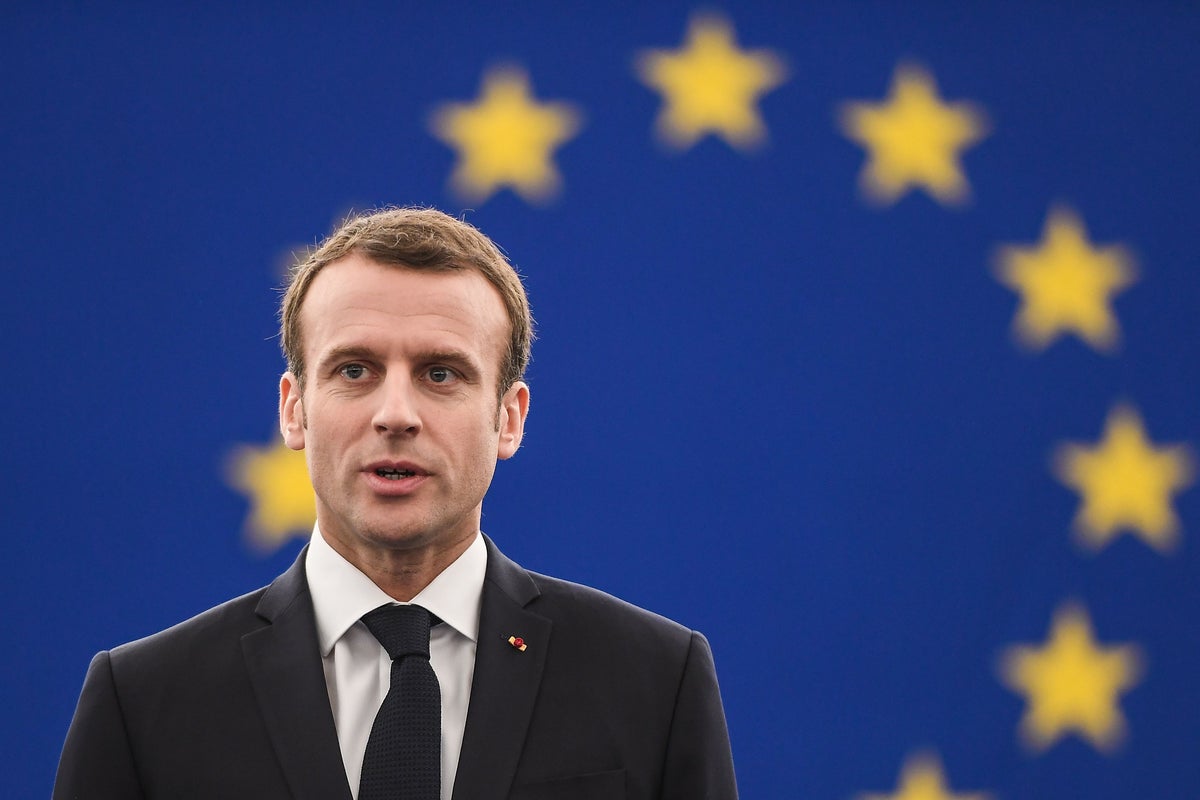
French set to replace English as EU’s ‘working language’
Notes, minutes, letters and meetings will be ‘French-first’ when France takes over European Council’s presidency
The Independent
182 points · by nomoreplease · 5y ago · 369 comments
According to Wikipedia we have:
* Germany: 56% English speakers, 14.5% French speakers
* Italy: 34% English vs. 19.43% French
* Spain: 22% English vs. 11.73% French
* Sweden: 89% English vs. 8% French
I can't get over how bad this decision is. How can you ignore these kinds of discrepancies?
[1] https://en.wikipedia.org/wiki/List_of_countries_by_English-s...
[2] https://en.wikipedia.org/wiki/Geographical_distribution_of_F...
So this is the President of France postulating that when his country takes the Presidency next year, he will use that to push French to be the next working language. I don’t know what the President of the Council of Europe does besides Chair meetings, but apparently it includes setting the language for which the meetings will be held in.
So this isn’t something the EU as a whole has determined will be policy going forward, more like the first guy to drop his pants in a newly opened frontier for dick-waving. If this was something the President of the Council of the European Union could do unilaterally anyway, then my read is that Emmanuel Macron would have pulled this stunt, Brexit or no Brexit, and Brexit is just convenient political cover.
More likely this won’t last more than the 6 months that France has the Presidency, and it will be amusing to see if say, Hungary the next time they have the Presidency insists on high level communications in Hungarian.
Please excuse my pedantry, but you've misspoken here: the European Council, the Council of the European Union, and the Council of Europe are three different things; and here you've accidentally said the third when you meant to speak of the second. The first two are EU institutions–the European Council is senior to the Council of the European Union, in the former EU member states are represented by heads of state or government, in the later they are represented by the ministers responsible for various policy areas (finance, agriculture, trade, transport, education, etc). The Council of Europe, by contrast, is a separate international organisation from the EU, with a much broader membership – it includes the vast majority of European countries; it is most famous for hosting the European Court of Human Rights (ECHR), although it is active in other policy areas as well.
And all three have a presidency. The President of the European Council is an individual, currently former Belgian Prime Minister Charles Michel. He doesn't take orders from the Belgian government, he is truly independent. By contrast, the presidencies of the Council of the European Union, and the Council of Europe, are held by governments not by individuals. The presidency of the Council of the European Union rotates every six months, it is currently held by Portugal, Slovenia is up next. Likewise, the presidency of the Council of Europe rotates every six months; currently it is held by Hungary.
Yes, yes I did and I did not catch it, and I’m outside the Edit window as well.
It seems not even I can keep up with Europe’s love of councils.
And besides the long term costs that can be reasoned out, all sorts of emotions, insecurities, etc., will undoubtedly come flying out from many quarters.
I doubt if these sorts of topics can be discussed calmly by anyone invested in the change.
Yes. The consequences are hopefully getting re-elected as a moderate at a time when right-wing populism and nationalistic rhetoric is popular. The next French election is next year.
If this is what it takes to keep Le Pen out then consider ourselves fortunate.
But I don't think the French really care about how other cultures work. It's all nationalist nonsense and living in the glorious past for them. See Strasbourg.
The European Parliament would love to pick up and leave Strasbourg, but it is legally bound to meet there several times a year for a full session despite the majority of its work being in Brussels.
This is such a useless egoistic move from the french, just accept that english is the lingua franca.
I think it’s sad that that you don’t seem to realize that it’s a problem that most of the content we are exposed comes from a single culture.
As for the move, it’s totally useless, and if they wanted to be strongest against english they should have said “we’ll only accept communication in french or german” but that would have meant most of the communications would have been in german.
I don't think GP's desire to minimise language barriers among 27 co-operating governments implies that they are oblivious to cultural bias.
I do think the latter is an issue worth addressing, but this is probably not an effective or appropriate way to do it.
Using English exposes people to a certain way of thinking that is more linked to a set of cultures or traditions. It's an undeniable fact, both semantics and linguistics teach us that.
But if the aim is to help politicians think from a different perspective, French is a bad choice. If that was the purpose, a reasonable choice would be to opt for languages related to cultures of more practical rationality.. German or Scandinavian languages
Of course it's the French politicians who have the nerve to try impose their language. Perhaps it has something to do with the fact that French culture is one of the most pedantic and nationalistic in Europe, to the detriment of the other members.
I lived in the Netherlands, worked for an international organization and I still have a lot of friends who works (or worked) in Brussels. Few comments:
1. The level of profentiency in foreign language of people working for the European institutions is orders of magnitude higher than readers of HN. Not too mention translators. It's not rare to meet people speak 6 languages totally fluently. Switching languages for some working documents is almost a non-event beyond signaling. There will be zero impact for the rest of us.
2. I totally support a Europe where people speak foreign languages beyond English.
The appeal to the popularity of English is entirely circular. Obviously you're exposed to more English if nobody makes an effort to use another language. Not an argument against changing that state of affairs.
I'm no expert on international politics, but it seems like that would severely disadvantage these countries, wouldn't it? With a smaller pool of politicians and technocrats who are proficient in the working language of the EU, they'll have to rely more on translation, and will consequently be less able to communicate efficiently when representing their respective countries.
1) Everyone's beautiful 2) Everyone's super tall. I'm 184cm and saw multiple women every day that were taller than me, let alone men. In the US it's quite rare for me to see women taller than me. 3) Everyone's rather slim. It's nice to see a population at healthier weights than what I'm used to in the US 4) Not once did I find somebody who couldn't speak English, from workers at train stations to museums to airports. It was crazy. In contrast, Germans being about 50/50 matches up with my experience. Italy felt lower than 1/3 even in Venice, but I spent much less time there.
Sweden sure is amazing; can't wait to visit again.
It's crazier than that. I've moved to a small village in northern Sweden in the middle of nowhere, and everybody speaks English here, too.
> Everyone's rather slim.
Agreed, but Austria beats it - there, everyone is ripped :)
So 6 foot tall (72in) is like a magic number for American men. That's like the threshold for manliness in popular culture. If you were to plot the self-reported heights men in America, you'd absolutely see a dip at 70 and 71 inches, then a big spike at 72in.
What's this magic number in various metric countries? 185cm seems like a sound choice, but I could see it being 190 in some places.
I ~think~ that's why someone downvoted you.
You can experience it in advance with Tinder Passport.
It's not by chance that many invaders tend to force their language to country they invade (the French being no exception, they did both in former colonies and in our own current territory during the French revolution - that's actually a very hot topic currently in France, as some "immersive teaching" of regional languages were found unconstitutional a few days ago)
And well, I'd rather be more German than more American. But I'm one of those who feel more EUropean than french, so maybe that's why :)
The french political class: "It eez time to stick eet to ze germans and ze eengleesh"
Let’s force the 3 letter agencies to improve their deep learning NLP models for other languages.
Nobody speaks it in the EU, but if we’re going with popular languages i also don’t think mandarin would be an appropriate language.
I’m french and I think there should be a common EU language, and for political purpose it should a truly neutral language, like Esperanto or another novlang.
(Or maybe french should become the lingua franca of the EU if French official communications to the EU could only be in German)
Latin is rooted in catholicism, which is anything but neutral in terms of history and human rights.
Let’s level the playing field a bit, there is enough english in the world.
[this post made in english, and I write most often in english because nobody reads french compared to english]
English is one of the two official languages of Ireland.
Either way, I think everything you've said is basically beside the point because English is the primary international language of the business and science worlds. That's why virtually all airports everywhere in the world have English signage and announcements, that's why many international university lectures are in English. It's very practical.
For better or for worse, that's how it is, and choosing another language based on some principle of neutrality (which certainly won't really be neutral, because anyone's definition of neutrality will be biased) is going against the flow. Something like Esperanto would actually be an especially terrible choice given that there's almost no one who speaks it and virtually no entertainment media that uses it, which makes it far more difficult to learn.
Learning languages is hard enough as it is. As someone who lived in Tokyo and studied Japanese full time, it's something you really need to be motivated for to make it work.
it’s like saying cobol is the most used programming language, why use java or python?
(Latin is oppressive? I’ve heard it all. Better tell the scientists.)
The irony.
Not sure if it's still done this way.
No big deal.
> “We will always ask the Commission to send us in French the letters it wishes to address to the French authorities, and if they fail to do so, we will wait for the French version before sending it,” the diplomat said.
"Send us French or consider your request to be second-class and ignored until you send us French".
> The unnamed diplomat said all high-level meetings of the Council – the body which helps sets the political agenda in Brussels – will be conducted in French instead of English during the six-month presidency.
It’s only during the Council, outside of the Council every country expects documents in their language.
Decision-making should not be reduced to the law of the majority. If Europe wants to push people to learn and practice more foreign languages, I'm all for it. (Disclosure: that starts with me, I speak 3 languages and I'm learning a fourth one).
Some claim that learning a second language will make a person better at thinking -- or confer other broad advantages, but I am unconvinced by the evidence I have seen for those claims.
To improve him or herself and his or her society, the person would do better to spend the time he or she would have spent learning a second language learning science, history, technology and practical arts.
Switzerland wants its young people to study both French and German because it wants to remain one country and to avoid splitting into a German-speaking country and a French-speaking one. That is an example where it makes sense to advocate and to encourage bilingualism IMO. I have a lot of sympathy for the Swiss policy of encouraging bilingualism. I have much less sympathy for the general belief that bilingualism and trilingualism are good in themselves. Human lives are short; people should focus their learning on the things that most advance themselves and their societies.
I guess you could argue that all of Europe is in a milder version of the Switzerland situation: that it is necessary for European individuals to invest a lot into learning second and third language to keep Europe integrated and to prevent wars from breaking out. Maybe that is the root of the belief among Europeans that it is good to learn multiple languages.
But I can't help notice that if there were a button that when pushed, makes it so that all of Europe (or all of the world) magically becomes fluent in the same language, I would vote for pushing the button: the advantages are great (namely, freeing up time currently devoted to the learning of second and third European languages for learning more potent things) and the risks are low IMO (the main risk being the small probability that different languages really do confer on their learners significantly different cognitive strengths and weaknesses).
There are many exceptions to this for sure, after all German part has french for like 4 years at school. And older people more likely actually learned the language to the point of speaking it, younger people are usually much more skilled in English as their second language whatever they are French, German.
It isn’t really English. It’s “work English.”
I bet a lot more people speak “work English” than are fluent in the full language.
https://curia.europa.eu/jcms/jcms/Jo2_10739/en/
"The Court needs a common language in which to conduct deliberations. That language is, by custom, French."
They should just replace English as one of the three working language of the EU with esperanto / ido / interlingua or another conlang.
Malta and the Netherlands are other countries where a large majority also speak English.
In some places in the EU the UK's union jack flag is being replaced with the Irish tricolour on bank ATM's display of language choices, which amuses the Irish.
For the UK the figures are: total speakers 98.3% as first language 92.3%
I haven't done the math, but I'd bet in the EU there are probably more English speakers than any other native language.
their English is terrîble
I know very little people my age that speak enough French to be able to work, however, everyone I know my age speaks English.
Would they have done this if Brexit hadn’t happened? Yes, they would. France has a chip on its shoulder about French being replaced as the world’s lingua franca, but stunts like this aren’t going to bring it back. Not even in Brussels.
Most people in Brussels already speak French... https://en.wikipedia.org/wiki/Francization_of_Brussels
Same family https://rarehistoricalphotos.com/king-george-tsar-nicholas-1...
For everybody but the French, that is.
> that ersatz of the English language, which narrows the scope of one’s thoughts, and restricts one’s ability to express him or herself
And the ability to formulate a new policy with a subtle twist in your favor that no-one gets until it's too late.
Embarrassing.
This sounds awfully close to Sapir–Whorf https://en.wikipedia.org/wiki/Linguistic_relativity
They should use Ithkuil instead then :D
For an example of the daft amounts of human life expended on examples of such trivialities, look at the amount of effort spent on arguing if the Concorde airplane should terminate with or without an 'e'.[2]
[1] https://www.space.com/what-is-utc.html
[2] https://www.nationalarchives.gov.uk/cabinet-office-100/the-s...
One of the marvels of the EU institutional cathedral is the way they can manage effectively more than a dozen different languages. Yes, there are a handful of preferred ones, but in the end everything has to be translated to even the most obscure lingo. Sadly, instead of celebrating this epic taming of Babel, the French insist in narrow-minded cultural imperialism (as a reaction to Anglo-american imperialism, many of them would probably retort...), so they periodically pull these stunts. Nobody really cares, but if it keeps them invested in the Union, I'm happy to let them play king for 6 months.
(Does Klingon have a word for bridge-of-a-ship and not bridge-over-water, or is that just an urban legend?)
I'm not going to bother finding the hyperlink for the relevant xkcd comic, because we've all seen it before.
You also forget about the Maltese. The combined population of the two would still make it a middling region of France like Grand Est or a somewhere between Rheinland-Pfalz and Hesse in the case of the German Länder.
Latin even has a large amount of texts written at a basic level. Works like Summa Theologica and the Vulgate Bible were written in extremely simple language.
It has a very small vocabulary. There are some weird edge cases (imperative plural, for example), but even they follow common rules.
http://www.bbc.co.uk/languages/european_languages/languages/...
After all even if EU matters were done purely in french it wouldn't be "the killer feature" to make french be taught much more in schools since english is the universal business language. And even if EU states decided that they needed to start teaching another language besides english to their kids to prepare them for future employment I would actually go for chinese instead of french. Because that will be the next actual global language by the end of this century unless humanity nukes it self out of existence.
Majority of business communication worldwide is already in english so are technical docs. well, unless it's electronic stuff which is in chinese | german. Culturally america's most known exports are in english.
So yeah, what France is pushing is largely stupid, though i'm an ardent listener of French hip hop.
That is not going to happen. Nothing is done purely in one language in the EU. The language rules are deeply embedded in the treaties; changing this would require quite a lot of countries to agree formally. The three work languages of the Commission are English, French, and German, and that’s not going to change. What can change is which one of these is used the most.
It's already the case that we learn another language beside English in most (all?) of the EU. Typically French, German or Spanish.
It's also an explicit goal of the EU that every citizen speak two additional languages besides their own native language.
Arrogant, privileged, disconnected from reality, risk averse and comfortably protected by the bureaucracy which they use to masquerade the gross in efficiency of the whole apparatus.
The UK leaving the EU should have been the loud wake up call it needed to shape up.
As it so often happens in arrogant filled relationships, the departing party is appointed the entirety of the blame.
Even if France's motivations are purely nationalistic, it's really no different or worse than how we arrived at the status quo.
In short: no chance.
It's a fruitless discussion if you pretend that all languages are equal and have the same inertia and networks effects anyway. The network effects of English are too strong, and there would be absolutely no coming back from openly using it as a Paneuropean vehicular language. It's a massive civilisational choice, not some technical detail.
As for orthography, I was merely making an observation. The formal history of both French and English are interesting. I don't think it's a valid point in favour of one language or the other.
See the different ways of pronouncing "tous" or the different words that have irregularly silent "l"s (e.g. fusil) and other irregularly silent consonants in the middle of words (e.g. automne).
French has quite a lot of exceptions to its pronunciation rules in addition to its already fairly complex regular relationship between letters and sounds.
EDIT: Oh I forgot my pet peeve: there are so many exceptions to the pronunciation of "er" that it's kind of misleading to give its pronunciation as the equivalent of an English "a" as in "slate" (hiver, cher, cancer, mer, the list goes on and on and on).
For 'er' though, isn't the rule essentially that it is pronounced 'a' at the end of verbs, and 'ar' otherwise? I realize that is not a phonetic rule, though.
Sorry for being blunt but pronouncing 50% of the letters is extremely non phonetical. There's just no other way of putting it
Granted, the sibling comment lists quite a few exceptions to these rules, but it is still quite a regular language.
The system of silent consonants is quite useful in keeping the language have somewhat regular declensions/conjugations. If they were not preserved, it would seem that French conjugations are mad, inventing consonants out of thin air. For example, coup/coupee, meaning to cut/ cut (up), are pronounced ku/kupe. This would make it seem like the participle is adding -pe to the infinitive (and it would add -te or -ze or many others), when in fact the participle is almost always adding -e, which forces the consonant in the root to be pronounced, since French really hates hiatuses.
If anything, French phonetics are the real problem, aggressively dropping consonants of the end of words, but loathing hiatuses, sometimes even between words in literary contexts (where sometimes a 't' or 'z' sound is added between a word ending in a vowel and the next word beginning with a vowel, 'la liaison').
If your native language has sane spelling correspondences this feature of English never ceases to amaze and to be honest baffle, even bother you.
Will this vowel in this particular word be the diphthong you'd expect according to the patterns you've inferred up to this point or some wild monophtong just because? Let's find out!
As for the French, good for them, they speak a world language that is also one of the three working languages of the EU. My native language is another world language. English is a lingua franca nowadays, but there's no methaphysical necessity about speaking English, it's just popular enough and therefore convenient.
What matters is that a sequence of symbols _consistently_ matches a phoneme. For example, you'll find that the "u" phoneme is often written as "ou" in French. Same thing for the "o" sound and "eau" (you misspelt "beaucoup").
What I would consider "non-phonetic" is the set "though", "through", "thorough", and "thought" in English, where "ough" has four different sounds.
It was successful. That language is English, the obvious choice agreed upon by everyone who isn't interested in playing idiotic political games.
In turn, the use of the term Frank to refer to western europeans was in relation to the Frankish Empire, a confederation of germanic tribes. France is one descendant of the Frankish Empire, Germany being another. The Franks themselves spoke a germanic language.
How is this multiculturalism? I and many other people that rely on English as a language to communicate across nations feel left out. Looking at the comments, there seems to be a distorted impression that EU=France (or any major Western country) and on top of that, the rest of the countries should be grateful for being given a chance to be put in uncomfortable situations that require a costly readaptation, aka, be glad your language skill is now obsolete because we decided so.
It's ignorance towards the rest of EU member states. I don't even have a problem with French per say, I speak French and understand the urge to speak your own language. Just the approach of assuming that one of the member states knows best is mind-boggling to me and disrespectful. Looking forward to see the upcoming countries, each getting cocky about forcing their language. That's going to take us nowhere... So much for democracy.
I was really looking forward to see the EU flourish for years now and all I see is them concerning with offense, accusations and procrastinating issues or matters that don't serve the union but rather a part of it. EU, just get over it, Brexit happened, whatever.
Sadly those ideologies fuel themselves. This is in fact an attempt at a propaganda victory, in an electoral year, to try and stop the ultraright from conquering the French presidence next April.
> all I see is them concerning with offense, accusations and procrastinating issues
All you see is what the anglo press wants you to focus on. The Union is doing ok; they agreed some historical aid packages to help their most troubled economies, moving one step forward towards a real shared treasury; they changed rules to try and sort out the "Eastern problem" of Poland and Hungary, the impact of which we'll see in the next 5-10 years, particularly on refugee policies; they are slowly grinding down their internal tax havens, and fielding multiple attacks to the monopolistic FAANGs; and are slowly clarifying a constitutional setup that is not even 30 years old, and hence still very much in-progress. (There was a bit of a fumble on vaccines but, as we've seen this week, nobody really came out well of COVID response, and they are reaching a decent velocity now.) On Northern Ireland, their internal public opinion wants them to hold firm against UK trickery; this will generate some hate on the English press, but it's a problem entirely of England's own making (and yes, I use "England" on purpose here).
For something coordinating 400m people over a territory that's never been so united, the EU is doing incredibly well. 30 years after the American Revolution ended, the US was still very fragile internally and went to war with Britain and France; a lot of internal tensions were not solved until the US Civil War, 60 years after the US Constitution was ratified. The EU is not at war, hopefully we'll continue to settle our disputes around a table, and that's the real victory.
From that point on, I am now of the opinion that we need to protect, and use, more languages, not fewer. Not because of their cultural and historical value but because of their possibility to open up for completely seperate ways of thinking.
Apparently we can now add an infantility problem to the list.
So the EU's argument in Le Figaro is basically the Sapir-Whorf hypothesis?
Will be the time I'll look into moving to Antarctica.
You can speak it pretty “badly” and still be understood fine with a bit of patience.
Speak like Yoda you could and still be understood.
French is a beautiful language but seems to have a harder time dealing beginners mangling its grammar or pronunciation.
(I still really want to learn French though regardless).
It's pretty clear how that middle finger exercise is going to turn out for France. The British at least, for their part, are riding the global language (which gives them all manner of advantages, not least of which is cultural export which helps to maintain relevance).
(and no, Mandarin does not have a future in that language role, China's population will rapidly decline and Mandarin is extremely difficult to learn, while simultaneously the global population that speaks English will continue to expand; in 50 years more people will be speaking English and fewer people will be speaking Mandarin)
interesting. any sources where i could find out more?
So it’s only for 6 months, then back to English.
So at the moment there is no country that has claimed English as its official language for EU purposes, thus it's legally OK to ignore anything official from or within the EU that is in English.
Malta has the population of Oakland, but most of the people there apparently speak Maltese. Ireland has about half the population of the Bay Area but only about 40% of them claim to have some facility in Irish. In both countries it appears English is universally understood and spoken. (all this info from Wikipedia FWIW).
I think it would be smart for the EU to nominate an English (of some sort) as the supranational language as it would elevate no member state over another. This same approach has worked pretty well for India, where the use of that language has a far more fraught history. But Malta or Ireland could simply take one for the team and switch their nominated language.
Maybe Austria would do it? It's the only EU country I can think of that doesn't claim to have its own language. Edit: also Belgium and Luxembourg.
I'm pretty sure that you can have more than one nominated language, given that Belgium and Spain have a bunch of them.
This is the reason the only Spanish language which is an official EU language is Castillian. The other three (Galician, Catalan and Basque) are not EU official languages. Same happens to many other languages spoken in Europe.
https://www.europarl.europa.eu/doceo/document/E-8-2018-00402...
I have no idea what we would replace it with though. Everything seems to have massive problems.
>Drawing up plans for French to replace English as the official “working language” of the EU in 2022.
We could pretty much move on until this actually go somewhere or anywhere. And there are enough ( obvious ) reasons listed in other comments.
They just keep playing the imperialism game in a very old-fashioned way, with little care for modern sensibilities.
Romansh is an European language not used in the EU; choosing it would level the playing field (and would not be so politically complex as another such like Basque).
More people speak English than Mandarin and that language base represents a dramatically larger economy than Mandarin does.
The long-term trends favor English over Mandarin, not least of which is due to the difficulty of learning Mandarin vs English. The demographics underpinning Mandarin use are exceptionally bad in terms of direction, whereas the demographics underpinning English use globally are exceptionally good. The past 20 years has more than demonstrated the very low interest globally in Mandarin, despite the huge increase in China's importance and economy there has been no corresponding boom in the pick-up of Mandarin outside of China. In the next 20 years Mandarin will become a contracting language, while English will continue to expand globally. Over the time that China has been rapidly rising (since ~1990), English has only become more important globally, not less. Eventually, across this century, nearly as many people in China will speak English as Mandarin (they're very hard at work on achieving that; it'll be to their benefit and they full well know it).
Oh I agree but I was jocularly speculating on multiple constraints, to whit English is unacceptable as it would imply something favourable about those damned splittists; Spanish would not be acceptable because it would elevate one European country's language above others (though wasn't that the de facto story about English before Brexit?) etc etc.
In a different comment I argued for English because is not the selected language of any EU country.
Hmm, German might be a good choice as it is the EU language of three nations, so has a "majority vote" :-)
No, making Mandarin the working language of the EU bureaucracy wouldn't open the EU up to any additional people, and the vast majority of Mandarin speakers are subject to one government or another that has no interest in the EU (and particularly, for instance, being accountable to the European Convention on Human Rights.)
> Romansh is an European language not used in the EU; choosing it would level the playing field
No, it wouldn’t. In terms of making communication within the levels of the bureaucracy to which it applies all but impossible, sure.
Not sure why that would be the goal, though.
French is also the official language in 29 countries, which puts it in second place behind English, and is the official procedural language for EU courts and one of the core main languages for the UN.
Not only this, but several reports are saying that by 2050 nearly 700M will be speaking French²
¹. https://www.babbel.com/en/magazine/how-many-people-speak-fre...
² https://www.forbes.com/sites/pascalemmanuelgobry/2014/03/21/...
[1] https://en.wikipedia.org/wiki/Languages_of_the_European_Unio...
(Also: Obsolete? What?)
Teach everyone to spell it "color" in Europe if you want to be petty back at the Brits.
Though I suspect this might be thr impetus for changing that once France’s term expires.
Brexit makes the case for English even stronger as it is more of a neutral common ground than before (since Ireland and Malta have it as official languages - though not the "first" official language of Ireland, in theory, of course)
Now more seriously, I think what the French are trying to do is just to avoid a complete switch to English in the EU institutions. Since the start of the pandemic, most meetings which used to be multilingual (with interpretation) are now English only and nobody seems to have a big problem with that. If anything, it makes interactions more natural (talking through interpreters is a pain in the ass). French are probably worried that this could be here to stay and are just trying to go back to the status quo.
What really happens is that in the 15 last years English has gained space foot in the EU institutions, to the point that they are quickly becoming just English speaking. You have a service which used to homd all meetings in English, a new Croatian, Hungarian or Polish staff member who doesn't speak French arrives and suddenly all the meetings and mass emails are written in English. The opposite doesn't really happen.
After the start of the pandemic French suddenly lost almost all space in meetings with Member States representatives or just multiple services present. They have become English onlycause there is no interpretation anymore and many people can't speak or even understand French. Many people that chose to speak French in meetings (mostly as a matter of principle) now speak English. The change in the last year was huge. French just want to go back to the previous status quo.
In every country children are told quite silly things about the world and, in particular, about the importance of their country in the world. This is even worse for current or former empires (UK, France, Germany, Spain, Italy, Greece, Russia, US, China...).
Children there are told they are special and superior in some way to other children who were born in other places. It's not surpising that they end up asuming those lies as something obvious and natural. The most striking example nowdays is of course the United States, just because they are the biggest superpower (China's children are not less indoctrinated, though). Most American adults believe that their country is the biggest democracy the world has ever seen (cough, cough, India), their lifestyle the highest (Scandinavia smiles amusingly with a barely hidden condescending gesture) or that their wars are fought just to defend freedom (and Irak invaded because of the mass destruction weapons, apparently).
In the case of France they take as reference the Napoleonic times where their country was dominant and their language the vehicule of culture and politics in Europe. They also think the French Revolution invented real democracy or something similar (even though American Revolution started more than ten years earlier and Greeks had true democracies a couple thousand years before that).
Of course, those days are long gone, but this is what French are tought since they are small children, so most of them end up believing it.
Nationalism is a serious disease and most countries are infected.
Furthermore, I think you are missing something quite fundamental here - French is pretty much one of the core building blocks of France, and no, this is not obvious. 150 years ago, not many people spoke French in France : they spoke Basque, Breton, Occitan, Corsican, Alsacian, and various forms of patois. What brought French everywhere was compulsory education led by missionary style teachers, world war I, and forbidding people from speaking their regional language. In essence, the language was a political tool to unify the country, and the French never stopped considering language as a political tool.
You may assume that this is 'arrogant nationalist French' behavior, but I will disagree.