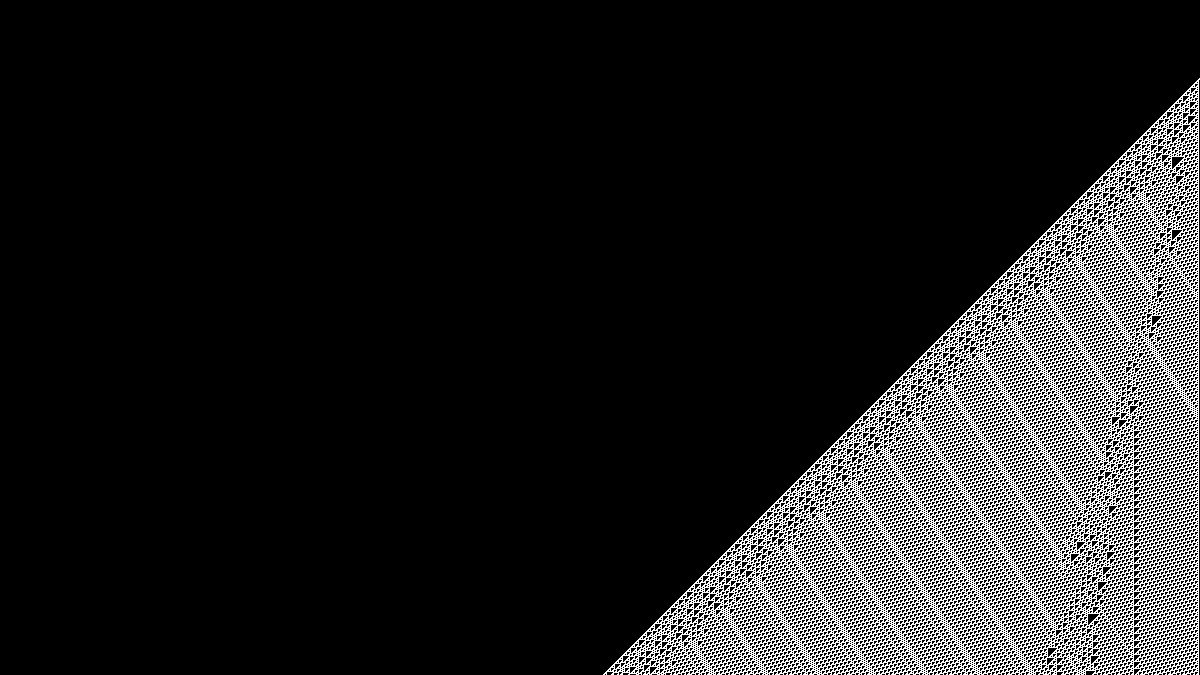
JPEG XL would be Turing-complete
You can construct the Rule 110 cellular automaton in JPEG XL.
DBohdan.com
104 points · by networked · 5y ago · 36 comments
It's not "Turing machine but the tape is limited to 1024 cells" - i.e. you don't get 1024 units of memory and a conditional branch instruction. You can't branch at all.
In order to simulate the Turing machine, you need to run the Rule 110 automation, which necessarily implies expanding linearly into that 1024 cell space - i.e. your simulated program really isn't going to get very far.
Edit: see comments by dTal and Dylan16807
FTA: "To help with parallel decoding, JPEG XL decoders work on slices of images 1024 by 1024 pixels in size. So JPEG XL itself isn't Turing-complete; a version of it without the 1024×1024 pixel limitation would be."
Then again, no real computer is Turing complete because they all have finite memory so they're strictly speaking only big finite state machines (though we do typically consider them Turing complete anyway).
I think the main point here is that the context/prediction model of JPEG XL's modular mode is expressive enough to consider it a kind of mini-programming language which is 'Turing-complete' (with some asterisks like requiring infinite images).
It's not a security risk though: the decode computation per pixel is still bounded, so there is no way to make the decoder go into an infinite loop or anything like that. In that respect it's (intentionally) not Turing complete, unlike some other image formats like PostScript and SVG that do have actual programming languages in them that can cause a decoder/interpreter to go into an infinite loop (safe handling of such files does require sandboxing and time-outs).
Memory is only finite if it uses absolute addresses like RAM, e.g. "load 0x12345" refers to the same piece of memory, regardless of where in memory that instruction appears (ignoring complications from paging, etc.). Computers can also have external storage that's addressed relatively, e.g. a tape which can move forwards or backwards.
I like to think of Turing machines has having a "tape factory" at both ends of the tape, which appends new cells whenever the read/write head gets close. We can do the same thing with a real computer, by pausing the computer and splicing on new sections on to the tape as needed; or by extending the rails and racks of a tape robot.
Of course, our factories are ultimately limited by raw materials, even once production expands into space. The key is that relatively-addressed memory is infinitely expandable, whilst absolutely-addressed memory has a predefined upper-limit.
Yes, this is exactly the point I intended. I have added a link Gwern Branwen's https://www.gwern.net/Turing-complete for context. (I considered adding a note on how no physical computer or interpreter running on one is really Turing-complete before submitting the story but decided against it, because the context should convey the asterisks on "Turing-complete".)
I have also quoted your paragraph on security on the page. Something I did not consider was that people may link to my page to support security FUD against JPEG XL, a format I like and look forward to adopting. I hope this is sufficient mitigation.
Interestingly, cloud computing made this limitation less obvious: one can imagine a program running on the cloud that bill the cloud provider when it runs out of disk space. And the cloud provider will buy more hard drives for its servers when needed. There is still obviously a limit somewhere, but its much farther ahead, because its more limited by factors such as how much hard drives we can build.
Isn't that like saying C++ templates aren't Turing complete on account of recursion depth limits?
</pedantry-mode>
edit sonthonax beat me to it
"2^enormous" not actually being infinity will never matter.
"fixed number of steps" doesn't even start to resemble infinity.
- Write an efficient Bitcoin miner that runs in a JPEG.
- Steal the memory of a user using the Spectre vulnerability.
> Since Rule 110 is Turing-complete, this seems to prove that JPEG XL predictors are themselves Turing-complete — except they are not!
Very quick take, but systems are very interconnected these days, so sandboxes tend to leak in very unintentional ways.